
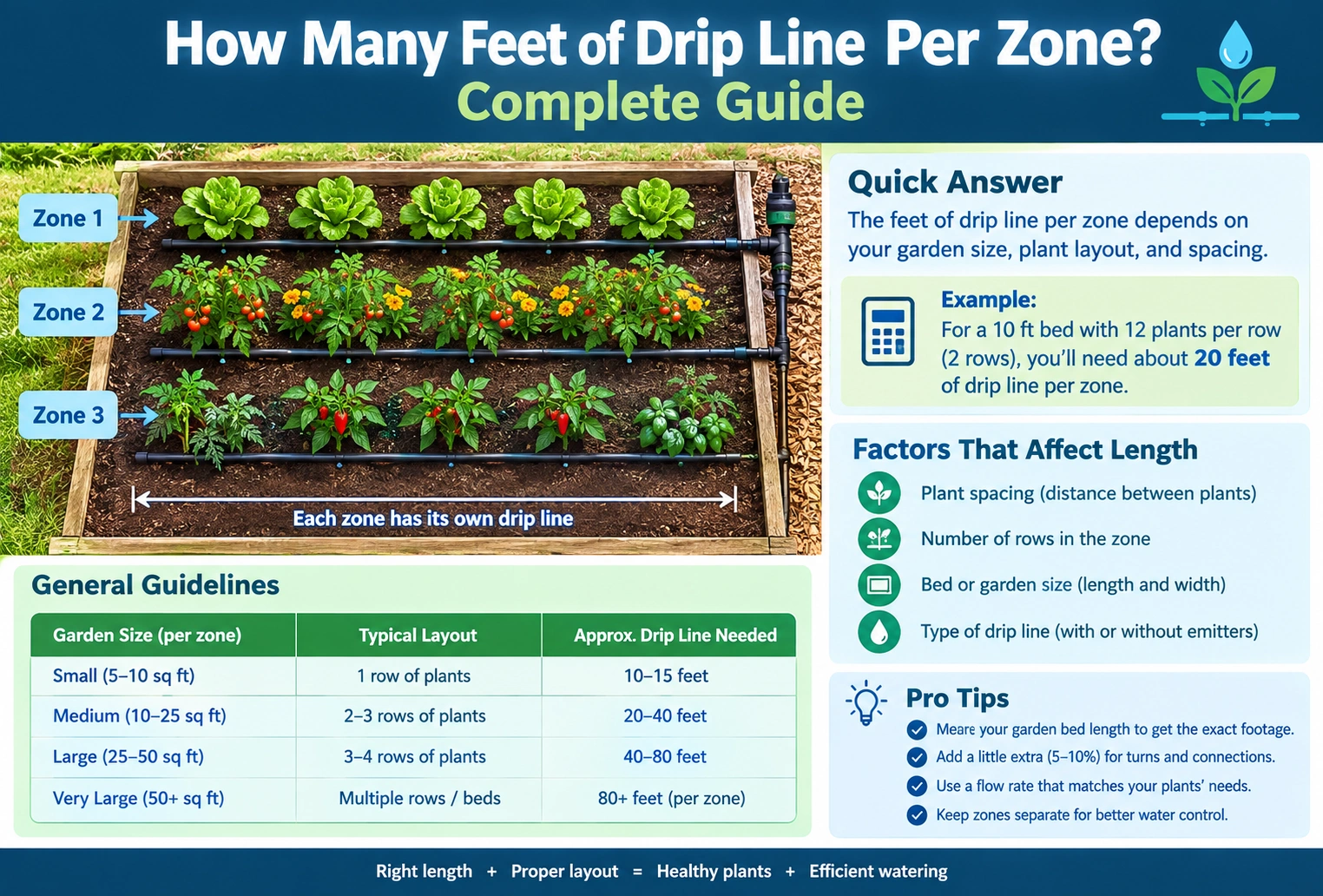
The amount of drip line you can run in one irrigation zone depends mainly on the drip-line flow rate, emitter spacing, water pressure, and available gallons per minute (GPM).
For a typical residential system using ½-inch drip tubing with 0.5 GPH emitters spaced 18 inches apart, a practical zone may often handle approximately 200–500 feet of drip line, but the exact maximum can be higher or lower depending on the tubing and water supply.
| Drip Line Setup | Typical Practical Length Per Zone |
|---|---|
| Small garden zone | 100–200 ft |
| Medium garden zone | 200–400 ft |
| Larger residential zone | 400–600 ft |
| High-flow/pressure setup | 600+ ft may be possible |
These are general planning ranges, not universal limits. Always check the manufacturer’s flow specifications and your water supply before designing a zone.
What Determines How Many Feet of Drip Line Per Zone?
When figuring out how many feet of drip line per zone, you cannot use a single number for every irrigation system.
The maximum length depends on several factors:
- Drip-line diameter
- Emitter flow rate
- Emitter spacing
- Water pressure
- Available water flow
- Elevation changes
- Number of emitters
- Tubing manufacturer’s specifications
- Desired uniformity of watering
A zone with a strong water supply and properly sized tubing can support more drip line than a zone with low pressure or restricted flow.
The key is to calculate the total water demand of the drip line and compare it with the flow available to that irrigation zone.
How to Calculate Drip Line Length Per Zone
The basic calculation starts with the flow rate of each emitter.
Step 1: Determine Emitter Spacing
Suppose your drip line has emitters every 18 inches.
There are:
12 ÷ 1.5 = 8 emitters per 10 feet
Or more directly, 18 inches equals 1.5 feet.
Therefore:
10 ÷ 1.5 = 6.67 emitters per 10 feet
Step 2: Determine Emitter Flow
Assume each emitter releases 0.5 gallons per hour (GPH).
For 100 feet of drip line with 18-inch spacing:
100 ÷ 1.5 = approximately 66.7 emitters
Then:
66.7 × 0.5 GPH = 33.35 GPH
Convert GPH to GPM:
33.35 ÷ 60 = approximately 0.56 GPM
So, 100 feet of this drip line requires about 0.56 GPM.
Step 3: Compare With Available Zone Flow
If your irrigation zone can safely provide 2 GPM:
2 ÷ 0.56 ≈ 3.57
That suggests the theoretical flow capacity could support roughly 350 feet under those assumptions.
However, actual maximum tubing length should also account for pressure loss and manufacturer recommendations.
Drip Line Length by Emitter Spacing
Emitter spacing has a major effect on how much water a zone needs.
More closely spaced emitters mean more emitters per foot and therefore greater total water demand.
| Emitter Spacing | Emitters Per 100 ft | Water Demand at 0.5 GPH |
|---|---|---|
| 6 inches | 200 | 100 GPH |
| 12 inches | 100 | 50 GPH |
| 18 inches | 67 | 33.5 GPH |
| 24 inches | 50 | 25 GPH |
| 36 inches | 33 | 16.5 GPH |
These figures are approximate and assume 0.5 GPH emitters.
How Many Feet of ½-Inch Drip Line Per Zone?
½-inch drip tubing is one of the most common choices for residential gardens and landscape beds.
A typical ½-inch drip line may support several hundred feet in a zone, but the manufacturer’s maximum recommended run is important.
| ½-Inch Drip Line Application | Approximate Zone Length |
|---|---|
| Small garden | 100–200 ft |
| Typical garden bed | 200–300 ft |
| Medium landscape zone | 300–500 ft |
| Larger system | 500+ ft with proper design |
Do not assume that every ½-inch drip line can safely run the same distance. Different tubing products have different internal diameters, emitter specifications, pressure requirements, and maximum recommended run lengths.
How Many Feet of Drip Line Per Zone With 0.5 GPH Emitters?
0.5 GPH emitters are common in drip irrigation.
The total flow depends on how many emitters are installed.
For example, with emitters spaced every 18 inches:
| Drip Line Length | Approx. Emitters | Total Flow at 0.5 GPH |
|---|---|---|
| 50 ft | 33 | 16.5 GPH |
| 100 ft | 67 | 33.5 GPH |
| 200 ft | 133 | 66.5 GPH |
| 300 ft | 200 | 100 GPH |
| 400 ft | 267 | 133.5 GPH |
| 500 ft | 333 | 166.5 GPH |
To convert GPH to GPM, divide by 60.
For example:
100 GPH ÷ 60 = 1.67 GPM
Therefore, 300 feet of line with 0.5 GPH emitters every 18 inches would require approximately 1.67 GPM.
How Many Drip Emitters Can One Zone Handle?
The number of emitters is another way to determine zone capacity.
If your zone has a maximum available flow of 2 GPM:
2 GPM × 60 = 120 GPH
If every emitter uses 0.5 GPH:
120 ÷ 0.5 = 240 emitters
The theoretical capacity would therefore be about 240 emitters.
| Available Flow | Available GPH | 0.5 GPH Emitters |
|---|---|---|
| 0.5 GPM | 30 GPH | 60 |
| 1 GPM | 60 GPH | 120 |
| 1.5 GPM | 90 GPH | 180 |
| 2 GPM | 120 GPH | 240 |
| 3 GPM | 180 GPH | 360 |
| 4 GPM | 240 GPH | 480 |
Real systems should leave some capacity for pressure loss and other system limitations rather than operating continuously at the absolute theoretical maximum.
How Water Pressure Affects Drip Line Length
Water pressure is critical because pressure decreases as water travels through tubing.
A long run creates more pressure loss than a short run.
| Drip Line Condition | Expected Effect |
|---|---|
| Short run | Lower pressure loss |
| Long run | Greater pressure loss |
| Larger tubing | Generally lower friction loss |
| Smaller tubing | Generally higher friction loss |
| High water pressure | More operating capacity |
| Low water pressure | Shorter practical runs |
If pressure becomes too low at the end of a drip line, the final emitters may deliver less water than the emitters near the beginning.
That can result in uneven irrigation.
Why Drip Line Should Not Always Be One Long Run
It may seem easier to connect hundreds of feet of tubing together and run everything from one valve.
However, extremely long runs can create uneven pressure.
For larger areas, dividing the system into multiple zones can provide better water distribution.
| Design | Advantages | Disadvantages |
|---|---|---|
| One long zone | Simple layout | Greater pressure loss |
| Two shorter zones | Better pressure balance | Requires another zone |
| Multiple zones | More control and uniformity | More valves and installation work |
For a large garden, several shorter runs can often provide more consistent watering than one extremely long run.
How Many Feet of Drip Line Per Zone for a Vegetable Garden?
Vegetable gardens can use substantial amounts of drip tubing because plants may be arranged in several rows.
For example, a garden with five 50-foot rows would require:
5 × 50 = 250 feet
If all five rows are supplied by the same zone, the total flow requirement must be checked.
| Garden Layout | Drip Line Needed |
|---|---|
| 3 rows × 25 ft | 75 ft |
| 4 rows × 50 ft | 200 ft |
| 5 rows × 50 ft | 250 ft |
| 6 rows × 50 ft | 300 ft |
| 8 rows × 50 ft | 400 ft |
| 10 rows × 50 ft | 500 ft |
The total footage is only one part of the calculation. The water demand of all emitters must also be within the zone’s capacity.
How Many Feet of Drip Line Per Zone for Raised Beds?
Raised beds often require shorter drip-line runs.
For example, if you have four raised beds that are each 20 feet long and one line runs down each bed:
4 × 20 = 80 feet
That makes 80 feet of drip tubing.
For multiple beds, you can calculate the total length first and then determine whether the zone has enough flow.
| Number of Beds | Bed Length | Total Drip Line |
|---|---|---|
| 2 | 20 ft | 40 ft |
| 4 | 20 ft | 80 ft |
| 6 | 20 ft | 120 ft |
| 8 | 20 ft | 160 ft |
| 10 | 20 ft | 200 ft |
How Many Feet of Drip Line Per Zone for Trees and Shrubs?
Trees and shrubs are often irrigated differently from vegetable rows.
Instead of using a continuous drip line, some landscapes use individual emitters around each plant.
The appropriate setup depends on plant size, soil type, climate, and irrigation design.
For a landscape containing many trees and shrubs, calculate the total emitter flow rather than simply adding up tubing length.
| Irrigation Method | Best Measured By |
|---|---|
| Dripline rows | Feet of tubing |
| Individual emitters | Number of emitters |
| Tree rings | Feet of tubing or emitters |
| Shrub beds | Total emitter flow |
| Vegetable beds | Tubing length + emitter flow |
How to Divide Drip Line Into Zones
If you have more drip tubing than one zone can support, divide it into multiple zones.
For example, suppose you need 800 feet of drip line and your system is designed to comfortably handle about 300 feet per zone.
Instead of putting all 800 feet into one zone, you could divide it into approximately three zones.
| Total Drip Line | Approx. Capacity Per Zone | Possible Zones |
|---|---|---|
| 200 ft | 300 ft | 1 |
| 400 ft | 300 ft | 2 |
| 600 ft | 300 ft | 2 |
| 800 ft | 300 ft | 3 |
| 1,000 ft | 300 ft | 4 |
The actual zone design should be based on flow and pressure calculations rather than footage alone.
How to Find Your Water Flow Before Designing a Zone
One of the best ways to size a drip irrigation zone is to measure your available water flow.
You can use a bucket to estimate flow from an accessible water source.
If a 5-gallon bucket fills in 30 seconds:
5 gallons ÷ 30 seconds × 60 = 10 GPM
That gives an approximate flow rate of 10 GPM at that point.
However, available flow at the irrigation zone can be lower after accounting for pressure regulators, filters, valves, pipes, fittings, and other restrictions.
For irrigation design, it is better to work with the usable flow available after system components rather than assuming the raw supply flow is fully available.
What Happens If You Run Too Much Drip Line in One Zone?
Running too much tubing can cause uneven irrigation.
Possible symptoms include:
- Weak flow near the end of the line
- Plants at the end receiving less water
- Uneven emitter output
- Pressure problems
- Poor irrigation uniformity
- Longer watering times
- Difficulty maintaining consistent moisture
If the beginning of a drip line appears to be watering normally while the far end is barely dripping, the run may be too long or the system may have insufficient pressure or flow.
How to Improve a Drip Irrigation Zone
If your zone is struggling to supply the entire drip system, several design changes can help.
| Problem | Possible Solution |
|---|---|
| Run is too long | Divide into multiple zones |
| Low pressure | Check regulator and supply |
| Too many emitters | Split the zone |
| Small tubing | Use appropriately sized mainline/submain |
| Clogged filter | Clean or replace filter |
| Uneven distribution | Shorten runs or redesign layout |
| Elevation change | Design for pressure differences |
Do not simply increase pressure beyond the tubing or component manufacturer’s limits. The irrigation system should be designed around the operating pressure required by its components.
Common Mistakes When Calculating Drip Line Per Zone
Using Feet Alone
Footage does not tell you the entire story. A 300-foot line with high-flow emitters can require much more water than a 300-foot line with low-flow emitters.
Ignoring Emitter Spacing
Emitter spacing changes the number of emitters in every foot of tubing.
Ignoring Pressure Loss
Long tubing runs can lose pressure as water travels through the line.
Treating All ½-Inch Tubing as Identical
Different products can have different flow and pressure specifications.
Running Every Garden Bed From One Zone
Multiple beds may require more flow than one zone can provide.
Using the Maximum Theoretical Capacity
A system should not be designed right at its theoretical limit. Leaving some capacity helps account for real-world pressure and flow losses.
Frequently Asked Questions
How many feet of drip line can I run on one zone?
A common residential zone may use approximately 200–500 feet of drip line, but the actual maximum depends on tubing size, emitter flow, spacing, water pressure, and available GPM.
How much drip line can a ½-inch line handle?
Many ½-inch drip systems can handle several hundred feet, but the exact maximum varies by product. Check the manufacturer’s recommended maximum run length and flow specifications.
How many drip emitters can one zone handle?
It depends on available GPM and emitter flow. For example, a 2 GPM supply provides 120 GPH, which theoretically supports 240 emitters rated at 0.5 GPH each before accounting for system losses.
Should drip irrigation be split into zones?
Large irrigation systems are often divided into multiple zones when the total tubing or emitter flow exceeds what one valve and water supply can deliver uniformly.
How do I calculate drip line flow?
Multiply the number of emitters by the flow rate of each emitter. For example, 200 emitters × 0.5 GPH equals 100 GPH, or approximately 1.67 GPM.
Conclusion
So, how many feet of drip line per zone? A typical residential drip irrigation zone may handle roughly 200–500 feet, but there is no universal maximum.
The correct amount depends on the drip-line diameter, emitter spacing, emitter flow rate, available GPM, water pressure, and pressure loss through the system.
For accurate planning, calculate the total emitter flow first. If the water demand is too high for one zone, divide the irrigation system into multiple shorter zones. This usually provides more consistent pressure and more uniform watering.
The most important rule is simple: size your drip zones by water flow and pressure—not just by the number of feet of tubing.
Discover More Articles
How Many Cubic Feet Is My Freezer? Easy Size Guide