
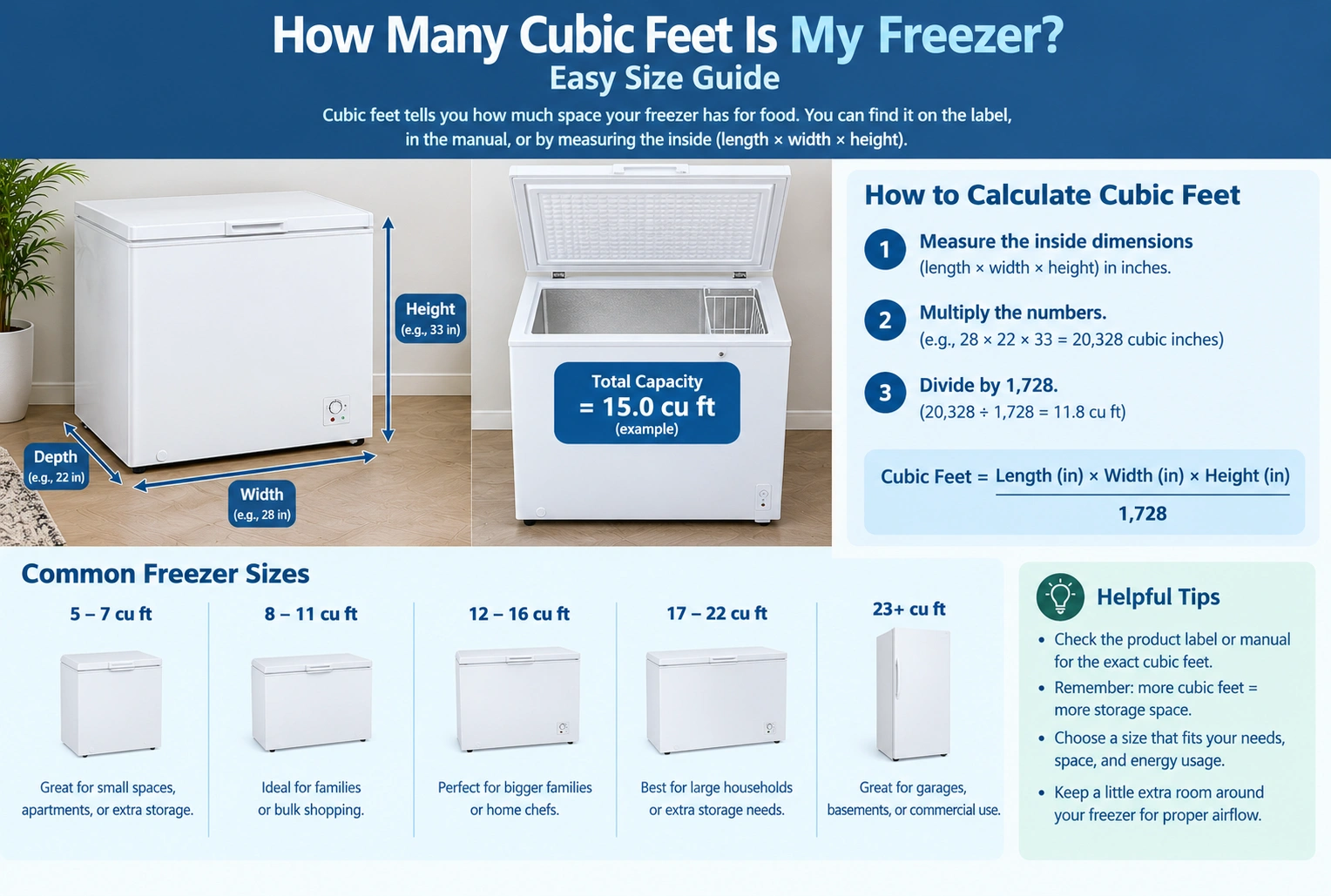
If you’re wondering how many cubic feet your freezer is, you can usually find the answer from the appliance’s capacity label, model number, owner’s manual, or by measuring the freezer’s interior dimensions.
Freezer capacity is measured in cubic feet (cu. ft.), which describes the amount of three-dimensional storage space inside the appliance.
If you do not know your freezer’s capacity, you can calculate an approximate figure yourself.
Measure the interior length, width, and height, then multiply the three measurements together.
For example, a freezer with an interior measuring 3 feet long × 2 feet wide × 2 feet high has:
3 × 2 × 2 = 12 cubic feet
The calculation is simple, but getting accurate measurements is important because shelves, baskets, drawers, insulation, and the shape of the freezer can affect usable storage space.
Quick Answer
The easiest way to determine how many cubic feet your freezer is depends on the information you have.
| Information Available | Best Method |
|---|---|
| Capacity label | Read the listed cubic feet |
| Model number | Look up the manufacturer’s specifications |
| Owner’s manual | Check the specifications section |
| Interior dimensions | Multiply length × width × height |
| Exterior dimensions only | Gives only a rough estimate |
If you know the inside dimensions, use this formula:
Cubic feet = length × width × height
Make sure all three measurements are in feet before multiplying.
For measurements in inches, use:
Cubic feet = (length × width × height) ÷ 1,728
because one cubic foot contains 1,728 cubic inches.
How to Find Your Freezer’s Cubic Feet
Before measuring the freezer yourself, check whether its capacity is already listed somewhere.
The information may be found in several places.
| Location | What to Look For |
|---|---|
| Freezer interior label | Capacity or model information |
| Door frame | Appliance information sticker |
| Side or back panel | Model and serial information |
| Owner’s manual | Specifications and capacity |
| Manufacturer’s website | Product dimensions and capacity |
| Purchase receipt | Product name or model number |
The model number is especially useful. Once you identify it, the manufacturer’s specifications may provide the freezer’s official capacity.
This is generally more reliable than estimating capacity from the appliance’s exterior dimensions.
Calculate Freezer Capacity From Dimensions
If you cannot find the freezer’s capacity, you can calculate an approximate cubic-foot measurement.
The basic formula is:
Length × Width × Height = Cubic inches
If your measurements are already in feet:
Length × Width × Height = Cubic feet
For example, suppose the inside of a freezer measures:
| Measurement | Size |
|---|---|
| Length | 3 ft |
| Width | 2 ft |
| Height | 2 ft |
| Capacity | 12 cu. ft. |
The calculation is:
3 × 2 × 2 = 12 cubic feet
If your measurements are in inches, divide the result by 1,728.
For example, an interior measuring 36 × 24 × 24 inches would be:
36 × 24 × 24 ÷ 1,728 = 12 cubic feet
This method gives you a useful estimate of the freezer’s internal volume.
Measure the Inside of Your Freezer
For the most useful estimate, measure the interior storage area, not the outside of the appliance.
Empty the freezer as much as practical and measure:
- Interior length
- Interior width
- Interior height
Use a tape measure and record each measurement in inches or feet.
For a chest freezer, measure the usable interior from side to side, front to back, and bottom to top.
For an upright freezer, measure the relevant interior compartments. If the interior is divided into different sections with substantially different dimensions, calculating each section separately can produce a better estimate.
Example
Suppose your chest freezer measures approximately:
| Interior Measurement | Value |
|---|---|
| Length | 42 in |
| Width | 22 in |
| Height | 30 in |
Calculate the volume:
42 × 22 × 30 = 27,720 cubic inches
Then convert to cubic feet:
27,720 ÷ 1,728 ≈ 16.0 cubic feet
So the freezer is approximately 16 cubic feet based on those interior measurements.
Where to Find the Freezer Capacity
Many people do not need to perform any calculation because the capacity is already provided by the manufacturer.
Look for a label containing information such as:
- Capacity
- Total capacity
- Volume
- Cubic feet
- Cu. ft.
- Model number
The manufacturer’s listed capacity is generally preferable when available because appliance interiors are not always simple rectangular boxes.
For example, shelves, baskets, compressors, drawers, door compartments, and rounded interior surfaces can make a simple length × width × height calculation different from the official rated capacity.
Freezer Size by Type
Freezers come in several common configurations, and their capacities vary.
| Freezer Type | Common Capacity Range |
|---|---|
| Small compact freezer | 1–5 cu. ft. |
| Small chest freezer | 3–7 cu. ft. |
| Medium chest freezer | 7–15 cu. ft. |
| Large chest freezer | 15–25+ cu. ft. |
| Small upright freezer | 5–10 cu. ft. |
| Medium upright freezer | 10–18 cu. ft. |
| Large upright freezer | 18–25+ cu. ft. |
These are general size ranges. Individual models can fall outside them.
Chest freezers often provide a large open storage area, while upright models use shelves and drawers to divide the available space.
Common Freezer Sizes
If you’re trying to identify your freezer’s approximate size, compare its capacity with these common categories.
| Freezer Capacity | General Size |
|---|---|
| 3 cu. ft. | Very small |
| 5 cu. ft. | Small |
| 7 cu. ft. | Small to medium |
| 10 cu. ft. | Medium |
| 12 cu. ft. | Medium |
| 15 cu. ft. | Large |
| 18 cu. ft. | Large |
| 20 cu. ft. | Very large |
| 25 cu. ft. | Extra large |
A 5-cubic-foot freezer is useful for limited storage, while a 15–20-cubic-foot freezer provides considerably more room for bulk food storage.
How Much Food Can Different Freezer Sizes Hold?
Freezer capacity gives you an idea of the available volume, but the actual amount of food you can store depends on how efficiently you organize the interior.
A freezer filled with irregularly shaped packages may hold less food than one organized with stackable containers and baskets.
As a general planning comparison:
| Freezer Size | Typical Use |
|---|---|
| 3–5 cu. ft. | Small households or limited frozen storage |
| 5–9 cu. ft. | Supplemental freezer space |
| 10–15 cu. ft. | Regular family food storage |
| 15–20 cu. ft. | Bulk shopping and larger households |
| 20+ cu. ft. | Extensive frozen-food storage |
These categories should be treated as planning guidelines rather than exact food-capacity measurements.
The shape and organization of the freezer can make a significant difference.
Why Interior Capacity Can Differ From Exterior Size
One of the most common mistakes is assuming that exterior dimensions directly tell you the freezer’s cubic-foot capacity.
They do not.
A freezer has insulation between the outside cabinet and the interior storage compartment. Other components also occupy space.
These can include:
- Insulation
- Compressor components
- Shelves
- Drawers
- Baskets
- Door liners
- Interior walls
- Mechanical components
For this reason, a freezer’s exterior volume is larger than its usable interior volume.
For an accurate capacity figure, use the manufacturer’s rated cubic feet or measure the interior.
Chest Freezer vs. Upright Freezer Capacity
Two freezers with the same rated cubic footage can feel very different to use.
| Feature | Chest Freezer | Upright Freezer |
|---|---|---|
| Storage layout | Open and deep | Vertical shelves/drawers |
| Organization | Can require baskets | Usually easier to organize |
| Footprint | Wider | Narrower |
| Access | Items may be stacked | Items are generally easier to reach |
| Bulk storage | Excellent | Good |
| Space efficiency | Depends on available floor area | Uses vertical space |
A chest freezer can be especially useful when storing large quantities of similarly sized frozen products.
An upright freezer may be more convenient when you want quick access to individual packages.
What Does a 10-Cubic-Foot Freezer Mean?
A 10-cubic-foot freezer has a rated internal volume of approximately 10 cubic feet.
It does not necessarily mean that every part of the interior forms a perfect 10-cubic-foot rectangular box.
Instead, cubic feet represent the freezer’s overall internal storage capacity.
For comparison:
| Capacity | Cubic Inches |
|---|---|
| 3 cu. ft. | 5,184 cu. in. |
| 5 cu. ft. | 8,640 cu. in. |
| 7 cu. ft. | 12,096 cu. in. |
| 10 cu. ft. | 17,280 cu. in. |
| 15 cu. ft. | 25,920 cu. in. |
| 20 cu. ft. | 34,560 cu. in. |
This conversion can be useful if you’re comparing measurements taken in inches with a manufacturer’s capacity listed in cubic feet.
What Does a 15-Cubic-Foot Freezer Mean?
A 15-cubic-foot freezer provides approximately three times the volume of a 5-cubic-foot freezer.
It can be useful for households that purchase frozen foods in bulk or need significant supplemental freezer space.
However, usable storage depends on the freezer’s internal design.
A freezer with baskets and shelves may have a different practical storage experience than a large open chest freezer, even when their rated capacities are similar.
Common Mistakes When Measuring a Freezer
Measuring the Outside
Exterior measurements include insulation and components that do not provide storage space.
For capacity calculations, use interior dimensions when possible.
Forgetting to Convert Inches
If your measurements are in inches, you cannot simply multiply them and call the result cubic feet.
You must divide the cubic-inch result by 1,728.
Assuming Every Freezer Is a Perfect Rectangle
Freezer interiors can have rounded corners, shelves, drawers, and other features that affect usable space.
Confusing Dimensions With Capacity
A freezer’s dimensions describe its physical size, while cubic feet describe its internal volume.
Ignoring the Model Number
If the model number is available, checking the manufacturer’s specifications may provide a more accurate capacity than a manual calculation.
FAQs
How many cubic feet is my freezer?
You can find the official capacity on the freezer’s label, manual, or manufacturer’s specifications. If you cannot find it, multiply the interior length × width × height and convert the result to cubic feet.
How do I calculate cubic feet in a freezer?
If measurements are in feet, multiply:
Length × width × height = cubic feet
If measurements are in inches, use:
Length × width × height ÷ 1,728 = cubic feet
How many cubic feet is a standard freezer?
There is no single standard freezer size. Common household freezers range from small models of around 3–5 cubic feet to large models exceeding 20 cubic feet.
Is a 5-cubic-foot freezer big?
A 5-cubic-foot freezer is generally considered small. It can provide useful supplemental storage but has much less capacity than a 15- or 20-cubic-foot freezer.
Is a 10-cubic-foot freezer big enough for a family?
A 10-cubic-foot freezer can provide a useful amount of storage for many households, particularly as supplemental freezer space. The right size depends on household size and shopping habits.
Is a 15-cubic-foot freezer large?
Yes. A 15-cubic-foot freezer provides substantial storage capacity and can work well for households that regularly purchase frozen food in bulk.
Can I calculate freezer capacity from outside dimensions?
You can estimate the maximum external volume, but it will not accurately represent the freezer’s storage capacity. Interior measurements or the manufacturer’s specifications are better.
Where is the model number on my freezer?
The model number may be located on a label inside the freezer, around the door frame, on the side or back of the appliance, or in the owner’s manual.
How many cubic feet is a 7-cubic-foot freezer?
A freezer labeled 7 cubic feet has a rated capacity of 7 cubic feet. It is generally considered a small-to-medium freezer.
What is the difference between freezer size and freezer capacity?
Freezer size usually refers to the appliance’s physical dimensions, while freezer capacity refers to the amount of internal storage volume, measured in cubic feet.
Conclusion
If you’re asking “how many cubic feet is my freezer?”, the fastest answer is usually found on the appliance’s capacity label, owner’s manual, or manufacturer’s product specifications.
If that information is unavailable, you can estimate the capacity by measuring the freezer’s interior length, width, and height. When using measurements in inches, multiply the three dimensions and divide the result by 1,728 to convert cubic inches to cubic feet.
Common household freezers range from approximately 3 to more than 20 cubic feet, with 5–10 cubic feet generally considered smaller models and 15–20+ cubic feet providing substantially more storage.
For the most accurate answer, use the manufacturer’s listed capacity whenever possible because shelves, insulation, drawers, baskets, and the freezer’s internal shape can make a simple dimensional calculation different from the official rated capacity.
Discover More Articles
How Many BTU Do I Need to Heat 1,000 Square Feet?