
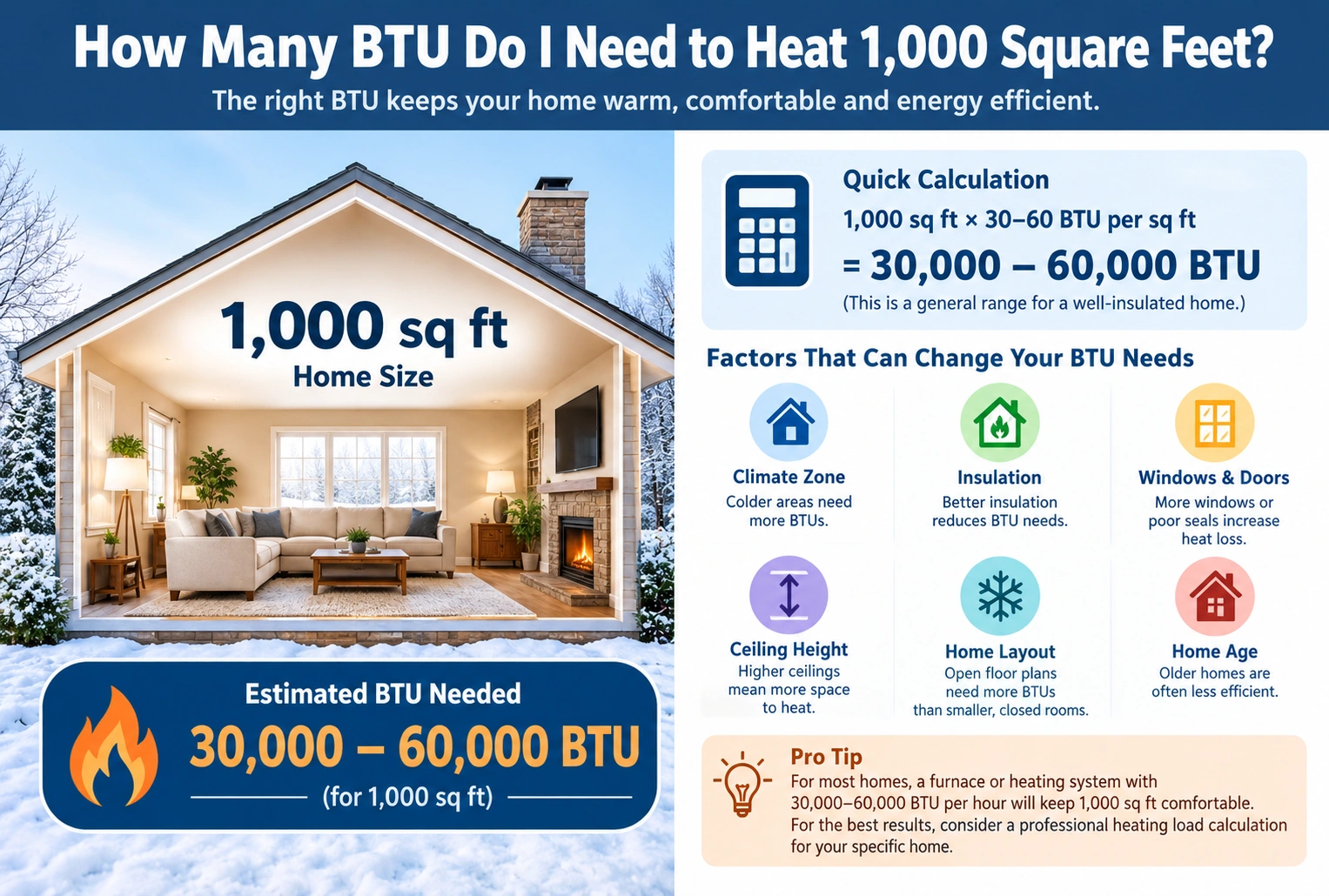
If you’re wondering how many BTU you need to heat 1,000 square feet, a typical home may require approximately 20,000 to 30,000 BTU per hour.
A commonly used starting estimate is around 20–30 BTU per square foot, but the right heating capacity depends on your climate, insulation, ceiling height, windows, home layout, and how well the building holds heat.
For a moderately insulated 1,000-square-foot home, 25,000 BTU per hour can be a reasonable preliminary estimate.
| Home Condition | Approx. BTU per Sq Ft | BTU Needed for 1,000 Sq Ft |
|---|---|---|
| Well insulated, mild climate | 20 BTU | 20,000 BTU |
| Average insulation | 25 BTU | 25,000 BTU |
| Colder climate | 30 BTU | 30,000 BTU |
| Very cold climate / poor insulation | 35–40+ BTU | 35,000–40,000+ BTU |
These figures are planning estimates, not a substitute for a professional heating-load calculation.
How Many BTU Does a 1,000-Square-Foot House Need?
A 1,000-square-foot house does not automatically require one specific BTU rating. Heating requirements vary from one building to another.
A simple estimating method is:
BTU needed = square feet × BTU per square foot
For example, using 25 BTU per square foot:
1,000 × 25 = 25,000 BTU
So a preliminary estimate would be 25,000 BTU per hour.
| BTU per Sq Ft | Calculation | Estimated Heating Capacity |
|---|---|---|
| 20 | 1,000 × 20 | 20,000 BTU |
| 25 | 1,000 × 25 | 25,000 BTU |
| 30 | 1,000 × 30 | 30,000 BTU |
| 35 | 1,000 × 35 | 35,000 BTU |
| 40 | 1,000 × 40 | 40,000 BTU |
The appropriate number depends on the conditions of the home.
BTU Requirements by Climate
Climate is one of the biggest factors affecting heating demand.
A 1,000-square-foot home in a mild climate may need substantially less heating capacity than an equally sized home in an area with very cold winters.
| Climate | Approx. BTU per Sq Ft | 1,000 Sq Ft Estimate |
|---|---|---|
| Mild | 20–25 | 20,000–25,000 BTU |
| Moderate | 25–30 | 25,000–30,000 BTU |
| Cold | 30–35 | 30,000–35,000 BTU |
| Very cold | 35–40+ | 35,000–40,000+ BTU |
These ranges are useful for preliminary planning, but local outdoor design temperatures and the building’s construction can significantly change the actual requirement.
How Insulation Affects BTU Requirements
Insulation helps slow the movement of heat through walls, ceilings, floors, and other parts of the building.
A well-insulated 1,000-square-foot home may need less heating capacity than a poorly insulated home of exactly the same size.
| Insulation Level | Typical Effect on Heating Need |
|---|---|
| Excellent | Lower BTU requirement |
| Good | Relatively efficient heating |
| Average | Moderate BTU requirement |
| Poor | Higher BTU requirement |
| Very poor | Significantly higher heating demand |
Air leakage also matters. Drafty doors, windows, walls, and other openings can allow heated air to escape and cold outdoor air to enter.
How Ceiling Height Changes BTU Requirements
Square footage alone does not tell you how much air needs to be heated.
For example, two homes can both have 1,000 square feet of floor area but have different ceiling heights.
| Floor Area | Ceiling Height | Approx. Volume |
|---|---|---|
| 1,000 sq ft | 8 ft | 8,000 cu ft |
| 1,000 sq ft | 9 ft | 9,000 cu ft |
| 1,000 sq ft | 10 ft | 10,000 cu ft |
| 1,000 sq ft | 12 ft | 12,000 cu ft |
A home with unusually high ceilings can require more heating than a similar-sized home with standard 8-foot ceilings.
Open floor plans, vaulted ceilings, and large connected spaces can also affect how heat moves throughout the building.
Windows and Doors Can Increase Heating Demand
Windows and exterior doors can be important sources of heat loss.
Older single-pane windows generally provide less insulation than modern energy-efficient windows. Large areas of glass can also increase the amount of heat that escapes during cold weather.
| Building Feature | Potential Heating Impact |
|---|---|
| Modern insulated windows | Lower heat loss |
| Older single-pane windows | Higher heat loss |
| Energy-efficient exterior doors | Lower heat loss |
| Drafty doors | Higher heat loss |
| Large window areas | Potentially higher heating demand |
| Well-sealed openings | Lower heat loss |
This is why two 1,000-square-foot houses can require different heating-system capacities.
How Many BTU for a 1,000-Square-Foot House by Home Condition?
A rough planning comparison can help show how construction quality affects the estimate.
| Home Type | Approx. BTU Range |
|---|---|
| New, highly efficient home | 15,000–25,000 BTU |
| Well-insulated average home | 20,000–25,000 BTU |
| Typical older home | 25,000–35,000 BTU |
| Poorly insulated older home | 35,000–40,000+ BTU |
These are broad estimates. A professional load calculation may produce a result outside these ranges depending on the building’s location and construction.
How Many BTU Is a Furnace for 1,000 Square Feet?
A furnace’s advertised BTU rating usually refers to its input capacity, while the amount of heat actually delivered to the home depends on its efficiency.
For example, a 40,000-BTU furnace with an 80% efficiency rating would provide approximately:
40,000 × 0.80 = 32,000 BTU/hour
A high-efficiency furnace with the same input rating would deliver more usable heat.
| Furnace Input | Efficiency | Approx. Heat Output |
|---|---|---|
| 30,000 BTU | 80% | 24,000 BTU |
| 40,000 BTU | 80% | 32,000 BTU |
| 40,000 BTU | 90% | 36,000 BTU |
| 50,000 BTU | 80% | 40,000 BTU |
| 50,000 BTU | 95% | 47,500 BTU |
When comparing furnaces, look at both input BTU and output BTU, along with the efficiency rating.
Is a 30,000 BTU Furnace Enough for 1,000 Square Feet?
A 30,000 BTU furnace may be enough for some 1,000-square-foot homes, particularly in a mild or moderate climate with good insulation.
However, it may not be enough for a poorly insulated home in a very cold climate.
| Situation | 30,000 BTU Suitability |
|---|---|
| Mild climate + good insulation | Often potentially suitable |
| Moderate climate + average insulation | May be suitable |
| Cold climate + average insulation | May be borderline |
| Very cold climate + poor insulation | Likely insufficient |
The furnace should be selected based on the home’s actual heating load rather than square footage alone.
Is a 40,000 BTU Furnace Too Big for 1,000 Square Feet?
Not necessarily, but it could be oversized depending on the home’s heating requirements.
An oversized furnace can reach the thermostat setting quickly and cycle on and off more frequently. This can affect comfort, efficiency, and equipment operation.
For example, if a well-insulated 1,000-square-foot house only needs 20,000–25,000 BTU during design conditions, installing a much larger furnace may provide more capacity than necessary.
The goal is not to choose the biggest furnace available. The goal is to choose a system that can adequately meet the calculated heating load.
1,000 Square Feet Heating Requirements Compared With Other Home Sizes
Using a simple 25 BTU-per-square-foot planning estimate, you can compare different floor areas.
| Home Size | At 20 BTU/Sq Ft | At 25 BTU/Sq Ft | At 30 BTU/Sq Ft |
|---|---|---|---|
| 500 sq ft | 10,000 BTU | 12,500 BTU | 15,000 BTU |
| 750 sq ft | 15,000 BTU | 18,750 BTU | 22,500 BTU |
| 1,000 sq ft | 20,000 BTU | 25,000 BTU | 30,000 BTU |
| 1,250 sq ft | 25,000 BTU | 31,250 BTU | 37,500 BTU |
| 1,500 sq ft | 30,000 BTU | 37,500 BTU | 45,000 BTU |
| 2,000 sq ft | 40,000 BTU | 50,000 BTU | 60,000 BTU |
This table is useful for general comparison, but actual heating requirements should be calculated for the specific building.
How to Calculate BTU for 1,000 Square Feet
For a basic estimate, use:
BTU = square footage × BTU per square foot
If you use 25 BTU per square foot:
1,000 × 25 = 25,000 BTU
If you use 30 BTU per square foot:
1,000 × 30 = 30,000 BTU
Therefore, a basic planning range could be 25,000–30,000 BTU per hour for an average 1,000-square-foot home.
However, this method does not account for every source of heat loss.
Why a Manual J Calculation Is Better
For residential heating and cooling systems, a Manual J load calculation provides a much more detailed estimate than simply multiplying square footage by a BTU factor.
A proper heating-load calculation can consider:
- Local outdoor design temperature
- Indoor temperature target
- Wall insulation
- Attic insulation
- Floor construction
- Window size and efficiency
- Exterior doors
- Air leakage
- Ceiling height
- Building orientation
- Number of occupants
- Other building characteristics
This helps determine how much heat the home actually needs during the coldest expected conditions.
How Much Does It Cost to Heat 1,000 Square Feet?
Heating cost cannot be determined from BTU capacity alone.
The actual operating cost depends on the fuel or energy source, local energy prices, equipment efficiency, outdoor temperature, thermostat settings, insulation, and how many hours the system operates.
| Factor | Effect on Heating Cost |
|---|---|
| Higher fuel/electricity prices | Increases cost |
| Poor insulation | Increases heat loss |
| Higher thermostat setting | Usually increases demand |
| Efficient heating equipment | Can reduce energy use |
| Air leaks | Increase heat loss |
| Mild winter weather | Usually reduces demand |
| Very cold weather | Usually increases demand |
A correctly sized and efficient heating system can help avoid unnecessary energy use.
Common Mistakes When Choosing BTU for 1,000 Square Feet
Choosing BTU Based Only on Square Footage
Square footage is useful for a preliminary estimate, but it does not describe the entire building envelope.
Buying the Largest Furnace
More BTUs are not automatically better. Oversized equipment can create comfort and cycling problems.
Ignoring Insulation
A well-insulated home and a poorly insulated home can have very different heating requirements.
Confusing Input and Output BTU
A furnace’s input rating is not necessarily the amount of heat delivered to the living space.
Ignoring Climate
A 1,000-square-foot home in a mild climate may require significantly less heating capacity than one in a very cold climate.
FAQs
How many BTU do I need to heat 1,000 square feet?
A rough estimate is 20,000–30,000 BTU per hour, although colder climates, poor insulation, high ceilings, and other factors can increase the requirement.
Is 25,000 BTU enough to heat 1,000 square feet?
It can be enough for a reasonably insulated 1,000-square-foot home under moderate conditions, but the actual requirement depends on climate and building characteristics.
Is 30,000 BTU enough for 1,000 square feet?
A 30,000-BTU heating system may be suitable for many 1,000-square-foot homes, but it can be too small or too large depending on the home’s heat loss.
How many BTU does a 1,000-square-foot house need in a cold climate?
A rough estimate may be 30,000–35,000 BTU or more, depending on insulation, windows, ceiling height, air leakage, and local winter temperatures.
How many BTU does a 1,000-square-foot house need in a mild climate?
A rough starting range may be 20,000–25,000 BTU, especially for a well-insulated home.
Is a 40,000 BTU furnace enough for 1,000 square feet?
It may be enough and could be oversized for some efficient homes. The correct size depends on the home’s calculated heat loss.
Can a furnace be too big for a 1,000-square-foot house?
Yes. A furnace that is significantly larger than the home’s heating load can cycle frequently and may provide less consistent comfort.
What is the best way to determine BTU for a 1,000-square-foot home?
A professional heating-load calculation is more accurate than relying solely on a square-footage rule of thumb.
Conclusion
If you’re asking how many BTU you need to heat 1,000 square feet, a reasonable preliminary range is approximately 20,000–30,000 BTU per hour for many homes.
A moderately insulated 1,000-square-foot home might use around 25,000 BTU per hour as a starting estimate, while homes in colder climates or with poor insulation may need substantially more.
| Home Condition | Approximate BTU |
|---|---|
| Efficient / mild climate | 20,000–25,000 BTU |
| Average conditions | 25,000–30,000 BTU |
| Cold climate | 30,000–35,000 BTU |
| Very cold / poorly insulated | 35,000–40,000+ BTU |
For an actual furnace or heating-system purchase, don’t size the equipment from square footage alone. A detailed heating-load calculation provides a more reliable basis for selecting the appropriate BTU capacity.
Discover More Articles
How Many Cubic Feet Does a Wheelbarrow Hold?