
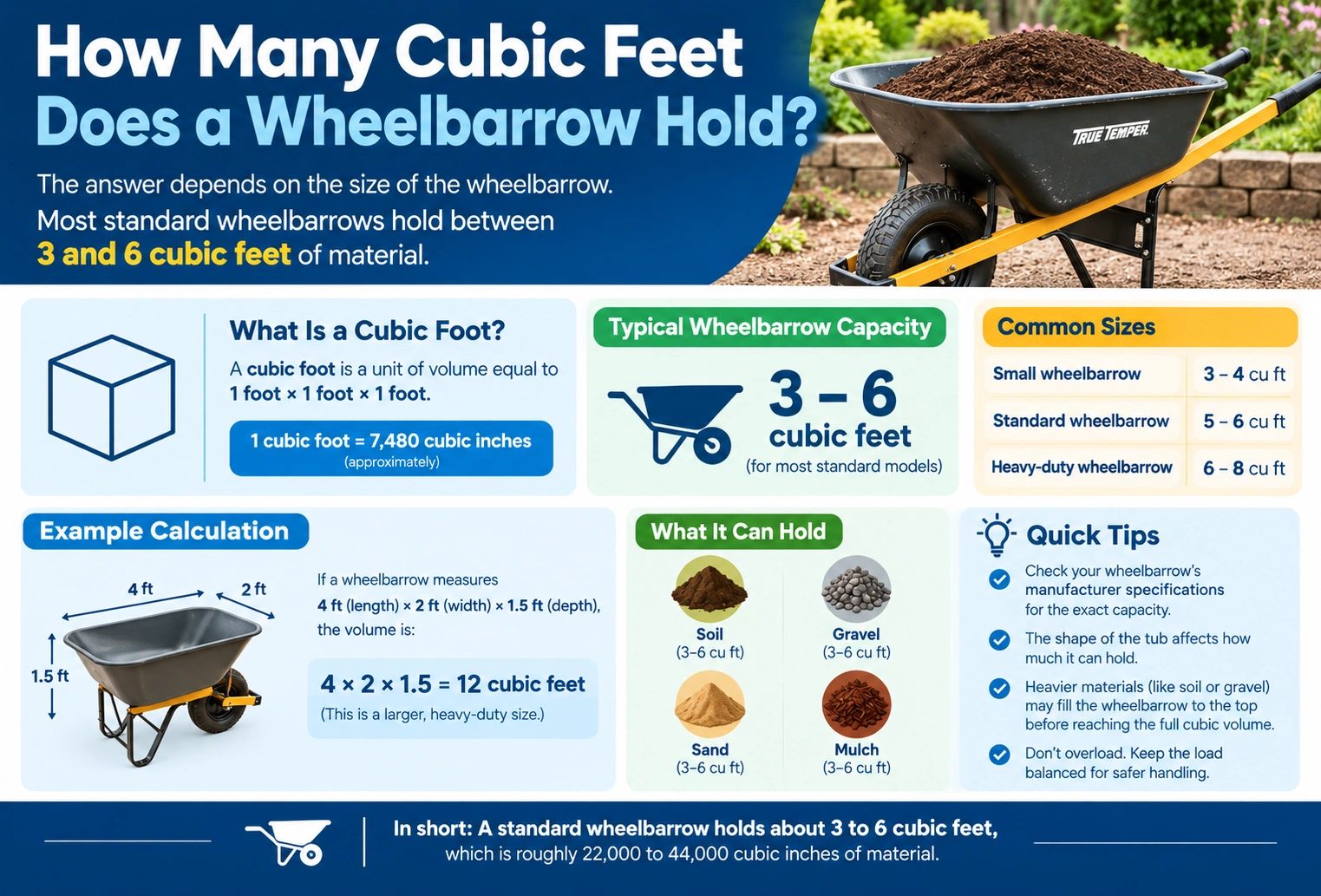
A typical wheelbarrow holds about 2 to 6 cubic feet, depending on its size and design. A common homeowner wheelbarrow has a capacity of around 4–6 cubic feet, while smaller garden wheelbarrows may hold closer to 2–3 cubic feet.
| Wheelbarrow Type | Approximate Capacity |
|---|---|
| Small garden wheelbarrow | 2–3 cubic ft |
| Standard homeowner wheelbarrow | 4–6 cubic ft |
| Heavy-duty wheelbarrow | 6+ cubic ft |
| Contractor wheelbarrow | 6–8+ cubic ft |
For many landscaping and concrete calculations, 6 cubic feet is a useful estimate for a large standard wheelbarrow, but always check the manufacturer’s stated capacity for an exact figure.
What Is the Cubic-Foot Capacity of a Wheelbarrow?
The capacity of a wheelbarrow is measured in cubic feet, which tells you how much three-dimensional material the tray can hold.
Unlike a bucket, wheelbarrows come in many different shapes and sizes. Their trays may be narrow and deep, wide and shallow, or somewhere between the two.
That is why there is no single answer to how many cubic feet does a wheelbarrow hold.
A typical wheelbarrow may have a capacity of 4 to 6 cubic feet, while smaller models can hold only 2 or 3 cubic feet and larger contractor models may exceed 6 cubic feet.
How Many Cubic Feet Are in a Standard Wheelbarrow?
A standard wheelbarrow commonly holds about 6 cubic feet when discussing larger construction or landscaping models.
However, “standard” is not an official universal size.
| Capacity | Typical Use |
|---|---|
| 2 cubic ft | Small gardening jobs |
| 3 cubic ft | Gardening and light landscaping |
| 4 cubic ft | General residential work |
| 5 cubic ft | Landscaping and soil transport |
| 6 cubic ft | Common large wheelbarrow |
| 7 cubic ft | Heavy-duty work |
| 8+ cubic ft | Large contractor applications |
If you need to calculate how many wheelbarrow loads are required for a project, use the actual capacity printed on your wheelbarrow whenever possible.
How to Calculate Cubic Feet in a Wheelbarrow
If the manufacturer’s capacity is not available, you can estimate the volume by measuring the inside of the tray.
The basic formula is:
Length × Width × Depth = Cubic Feet
All measurements must be in feet.
For example, suppose the approximate interior dimensions are:
- Length = 3 feet
- Width = 2 feet
- Average depth = 1 foot
The calculation would be:
3 × 2 × 1 = 6 cubic feet
This gives an estimated capacity of 6 cubic feet.
Why the Calculation Is Only an Estimate
Wheelbarrow trays are usually curved rather than rectangular. The sides may also slope inward toward the bottom.
Therefore, simply multiplying the longest length, widest width, and deepest point can overestimate the actual capacity.
For accurate volume, use the manufacturer’s stated capacity.
Wheelbarrow Capacity in Cubic Yards
Construction materials are often sold by the cubic yard, so it is useful to convert wheelbarrow capacity into cubic yards.
One cubic yard equals:
27 cubic feet
If a wheelbarrow holds 6 cubic feet:
6 ÷ 27 = 0.222 cubic yards
So a 6-cubic-foot wheelbarrow holds approximately 0.22 cubic yards per full load.
| Wheelbarrow Capacity | Cubic Yards per Full Load |
|---|---|
| 2 cu ft | 0.074 yd³ |
| 3 cu ft | 0.111 yd³ |
| 4 cu ft | 0.148 yd³ |
| 5 cu ft | 0.185 yd³ |
| 6 cu ft | 0.222 yd³ |
| 7 cu ft | 0.259 yd³ |
| 8 cu ft | 0.296 yd³ |
This conversion is especially helpful when moving mulch, gravel, sand, soil, or concrete.
How Many Wheelbarrows Are in a Cubic Yard?
Because one cubic yard contains 27 cubic feet, divide 27 by the wheelbarrow’s capacity.
For a 6-Cubic-Foot Wheelbarrow
27 ÷ 6 = 4.5 loads
Therefore, a 6-cubic-foot wheelbarrow theoretically requires about 4.5 full loads to move one cubic yard.
In real work, you may need more trips because wheelbarrows are not always filled perfectly to their rated capacity.
| Wheelbarrow Size | Loads per Cubic Yard |
|---|---|
| 2 cu ft | 13.5 loads |
| 3 cu ft | 9 loads |
| 4 cu ft | 6.75 loads |
| 5 cu ft | 5.4 loads |
| 6 cu ft | 4.5 loads |
| 7 cu ft | 3.86 loads |
| 8 cu ft | 3.38 loads |
For practical planning, it is smart to round upward rather than assume every load will be perfectly full.
How Many Wheelbarrows of Dirt Are in a Cubic Yard?
The answer depends on the wheelbarrow’s capacity.
For example, with a 6-cubic-foot wheelbarrow:
27 ÷ 6 = 4.5
So one cubic yard of dirt is approximately 4.5 full wheelbarrow loads.
If you are using a 4-cubic-foot wheelbarrow:
27 ÷ 4 = 6.75
That means you need approximately 7 loads.
| Wheelbarrow Capacity | Loads of Dirt per Cubic Yard |
|---|---|
| 3 cu ft | 9 |
| 4 cu ft | 6.75 |
| 5 cu ft | 5.4 |
| 6 cu ft | 4.5 |
| 7 cu ft | 3.86 |
| 8 cu ft | 3.38 |
How Many Cubic Feet Does a Wheelbarrow Hold for Mulch?
Wheelbarrow capacity does not change because the material changes. A 6-cubic-foot wheelbarrow still has approximately 6 cubic feet of physical volume whether you fill it with mulch, soil, or another material.
What changes is the weight.
| Material | Volume in a 6-Cu-Ft Wheelbarrow | Weight Consideration |
|---|---|---|
| Dry mulch | 6 cu ft | Relatively light |
| Topsoil | 6 cu ft | Much heavier |
| Sand | 6 cu ft | Very heavy |
| Gravel | 6 cu ft | Very heavy |
| Loose compost | 6 cu ft | Usually lighter than soil |
This distinction is important. A wheelbarrow may be large enough to hold 6 cubic feet but may become difficult or unsafe to push when filled with dense materials.
How Many Cubic Feet Does a Wheelbarrow Hold of Concrete?
The volume capacity remains the same, but concrete is much heavier than many landscaping materials.
A 6-cubic-foot wheelbarrow can physically hold approximately 6 cubic feet of concrete, but filling it completely may make the load extremely difficult to move.
For concrete work, workers often use smaller loads to make transportation easier and safer.
| Wheelbarrow Capacity | Maximum Volume |
|---|---|
| 3 cu ft | 3 cu ft |
| 4 cu ft | 4 cu ft |
| 5 cu ft | 5 cu ft |
| 6 cu ft | 6 cu ft |
The practical load may be less than the maximum capacity because of the weight of the concrete and the terrain over which it must be transported.
How Many Wheelbarrows Do You Need for a Project?
You can estimate the number of wheelbarrow trips with a simple formula:
Number of loads = Total material volume ÷ Wheelbarrow capacity
For example, suppose you have 2 cubic yards of soil.
First convert cubic yards to cubic feet:
2 × 27 = 54 cubic feet
Using a 6-cubic-foot wheelbarrow:
54 ÷ 6 = 9 loads
So, theoretically, you need 9 full wheelbarrow loads.
In practice, plan for additional trips if the wheelbarrow will not be completely filled.
Wheelbarrow Loads for Common Material Quantities
A quick reference can make planning easier.
| Material Volume | 3-Cu-Ft Wheelbarrow | 4-Cu-Ft Wheelbarrow | 6-Cu-Ft Wheelbarrow |
|---|---|---|---|
| 1 cubic yard | 9 loads | 6.75 loads | 4.5 loads |
| 2 cubic yards | 18 loads | 13.5 loads | 9 loads |
| 3 cubic yards | 27 loads | 20.25 loads | 13.5 loads |
| 4 cubic yards | 36 loads | 27 loads | 18 loads |
| 5 cubic yards | 45 loads | 33.75 loads | 22.5 loads |
For actual work, round the number of loads upward.
Does a Heaped Wheelbarrow Hold More?
Yes. If you pile material above the rim, the wheelbarrow can carry more volume than its rated level capacity.
However, a heaped load is not the same as the manufacturer’s stated capacity.
A heap can also:
- Spill while moving
- Make the wheelbarrow harder to control
- Increase the load weight
- Change the center of gravity
- Make pushing more difficult
For consistent material calculations, use the rated capacity rather than estimating an oversized heap.
How Much Does a Full Wheelbarrow Weigh?
There is no single weight because the answer depends on both volume and material density.
A 6-cubic-foot wheelbarrow filled with dry mulch will weigh much less than one filled with wet soil or gravel.
| Material | Relative Load Weight |
|---|---|
| Dry leaves | Very light |
| Dry mulch | Light |
| Compost | Moderate |
| Topsoil | Heavy |
| Wet soil | Very heavy |
| Sand | Very heavy |
| Gravel | Very heavy |
| Concrete | Extremely heavy |
For this reason, wheelbarrow capacity should be considered in both volume and weight.
How Many Cubic Feet Is a Wheelbarrow Load?
A wheelbarrow load can be anywhere from approximately 2 to 8 cubic feet, depending on the model.
For quick calculations, these are useful assumptions:
- Small wheelbarrow: 2–3 cubic feet
- Medium wheelbarrow: 4–5 cubic feet
- Large wheelbarrow: 6 cubic feet
- Heavy-duty model: 7–8+ cubic feet
If you are calculating material quantities for a specific project, check the wheelbarrow’s specifications instead of relying on a general average.
Wheelbarrow vs Yard of Material
Understanding the relationship between cubic feet, wheelbarrows, and cubic yards makes landscaping calculations easier.
| Measurement | Equivalent |
|---|---|
| 1 cubic foot | 1 cu ft |
| 1 cubic yard | 27 cu ft |
| 1/2 cubic yard | 13.5 cu ft |
| 1/4 cubic yard | 6.75 cu ft |
| 6-cu-ft wheelbarrow | 0.222 cu yd |
| 4-cu-ft wheelbarrow | 0.148 cu yd |
| 3-cu-ft wheelbarrow | 0.111 cu yd |
A quarter cubic yard is particularly useful to visualize. Since it equals 6.75 cubic feet, a 6-cubic-foot wheelbarrow carries slightly less than one-quarter cubic yard in a level full load.
Tips for Measuring Wheelbarrow Capacity
If you do not know your wheelbarrow’s capacity, you can estimate it.
1. Measure the Inside
Measure the usable interior rather than the outside dimensions.
2. Measure the Longest Length
Measure from the front of the tray to the back.
3. Measure the Widest Point
Wheelbarrows often become narrower toward the bottom, so the widest measurement is only an approximation.
4. Estimate Average Depth
Do not automatically use the deepest point if the tray is curved.
5. Compare With the Manufacturer’s Rating
If a capacity label or product specification is available, use it for the most accurate calculation.
Common Mistakes When Calculating Wheelbarrow Capacity
Mistake 1: Assuming Every Wheelbarrow Holds 6 Cubic Feet
Wheelbarrows come in many sizes. A small garden model may hold only half as much.
Mistake 2: Confusing Cubic Feet With Square Feet
Square feet measure area, while cubic feet measure volume.
A wheelbarrow’s capacity is measured in cubic feet.
Mistake 3: Forgetting That One Cubic Yard Equals 27 Cubic Feet
This is one of the most important conversions for landscaping projects.
Mistake 4: Counting Heaped Loads as Rated Loads
A pile above the rim adds volume but makes the load inconsistent.
Mistake 5: Ignoring Weight
A wheelbarrow can have enough volume for a material without being practical to fill completely because of the material’s weight.
Frequently Asked Questions
How many cubic feet does a wheelbarrow hold?
Most wheelbarrows hold approximately 2 to 6 cubic feet, although larger contractor models can hold 7–8 cubic feet or more. A common large wheelbarrow capacity is around 6 cubic feet.
How many wheelbarrows are in 1 cubic yard?
It depends on the wheelbarrow. A 3-cubic-foot wheelbarrow requires about 9 loads, a 4-cubic-foot wheelbarrow requires about 6.75 loads, and a 6-cubic-foot wheelbarrow requires about 4.5 loads.
How many cubic feet are in a 6-foot wheelbarrow?
If you mean a 6-cubic-foot wheelbarrow, its rated capacity is approximately 6 cubic feet. This equals about 0.22 cubic yards.
How much dirt does a standard wheelbarrow hold?
A typical wheelbarrow may hold about 4–6 cubic feet of dirt, depending on its size. A 6-cubic-foot model holds approximately 6 cubic feet when filled to its rated capacity.
How many cubic feet are in a cubic yard?
One cubic yard contains exactly 27 cubic feet. To convert cubic yards to cubic feet, multiply the number of cubic yards by 27.
Conclusion
So, how many cubic feet does a wheelbarrow hold? Most wheelbarrows hold approximately 2–6 cubic feet, while larger heavy-duty models can hold 7–8 cubic feet or more.
For quick project estimates, a 6-cubic-foot wheelbarrow is a useful example. It holds about 0.22 cubic yards, meaning approximately 4.5 full loads are needed to move one cubic yard of material.
For accurate calculations, always use the manufacturer’s stated wheelbarrow capacity and account for the weight of the material, especially when moving soil, gravel, sand, or concrete.
Discover More Articles
How Many Feet Is a NFL Football Field? Complete Guide