
If you’ve ever wondered how big is 2mm, you’re not alone. Millimeters are commonly used to measure very small objects, making it difficult to picture their actual size without a ruler.
The short answer is:
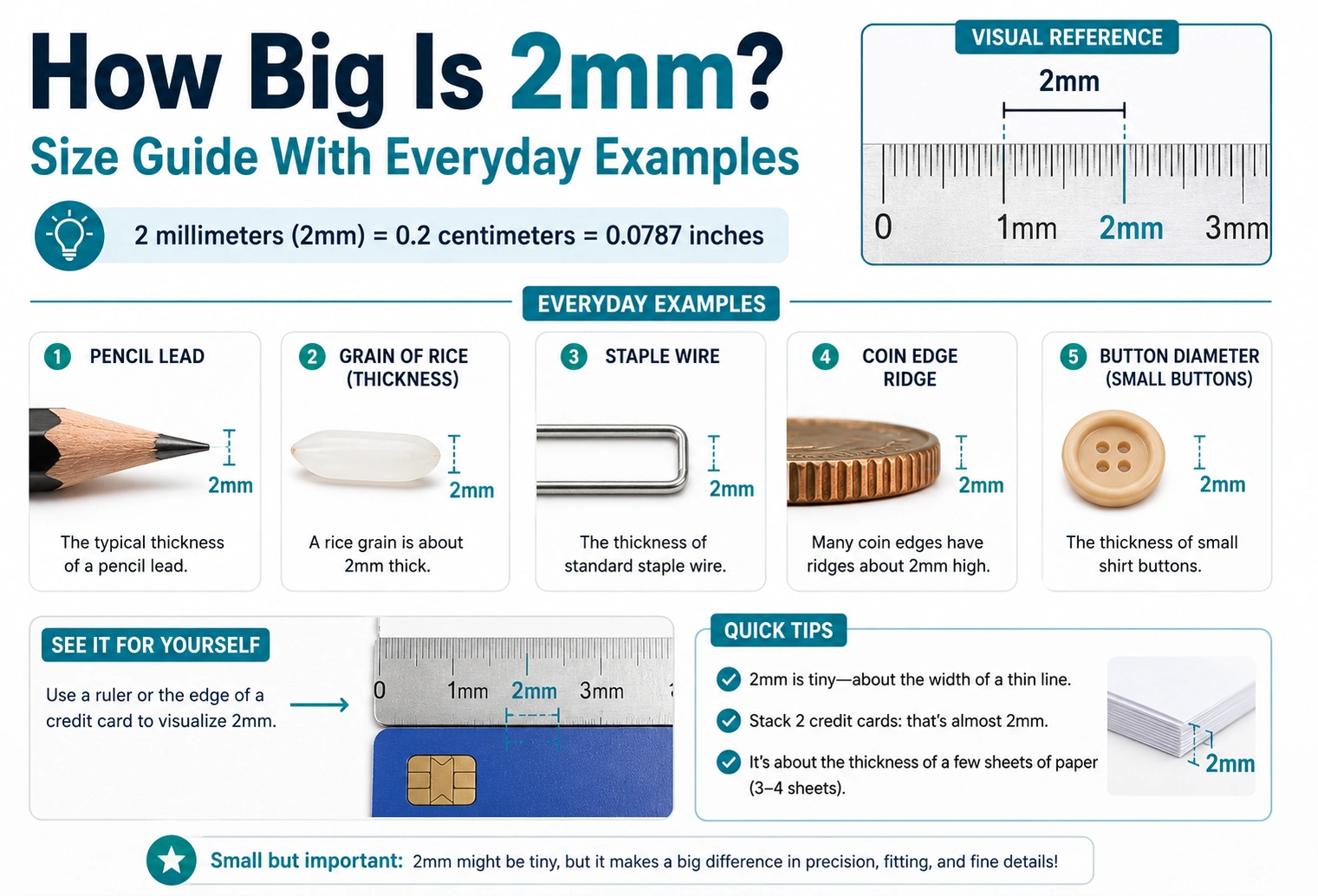
2 millimeters (2 mm) is equal to 0.2 centimeters, 0.0787 inches, or about 1/13 of an inch.
Although it’s a very small measurement, you’ll find 2 mm used in jewelry, engineering, electronics, medical devices, crafts, and everyday household items.
This guide explains exactly how big 2 mm is using simple conversions, comparison charts, and familiar objects.
Quick Answer
| Measurement | Equivalent |
|---|---|
| 2 millimeters | 0.2 centimeters |
| 0.0787 inches | |
| 0.00656 feet | |
| 2,000 micrometers (µm) |
2 mm is just under one-tenth of an inch.
What Does 2mm Look Like?
Because 2 mm is such a small measurement, comparing it with everyday objects makes it easier to understand.
Approximately 2 mm is similar to:
- The thickness of a standard credit card (around 0.76 mm) stacked about 2½ to 3 cards thick.
- The diameter of a small peppercorn.
- The thickness of two pennies stacked together is close, though slightly thicker.
- A small craft bead often measures around 2 mm in diameter.
- The width of the 2 mm mark on a metric ruler.
These comparisons provide a general idea, though actual object sizes can vary.
2mm Conversion Chart
Here are the exact conversions for 2 mm.
| Unit | Conversion |
|---|---|
| Millimeters | 2 mm |
| Centimeters | 0.2 cm |
| Meters | 0.002 m |
| Inches | 0.0787 in |
| Feet | 0.00656 ft |
| Micrometers | 2,000 µm |
Everyday Objects That Are About 2mm
Visual references can make small measurements easier to imagine.
Small Jewelry Beads
Seed beads and decorative craft beads are often available in 2 mm sizes.
Mechanical Pencil Lead
Common mechanical pencil lead diameters include 2 mm, especially in drafting pencils.
Fine Electrical Wire
Some insulated electrical wires measure close to 2 mm in overall diameter.
Plastic Sheet Thickness
Certain thin acrylic and plastic sheets used for signs or crafts are around 2 mm thick.
Small Screws
Many electronics and eyeglass screws have diameters close to 2 mm.
Where You’ll See 2mm Measurements
The 2 mm measurement appears in many industries.
Jewelry
- Gemstones
- Beads
- Necklace chains
- Earrings
Construction
- Tile spacers
- Gap measurements
- Finishing materials
Engineering
- Metal thickness
- Machine components
- Precision parts
Medical Field
- Surgical instruments
- Catheters
- Needle dimensions
Crafts and DIY
- Foam sheets
- Leather thickness
- Decorative materials
How to Measure 2mm Accurately
Small measurements require precise tools.
Metric Ruler
Most rulers include millimeter markings.
Locate the 2 mm line after the zero mark.
Digital Caliper
A digital caliper provides highly accurate readings, often within 0.01 mm.
Micrometer
For engineering and machining, a micrometer offers even greater precision.
Measuring Gauge
Wire gauges and thickness gauges are useful for measuring materials around 2 mm thick.
Why Understanding 2mm Matters
Knowing the size of 2 mm helps with many everyday tasks.
Buying Jewelry
Stone and bead sizes are commonly listed in millimeters.
Home Repairs
Accurate measurements help ensure proper fit and alignment.
Manufacturing
Small dimensional differences can affect product performance.
DIY Projects
Precise measurements improve project quality and reduce waste.
Common Mistakes When Measuring Small Sizes
Estimating by Eye
Objects measuring only a few millimeters are difficult to judge accurately without a measuring tool.
Confusing Millimeters and Centimeters
Remember:
- 10 mm = 1 cm
- 2 mm = 0.2 cm
Using Worn Measuring Tools
Damaged rulers or inaccurate tools can produce incorrect measurements.
Mixing Metric and Imperial Units
Always convert measurements into the same unit before comparing sizes.
Expert Tips
- Keep a metric ruler in your toolbox for quick measurements.
- Use digital calipers when precision is important.
- Compare unknown objects with a ruler instead of estimating.
- Double-check measurements before ordering replacement parts.
- Remember that millimeters are ideal for measuring very small objects.
Common Metric Size Comparison
| Size | Inches |
|---|---|
| 1 mm | 0.0394 in |
| 2 mm | 0.0787 in |
| 3 mm | 0.1181 in |
| 5 mm | 0.1969 in |
| 10 mm | 0.3937 in |
9. Frequently Asked Questions
1. How big is 2mm?
2 millimeters equals 0.2 centimeters or approximately 0.0787 inches.
2. Is 2mm close to 1/8 inch?
Not exactly. 2 mm is slightly smaller than 1/8 inch, which is approximately 3.18 mm.
3. What everyday object is about 2mm?
Examples include a 2 mm craft bead, 2 mm mechanical pencil lead, or the thickness of some plastic sheets.
4. How do I measure 2mm?
Use a metric ruler, digital caliper, or micrometer for accurate results.
5. Is 2mm considered thick?
It depends on the application. For paper, 2 mm is quite thick, while for wood, metal, or construction materials, it is considered relatively thin.
10. Conclusion
Understanding how big is 2mm becomes much easier when you compare it with familiar objects and know its exact conversions. 2 millimeters equals 0.2 centimeters, 0.0787 inches, and 2,000 micrometers, making it a small but commonly used measurement in jewelry, engineering, construction, crafts, and everyday life.
Whether you’re purchasing small parts, measuring materials, or completing a DIY project, using a metric ruler or digital caliper will help you measure 2 mm accurately. With the conversion charts and practical examples in this guide, you’ll be able to visualize and work with 2 mm confidently.
Discover More Articles
Pringles Dimensions: Can Sizes & Chip Measurements
Drops in 1 mL: How Many Drops Are in 1 Milliliter?
Pokémon God Packs: What They Are, Odds, and How to Find Them