

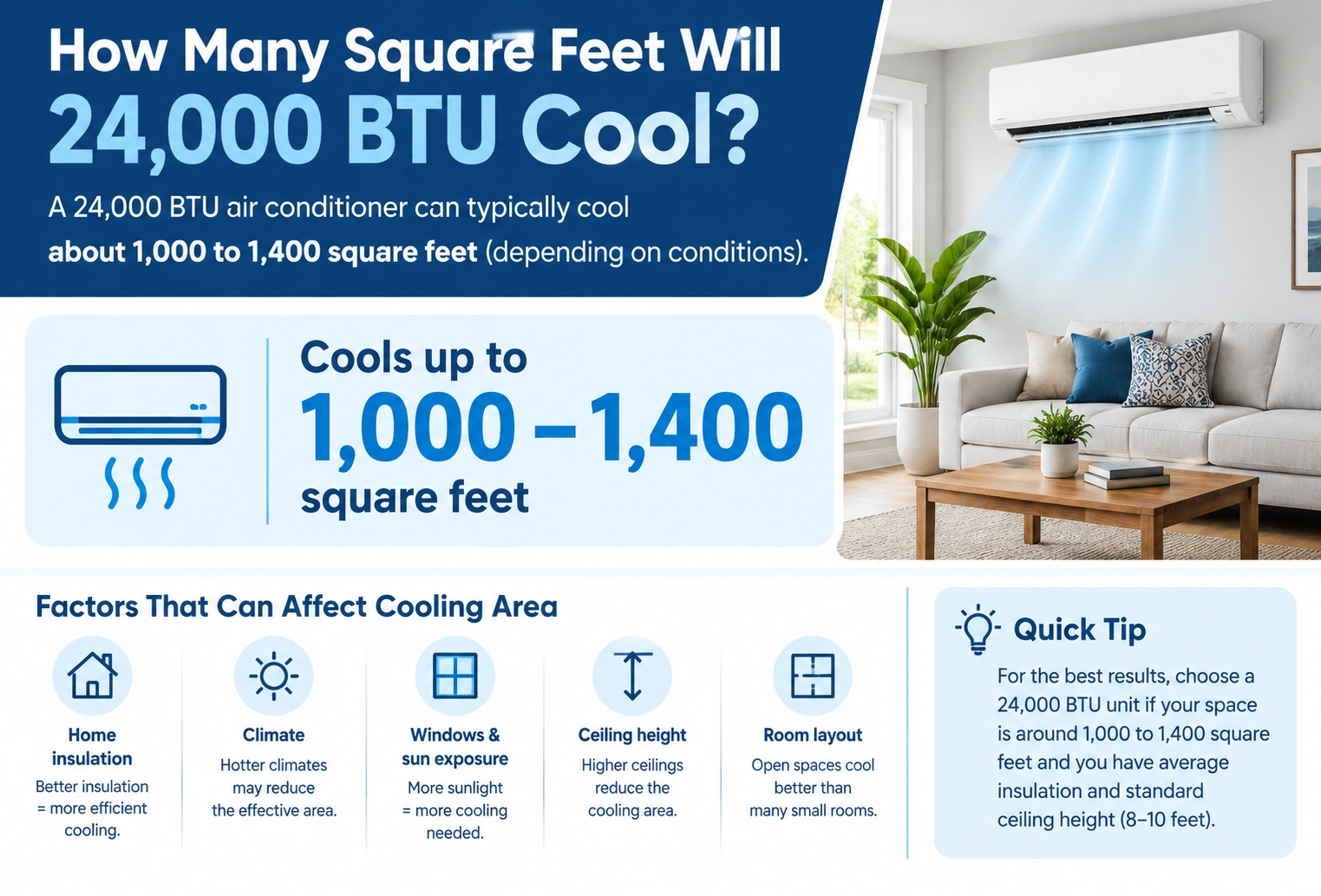
A 24,000 BTU air conditioner will typically cool about 900–1,500 square feet, depending on the climate, insulation, ceiling height, windows, and room layout.
For an average room or home with standard conditions, 24,000 BTU is commonly suitable for around 1,000–1,200 square feet. In a very hot climate or poorly insulated space, the effective coverage can be lower.
| 24,000 BTU AC | Approximate Coverage |
|---|---|
| Mild climate, good insulation | 1,200–1,500 sq ft |
| Average conditions | 1,000–1,200 sq ft |
| Hot climate | 900–1,000 sq ft |
| Poor insulation/high heat load | 800–900+ sq ft |
How Many Square Feet Will 24000 BTU Cool?
The answer depends on more than just the BTU rating. A 24,000 BTU air conditioner has a cooling capacity of 24,000 BTUs per hour, but the amount of space it can comfortably cool changes with the conditions inside and outside the building.
As a general starting point, 24,000 BTU can cool approximately 900 to 1,500 square feet. For average residential conditions, planning around 1,000 to 1,200 square feet is often a reasonable estimate.
The exact size should account for factors such as climate, insulation, sunlight, ceiling height, windows, occupancy, and whether the space is open or divided into several rooms.
What Does 24,000 BTU Mean?
BTU stands for British Thermal Unit. In air conditioning, BTUs describe how much heat an AC can remove from a space over a specific period.
A 24,000 BTU AC has a nominal cooling capacity of 24,000 BTUs per hour.
This does not mean the unit automatically cools a fixed number of square feet. Two homes with the same floor area can require very different amounts of cooling.
For example, a well-insulated 1,200-square-foot home may require less cooling than a poorly insulated 900-square-foot home exposed to strong afternoon sunlight.
24,000 BTU AC Coverage by Room Conditions
The following estimates show how the same 24,000 BTU unit can perform under different conditions.
| Room or Building Condition | Approximate Coverage |
|---|---|
| Excellent insulation, mild climate | 1,300–1,500 sq ft |
| Good insulation, moderate climate | 1,200–1,400 sq ft |
| Average insulation and climate | 1,000–1,200 sq ft |
| Hot climate with average insulation | 900–1,000 sq ft |
| Poor insulation and strong sun exposure | 800–900+ sq ft |
These figures are general planning ranges rather than a substitute for a professional cooling-load calculation.
How to Calculate 24000 BTU Coverage
A simple way to estimate AC sizing is to compare the BTU rating with the floor area.
A rough residential rule often starts with approximately 20–25 BTUs per square foot, although actual requirements can vary significantly.
Using 25 BTUs per square foot:
24,000 ÷ 25 = 960 square feet
Using 20 BTUs per square foot:
24,000 ÷ 20 = 1,200 square feet
So the basic calculation produces a range of roughly 960–1,200 square feet.
Simple Formula
You can use:
Estimated square feet = BTU capacity ÷ BTUs required per square foot
For a 24,000 BTU unit:
24,000 ÷ 20 = 1,200 sq ft
24,000 ÷ 25 = 960 sq ft
This is why a 24,000 BTU AC is often associated with approximately 1,000–1,200 square feet under average conditions.
Can a 24000 BTU AC Cool 1,000 Square Feet?
Yes. 1,000 square feet is generally within the practical range of a 24,000 BTU air conditioner.
For an average home with reasonable insulation and normal ceiling heights, a 24,000 BTU unit can provide substantial cooling for 1,000 square feet.
However, the layout matters.
A single open-plan 1,000-square-foot area may be easier to cool evenly than a 1,000-square-foot home divided into many closed bedrooms and hallways.
| Space Size | 24,000 BTU Suitability |
|---|---|
| 700 sq ft | More than enough in many conditions |
| 800 sq ft | Generally strong capacity |
| 900 sq ft | Usually suitable |
| 1,000 sq ft | Generally suitable |
| 1,100 sq ft | Often suitable |
| 1,200 sq ft | Suitable under favorable conditions |
| 1,300 sq ft | May work with good conditions |
| 1,500 sq ft | Often requires favorable conditions and proper distribution |
| 1,600+ sq ft | Usually consider additional capacity or another system |
Can a 24000 BTU AC Cool 1200 Square Feet?
Yes, 24,000 BTU can cool around 1,200 square feet, particularly when the building has good insulation, average ceiling heights, limited heat gain, and a suitable climate.
At 1,200 square feet, the unit provides:
24,000 ÷ 1,200 = 20 BTUs per square foot
That is within a commonly used rough planning range.
However, a 1,200-square-foot space in a very hot climate with large unshaded windows may need more cooling capacity than a similar space in a mild climate.
Can a 24000 BTU AC Cool 1500 Square Feet?
A 24,000 BTU unit may cool 1,500 square feet in favorable conditions, but it is near the upper end of the general range.
At 1,500 square feet:
24,000 ÷ 1,500 = 16 BTUs per square foot
That can be insufficient in a hot, poorly insulated building.
For a 1,500-square-foot space, consider the following factors before relying on a single 24,000 BTU unit:
- Local outdoor temperature
- Insulation quality
- Number and size of windows
- Direct sunlight
- Ceiling height
- Number of occupants
- Appliances and electronics
- Open-plan versus divided rooms
- Air leakage
- Whether the space is on the top floor
Factors That Affect 24000 BTU Cooling Capacity
1. Climate
Climate is one of the biggest factors.
A 24,000 BTU AC may handle a larger area in a mild climate than it can in an extremely hot climate.
| Climate | Effect on 24,000 BTU Coverage |
|---|---|
| Mild | Higher potential coverage |
| Moderate | Typical coverage |
| Hot | Lower coverage |
| Very hot | May require additional capacity |
2. Insulation
Good insulation reduces the amount of outdoor heat entering the building.
A well-insulated room can therefore stay comfortable with less cooling capacity than a poorly insulated room.
Poor insulation can cause a 24,000 BTU AC to struggle even when the calculated floor area appears appropriate.
3. Ceiling Height
Most basic sizing estimates assume a standard ceiling height.
A room with 10- or 12-foot ceilings contains more air volume than a room with 8-foot ceilings.
| Ceiling Height | Cooling Consideration |
|---|---|
| 8 ft | Typical baseline |
| 9 ft | Slightly higher load |
| 10 ft | Higher cooling requirement |
| 12 ft | Significantly more air volume |
4. Windows and Sunlight
Large windows can introduce considerable heat, particularly when they receive direct afternoon sunlight.
A room with several large, unshaded windows may need more cooling than a room with smaller, shaded windows.
5. Number of People
People generate heat. A crowded living room, office, classroom, or entertainment space can therefore require more cooling.
A space designed for occasional occupancy may have a lower cooling load than the same-size space regularly occupied by many people.
6. Appliances
Ovens, computers, televisions, refrigerators, lighting, and other electrical equipment contribute heat to indoor spaces.
A kitchen or home office may therefore require more cooling than an otherwise identical room.
24,000 BTU Compared With Other AC Sizes
Comparing BTU ratings can help you understand where a 24,000 BTU system fits.
| AC Capacity | Approximate General Coverage |
|---|---|
| 6,000 BTU | 200–300 sq ft |
| 8,000 BTU | 300–400 sq ft |
| 10,000 BTU | 400–500 sq ft |
| 12,000 BTU | 500–600 sq ft |
| 18,000 BTU | 700–900 sq ft |
| 24,000 BTU | 900–1,500 sq ft |
| 30,000 BTU | 1,200–1,600+ sq ft |
| 36,000 BTU | 1,500–2,000+ sq ft |
These are broad estimates. Manufacturer specifications and a proper cooling-load calculation should take priority over a simple BTU-per-square-foot rule.
Is a 24000 BTU AC Too Big for 800 Square Feet?
It can be, depending on the building.
A 24,000 BTU unit has substantially more cooling capacity than many 800-square-foot spaces require under normal conditions.
Oversizing an AC is not always beneficial. A unit that is too large may cool the air quickly but cycle off before adequately removing humidity, depending on the system and conditions.
| Space | Possible Result With 24,000 BTU |
|---|---|
| 600 sq ft | Likely oversized in many conditions |
| 700 sq ft | Potentially oversized |
| 800 sq ft | May be oversized |
| 900 sq ft | More reasonable |
| 1,000 sq ft | Common target range |
| 1,200 sq ft | Common target range under average conditions |
| 1,500 sq ft | Near upper end in many conditions |
The goal is not to choose the biggest AC available. The goal is to choose a capacity that matches the actual cooling load.
24000 BTU for Different Room Types
A 24,000 BTU system can be used in many types of spaces, but distribution is important.
| Space Type | Example Area | 24,000 BTU Potential |
|---|---|---|
| Large living room | 600–900 sq ft | Strong capacity |
| Open living/dining area | 800–1,200 sq ft | Often suitable |
| Small apartment | 800–1,000 sq ft | Often suitable |
| Large open floor plan | 1,000–1,300 sq ft | Often suitable |
| Whole small home | 1,000–1,500 sq ft | Depends heavily on layout and climate |
| Office | 800–1,200 sq ft | Depends on occupants/equipment |
One 24,000 BTU AC vs Multiple Smaller Units
For a building with several rooms, multiple smaller AC units can sometimes distribute cooling more effectively than one large unit.
| Setup | Main Advantage | Main Limitation |
|---|---|---|
| One 24,000 BTU unit | Simple installation and centralized cooling | May struggle to distribute air to closed rooms |
| Two 12,000 BTU units | Better room-by-room control | More equipment |
| Three 8,000 BTU units | Flexible zoning | More installation and maintenance |
| Ducted system | Even distribution when properly designed | Higher installation complexity |
The best choice depends on the floor plan rather than square footage alone.
How Much Electricity Does a 24000 BTU AC Use?
BTU capacity and electrical consumption are not the same thing.
A 24,000 BTU rating describes cooling capacity, while electricity use depends on the unit’s efficiency, technology, operating conditions, and compressor design.
For example, two 24,000 BTU ACs can have the same cooling capacity but different electrical consumption.
When comparing models, look at the manufacturer’s efficiency ratings and electrical specifications rather than assuming every 24,000 BTU unit consumes the same amount of electricity.
Signs a 24,000 BTU AC Is Too Small
A properly sized AC should be able to maintain the desired indoor temperature under normal design conditions.
Signs that the unit may be undersized include:
- It runs almost continuously during hot weather.
- The room never reaches the thermostat setting.
- Indoor temperatures remain uncomfortable.
- Cooling becomes weak during peak afternoon heat.
- The system struggles when several people are present.
- Upstairs rooms remain much hotter than downstairs rooms.
Before replacing the unit, check filters, airflow, insulation, ductwork, refrigerant issues, and other possible problems.
Signs a 24,000 BTU AC Is Too Large
Oversizing can also create problems.
Possible signs include:
- Very short operating cycles
- Frequent starting and stopping
- Uneven temperature
- Poor humidity control
- Higher-than-expected operating costs
- The room becomes cold quickly but does not feel comfortable
A short cycling problem does not automatically mean the AC is oversized. Installation problems, thermostat issues, airflow restrictions, and equipment faults can produce similar symptoms.
How to Get the Right 24,000 BTU AC Size
Use square footage as a starting point, but consider the complete cooling load.
Step 1: Measure the Area
Multiply the room’s length by its width.
Length × Width = Square Feet
For example:
30 ft × 40 ft = 1,200 sq ft
Step 2: Check Ceiling Height
Determine whether the ceilings are standard or significantly taller than average.
Step 3: Consider Sun Exposure
Count large windows and identify rooms that receive strong direct sunlight.
Step 4: Evaluate Insulation
Good insulation generally reduces cooling demand, while poor insulation increases it.
Step 5: Consider Occupancy
A heavily occupied room needs more cooling than an occasionally occupied room of the same size.
Step 6: Consider the Layout
An open 1,200-square-foot area may distribute cooling more easily than five separate rooms totaling 1,200 square feet.
Step 7: Check Manufacturer Specifications
Once you have estimated the required capacity, compare the actual AC specifications and installation requirements.
Common Mistakes When Choosing a 24,000 BTU AC
Mistake 1: Using Only Square Footage
Square footage is important, but it does not tell the entire story.
Mistake 2: Always Choosing a Bigger AC
More BTUs are not automatically better. Oversizing can affect cycling and humidity control.
Mistake 3: Ignoring Climate
An AC that works well for 1,300 square feet in a mild climate may not provide the same results in a very hot region.
Mistake 4: Ignoring Sunlight
A heavily sun-exposed room can have a much higher cooling load.
Mistake 5: Forgetting Ceiling Height
Tall ceilings increase the volume of air that needs to be conditioned.
Mistake 6: Ignoring Air Distribution
A single indoor unit cannot necessarily distribute cooling evenly throughout a home with multiple closed rooms.
Frequently Asked Questions
How many square feet will 24,000 BTU cool?
A 24,000 BTU AC will generally cool about 900–1,500 square feet, depending on climate, insulation, ceiling height, windows, and layout. Around 1,000–1,200 square feet is a useful general planning range for average conditions.
Will a 24,000 BTU AC cool 1,500 square feet?
It may, especially in a well-insulated building with favorable conditions. However, 1,500 square feet is toward the upper end of the general range, so a cooling-load calculation is recommended for accurate sizing.
Will 24,000 BTU cool 1,000 square feet?
Yes. 1,000 square feet is generally a reasonable target for a 24,000 BTU AC under average conditions.
Is 24,000 BTU enough for 1,200 square feet?
It can be. A 24,000 BTU unit provides approximately 20 BTUs per square foot at 1,200 square feet, which can be appropriate under many average conditions.
Is a 24,000 BTU AC too big for 800 square feet?
It may be oversized for an 800-square-foot space under normal conditions. However, unusually high heat loads can change the required capacity. Always consider climate, insulation, windows, and occupancy before deciding.
Conclusion
So, how many square feet will 24000 BTU cool? A 24,000 BTU air conditioner will generally cool around 900–1,500 square feet, with 1,000–1,200 square feet being a practical general range for average conditions.
The exact coverage depends on climate, insulation, ceiling height, windows, sunlight, occupancy, appliances, and room layout. For the most accurate sizing, use square footage as a starting point and have the actual cooling load evaluated before purchasing an AC.
Discover More Articles
How Many Feet Is a NFL Football Field? Complete Guide