

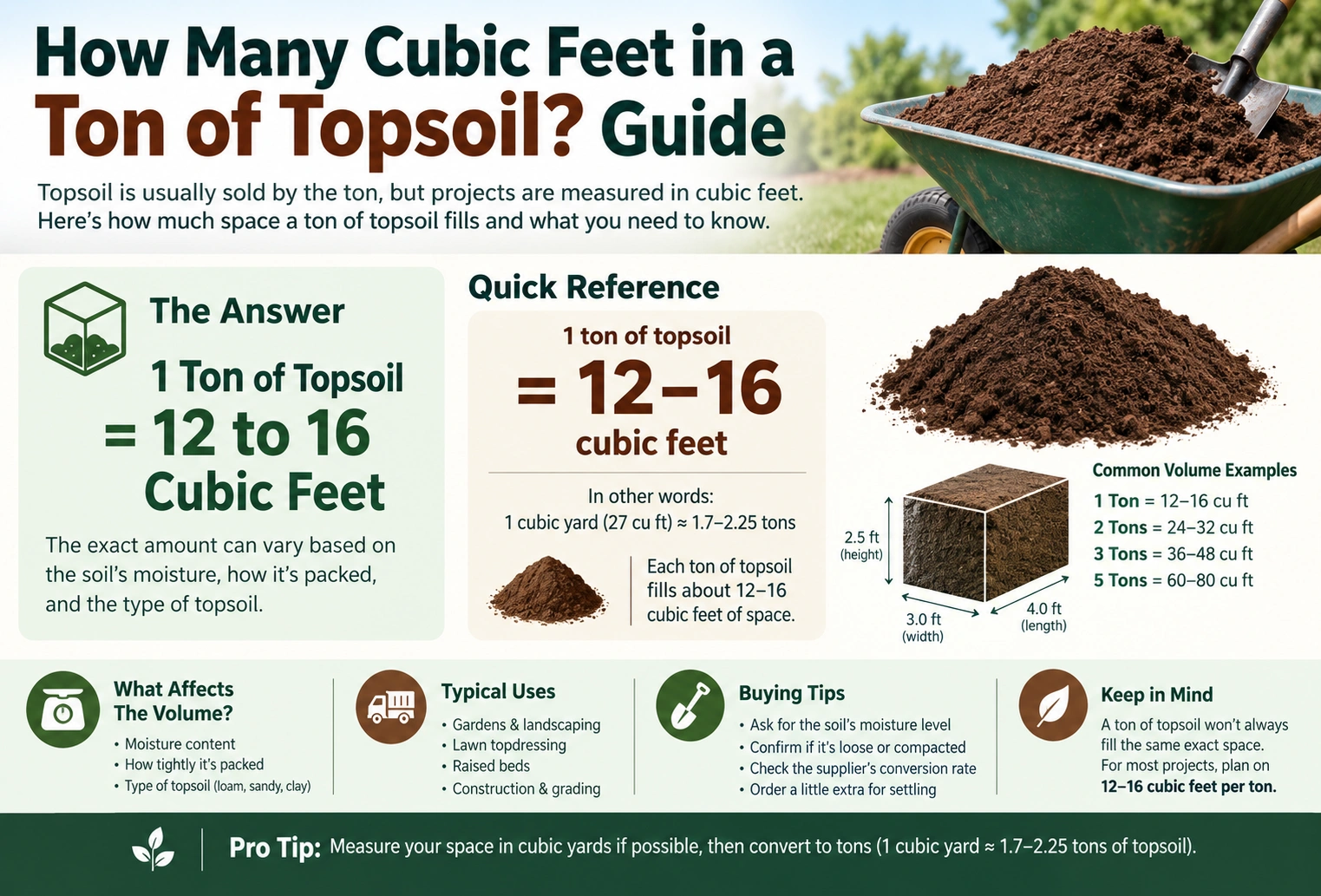
If you’re buying topsoil by the ton but need to know the volume in cubic feet, the answer depends on the density of the soil. Unlike water or other materials with a relatively consistent density, topsoil can vary considerably in weight because of moisture, organic matter, sand, clay, and how compacted it is.
As a general estimate, one ton of topsoil contains about 27 to 36 cubic feet.
A commonly used planning estimate is around 30–33 cubic feet per ton, but the actual volume can be higher or lower depending on the supplier’s stated soil density.
Quick Answer
One ton of topsoil is approximately 27–36 cubic feet.
For a quick planning estimate, you can use about 30 cubic feet per ton unless your supplier provides a specific density or conversion.
| Topsoil Density | Approx. Cubic Feet per Ton | Approx. Cubic Yards per Ton |
|---|---|---|
| 1,500 lb/yd³ | 36.0 ft³ | 1.33 yd³ |
| 1,600 lb/yd³ | 33.75 ft³ | 1.25 yd³ |
| 1,800 lb/yd³ | 30.0 ft³ | 1.11 yd³ |
| 2,000 lb/yd³ | 27.0 ft³ | 1.00 yd³ |
Because topsoil density varies, there is no single exact cubic-foot measurement for every ton of topsoil.
For many landscaping calculations, using 30 cubic feet per ton provides a simple estimate when the actual density is unknown.
Why a Ton of Topsoil Does Not Have One Exact Volume
A ton is a measurement of weight, while a cubic foot is a measurement of volume.
The relationship between the two depends on density.
For example, two different loads may each weigh one ton but occupy different amounts of space:
| Soil Type or Condition | Relative Density | Volume of 1 Ton |
|---|---|---|
| Lightweight, dry topsoil | Lower | More than 30 ft³ |
| Typical topsoil | Moderate | About 30–34 ft³ |
| Heavy or moist topsoil | Higher | About 27–30 ft³ |
| Very dense soil | High | Potentially less than 27 ft³ |
This is why simply assuming that every ton equals a fixed number of cubic feet can produce inaccurate material estimates.
Moisture is especially important. Wet soil weighs more than dry soil, so a ton of wet topsoil can occupy less space than a ton of relatively dry soil.
Topsoil Weight and Density
Topsoil is often sold by either weight or volume. Bulk suppliers may quote prices by the ton, while landscaping companies and garden suppliers frequently use cubic yards.
Density is the factor that connects these measurements.
One cubic yard contains:
27 cubic feet
Therefore, if you know how many pounds one cubic yard of topsoil weighs, you can calculate the cubic feet contained in a ton.
For example, suppose a particular topsoil has a bulk density of 1,800 pounds per cubic yard.
One ton equals 2,000 pounds.
The calculation is:
2,000 ÷ 1,800 = 1.11 cubic yards
Then convert cubic yards to cubic feet:
1.11 × 27 = approximately 30 cubic feet
So, at a density of 1,800 pounds per cubic yard, one ton of topsoil contains about 30 cubic feet.
Tons of Topsoil to Cubic Feet Conversion
The following table provides useful estimates at several common assumed densities.
| Tons | 1,500 lb/yd³ | 1,600 lb/yd³ | 1,800 lb/yd³ | 2,000 lb/yd³ |
|---|---|---|---|---|
| 0.5 ton | 18.0 ft³ | 16.88 ft³ | 15.0 ft³ | 13.5 ft³ |
| 1 ton | 36.0 ft³ | 33.75 ft³ | 30.0 ft³ | 27.0 ft³ |
| 2 tons | 72.0 ft³ | 67.5 ft³ | 60.0 ft³ | 54.0 ft³ |
| 3 tons | 108.0 ft³ | 101.25 ft³ | 90.0 ft³ | 81.0 ft³ |
| 4 tons | 144.0 ft³ | 135.0 ft³ | 120.0 ft³ | 108.0 ft³ |
| 5 tons | 180.0 ft³ | 168.75 ft³ | 150.0 ft³ | 135.0 ft³ |
This demonstrates why the supplier’s density information is valuable when ordering large quantities.
Tons to Cubic Yards of Topsoil
Since landscaping materials are frequently sold by the cubic yard, it is useful to know the relationship between tons and cubic yards.
There are 27 cubic feet in one cubic yard.
Using an assumed density of 1,800 pounds per cubic yard:
2,000 ÷ 1,800 = 1.11 cubic yards
Therefore:
1 ton of topsoil ≈ 1.11 cubic yards
At different densities, the conversion changes.
| Topsoil Density | Cubic Yards per Ton | Cubic Feet per Ton |
|---|---|---|
| 1,500 lb/yd³ | 1.33 yd³ | 36.0 ft³ |
| 1,600 lb/yd³ | 1.25 yd³ | 33.75 ft³ |
| 1,700 lb/yd³ | 1.18 yd³ | 31.76 ft³ |
| 1,800 lb/yd³ | 1.11 yd³ | 30.0 ft³ |
| 1,900 lb/yd³ | 1.05 yd³ | 28.42 ft³ |
| 2,000 lb/yd³ | 1.00 yd³ | 27.0 ft³ |
So, depending on density, one ton of topsoil can represent roughly 1 to 1.33 cubic yards.
How to Calculate Cubic Feet From Tons of Topsoil
If you know the density of your topsoil, you can calculate its volume using a simple formula.
Formula
Cubic feet = (tons × 2,000 ÷ pounds per cubic yard) × 27
For example, assume you have 2 tons of topsoil with a density of 1,800 pounds per cubic yard.
First convert tons to pounds:
2 × 2,000 = 4,000 pounds
Then calculate cubic yards:
4,000 ÷ 1,800 = 2.22 cubic yards
Finally, convert cubic yards to cubic feet:
2.22 × 27 = approximately 60 cubic feet
So:
2 tons of this topsoil ≈ 60 cubic feet
| Amount of Topsoil | At 1,800 lb/yd³ | Approx. Cubic Feet |
|---|---|---|
| 0.5 ton | 0.56 yd³ | 15 ft³ |
| 1 ton | 1.11 yd³ | 30 ft³ |
| 1.5 tons | 1.67 yd³ | 45 ft³ |
| 2 tons | 2.22 yd³ | 60 ft³ |
| 3 tons | 3.33 yd³ | 90 ft³ |
| 4 tons | 4.44 yd³ | 120 ft³ |
How Much Area Can a Ton of Topsoil Cover?
Knowing the cubic-foot volume is only part of the calculation. You also need to know the depth at which you’re spreading the soil.
The basic formula is:
Coverage area = cubic feet ÷ depth in feet
For example, if one ton provides approximately 30 cubic feet of soil, its coverage changes according to the application depth.
| Soil Depth | Depth in Feet | Approx. Coverage From 1 Ton at 30 ft³ |
|---|---|---|
| 1 inch | 0.083 ft | 360 sq ft |
| 2 inches | 0.167 ft | 180 sq ft |
| 3 inches | 0.25 ft | 120 sq ft |
| 4 inches | 0.333 ft | 90 sq ft |
| 6 inches | 0.5 ft | 60 sq ft |
| 8 inches | 0.667 ft | 45 sq ft |
| 12 inches | 1 ft | 30 sq ft |
These figures are estimates and assume the soil provides approximately 30 cubic feet per ton.
For example, if you want to spread one ton of topsoil at a depth of 3 inches, you could cover approximately 120 square feet.
Factors That Affect Topsoil Volume
Several factors can change how much space a ton of topsoil occupies.
Moisture Content
Wet topsoil generally weighs more than dry topsoil. This means two loads with the same volume can have different weights.
Conversely, when purchasing by weight, moisture can affect how much actual soil volume you receive.
Organic Matter
Topsoil containing substantial compost or other organic material may be less dense than heavier mineral soil.
Sand and Clay Content
The mineral composition of soil affects its bulk density. Heavier, denser soil generally provides fewer cubic feet per ton than lighter soil.
Compaction
Loose soil occupies more space than heavily compacted soil. Once topsoil is spread and settled, its volume can change.
Supplier’s Soil Mix
Commercial topsoil products can contain different combinations of screened soil, sand, compost, and other amendments. Always check the supplier’s stated conversion when available.
How Many Tons of Topsoil Do You Need?
To determine how much topsoil you need, start with the dimensions of the area.
Use:
Length × Width × Depth = Cubic Feet
If your measurements are in feet, calculate the volume directly.
For example, suppose you have a garden area that is:
- 20 feet long
- 15 feet wide
- 4 inches deep
Convert 4 inches to feet:
4 ÷ 12 = 0.333 feet
Then calculate:
20 × 15 × 0.333 = 99.9 cubic feet
You need approximately 100 cubic feet of topsoil.
If your topsoil provides approximately 30 cubic feet per ton:
100 ÷ 30 = 3.33 tons
You would therefore need approximately 3.3 tons, before allowing for settling, uneven ground, or waste.
| Project Size | Depth | Soil Needed |
|---|---|---|
| 10 × 10 ft | 3 in | 25 ft³ |
| 10 × 20 ft | 4 in | 66.7 ft³ |
| 20 × 20 ft | 4 in | 133.3 ft³ |
| 20 × 30 ft | 6 in | 300 ft³ |
| 30 × 30 ft | 4 in | 300 ft³ |
| 40 × 50 ft | 6 in | 1,000 ft³ |
For larger landscaping projects, converting the final volume to cubic yards can make ordering easier.
Common Topsoil Calculation Mistakes
Assuming Every Ton Equals 27 Cubic Feet
A cubic yard contains 27 cubic feet, but that does not mean one ton of topsoil always equals 27 cubic feet.
That would only be true if the topsoil weighed approximately 2,000 pounds per cubic yard.
Ignoring Soil Density
Density can significantly change the volume represented by one ton.
For example:
| Density | Volume of 1 Ton |
|---|---|
| 1,500 lb/yd³ | 36 ft³ |
| 1,800 lb/yd³ | 30 ft³ |
| 2,000 lb/yd³ | 27 ft³ |
Forgetting to Convert Inches to Feet
If you’re calculating volume using feet, convert the soil depth from inches to feet before multiplying.
| Soil Depth | Feet |
|---|---|
| 1 inch | 0.0833 ft |
| 2 inches | 0.1667 ft |
| 3 inches | 0.25 ft |
| 4 inches | 0.3333 ft |
| 6 inches | 0.5 ft |
| 12 inches | 1 ft |
Ordering Exactly the Calculated Amount
The calculated volume may not account for settling, uneven surfaces, spillage, or variations in soil density. For larger projects, asking the supplier for the recommended quantity can help avoid ordering too little.
FAQs
How many cubic feet are in a ton of topsoil?
A ton of topsoil generally contains about 27–36 cubic feet, depending on density and moisture. A practical estimate for many projects is around 30 cubic feet per ton.
Is a ton of topsoil the same as a cubic yard?
No. A cubic yard measures volume, while a ton measures weight. Depending on density, one ton of topsoil may equal approximately 1–1.33 cubic yards.
How many cubic feet are in 2 tons of topsoil?
At an assumed volume of 30 cubic feet per ton, 2 tons of topsoil equal approximately 60 cubic feet.
How many cubic yards are in a ton of topsoil?
The answer depends on density. At 1,800 pounds per cubic yard, one ton equals approximately 1.11 cubic yards.
How much does one cubic foot of topsoil weigh?
The weight varies by soil density and moisture. Using 1,800 pounds per cubic yard as an example, one cubic foot weighs approximately:
1,800 ÷ 27 = 66.7 pounds
So that soil would weigh about 67 pounds per cubic foot.
How many square feet will one ton of topsoil cover?
If one ton provides about 30 cubic feet, coverage depends on depth.
| Depth | Approx. Coverage |
|---|---|
| 1 inch | 360 sq ft |
| 2 inches | 180 sq ft |
| 3 inches | 120 sq ft |
| 4 inches | 90 sq ft |
| 6 inches | 60 sq ft |
How do I get the most accurate topsoil conversion?
Ask your soil supplier for the bulk density or tons-per-cubic-yard conversion of the exact topsoil product you’re purchasing. This is more accurate than using a general estimate.
Conclusion
So, how many cubic feet are in a ton of topsoil? The answer is typically around 27–36 cubic feet per ton, depending primarily on soil density and moisture.
For quick estimates, 30 cubic feet per ton is a useful planning figure. However, the actual amount can vary substantially between different topsoil products.
For the most accurate calculation, use the supplier’s density information and convert the material using:
Cubic feet = (tons × 2,000 ÷ pounds per cubic yard) × 27
Once you know the cubic-foot volume, you can calculate how much area the topsoil will cover at a particular depth. This makes it easier to estimate soil requirements for gardens, lawns, raised beds, landscaping, grading, and other projects.
Discover More Articles
How Many Feet Is a Hockey Rink? Rink Size Guide