
If you’re planning a small concrete project, one of the first questions to answer is how many cubic feet an 80 lb bag of concrete produces.
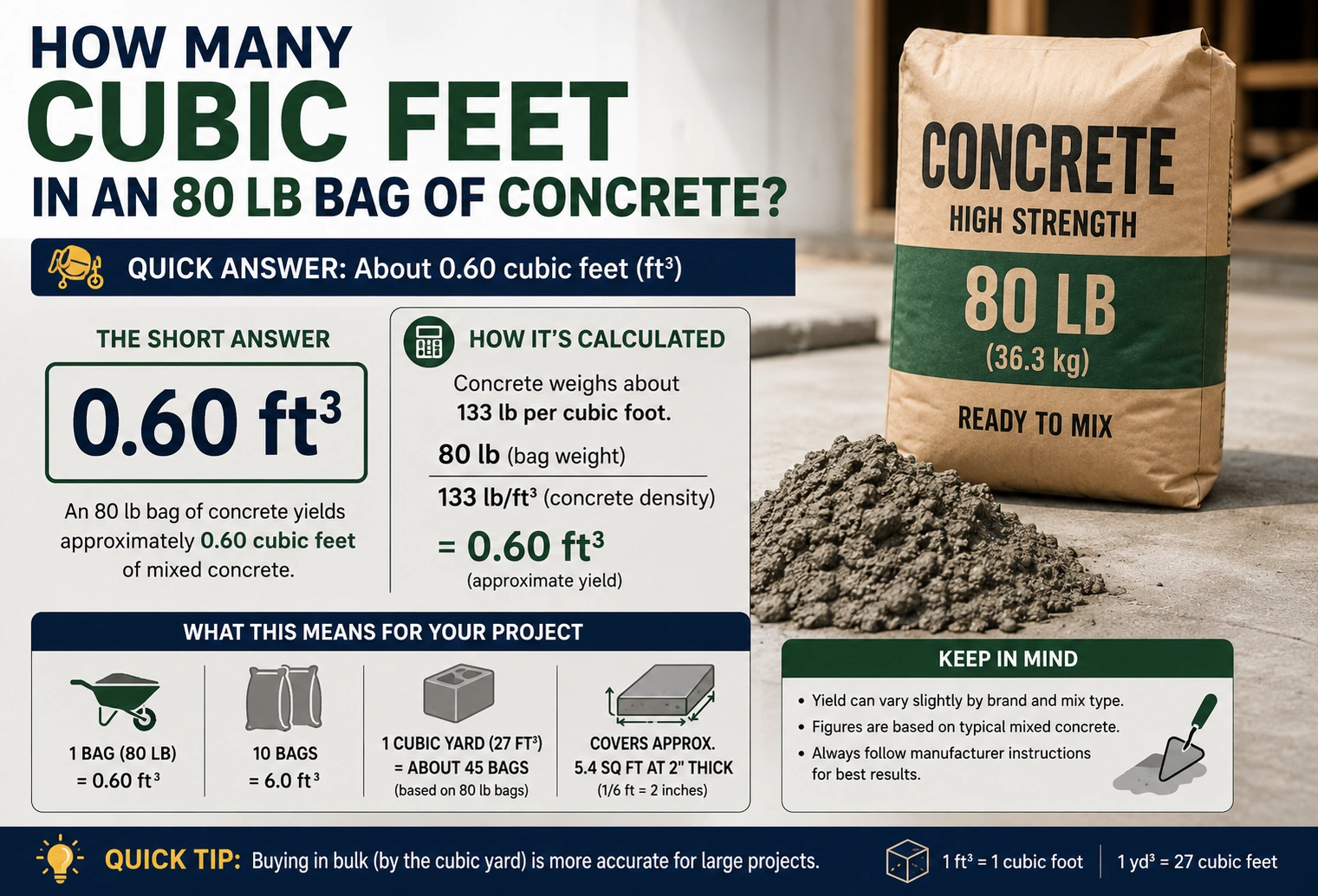
An 80 lb bag of concrete typically yields about 0.60 cubic feet of concrete when mixed according to the manufacturer’s instructions. However, the exact yield can vary slightly between products, so always check the yield printed on the bag or the manufacturer’s product specifications before purchasing a large quantity.
For estimating purposes, 0.60 cubic feet per 80 lb bag is a commonly used figure.
Quick Answer
An 80 lb bag of concrete typically makes approximately 0.60 cubic feet of mixed concrete.
Here are the key conversions:
| Measurement | Approximate Amount |
|---|---|
| Concrete per 80 lb bag | 0.60 cu ft |
| Concrete per 10 bags | 6.0 cu ft |
| Concrete per 20 bags | 12.0 cu ft |
| Concrete per 30 bags | 18.0 cu ft |
| Concrete per 40 bags | 24.0 cu ft |
| 80 lb bags per cubic yard | About 45 bags |
One cubic yard contains 27 cubic feet, so:
27 ÷ 0.60 = 45 bags
Therefore, you would need approximately 45 bags of 80 lb concrete mix to produce 1 cubic yard, assuming each bag yields exactly 0.60 cubic feet.
How Much Concrete Does an 80 lb Bag Make?
The amount of finished concrete produced by a bag is called its yield.
An 80 lb bag may contain cement, sand, gravel, and other ingredients that are mixed with water to create concrete. The dry weight of the bag does not directly tell you the final volume. Instead, manufacturers provide a yield based on the specific mix.
For general estimating, an 80 lb bag that yields 0.60 cubic feet produces:
0.60 cubic feet of mixed concrete
This is equal to approximately 16.2 gallons of concrete volume.
| Conversion | Amount |
|---|---|
| 80 lb bag yield | 0.60 cu ft |
| Cubic inches | 1,036.8 cu in |
| Gallons | About 4.49 gal |
The gallon conversion above refers to U.S. liquid-volume gallons by volume; concrete is normally estimated in cubic feet or cubic yards rather than gallons.
80 lb Bag of Concrete Coverage
The amount of surface area an 80 lb bag covers depends on the thickness of the concrete.
A thinner layer covers more square feet, while a thicker slab covers less area.
For example, a 0.60 cubic-foot yield can cover approximately:
| Concrete Thickness | Coverage per 80 lb Bag |
|---|---|
| 1 inch | 7.2 sq ft |
| 2 inches | 3.6 sq ft |
| 3 inches | 2.4 sq ft |
| 4 inches | 1.8 sq ft |
| 5 inches | 1.44 sq ft |
| 6 inches | 1.2 sq ft |
These figures assume a full 0.60 cubic-foot yield and do not include extra concrete for waste, uneven ground, or variations in mixing and placement.
Example: 4-Inch-Deep Area
Suppose you’re filling an area measuring 10 square feet at a thickness of 4 inches.
First, convert 4 inches to feet:
4 ÷ 12 = 0.333 feet
Then calculate the volume:
10 × 0.333 = 3.33 cubic feet
If each 80 lb bag produces 0.60 cubic feet:
3.33 ÷ 0.60 = 5.55 bags
Since you cannot buy a fraction of a bag for the finished project, you would need at least 6 bags, with additional material recommended if there may be waste or uneven conditions.
How to Calculate How Many Bags You Need
Calculating the number of 80 lb bags required is straightforward once you know the project’s dimensions.
Step 1: Measure the Project
Measure:
- Length
- Width
- Concrete thickness
Use feet for all measurements.
Step 2: Calculate Cubic Feet
For a rectangular area, use:
Length × Width × Thickness = Cubic Feet
If thickness is measured in inches, divide it by 12 first.
Step 3: Divide by the Bag Yield
Once you know the required cubic feet, divide by the yield of one bag.
Cubic feet needed ÷ 0.60 = Number of 80 lb bags
For example, if your project requires 12 cubic feet:
12 ÷ 0.60 = 20 bags
You would need approximately 20 bags, before adding an allowance for waste.
80 lb Concrete Bag Coverage by Thickness
Thickness has a major impact on how much area one bag can cover.
The following table provides a useful planning reference:
| Thickness | Approx. Coverage per 80 lb Bag |
|---|---|
| 1 inch | 7.2 sq ft |
| 2 inches | 3.6 sq ft |
| 3 inches | 2.4 sq ft |
| 4 inches | 1.8 sq ft |
| 5 inches | 1.44 sq ft |
| 6 inches | 1.2 sq ft |
| 8 inches | 0.9 sq ft |
For a typical 4-inch-thick small slab, an 80 lb bag yielding 0.60 cubic feet covers about 1.8 square feet.
That means a 10 × 10 foot area would require substantially more than a handful of bags.
How Many 80 lb Bags Do You Need?
The exact number depends on your project’s total volume.
Here are examples based on a yield of 0.60 cubic feet per bag:
| Required Concrete Volume | 80 lb Bags Needed |
|---|---|
| 1 cu ft | 1.67 bags |
| 2 cu ft | 3.33 bags |
| 3 cu ft | 5 bags |
| 4 cu ft | 6.67 bags |
| 5 cu ft | 8.33 bags |
| 6 cu ft | 10 bags |
| 10 cu ft | 16.67 bags |
| 15 cu ft | 25 bags |
| 20 cu ft | 33.33 bags |
| 27 cu ft | 45 bags |
Because bags are sold as whole units, round the calculated result up, not down.
For example:
10 ÷ 0.60 = 16.67
You would need 17 bags before accounting for waste.
For practical projects, buying a small amount of extra material can help prevent running short.
How Many 80 lb Bags Are in a Cubic Yard?
A cubic yard contains exactly 27 cubic feet.
If an 80 lb bag produces 0.60 cubic feet:
27 ÷ 0.60 = 45 bags
So approximately 45 80 lb bags are required to make one cubic yard of concrete.
| Concrete Volume | Approx. 80 lb Bags |
|---|---|
| 1 cubic foot | 1.67 bags |
| 5 cubic feet | 8.33 bags |
| 10 cubic feet | 16.67 bags |
| 15 cubic feet | 25 bags |
| 20 cubic feet | 33.33 bags |
| 25 cubic feet | 41.67 bags |
| 27 cubic feet | 45 bags |
| 1 cubic yard | 45 bags |
Buying nearly 45 individual bags can involve significant handling and mixing. For larger projects, comparing the cost and labor of bulk or ready-mix delivery may make more sense.
Factors That Can Affect Concrete Yield
The 0.60 cubic-foot figure is an estimate, not a universal yield for every concrete product.
Several factors can affect the final amount of usable concrete.
Product Formula
Different manufacturers use different proportions of cement, sand, aggregate, and additives. As a result, the stated yield can vary.
Always check the bag label for the manufacturer’s stated yield.
Water Added
Adding the correct amount of water is important for achieving the intended mixture and performance. Follow the product instructions rather than adding water simply to increase volume.
Uneven Surface
If the ground underneath the concrete is uneven, more material may be required to reach the desired finished thickness.
Waste
Some concrete can remain in the mixing container, wheelbarrow, tools, or forms. Small projects can also lose material during placement.
Measurement Errors
Incorrect measurements can significantly affect your estimate. A small difference in slab thickness across a large area can add up to a substantial amount of additional concrete.
Common Mistakes When Estimating Concrete
Mistake 1: Assuming Every 80 lb Bag Has the Same Yield
Not every concrete product has exactly the same yield.
Use 0.60 cubic feet as a planning estimate, but verify the actual yield printed on your product.
Mistake 2: Forgetting to Convert Inches to Feet
If your concrete thickness is 4 inches, you cannot directly multiply 4 by dimensions measured in feet.
Convert it first:
4 inches ÷ 12 = 0.333 feet
Mistake 3: Rounding Down
If your calculation produces 16.67 bags, buying 16 bags will leave you short.
Always round up to the next whole bag.
Mistake 4: Ignoring Waste
A theoretical calculation assumes that every bit of concrete is used perfectly. Real projects can require extra material.
For many small projects, having a modest additional allowance is practical, especially when the ground or forms are not perfectly uniform.
FAQs
How many cubic feet does an 80 lb bag of concrete make?
An 80 lb bag of concrete typically yields about 0.60 cubic feet of mixed concrete. Check the manufacturer’s stated yield because products can vary.
How many square feet does an 80 lb bag of concrete cover?
At a 4-inch thickness, a 0.60-cubic-foot bag covers approximately 1.8 square feet.
How many 80 lb bags of concrete are in a cubic yard?
A cubic yard contains 27 cubic feet. At 0.60 cubic feet per bag, you need approximately 45 bags.
How many 80 lb bags do I need for 1 cubic foot?
At a 0.60-cubic-foot yield per bag:
1 ÷ 0.60 = 1.67 bags
You would need approximately 2 bags to provide at least 1 cubic foot.
How many 80 lb bags do I need for a 10 × 10 slab?
The answer depends on the slab thickness.
| Slab Thickness | Concrete Needed | Approx. 80 lb Bags |
|---|---|---|
| 2 inches | 16.67 cu ft | 28 bags |
| 3 inches | 25 cu ft | 42 bags |
| 4 inches | 33.33 cu ft | 56 bags |
| 5 inches | 41.67 cu ft | 70 bags |
| 6 inches | 50 cu ft | 84 bags |
These calculations use a 0.60-cubic-foot yield per bag and should be adjusted for the actual product yield and any additional material needed for waste or uneven conditions.
Is 0.60 cubic feet the exact yield for every 80 lb concrete bag?
No. 0.60 cubic feet is a common estimating figure, but the actual yield depends on the specific concrete mix. Always check the product packaging or manufacturer’s specifications for the most accurate number.
Is an 80 lb bag enough for a small concrete repair?
It can be enough for small repairs, posts, footings, patches, or other limited applications, but the required quantity depends on the dimensions and thickness of the repair.
Calculate the project’s volume first and compare it with the bag’s stated yield.
Conclusion
An 80 lb bag of concrete typically produces about 0.60 cubic feet of mixed concrete. This makes it a useful size for small construction, repair, landscaping, and DIY projects.
At a 4-inch thickness, one 80 lb bag yielding 0.60 cubic feet covers approximately 1.8 square feet. To estimate the total number of bags, calculate your project’s volume in cubic feet and divide by the manufacturer’s stated yield.
For example, a project requiring 12 cubic feet would need:
12 ÷ 0.60 = 20 bags
For accurate purchasing, always check the yield printed on your specific concrete product and consider a small allowance for waste, uneven surfaces, and installation conditions.
Discover More Articles
How Many Square Feet Per Ton of Cooling?