
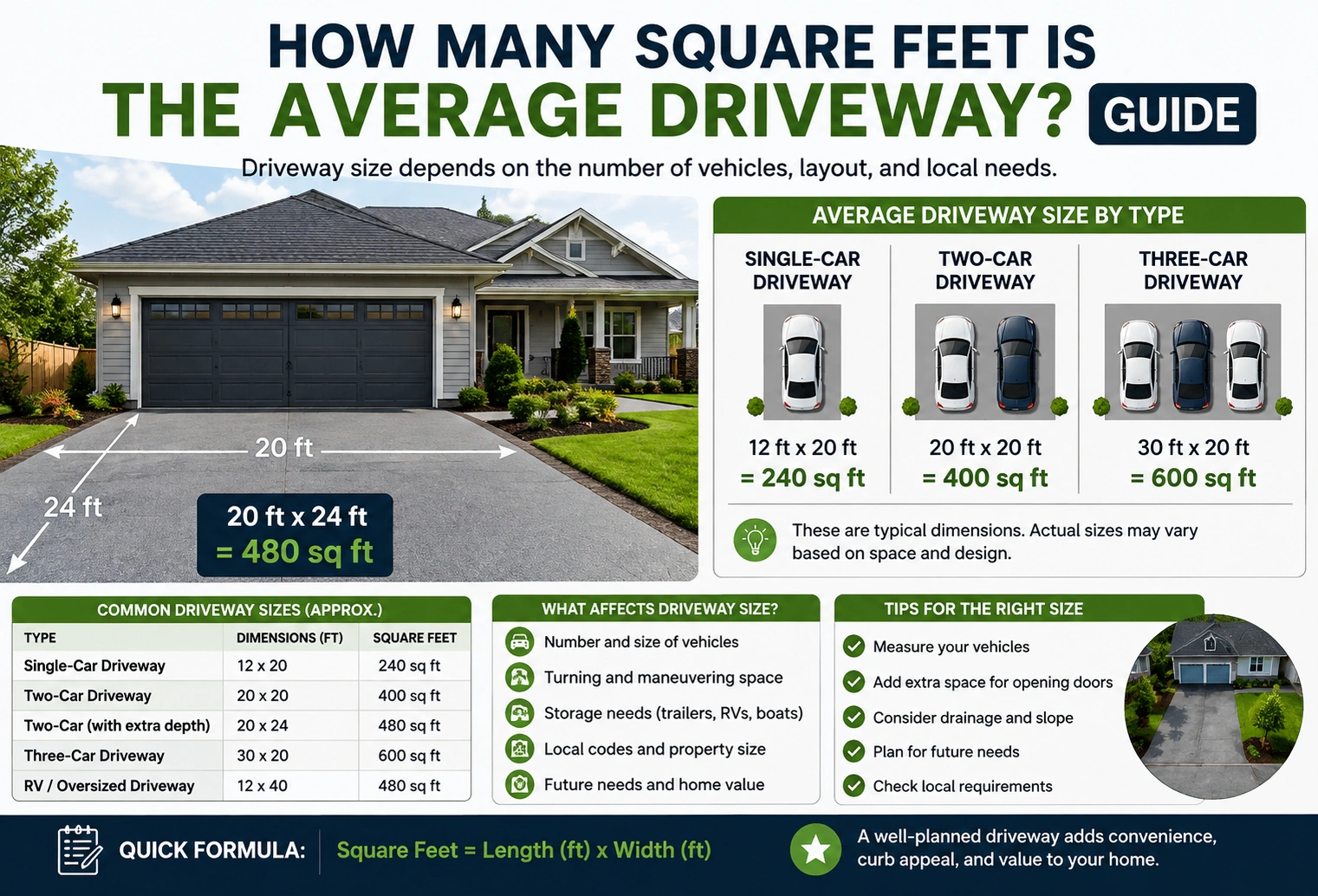
If you’re wondering how many square feet is the average driveway, there isn’t one universal size. Driveway square footage depends on its length, width, number of parking spaces, vehicle size, and the layout of the property.
A typical residential driveway can range from a few hundred square feet for a simple one-car driveway to more than 1,000 square feet for a large two-car or multi-vehicle driveway.
For a general estimate, many residential driveways fall somewhere around 400 to 800 square feet, although larger driveways can be significantly bigger.
The easiest way to determine the exact square footage of your driveway is to multiply its length by its average width.
Quick Answer
| Driveway Type | Typical Dimensions | Approximate Area |
|---|---|---|
| Small one-car driveway | 10 × 20 ft | 200 sq ft |
| Standard one-car driveway | 12 × 20 ft | 240 sq ft |
| Larger one-car driveway | 12 × 24 ft | 288 sq ft |
| Standard two-car driveway | 20 × 20 ft | 400 sq ft |
| Two-car driveway | 20 × 24 ft | 480 sq ft |
| Large two-car driveway | 24 × 30 ft | 720 sq ft |
| Wide/long driveway | 24 × 40 ft | 960 sq ft |
Answer: A typical residential driveway may be around 400 to 800 square feet, but the actual size varies considerably.
For example, a 20×20-foot driveway has:
20 × 20 = 400 square feet
A 20×24-foot driveway has:
20 × 24 = 480 square feet
Average Driveway Size by Number of Cars
The number of vehicles a driveway needs to accommodate is one of the biggest factors affecting its size.
A one-car driveway generally requires less width than a two-car driveway. A driveway designed for three or more vehicles may need additional width or length.
| Driveway Capacity | Typical Width | Typical Length | Approximate Area Range |
|---|---|---|---|
| One car | 10–12 ft | 20–24 ft | 200–288 sq ft |
| Two cars | 20–24 ft | 20–30 ft | 400–720 sq ft |
| Three cars | 24–30 ft | 20–30 ft | 480–900 sq ft |
| Four cars | 30–40 ft | 20–30 ft | 600–1,200 sq ft |
These are general residential planning ranges rather than universal standards. Local requirements, property layout, vehicle dimensions, and the desired parking arrangement can change the ideal size.
How to Calculate Driveway Square Footage
For a rectangular driveway, calculating square footage is simple.
Use:
Length × Width = Square Feet
For example, suppose a driveway is 22 feet long and 20 feet wide.
| Measurement | Value |
|---|---|
| Length | 22 ft |
| Width | 20 ft |
| Calculation | 22 × 20 |
| Area | 440 sq ft |
Therefore, a 22×20-foot driveway contains 440 square feet.
For a driveway with a simple rectangular shape, this calculation provides the total surface area needed for estimating paving, concrete, gravel, or other materials.
Calculating an Irregular Driveway
Not every driveway is a perfect rectangle. Some are wider near the garage, narrower near the street, or curved around landscaping.
For an irregular driveway, divide the surface into smaller sections.
For example:
| Section | Dimensions | Area |
|---|---|---|
| Main section | 20 × 20 ft | 400 sq ft |
| Side section | 10 × 15 ft | 150 sq ft |
| Total | — | 550 sq ft |
Add the areas of all sections together to determine the approximate total driveway area.
For curved or highly irregular driveways, taking several width measurements and using an average width can provide a useful estimate, although a detailed site measurement is more accurate.
Common Driveway Dimensions
Driveway dimensions vary depending on the property’s available space and the number of vehicles.
| Driveway Size | Square Feet | Typical Use |
|---|---|---|
| 10 × 20 ft | 200 sq ft | Compact one-car driveway |
| 12 × 20 ft | 240 sq ft | One-car driveway |
| 12 × 24 ft | 288 sq ft | Longer one-car driveway |
| 20 × 20 ft | 400 sq ft | Two-car driveway |
| 20 × 24 ft | 480 sq ft | Two-car driveway with more depth |
| 24 × 24 ft | 576 sq ft | Wide two-car driveway |
| 24 × 30 ft | 720 sq ft | Large two-car driveway |
| 24 × 40 ft | 960 sq ft | Large parking area |
The dimensions should provide enough room for vehicles while also allowing comfortable access to the garage, street, walkways, and surrounding property.
How Much Space Does a Driveway Need?
A driveway needs more than enough space for the vehicle itself. Drivers need room to enter, exit, open doors, maneuver, and access the garage or parking area.
For a single vehicle, a driveway around 10 to 12 feet wide can provide a practical starting point for residential planning.
For two vehicles parked side by side, a width around 20 to 24 feet provides substantially more usable space.
| Parking Arrangement | Approximate Width |
|---|---|
| One vehicle | 10–12 ft |
| Two vehicles side by side | 20–24 ft |
| Three vehicles side by side | 24–30 ft |
| Four vehicles side by side | 30–40 ft |
The required dimensions can vary depending on vehicle size and whether vehicles need to maneuver or turn around on the driveway.
Driveway Square Footage for Concrete and Asphalt
Driveway square footage is particularly important when estimating paving materials.
If your driveway measures 600 square feet, you can use that area as the starting point for calculating how much concrete or asphalt is required.
However, the total material requirement also depends on the planned thickness.
For example, a concrete driveway may be designed at a particular thickness based on its intended use and local requirements. Asphalt quantities likewise depend on the planned pavement thickness and material specifications.
| Driveway Area | 5% Extra Area | 10% Extra Area |
|---|---|---|
| 400 sq ft | 420 sq ft | 440 sq ft |
| 500 sq ft | 525 sq ft | 550 sq ft |
| 600 sq ft | 630 sq ft | 660 sq ft |
| 700 sq ft | 735 sq ft | 770 sq ft |
| 800 sq ft | 840 sq ft | 880 sq ft |
| 1,000 sq ft | 1,050 sq ft | 1,100 sq ft |
For materials sold by area, an allowance for waste and cutting may be appropriate. For concrete and asphalt, material quantities should be calculated using the product’s specified yield, density, and planned thickness rather than square footage alone.
How Much Concrete Is Needed for an Average Driveway?
The amount of concrete required depends on both the driveway’s surface area and its thickness.
For example, consider a 20×30-foot driveway.
| Measurement | Value |
|---|---|
| Length | 30 ft |
| Width | 20 ft |
| Area | 600 sq ft |
| Example thickness | 4 in |
| Thickness in feet | 0.333 ft |
| Approximate volume | 200 cu ft |
| Approximate volume in cubic yards | 7.41 cu yd |
The volume calculation is:
600 × (4 ÷ 12) = 200 cubic feet
Then convert cubic feet to cubic yards:
200 ÷ 27 ≈ 7.41 cubic yards
Actual concrete requirements should account for the specified design thickness, grade variations, forms, edges, and waste.
How Much Gravel Is Needed for a Driveway?
Gravel driveway requirements are also based on area and depth.
If you know the driveway’s square footage and desired gravel depth, you can calculate the approximate volume.
| Driveway Area | Depth | Approximate Volume |
|---|---|---|
| 400 sq ft | 4 in | 133.3 cu ft |
| 500 sq ft | 4 in | 166.7 cu ft |
| 600 sq ft | 4 in | 200 cu ft |
| 700 sq ft | 4 in | 233.3 cu ft |
| 800 sq ft | 4 in | 266.7 cu ft |
| 1,000 sq ft | 4 in | 333.3 cu ft |
For gravel, the volume can then be converted into cubic yards by dividing cubic feet by 27.
Actual quantities can vary because gravel compacts, settles, and may require multiple layers.
Factors That Affect Driveway Size
Number of Vehicles
A driveway designed for one vehicle can be much smaller than one intended for two, three, or four vehicles.
Vehicle Size
Large SUVs, pickup trucks, vans, and other vehicles can require more usable width and maneuvering space than compact cars.
Garage Configuration
The position and number of garage doors can affect driveway width and parking arrangement.
Property Layout
Trees, fences, sidewalks, landscaping, drainage systems, and property boundaries can limit the available driveway area.
Turning Space
A driveway may need additional space if vehicles must turn around rather than simply enter and exit in a straight line.
Local Requirements
Some locations have regulations governing driveway width, setbacks, drainage, curb cuts, and connections to public streets. Check applicable local requirements before construction.
Average Driveway Size vs. Parking Area
A driveway isn’t always the same thing as a dedicated parking area.
A narrow driveway might simply provide access from the street to the garage. A wider driveway can also function as a parking pad.
| Feature | Driveway | Parking Area |
|---|---|---|
| Primary purpose | Vehicle access | Vehicle parking |
| Typical shape | Often long and narrow | Often wider |
| Maneuvering needs | Depends on layout | Usually greater |
| Can accommodate multiple vehicles | Sometimes | Often |
| Square footage | Varies widely | Varies widely |
A property with a large parking area may have significantly more square footage than a basic driveway.
Common Mistakes When Measuring a Driveway
Measuring Only the Parking Space
Don’t measure only the area where the vehicle sits if the driveway extends from the street to the garage.
Using Length Instead of Area
A driveway’s square footage requires both length and width.
Length × Width = Area
Ignoring Irregular Sections
If your driveway has multiple sections, calculate each section separately and add them together.
Forgetting the Driveway’s Thickness
Square footage tells you the surface area, but concrete, asphalt, and gravel quantities also depend on depth or thickness.
Ordering Exactly the Calculated Material
Material estimates often require an allowance for waste, compaction, cutting, or variations in the actual surface.
FAQs
1. How many square feet is the average driveway?
A typical residential driveway may contain roughly 400 to 800 square feet, although smaller one-car driveways and larger multi-car driveways can fall outside this range.
2. How many square feet is a one-car driveway?
A one-car driveway measuring 10×20 feet contains 200 square feet. A 12×20-foot driveway contains 240 square feet.
| One-Car Dimensions | Area |
|---|---|
| 10 × 20 ft | 200 sq ft |
| 12 × 20 ft | 240 sq ft |
| 12 × 24 ft | 288 sq ft |
3. How many square feet is a two-car driveway?
A two-car driveway can vary considerably. Common examples include:
| Dimensions | Area |
|---|---|
| 20 × 20 ft | 400 sq ft |
| 20 × 24 ft | 480 sq ft |
| 24 × 24 ft | 576 sq ft |
| 24 × 30 ft | 720 sq ft |
4. What is a good width for a residential driveway?
A one-car driveway is commonly around 10 to 12 feet wide, while a two-car driveway may be around 20 to 24 feet wide. Actual requirements depend on the property, vehicles, local regulations, and desired layout.
5. How do I calculate driveway square footage?
Multiply the driveway’s length by its width.
| Example | Calculation | Area |
|---|---|---|
| 20 × 20 ft | 20 × 20 | 400 sq ft |
| 20 × 24 ft | 20 × 24 | 480 sq ft |
| 24 × 30 ft | 24 × 30 | 720 sq ft |
6. How many square feet is a 20×30 driveway?
A 20×30-foot driveway has 600 square feet.
20 × 30 = 600 square feet
7. Is 400 square feet enough for a driveway?
A 400-square-foot driveway can be suitable for a two-car layout depending on its dimensions. For example, a 20×20-foot driveway provides 400 square feet.
8. Does driveway square footage affect the cost?
Yes. A larger driveway generally requires more paving material, labor, excavation, and preparation. The final cost also depends on the material, thickness, site conditions, drainage, and local labor rates.
9. Should I include extra space when planning a driveway?
Yes. Consider vehicle dimensions, door clearance, maneuvering space, garage access, drainage, landscaping, and local requirements rather than designing the driveway solely around the vehicle footprint.
10. How much extra material should I order for a driveway?
The appropriate allowance depends on the material and project. For area-based materials, a planning allowance of around 5% to 10% is sometimes used, while concrete, asphalt, and gravel should be estimated using their specific material requirements.
Conclusion
The average residential driveway does not have one standard square footage, because driveway size depends on the number of vehicles, available property space, vehicle dimensions, and the driveway’s layout.
As a general planning range, many residential driveways fall around 400 to 800 square feet.
| Driveway Type | Example Dimensions | Square Feet |
|---|---|---|
| Small one-car | 10 × 20 ft | 200 sq ft |
| Standard one-car | 12 × 20 ft | 240 sq ft |
| Two-car | 20 × 20 ft | 400 sq ft |
| Two-car | 20 × 24 ft | 480 sq ft |
| Large two-car | 24 × 30 ft | 720 sq ft |
| Large driveway | 24 × 40 ft | 960 sq ft |
To calculate your own driveway’s size, multiply its length by its width. For irregular driveways, divide the area into smaller sections and add the individual measurements.
For example, a 20×30-foot driveway is:
20 × 30 = 600 square feet
That 600-square-foot figure can then be used as the starting point for estimating concrete, asphalt, gravel, or other driveway materials.
Discover More Articles
How Many Square Feet Per Ton of Cooling?