
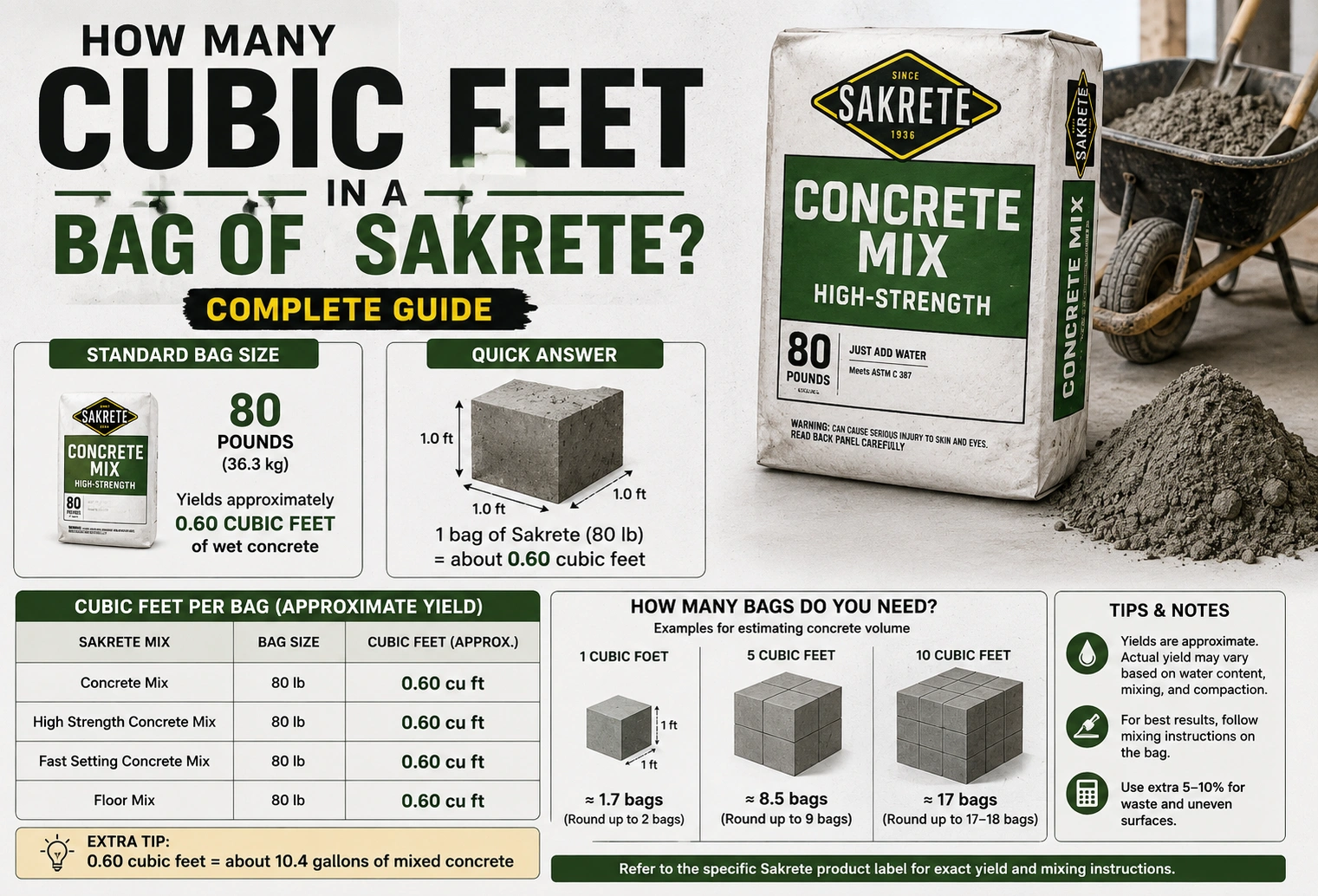
If you’re planning a concrete project, knowing how many cubic feet are in a bag of Sakrete helps you determine how many bags you need before you start mixing.
The exact yield depends on the Sakrete product and bag size. Common bag sizes include 40, 60, and 80 pounds, and each produces a different amount of mixed concrete.
For a typical Sakrete concrete mix, approximate yields are:
| Sakrete Bag Size | Approximate Concrete Yield |
|---|---|
| 40 lb bag | 0.30 cubic feet |
| 60 lb bag | 0.45 cubic feet |
| 80 lb bag | 0.60 cubic feet |
So, as a quick reference, an 80-pound bag of Sakrete typically produces about 0.60 cubic feet of concrete.
Always check the yield printed on the specific Sakrete product you’re using because different mixes can have different yields.
Quick Answer
The number of cubic feet in a bag of Sakrete depends on the bag size and specific product.
| Bag Size | Approximate Yield |
|---|---|
| 40 lb | 0.30 cu ft |
| 60 lb | 0.45 cu ft |
| 80 lb | 0.60 cu ft |
For example, if you’re using an 80-pound bag with a yield of approximately 0.60 cubic feet, you can estimate the number of bags required by dividing the total concrete volume by 0.60.
Example:
If your project requires 6 cubic feet of concrete:
6 ÷ 0.60 = 10 bags
You would need approximately 10 bags of 80-pound Sakrete before allowing for waste.
Sakrete Bag Yield by Weight
Bag weight is one of the easiest ways to estimate how much mixed concrete you can produce, but the yield isn’t determined by weight alone. The exact product formulation also matters.
A general comparison looks like this:
| Bag Size | Approximate Yield | Bags Needed for 1 Cubic Yard* |
|---|---|---|
| 40 lb | 0.30 cu ft | 90 bags |
| 60 lb | 0.45 cu ft | 60 bags |
| 80 lb | 0.60 cu ft | 45 bags |
*One cubic yard equals 27 cubic feet.
The table shows why larger bags are often more convenient for larger projects. An 80-pound bag produces approximately twice as much concrete as a 40-pound bag.
However, larger bags are also heavier to handle. For small repairs, posts, steps, walkways, or other projects where you need manageable quantities, smaller bags may be more convenient.
How to Calculate Cubic Feet of Concrete
Before determining how many bags of Sakrete you need, calculate the volume of your project in cubic feet.
For a rectangular project, use:
Length × Width × Thickness = Cubic Feet
Make sure all three measurements are in feet.
For example, suppose you’re pouring a small slab that is:
- 10 feet long
- 6 feet wide
- 4 inches thick
First convert 4 inches to feet:
4 ÷ 12 = 0.333 feet
Then calculate the volume:
10 × 6 × 0.333 = 19.98 cubic feet
So the project requires approximately 20 cubic feet of concrete.
If you’re using 80-pound bags that yield approximately 0.60 cubic feet each:
20 ÷ 0.60 = 33.33 bags
You would need approximately 34 bags, before accounting for additional waste or variations in actual yield.
How Many Bags of Sakrete Do You Need?
Once you know your project’s volume, the calculation is straightforward:
Number of bags = Total cubic feet ÷ Yield per bag
For example:
| Project Volume | 40 lb Bags at 0.30 cu ft | 60 lb Bags at 0.45 cu ft | 80 lb Bags at 0.60 cu ft |
|---|---|---|---|
| 1 cu ft | 4 bags | 3 bags | 2 bags |
| 3 cu ft | 10 bags | 7 bags | 5 bags |
| 5 cu ft | 17 bags | 12 bags | 9 bags |
| 10 cu ft | 34 bags | 23 bags | 17 bags |
| 20 cu ft | 67 bags | 45 bags | 34 bags |
Because you can’t purchase a fraction of a bag, round the result up to the next whole bag.
It’s also wise to purchase a little extra. Uneven ground, spillage, measurement differences, and other factors can increase the amount of concrete required.
Sakrete Coverage at Different Thicknesses
The amount of surface area a bag covers depends on the thickness of the concrete.
A thicker slab requires more concrete per square foot, while a thinner layer requires less.
For an 80-pound bag producing approximately 0.60 cubic feet, the approximate coverage is:
| Concrete Thickness | Approximate Coverage per 80 lb Bag |
|---|---|
| 2 inches | 3.6 sq ft |
| 3 inches | 2.4 sq ft |
| 4 inches | 1.8 sq ft |
| 5 inches | 1.44 sq ft |
| 6 inches | 1.2 sq ft |
These are mathematical estimates based on a 0.60-cubic-foot yield. Actual coverage can vary depending on the product and job conditions.
For example, at a 4-inch thickness, one 80-pound bag yielding 0.60 cubic feet covers approximately 1.8 square feet.
To estimate bags for a slab, you can use:
Square feet × thickness in feet ÷ yield per bag = bags required
For a 100-square-foot slab that is 4 inches thick:
100 × (4 ÷ 12) = 33.33 cubic feet
Then:
33.33 ÷ 0.60 = 55.55 bags
You would need approximately 56 bags of 80-pound mix, plus some additional allowance for waste.
What Affects Sakrete Yield?
The yield listed for a bag of concrete is based on the manufacturer’s specifications. Actual results can vary if the product is mixed or measured incorrectly.
One important factor is water. Adding more water than recommended does not simply create more concrete. It can change the consistency and may negatively affect the finished concrete.
The type of Sakrete product also matters. Concrete mix, high-strength concrete, fast-setting products, and other specialized mixes can have different characteristics and yields.
Project dimensions can also cause estimation errors. A slab that appears to be 4 inches thick may actually vary between 3.5 and 5 inches in different areas. Small differences become significant across a large surface.
For accurate planning, measure the actual length, width, and average thickness of the project and use the yield specified on the bag you’re purchasing.
Sakrete vs. Cubic Yard Measurements
Concrete is commonly sold in bags for smaller projects and by the cubic yard for larger jobs.
The relationship is:
1 cubic yard = 27 cubic feet
Using an approximate yield of 0.60 cubic feet for an 80-pound bag:
27 ÷ 0.60 = 45 bags
Therefore, approximately 45 80-pound bags would be required to produce one cubic yard of concrete based on a 0.60-cubic-foot yield.
This is a useful conversion when comparing the cost and convenience of bagged concrete with ready-mix concrete delivery.
For very large projects, ordering ready-mixed concrete by the cubic yard may be more practical than mixing dozens or hundreds of individual bags.
Common Projects That Use Sakrete
Bagged concrete such as Sakrete is commonly useful for smaller construction and repair projects.
Typical applications include:
- Fence-post installations
- Small slabs
- Walkways
- Steps
- Patios
- Footings
- Repair work
- Small pads
- Mailbox posts
- Garden structures
- Utility bases
The appropriate concrete product depends on the project requirements. For structural work or larger foundations, follow applicable building requirements and product specifications rather than relying only on a general yield estimate.
Common Mistakes When Estimating Sakrete
Using the Bag Weight as the Yield
An 80-pound bag does not produce 80 pounds or 80 cubic feet of concrete. Bag weight and concrete volume are different measurements.
Always use the manufacturer’s stated yield.
Forgetting to Convert Inches to Feet
If your slab is 4 inches thick, don’t enter 4 as the thickness when calculating cubic feet.
Convert it first:
4 inches ÷ 12 = 0.333 feet
This prevents a major calculation error.
Not Rounding Up
If your calculation says 22.4 bags, you cannot purchase 22.4 bags. Round up to 23 bags and consider an additional allowance for waste.
Ignoring Waste
Spillage, uneven surfaces, and inaccurate measurements can increase your actual concrete requirement. Ordering exactly the mathematical minimum can leave you short.
Assuming Every Sakrete Product Has the Same Yield
Different products and bag sizes can have different yields. Check the packaging for the specific product you’re using.
9. FAQs
1. How many cubic feet are in an 80 lb bag of Sakrete?
A typical 80-pound bag of Sakrete concrete mix produces approximately 0.60 cubic feet of concrete, although the exact yield depends on the specific product.
2. How many cubic feet are in a 60 lb bag of Sakrete?
A typical 60-pound bag produces approximately 0.45 cubic feet of concrete.
3. How many cubic feet are in a 40 lb bag of Sakrete?
A typical 40-pound bag produces approximately 0.30 cubic feet of concrete.
4. How many 80 lb bags of Sakrete make a cubic yard?
One cubic yard contains 27 cubic feet. At an approximate yield of 0.60 cubic feet per 80-pound bag:
27 ÷ 0.60 = 45 bags
So, approximately 45 80-pound bags are needed for one cubic yard.
5. How many bags of Sakrete do I need for 1 cubic foot?
Using the approximate yields above:
- 40 lb bag: about 4 bags
- 60 lb bag: about 3 bags
- 80 lb bag: about 2 bags
Always round up and check the product’s stated yield.
6. How much area does an 80 lb bag of Sakrete cover?
Coverage depends on thickness. At approximately 0.60 cubic feet per bag, one 80-pound bag covers about 1.8 square feet at 4 inches thick.
7. How do I calculate how many bags of Sakrete I need?
Calculate the project’s volume in cubic feet, then divide that number by the yield of one bag:
Total cubic feet ÷ cubic feet per bag = number of bags
Round the result up to the next whole bag and consider some additional material for waste.
8. Is one bag of Sakrete enough for a small project?
It depends on the project’s volume. Small repairs, posts, and patches may require only one or a few bags, while slabs and patios can require dozens of bags.
10. Conclusion
So, how many cubic feet are in a bag of Sakrete? The answer depends on the bag size and product, but common approximate yields are 0.30 cubic feet for a 40-pound bag, 0.45 cubic feet for a 60-pound bag, and 0.60 cubic feet for an 80-pound bag.
For an 80-pound bag with a 0.60-cubic-foot yield, you can estimate your material needs by dividing your project’s total cubic feet by 0.60.
Remember that these figures are approximate. For the most accurate estimate, check the yield printed on the specific Sakrete product you’re using, calculate your project’s volume carefully, round up to whole bags, and allow some extra material for waste.
Discover More Articles
How Many Square Feet Is an 8×8 Room? Easy Guide