

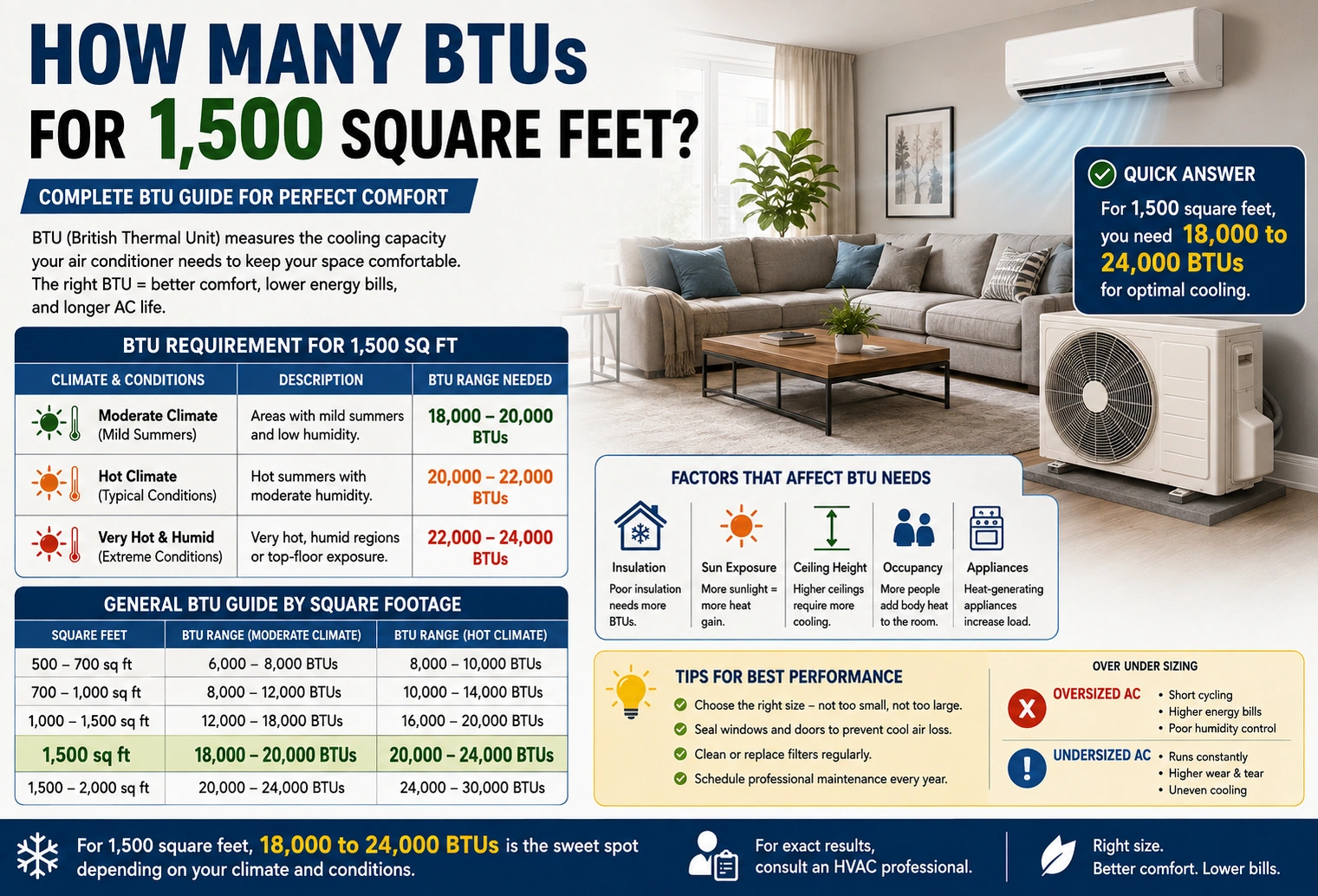
For a typical residential space of 1,500 square feet, a rough starting estimate is approximately 30,000 BTUs of cooling capacity.
Using a common estimate of about 20 BTUs per square foot:
1,500 × 20 = 30,000 BTUs
That is equivalent to approximately a 2.5-ton air conditioner, because one ton of cooling capacity equals 12,000 BTUs per hour.
However, the exact BTU requirement can vary considerably. Climate, insulation, windows, ceiling height, sunlight, occupancy, and other factors all affect the amount of cooling a 1,500-square-foot home needs.
Quick Answer
A 1,500-square-foot home may require roughly 30,000–36,000 BTUs, or approximately 2.5–3 tons of AC, as a general starting range.
| AC Capacity | Approx. Tonnage | Basic 20 BTU/Sq Ft Equivalent |
|---|---|---|
| 24,000 BTU | 2 tons | 1,200 sq ft |
| 30,000 BTU | 2.5 tons | 1,500 sq ft |
| 36,000 BTU | 3 tons | 1,800 sq ft |
| 42,000 BTU | 3.5 tons | 2,100 sq ft |
| 48,000 BTU | 4 tons | 2,400 sq ft |
These are preliminary estimates, not exact HVAC sizing recommendations.
How Do You Calculate BTUs for 1,500 Square Feet?
A simple preliminary method is to multiply the floor area by an estimated BTU requirement per square foot.
Using 20 BTUs per square foot:
1,500 × 20 = 30,000 BTUs
So the estimated cooling capacity is approximately 30,000 BTUs per hour.
You can also calculate the equivalent tonnage:
30,000 ÷ 12,000 = 2.5 tons
Therefore, a basic square-footage estimate points to a 2.5-ton AC system.
The actual equipment size should be based on the building’s cooling load rather than this simplified calculation alone.
Is 30,000 BTUs Enough for 1,500 Square Feet?
A 30,000-BTU system may be appropriate for some 1,500-square-foot homes.
The calculation is:
30,000 ÷ 1,500 = 20 BTUs per square foot
That makes 30,000 BTUs a reasonable preliminary estimate under the 20-BTU-per-square-foot method.
However, a home in a very hot climate, with poor insulation and substantial sun exposure, may need more capacity.
A highly efficient home in a mild climate may need less.
Is 36,000 BTUs Enough for 1,500 Square Feet?
A 36,000-BTU system provides 3 tons of cooling capacity.
For 1,500 square feet:
36,000 ÷ 1,500 = 24 BTUs per square foot
That is more cooling capacity per square foot than the basic 20-BTU estimate.
A 3-ton unit may therefore be appropriate for some higher-load homes, but it could be oversized for a well-insulated 1,500-square-foot property.
Oversizing can cause short cycling and reduce the system’s ability to remove humidity effectively.
How Many Tons of AC for 1,500 Square Feet?
A basic estimate of 30,000 BTUs corresponds to:
30,000 ÷ 12,000 = 2.5 tons
So 2.5 tons is a useful preliminary estimate for a 1,500-square-foot home.
Depending on climate and construction, the actual requirement could be closer to 2 tons or 3 tons.
| AC Size | BTU Capacity | Potential Use for 1,500 Sq Ft |
| 2 tons | 24,000 BTU | May work in efficient, lower-load homes |
| 2.5 tons | 30,000 BTU | Common preliminary estimate |
| 3 tons | 36,000 BTU | May suit higher cooling loads |
| 3.5 tons | 42,000 BTU | Often more capacity than needed unless load is high |
The correct size depends on the home’s actual cooling requirements.
What Factors Affect BTUs for 1,500 Square Feet?
Square footage is only one part of AC sizing.
Climate
Hotter climates generally require more cooling capacity.
A 1,500-square-foot house in a very hot region may need a larger system than the same-size house in a mild climate.
Insulation
Good insulation reduces heat transfer into the home.
Poorly insulated walls, ceilings, and attics can increase the cooling load.
Windows
Windows can contribute significantly to heat gain, especially when they receive direct sunlight.
Large windows, older windows, and poorly shaded windows may increase cooling requirements.
Ceiling Height
A home with 8-foot ceilings contains less conditioned air volume than a home with 10- or 12-foot ceilings.
Higher ceilings can therefore affect the required cooling capacity.
Sun Exposure
A house with substantial exposure to afternoon sunlight can absorb more heat than a shaded home.
Roof color, window orientation, exterior shading, and trees can all affect heat gain.
Number of People
People generate heat. A home with many occupants may require more cooling than a similarly sized home with fewer occupants.
Appliances
Ovens, refrigerators, computers, televisions, lighting, and other equipment add heat to indoor spaces.
1,500 Square Feet AC Size by BTU
The following table shows how different BTU capacities compare with a 1,500-square-foot home.
| BTUs | Tons | BTUs per Sq Ft |
| 24,000 | 2 tons | 16 |
| 27,000 | 2.25 tons | 18 |
| 30,000 | 2.5 tons | 20 |
| 33,000 | 2.75 tons | 22 |
| 36,000 | 3 tons | 24 |
| 42,000 | 3.5 tons | 28 |
| 48,000 | 4 tons | 32 |
This comparison shows why simply choosing the largest available system is not necessarily the best approach.
What Size Central AC for 1,500 Square Feet?
For a typical 1,500-square-foot home, a preliminary estimate may fall around 2.5–3 tons, or approximately 30,000–36,000 BTUs.
A 2.5-ton system provides 30,000 BTUs, while a 3-ton system provides 36,000 BTUs.
The better choice depends on the actual cooling load.
A professional HVAC calculation can account for the home’s construction, location, windows, insulation, orientation, occupancy, and other heat-gain factors.
What Size Mini Split for 1,500 Square Feet?
A mini-split system for 1,500 square feet cannot always be selected from square footage alone.
The required capacity depends on the home’s layout and whether the system uses one indoor unit or several indoor zones.
A 30,000-BTU system may be a starting point for some applications, while a 36,000-BTU system may be more appropriate for a higher cooling load.
For multiple rooms, several indoor heads may provide better distribution than one large indoor unit.
Can a 2-Ton AC Cool 1,500 Square Feet?
A 2-ton AC provides:
2 × 12,000 = 24,000 BTUs
For 1,500 square feet:
24,000 ÷ 1,500 = 16 BTUs per square foot
A 2-ton system could work in some highly efficient homes or favorable climates, but it may be insufficient for a home with high heat gain.
The actual cooling load is more important than the square-footage estimate alone.
Can a 3-Ton AC Cool 1,500 Square Feet?
Yes, a 3-ton AC can cool 1,500 square feet, but whether it is the correct size depends on the home’s cooling load.
A 3-ton system provides:
36,000 BTUs
For 1,500 square feet, that equals:
36,000 ÷ 1,500 = 24 BTUs per square foot
That may be appropriate for some homes, particularly those with higher cooling requirements.
What Happens If an AC Is Too Small?
An undersized air conditioner may run for long periods without adequately cooling the home.
Possible signs include:
- Long operating cycles
- Difficulty reaching the thermostat setting
- Rooms staying warm
- Poor comfort during hot weather
- Increased operating time
An undersized unit may struggle particularly during the hottest part of the day.
What Happens If an AC Is Too Large?
An oversized system can also create problems.
It may cool the air quickly and shut off before completing a long enough cycle to properly remove humidity.
Potential problems include:
- Short cycling
- Uneven temperatures
- Higher indoor humidity
- Reduced comfort
- Increased wear
The objective is to match the AC capacity to the home’s actual cooling load.
Does Location Matter for a 1,500-Square-Foot Home?
Yes.
The same 1,500-square-foot home can require different AC capacities depending on where it is located.
A hot, humid climate can create substantially more cooling demand than a mild climate.
Climate also affects the amount of heat entering through the roof, walls, windows, and doors.
This is why regional HVAC sizing practices can differ.
Frequently Asked Questions
How many BTUs do I need for 1,500 square feet?
A basic estimate is approximately 30,000 BTUs, using 20 BTUs per square foot. Depending on climate and home characteristics, the actual requirement may be around 24,000–36,000 BTUs or more.
How many tons of AC do I need for 1,500 square feet?
A rough estimate is around 2.5 tons, which equals 30,000 BTUs. Some homes may require 2 tons or 3 tons depending on their cooling load.
Is 30,000 BTUs enough for 1,500 square feet?
It can be. At 20 BTUs per square foot, 30,000 BTUs corresponds exactly to 1,500 square feet. Actual sizing depends on the home.
Is 36,000 BTUs enough for 1,500 square feet?
Yes, a 36,000-BTU system can cool 1,500 square feet, but it may be larger than necessary for some efficient homes.
Can a 2-ton AC cool 1,500 square feet?
It can in some circumstances, particularly in a mild climate or highly efficient home. A 2-ton unit provides 24,000 BTUs.
Can a 3-ton AC cool 1,500 square feet?
Yes. A 3-ton AC provides 36,000 BTUs and can cool 1,500 square feet in many applications, although it may be oversized in some homes.
Does insulation affect how many BTUs I need?
Yes. Better insulation reduces heat entering the home and can lower the required cooling capacity.
Do windows affect AC sizing?
Yes. Window size, type, orientation, shading, and solar exposure can all affect cooling requirements.
Should I choose an AC based only on square footage?
No. Square footage is useful for a preliminary estimate, but a proper cooling-load calculation is more accurate.
Conclusion
So, how many BTUs do you need for 1,500 square feet? A useful preliminary estimate is approximately 30,000 BTUs, which equals 2.5 tons of cooling capacity.
The basic calculation is:
1,500 × 20 = 30,000 BTUs
However, actual requirements can vary. A 1,500-square-foot home may need approximately 24,000–36,000 BTUs depending on climate, insulation, windows, ceiling height, sunlight, occupancy, and other heat-gain factors.
For a typical home, 2.5–3 tons (30,000–36,000 BTUs) may be a reasonable starting range, but the final AC size should be determined from a proper cooling-load calculation rather than square footage alone.
Discover More Articles
Water Bottle Sizes, Types & Buying Guide (2026)