
Knowing how to measure 100 feet accurately is useful for a wide range of projects, from installing fences and planning landscaping to laying foundations and marking sports fields. Whether you’re a homeowner tackling a DIY project or a contractor working on a construction site, using the right measuring method helps ensure accuracy and reduces costly mistakes.
There are several ways to measure 100 feet, including a tape measure, measuring wheel, laser distance meter, and GPS-based tools. The best option depends on your project’s size, location, and required precision.
In this guide, you’ll learn multiple ways to measure 100 feet, practical tips for improving accuracy, conversion charts, and real-world examples.
Quick Answer
100 feet equals:
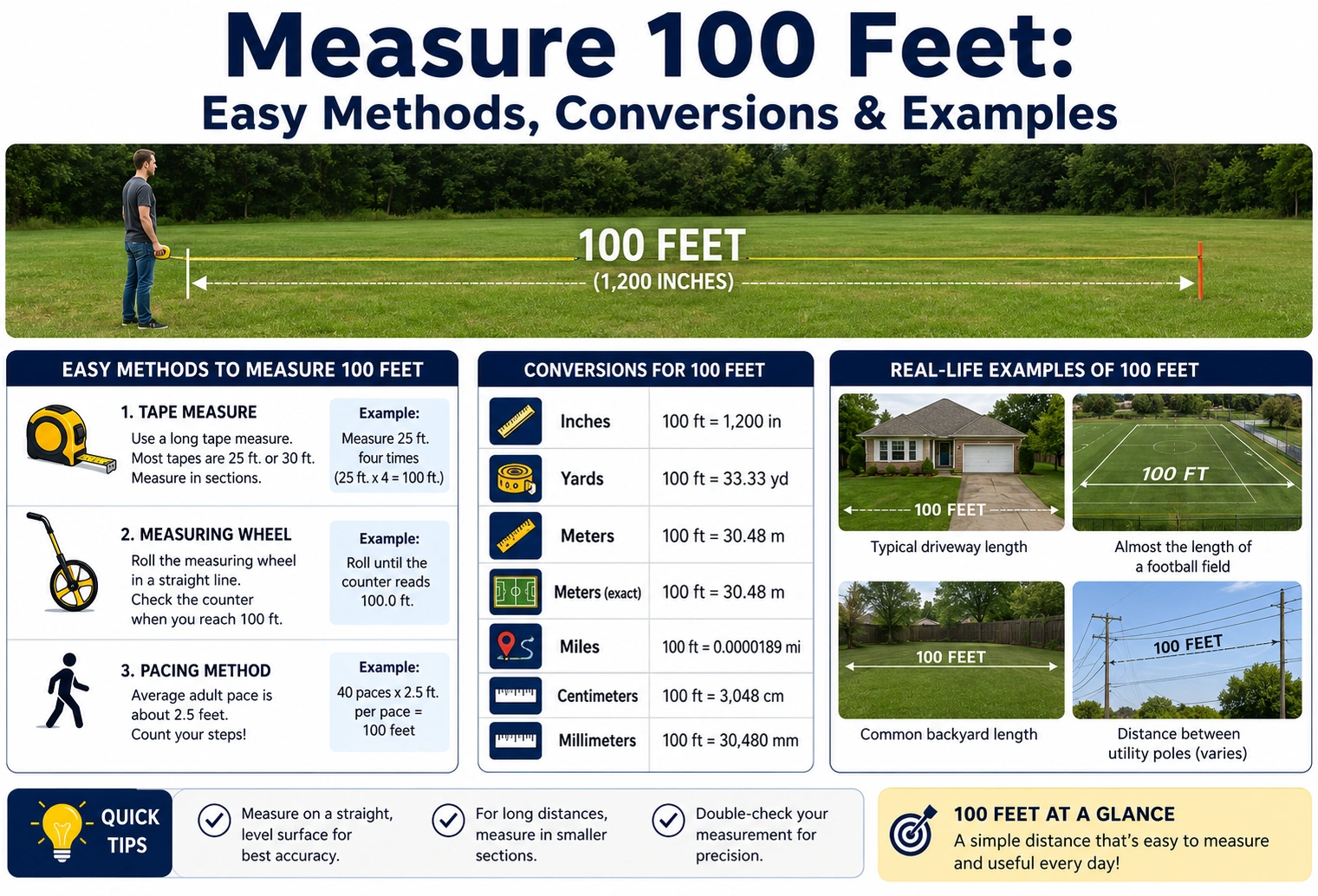
- 30.48 meters
- 33.33 yards
- 1,200 inches
- 0.0189 miles
You can measure 100 feet using:
- A 100-foot tape measure
- A measuring wheel
- A laser distance meter
- A GPS measuring app
- Surveying equipment
How Long Is 100 Feet?
Visualizing 100 feet can make planning much easier.
Here are a few familiar comparisons:
- About one-third the length of a football field (excluding end zones)
- Approximately the length of 10 average parked cars lined up bumper to bumper
- Roughly the height of a 10-story residential building
- Equal to 33⅓ yards
- About 30.5 meters
These comparisons provide a helpful mental picture when you don’t have measuring tools nearby.
Best Ways to Measure 100 Feet
Several tools can accurately measure 100 feet.
Using a Tape Measure
A long tape measure is one of the most reliable methods.
Steps
- Anchor one end at the starting point.
- Stretch the tape straight without twists.
- Pull it tight.
- Read the measurement at the 100-foot mark.
- Mark the endpoint if necessary.
This method works well for construction, landscaping, and property layouts.
Using a Measuring Wheel
A measuring wheel is ideal for outdoor distances.
How It Works
- Place the wheel at the starting point.
- Roll it in a straight line.
- Stop when the display reaches 100 feet.
Measuring wheels are commonly used by:
- Contractors
- Landscapers
- Surveyors
- Athletic field managers
Using a Laser Distance Meter
Laser distance meters provide fast and highly accurate measurements.
Advantages
- One-person operation
- High precision
- Ideal for indoor spaces
- Works well across open areas
Simply point the laser at the target and read the displayed distance.
Using a GPS App
Many smartphone apps can estimate distances using GPS.
These apps are useful for:
- Property boundaries
- Hiking trails
- Large outdoor areas
- Recreational planning
GPS measurements are generally less precise than professional surveying tools but work well for rough estimates.
100 Feet in Other Units
Converting 100 feet into other units can be helpful when working with international measurements.
| Unit | Equivalent |
|---|---|
| Feet | 100 |
| Inches | 1,200 |
| Yards | 33.33 |
| Meters | 30.48 |
| Kilometers | 0.03048 |
| Miles | 0.0189 |
These conversions are commonly used in engineering, construction, and education.
Real-World Examples of 100 Feet
Understanding real-life examples helps you visualize the distance.
Residential Property
A backyard may be approximately 100 feet long from the house to the rear fence.
Swimming Pool
Many community pools are close to 100 feet in length, though standard competition pools are longer.
Building Height
A typical 10-story residential building is around 100 feet tall, depending on floor height.
Construction Site
Builders frequently measure 100-foot sections when laying foundations, installing fences, or grading land.
Utility Installation
Water lines, electrical conduits, and drainage pipes are often installed over distances of 100 feet or more.
When You Need to Measure 100 Feet
Measuring 100 feet is useful for many projects.
Landscaping
- Installing irrigation
- Planning garden layouts
- Measuring lawn dimensions
Construction
- Building foundations
- Framing structures
- Setting fence posts
Sports
- Marking practice fields
- Creating training courses
Real Estate
- Measuring lot dimensions
- Estimating property boundaries
Outdoor Projects
- Installing lighting
- Building retaining walls
- Planning walkways
Common Measuring Mistakes
Measuring on Uneven Ground
Slopes can affect accuracy. Measure horizontally whenever possible.
Using a Short Tape Repeatedly
Repeated measurements increase the chance of cumulative errors.
Letting the Tape Sag
A loose tape produces inaccurate results.
Not Measuring in a Straight Line
Always follow the shortest, straightest path between two points.
Ignoring Obstacles
Trees, fences, or landscaping features can interfere with measurements.
100-Foot Conversion Chart
| Feet | Yards | Meters |
|---|---|---|
| 25 | 8.33 | 7.62 |
| 50 | 16.67 | 15.24 |
| 75 | 25 | 22.86 |
| 100 | 33.33 | 30.48 |
| 125 | 41.67 | 38.10 |
| 150 | 50 | 45.72 |
This chart makes it easy to compare common distances.
Practical Example
Imagine you’re installing a fence around one side of your property.
The required length is 100 feet.
You could:
- Use a 100-foot tape measure for maximum accuracy.
- Mark every 10 feet with stakes.
- Verify the final measurement before installing posts.
Taking time to measure carefully helps reduce waste and prevents costly adjustments later.
Expert Tips for Accurate Measurements
Use the Right Tool
Choose a tape measure for short distances and a measuring wheel or laser meter for larger areas.
Double-Check Measurements
Measure twice before cutting materials or placing permanent markers.
Keep the Measuring Tool Straight
Avoid curves or slack in the tape.
Measure Under Similar Conditions
Wind, uneven terrain, and obstacles can affect accuracy.
Mark Key Points
Use stakes, flags, or chalk to identify measured distances clearly.
9. FAQs
How can I measure 100 feet accurately?
The most accurate methods include a 100-foot tape measure, laser distance meter, or measuring wheel.
How many yards are in 100 feet?
100 feet equals approximately 33.33 yards.
How many meters is 100 feet?
100 feet equals exactly 30.48 meters.
Can I measure 100 feet using a smartphone?
Yes. GPS measuring apps can estimate 100 feet, although they may not be as accurate as professional measuring tools.
What is the easiest tool for measuring 100 feet outdoors?
A measuring wheel is one of the easiest and fastest tools for outdoor distance measurements.
10. Conclusion
If you need to measure 100 feet, choosing the right tool makes the job faster and more accurate. A 100-foot tape measure is ideal for precise construction and DIY work, while a measuring wheel is perfect for outdoor projects. For quick measurements, a laser distance meter or GPS app can also be effective. Since 100 feet equals 30.48 meters, 33.33 yards, and 1,200 inches, understanding these conversions can simplify planning and calculations. Whether you’re installing a fence, measuring property, planning landscaping, or marking a sports field, accurate measurement ensures better results and reduces costly mistakes.
Discover More Articles
How Long Is 9 Inches? Size Guide with Everyday Examples