
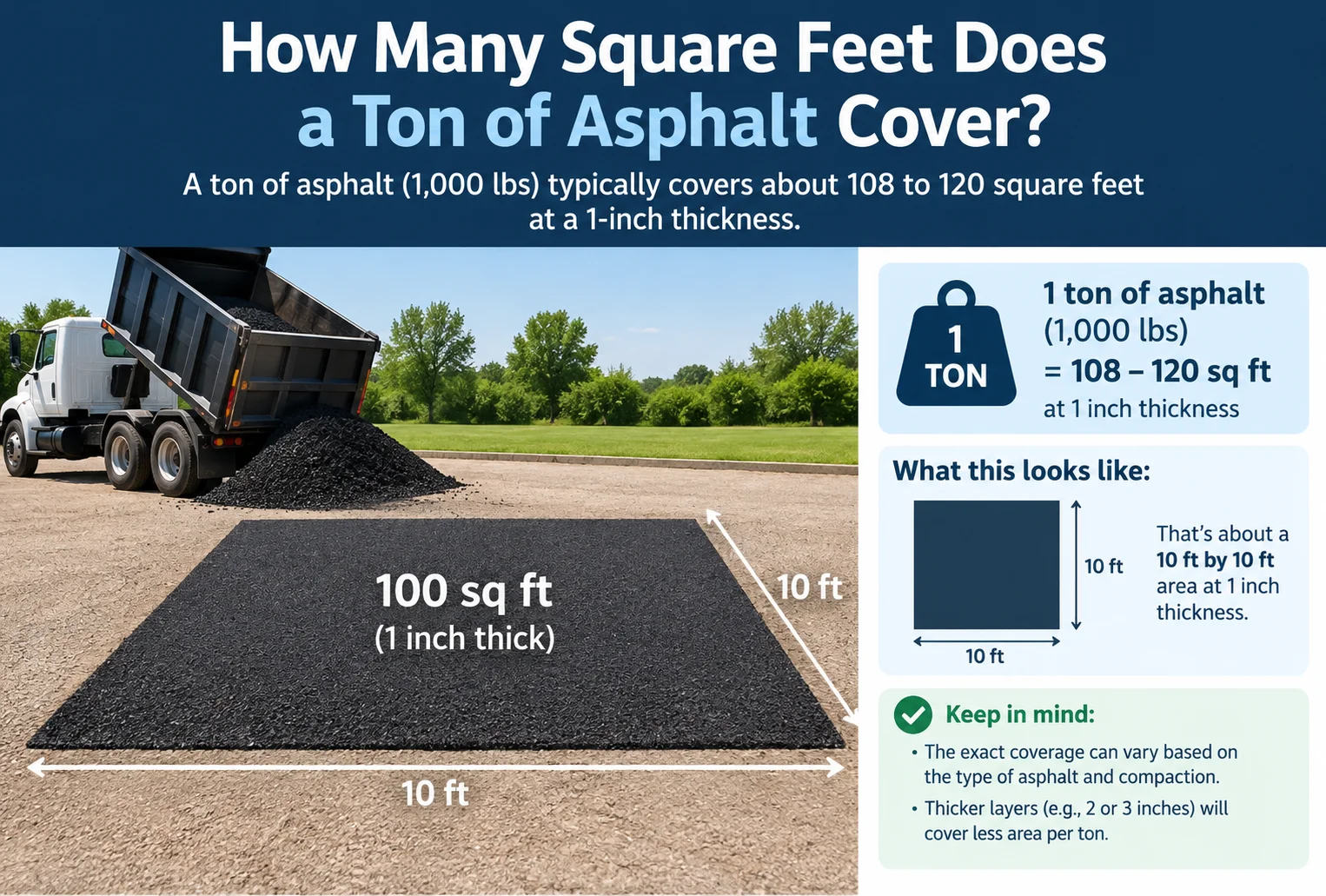
A ton of asphalt can cover a different amount of ground depending on the thickness of the pavement, the density of the asphalt mix, and how much the material is compacted. Understanding these factors helps you estimate the right amount of asphalt for a driveway, parking area, private road, or paving project.
For most estimates, one US ton of compacted hot-mix asphalt covers approximately 83 square feet at 2 inches thick or 55 square feet at 3 inches thick. These estimates assume a compacted asphalt density of about 145 pounds per cubic foot. Actual coverage varies by mix and project conditions. 【turn700991search0】【turn700991search2】
Quick Answer: How Many Square Feet Does a Ton of Asphalt Cover?
One US ton of asphalt weighs 2,000 pounds. Assuming a compacted density of 145 pounds per cubic foot, its approximate coverage is:
| Compacted Asphalt Thickness | Coverage per US Ton | Coverage in Square Yards |
|---|---|---|
| 1 inch | 165.5 sq ft | 18.4 sq yd |
| 1.5 inches | 110.3 sq ft | 12.3 sq yd |
| 2 inches | 82.8 sq ft | 9.2 sq yd |
| 2.5 inches | 66.2 sq ft | 7.4 sq yd |
| 3 inches | 55.2 sq ft | 6.1 sq yd |
| 4 inches | 41.4 sq ft | 4.6 sq yd |
| 5 inches | 33.1 sq ft | 3.7 sq yd |
| 6 inches | 27.6 sq ft | 3.1 sq yd |
These figures are estimates for the finished, compacted layer, not the loose asphalt delivered before rolling. The table assumes a density of 145 lb/ft³; a different mix density will change the results. 【turn700991search0】【turn700991search13】
How to Calculate Asphalt Coverage per Ton
You can calculate the coverage of one ton of asphalt using its weight, density, and finished thickness.
Asphalt Coverage Formula
The formula is:
Coverage in square feet = (Tons × 2,000 × 12) ÷ (Density × Thickness in inches)
Where:
- Tons is the amount of asphalt in US short tons.
- 2,000 is the number of pounds in one US ton.
- 12 converts feet to inches.
- Density is the compacted asphalt density in pounds per cubic foot.
- Thickness is the finished compacted thickness in inches.
For this example, use a density of 145 pounds per cubic foot.
Example: One Ton at 2 Inches Thick
Suppose you have one ton of asphalt and want to lay it 2 inches thick.
- Multiply 1 ton by 2,000 pounds to get 2,000 pounds.
- Multiply the weight by 12 to convert the thickness calculation to inches.
- Divide by 145 pounds per cubic foot multiplied by 2 inches.
Calculation:
Coverage = (1 × 2,000 × 12) ÷ (145 × 2)
Coverage = 24,000 ÷ 290
Coverage = approximately 82.8 square feet.
Therefore, one US ton of asphalt covers about 83 square feet at 2 inches of compacted thickness.
Example: One Ton at 3 Inches Thick
For a thicker layer of 3 inches:
Coverage = (1 × 2,000 × 12) ÷ (145 × 3)
Coverage = 24,000 ÷ 435
Coverage = approximately 55.2 square feet.
This explains why a ton of asphalt covers less ground when the pavement is thicker: the same weight must fill a greater depth.
How Much Asphalt Do You Need for Different Areas?
Once you know the square footage of your project, divide the area by the estimated coverage per ton. This gives you the approximate asphalt quantity before adding an allowance for waste or uneven ground.
| Project Area | Asphalt Thickness | Approximate Asphalt Needed |
|---|---|---|
| 100 sq ft | 2 inches | 1.21 tons |
| 200 sq ft | 2 inches | 2.42 tons |
| 300 sq ft | 2 inches | 3.62 tons |
| 500 sq ft | 2 inches | 6.04 tons |
| 500 sq ft | 3 inches | 9.06 tons |
| 600 sq ft | 3 inches | 10.87 tons |
| 800 sq ft | 3 inches | 14.49 tons |
| 1,000 sq ft | 3 inches | 18.12 tons |
| 1,000 sq ft | 4 inches | 24.17 tons |
These calculations use the same assumed density of 145 lb/ft³. The required tonnage should be checked against the asphalt supplier’s mix density and the project’s specified compacted thickness.
Example: A 20 × 30 Foot Driveway
Suppose your driveway is 20 feet long and 30 feet wide, and you plan to install asphalt 3 inches thick.
Step 1: Calculate the area.
Area = Length × Width
Area = 20 × 30 = 600 square feet.
Step 2: Calculate the asphalt quantity.
At 3 inches thick, one ton covers approximately 55.2 square feet.
Tons required = 600 ÷ 55.2
Tons required = approximately 10.87 tons.
Step 3: Allow for waste and site variation.
If you add a 5% allowance:
10.87 × 1.05 = approximately 11.41 tons.
If you add a 10% allowance:
10.87 × 1.10 = approximately 11.96 tons.
For this example, you would plan for roughly 11.4–12 tons, subject to the supplier’s recommendation and actual site conditions. The extra allowance is an estimating provision, not a guarantee that the project will need that exact amount.
How Asphalt Thickness Affects Coverage
Thickness is one of the biggest factors affecting how much area a ton of asphalt covers. Doubling the thickness approximately halves the coverage when the mix density remains the same.
| Thickness | Approximate Coverage per Ton | Coverage Compared With 1-Inch Layer |
|---|---|---|
| 1 inch | 165.5 sq ft | Full reference coverage |
| 2 inches | 82.8 sq ft | About half |
| 3 inches | 55.2 sq ft | About one-third |
| 4 inches | 41.4 sq ft | About one-quarter |
| 5 inches | 33.1 sq ft | About one-fifth |
| 6 inches | 27.6 sq ft | About one-sixth |
A thin asphalt overlay may cover a larger area, but the appropriate thickness depends on the pavement’s intended use, existing condition, traffic loads, and supporting base. Do not choose pavement thickness based only on how much area a ton can cover.
How Many Tons of Asphalt Do Common Driveways Need?
Driveway dimensions and required thickness determine the material quantity. The following examples assume rectangular driveways and compacted asphalt density of 145 lb/ft³.
| Driveway Dimensions | Total Area | At 2 Inches Thick | At 3 Inches Thick |
|---|---|---|---|
| 10 × 20 ft | 200 sq ft | 2.42 tons | 3.62 tons |
| 12 × 20 ft | 240 sq ft | 2.90 tons | 4.35 tons |
| 12 × 30 ft | 360 sq ft | 4.35 tons | 6.52 tons |
| 20 × 30 ft | 600 sq ft | 7.25 tons | 10.87 tons |
| 20 × 40 ft | 800 sq ft | 9.66 tons | 14.49 tons |
These quantities are material estimates, not structural recommendations. A driveway may require additional base preparation or different pavement layers depending on soil conditions, drainage, and vehicle use. Confirm the design with a qualified paving contractor.
What Factors Affect Asphalt Coverage?
Several factors can cause actual coverage to differ from a basic calculation.
1. Asphalt Density
Asphalt mixes vary in density because of aggregate type, gradation, binder content, and mix design. The table in this article uses 145 pounds per cubic foot as an estimating assumption.
If the actual compacted density is higher, one ton covers less area at the same thickness. If it is lower, one ton covers more area. Ask the asphalt supplier for the relevant mix data when accuracy matters.
2. Compacted Thickness
Coverage estimates should use the specified finished thickness after compaction. Loose asphalt is placed before rollers compact it into the final layer, so loose depth and finished depth are not interchangeable. The required loose placement depth depends on the mix and paving process. 【turn700991search17】
3. Ground Preparation
An uneven surface, soft spots, depressions, and areas requiring extra material can increase the quantity needed. A smooth, properly prepared base makes it easier to achieve a consistent layer.
4. Waste and Material Handling
Some material may be lost during loading, unloading, placement, or finishing. Small jobs may also be affected by supplier minimum orders. Include a reasonable allowance based on the site and contractor’s advice rather than automatically assuming every job needs the same percentage.
5. Type of Paving Project
A driveway, parking lot, private road, and industrial area may require different pavement designs. Heavy vehicles and turning movements can require a stronger pavement structure than light residential traffic. Asphalt thickness should be selected for the intended loads and the supporting base, not simply to maximize coverage.
How to Estimate Asphalt for a Parking Lot
For a parking lot, calculate the total paved area and then determine the asphalt required at the specified compacted thickness.
For example, a rectangular parking area measuring 50 feet by 40 feet has an area of:
50 × 40 = 2,000 square feet.
At 3 inches thick, the estimated quantity is:
2,000 ÷ 55.2 = approximately 36.2 US tons.
With a 5% allowance:
36.2 × 1.05 = approximately 38.0 tons.
This example estimates the asphalt layer only. It does not include the aggregate base, subbase, excavation, grading, drainage work, or other construction materials. A parking lot design should account for traffic and ground conditions.
US Ton vs. Metric Tonne of Asphalt
The word ton can mean different weights depending on the country and supplier. This distinction matters when ordering asphalt internationally.
| Unit | Weight | Approximate Coverage at 2 Inches Thick* |
|---|---|---|
| US short ton | 2,000 lb (907.2 kg) | 82.8 sq ft |
| Metric tonne | 1,000 kg (2,204.6 lb) | 90.0 sq ft |
Coverage assumes a compacted density of 145 lb/ft³ and is an estimate. The metric-tonne calculation uses the equivalent weight in pounds, so it covers more area than a US short ton under the same conditions.
When requesting a quote, confirm whether the supplier sells asphalt by US short ton or metric tonne. Also confirm the mix density, specified thickness, and whether the quoted quantity refers to loose delivered material or the finished compacted layer.
Frequently Asked Questions
1. How many square feet does one ton of asphalt cover at 2 inches thick?
One US ton covers approximately 82.8 square feet at 2 inches of compacted thickness, assuming a density of 145 pounds per cubic foot. Actual coverage depends on the mix and field conditions.
2. How many square feet does one ton of asphalt cover at 3 inches thick?
One US ton covers approximately 55.2 square feet at 3 inches of compacted thickness using the same density assumption.
3. How many square feet does one ton of asphalt cover at 4 inches thick?
One US ton covers approximately 41.4 square feet at 4 inches thick, assuming a compacted density of 145 pounds per cubic foot.
4. How many tons of asphalt do I need for 1,000 square feet?
At 2 inches thick, 1,000 square feet requires approximately 12.1 tons. At 3 inches thick, it requires about 18.1 tons. At 4 inches thick, it requires about 24.2 tons, before any extra allowance for waste or site variation.
5. Does asphalt coverage change after compaction?
The material’s finished volume and thickness change during compaction. For this reason, coverage calculations should be based on the finished compacted thickness and the relevant compacted density, not simply the depth of loose material as delivered.
6. Is 2 inches of asphalt enough for a driveway?
It depends on the existing pavement or base, soil conditions, drainage, and the vehicles using the driveway. Thickness should follow a suitable pavement design or contractor recommendation. A coverage calculation alone cannot establish whether a pavement will be durable.
7. How much extra asphalt should I order?
A small allowance, such as 5% to 10%, may be useful for preliminary estimates, but the appropriate amount depends on site conditions, geometry, placement accuracy, and supplier practices. Measure carefully and confirm the quantity with the paving contractor before ordering.
8. Can I calculate asphalt coverage in square yards?
Yes. Divide square feet by 9 to convert to square yards. For example, 82.8 square feet is approximately 9.2 square yards. One ton at 2 inches thick therefore covers about 9.2 square yards under the density assumption used here.
Conclusion
One US ton of asphalt covers approximately 83 square feet at 2 inches thick, 55 square feet at 3 inches thick, and 41 square feet at 4 inches thick, assuming a compacted density of 145 pounds per cubic foot.
To estimate the quantity for your project, measure the paved area, choose the specified compacted thickness, and divide the area by the coverage per ton. Account for density, site variation, and waste, and confirm the final order with your asphalt supplier or paving contractor.
Discover More Articles
How Many Cubic Feet Are in a Yard of Gravel?