
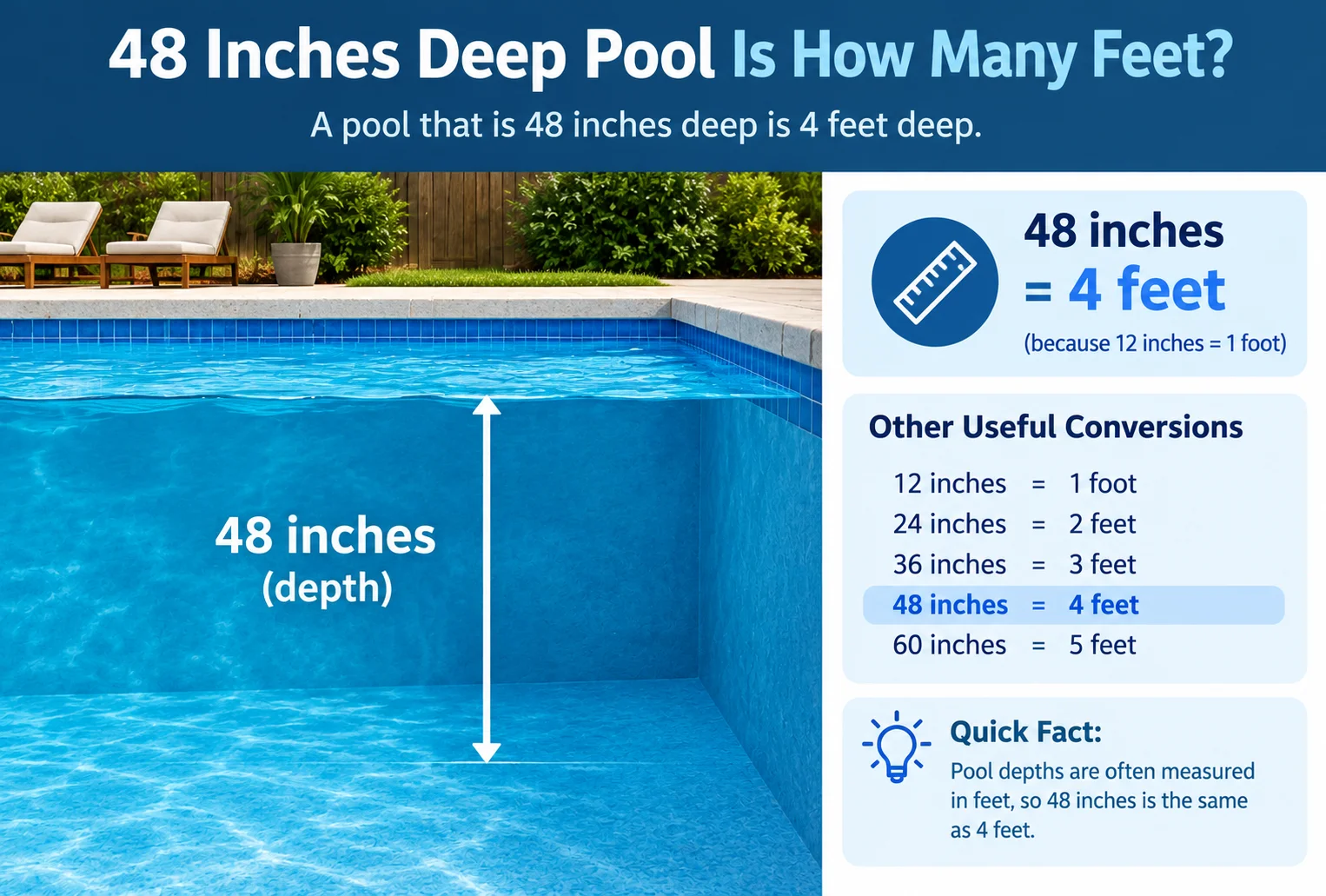
A pool described as 48 inches deep is 4 feet deep. Since one foot equals 12 inches, dividing 48 by 12 gives exactly 4 feet. This measurement is common when comparing pool wall heights and above-ground pool sizes, although the actual water depth may be less than the pool’s stated wall height.
Quick Answer
A 48-inch deep pool is 4 feet deep.
The conversion is:
48 inches ÷ 12 inches per foot = 4 feet
| Measurement | Equivalent |
|---|---|
| Inches | 48 inches |
| Feet | 4 feet |
| Feet and inches | 4 ft 0 in |
| Centimeters | 121.92 cm |
| Meters | 1.2192 m |
The conversion gives the exact length in feet. However, if 48 inches refers to the pool’s wall height rather than the actual water depth, the water level may be lower.
How to Convert 48 Inches to Feet
Converting inches to feet is simple because every foot contains 12 inches.
Use this formula:
Feet = Inches ÷ 12
For a 48-inch pool:
48 ÷ 12 = 4
Therefore, 48 inches equals 4 feet.
This formula works for any pool depth or other length measurement expressed in inches.
For example, a 36-inch pool is 3 feet deep, while a 60-inch pool is 5 feet deep. Divide the number of inches by 12 to determine the equivalent measurement in feet.
48-Inch Pool Depth in Other Units
Converting a pool’s depth into other units can help when comparing products, reading specifications, or planning a pool installation.
| Pool Depth in Inches | Depth in Feet | Depth in Centimeters | Depth in Meters |
|---|---|---|---|
| 24 inches | 2 ft | 60.96 cm | 0.6096 m |
| 30 inches | 2.5 ft | 76.20 cm | 0.762 m |
| 36 inches | 3 ft | 91.44 cm | 0.9144 m |
| 42 inches | 3.5 ft | 106.68 cm | 1.0668 m |
| 48 inches | 4 ft | 121.92 cm | 1.2192 m |
| 54 inches | 4.5 ft | 137.16 cm | 1.3716 m |
| 60 inches | 5 ft | 152.40 cm | 1.524 m |
| 72 inches | 6 ft | 182.88 cm | 1.8288 m |
A 48-inch measurement is exactly 4 feet, or 121.92 centimeters. These conversions describe the same vertical distance.
What Does a 48-Inch Deep Pool Mean?
A 48-inch deep pool has a nominal depth of 4 feet. That is a vertical measurement from the pool floor to the reference point used for the depth specification.
The meaning can vary depending on how the manufacturer describes the pool.
Pool Wall Height vs. Water Depth
Pool wall height and water depth are not always the same.
For example, an above-ground pool advertised as 48 inches high may have a recommended water level below the top of the wall. Its actual water depth could therefore be less than 4 feet.
| Measurement | What It Means |
|---|---|
| 48-inch wall height | The pool wall is nominally 4 feet tall |
| 48-inch stated depth | The specified depth is 4 feet, subject to the manufacturer’s measurement method |
| Actual water depth | The vertical distance from the pool floor to the water surface |
| Maximum fill line | The manufacturer’s indicated upper water level, where provided |
Always check the manufacturer’s specifications to determine whether the 48-inch figure describes the wall, the pool’s maximum depth, or the intended water depth.
Visualizing a 4-Foot Pool
Four feet is equal to 48 inches, approximately 1.22 meters. You can picture this distance as the height of a vertical measuring tape extending from the pool floor to the water surface.
A person’s experience of that depth will depend on their height, swimming ability, and whether they are standing on the pool floor. A depth that feels manageable to an adult may be too deep for a young child to stand in comfortably.
How Much Water Does a 48-Inch Deep Pool Hold?
A pool’s depth alone is not enough to calculate its water capacity. You also need its shape and horizontal dimensions, such as its diameter or length and width.
For a rectangular pool, the basic volume formula is:
Volume = Length × Width × Water Depth
For a round pool with a level bottom, the approximate volume is:
Volume = π × Radius² × Water Depth
For these calculations, all dimensions must use the same unit. The formulas estimate the pool’s volume when it is filled to the specified water depth.
Example: Rectangular Pool
Suppose a rectangular pool is 12 feet long, 8 feet wide, and has a water depth of 4 feet.
Calculation:
12 × 8 × 4 = 384 cubic feet
Since one cubic foot of water holds approximately 7.48 U.S. gallons:
384 × 7.48 ≈ 2,872 U.S. gallons
The estimated capacity is about 2,872 U.S. gallons when filled to 4 feet, assuming a rectangular interior and a level bottom.
Actual capacity may differ because of rounded corners, sloped walls, steps, or a lower fill level.
Example: Round Pool
Consider a round pool with a diameter of 15 feet and a water depth of 4 feet.
First, divide the diameter by 2 to find the radius:
15 ÷ 2 = 7.5 feet
Then calculate the volume:
π × 7.5² × 4 ≈ 706.86 cubic feet
Convert cubic feet to U.S. gallons:
706.86 × 7.48 ≈ 5,288 U.S. gallons
The estimated capacity is about 5,288 U.S. gallons, assuming a cylindrical pool filled to a uniform 4-foot water depth.
These examples show why knowing only the depth does not tell you the total amount of water a pool holds.
Is a 48-Inch Deep Pool Deep Enough for Swimming?
A 4-foot-deep pool can be suitable for recreational swimming for some users, depending on the pool’s design, intended use, and local safety requirements. However, depth alone does not determine whether a pool is appropriate for every swimmer.
Consider the following factors:
- User height: A 4-foot depth may be above the standing height of some children and below the standing height of many adults.
- Swimming ability: A person who cannot swim confidently may struggle even in water that appears relatively shallow.
- Pool design: Above-ground pools, in-ground pools, and pools with sloped bottoms can provide different swimming experiences at the same stated depth.
- Intended activities: A pool designed for casual cooling off may not be appropriate for diving or other activities that require specific depth and design conditions.
- Safety equipment: Barriers, secure access, appropriate supervision, and other safeguards remain important.
Never assume a 4-foot pool is safe for diving. Diving safety depends on pool design, depth, entry conditions, and applicable standards. Follow the manufacturer’s instructions and relevant local safety requirements.
Children and inexperienced swimmers need close, attentive adult supervision. Pool barriers and other safety measures should be used as appropriate for the pool and household.
Common Pool Measurement Mistakes
When converting pool dimensions, a few common errors can produce misleading results.
Confusing Inches With Feet
One foot equals 12 inches, not 10 inches. Therefore, 48 inches equals 4 feet, not 4.8 feet.
Assuming Wall Height Equals Water Depth
A 48-inch pool wall does not necessarily mean the water reaches 48 inches. The recommended fill level may be lower, so check the manufacturer’s guidance.
Calculating Water Capacity From Depth Alone
A pool’s volume depends on its length and width or diameter, as well as its water depth. Two pools with the same depth can hold very different amounts of water.
Using Inconsistent Units
When calculating volume, convert all dimensions into the same unit before multiplying. For example, use feet for length, width, and depth if you want the result in cubic feet.
FAQs
1. How many feet is a 48-inch deep pool?
A 48-inch deep pool is 4 feet deep, because 48 divided by 12 equals 4.
2. Is a 48-inch pool the same as a 4-foot pool?
Yes, when both measurements describe the same depth. Forty-eight inches and 4 feet represent exactly the same vertical distance.
3. How many centimeters deep is a 48-inch pool?
Forty-eight inches equals 121.92 centimeters, or approximately 1.22 meters.
4. Is a 48-inch pool actually filled with 4 feet of water?
Not necessarily. If 48 inches refers to the pool wall height, the recommended water level may be lower. Check the manufacturer’s specifications to find the actual intended fill depth.
5. How many gallons does a 48-inch deep pool hold?
The depth alone is not enough to determine capacity. You need the pool’s shape and dimensions. For example, an ideal rectangular pool measuring 12 feet by 8 feet with 4 feet of water holds approximately 2,872 U.S. gallons.
6. Is a 4-foot-deep pool safe for children?
Safety depends on the child’s swimming ability, supervision, pool design, and protective measures. Four feet may be too deep for some children to stand comfortably. Maintain close adult supervision and appropriate pool barriers.
7. Can you dive into a 48-inch deep pool?
Do not assume a 48-inch pool is suitable for diving. Diving requires a pool specifically designed for that activity, with appropriate depth and entry conditions. Follow applicable safety standards and manufacturer instructions.
8. How do you convert any pool depth from inches to feet?
Divide the depth in inches by 12. For example, 60 inches ÷ 12 = 5 feet, while 36 inches ÷ 12 = 3 feet.
Conclusion
A 48-inch deep pool is 4 feet deep, equivalent to 121.92 centimeters or approximately 1.22 meters. To convert any pool measurement from inches to feet, divide the number of inches by 12.
Remember that a pool’s stated wall height may differ from its actual water depth. For accurate capacity estimates, use the pool’s dimensions and intended water level, and always follow appropriate pool safety guidance.
Discover More Articles
How Many Cubic Feet Are in a Yard of Gravel?