

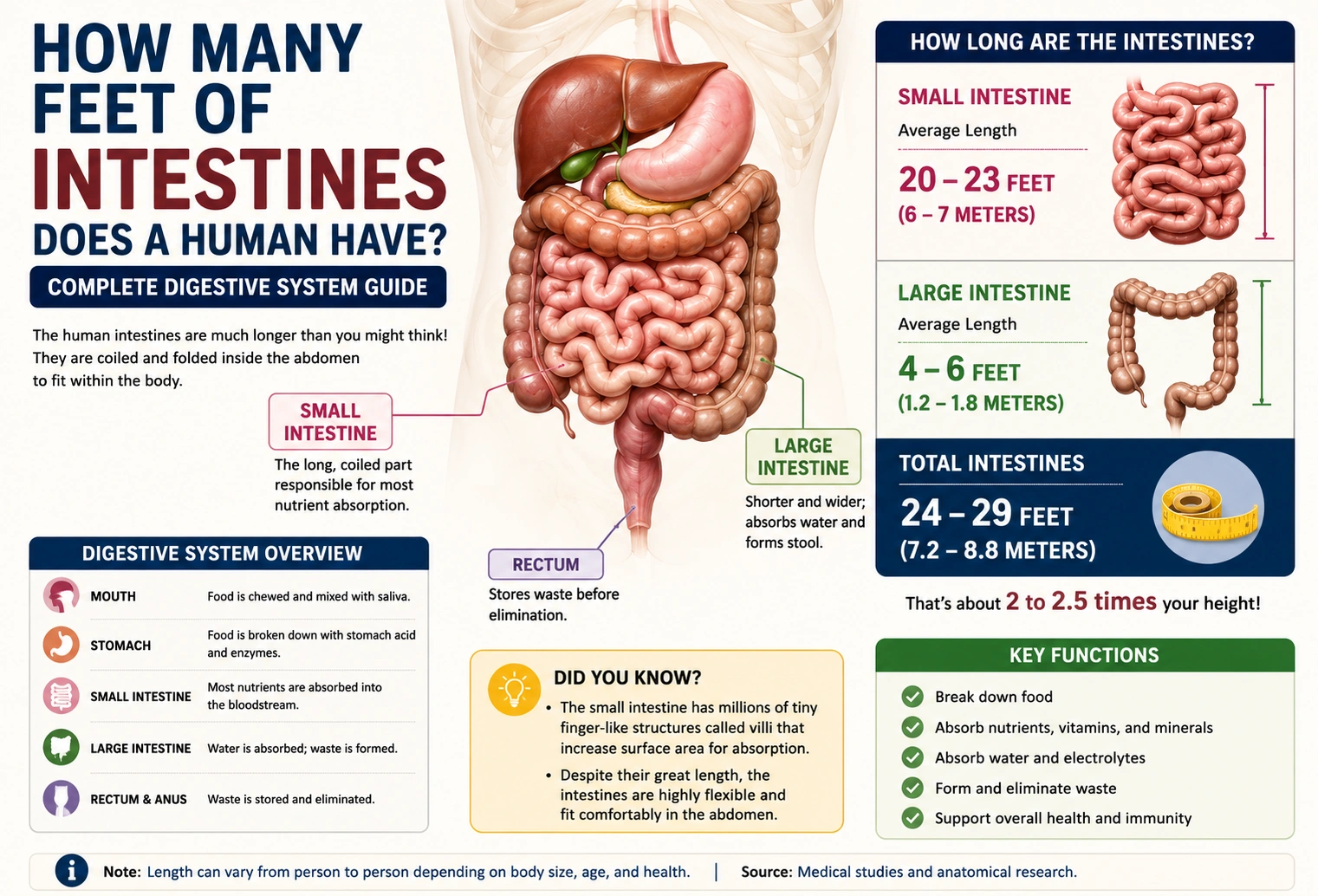
The human digestive system contains an impressive network of intestines responsible for breaking down food, absorbing nutrients, and removing waste. Although the intestines are tightly folded inside the abdomen, their combined length is surprisingly long when stretched out.
Most adults have approximately 25 to 30 feet of intestines, with the majority of that length coming from the small intestine.
Quick Answer
The average adult intestinal tract includes:
- Small intestine: about 20–22 feet
- Large intestine: about 5 feet
Total length:
- Approximately 25–30 feet of intestines
Length of the Small Intestine
The small intestine is the longest part of the digestive system.
Average length:
- Approximately 20 to 22 feet
- About 6 to 7 meters
The small intestine consists of three sections:
- Duodenum
- Jejunum
- Ileum
Most nutrient absorption occurs within this portion of the digestive tract.
Length of the Large Intestine
The large intestine, also called the colon, is shorter but wider.
Average length:
- Approximately 5 feet
- About 1.5 meters
Main sections include:
- Cecum
- Ascending colon
- Transverse colon
- Descending colon
- Sigmoid colon
- Rectum
Its primary role involves water absorption and waste formation.
Total Length of Human Intestines
When combined, the small and large intestines typically measure:
- 25 feet or more in many adults
- Up to 30 feet in some individuals
Approximate breakdown:
| Intestinal Section | Average Length |
|---|---|
| Small Intestine | 20–22 feet |
| Large Intestine | 5 feet |
| Total | 25–30 feet |
Actual measurements vary based on age, sex, body size, and individual anatomy.
Why Are the Intestines So Long?
A long digestive tract provides:
- Greater nutrient absorption
- Increased digestive efficiency
- More surface area for processing food
- Better water absorption
The small intestine contains folds, villi, and microvilli that dramatically increase the available surface area.
Functions of the Intestines
Small Intestine
Primary responsibilities include:
- Digesting food
- Absorbing nutrients
- Processing carbohydrates
- Absorbing proteins
- Absorbing fats
Large Intestine
Major functions include:
- Water absorption
- Electrolyte absorption
- Waste storage
- Formation of stool
- Support of beneficial gut bacteria
Interesting Facts About Human Intestines
- The small intestine is much longer than the large intestine despite its name.
- The term “large” refers to width rather than length.
- Intestinal folds create a massive surface area for nutrient absorption.
- The digestive tract hosts trillions of microorganisms that aid digestion.
- Most nutrient absorption occurs before food reaches the large intestine.
FAQs
1. How many feet of intestines does a human have?
Most adults have approximately 25 to 30 feet of intestines.
2. How long is the small intestine?
The small intestine is usually about 20 to 22 feet long.
3. How long is the large intestine?
The large intestine averages about 5 feet in length.
4. Why is the small intestine so long?
Its length provides additional surface area for nutrient absorption.
5. Are everyone’s intestines the same length?
No. Intestinal length varies among individuals based on anatomy and body size.
Conclusion
The average human has approximately 25 to 30 feet of intestines, consisting of a small intestine measuring roughly 20 to 22 feet and a large intestine measuring about 5 feet. This remarkable length allows the digestive system to efficiently absorb nutrients, process food, and eliminate waste. Despite being packed into the abdominal cavity, the intestines form one of the most important and extensive organ systems in the human body.
Discover More Articles
How Many Units of Botox for Crow’s Feet? Complete Treatment Guide
How Many Square Feet Is a 20×20 Room? Easy Area Calculation Guide
How Many Square Feet in a Square of Shingles? Complete Roofing Guide