
If you are planning a driveway, walkway, garden path, drainage project, or landscaping job, knowing how much gravel you need is essential. Gravel is commonly sold by the cubic yard, while many people measure their project in feet and inches. Converting between these units helps you estimate material quantities and avoid ordering too much or too little.
Quick Answer
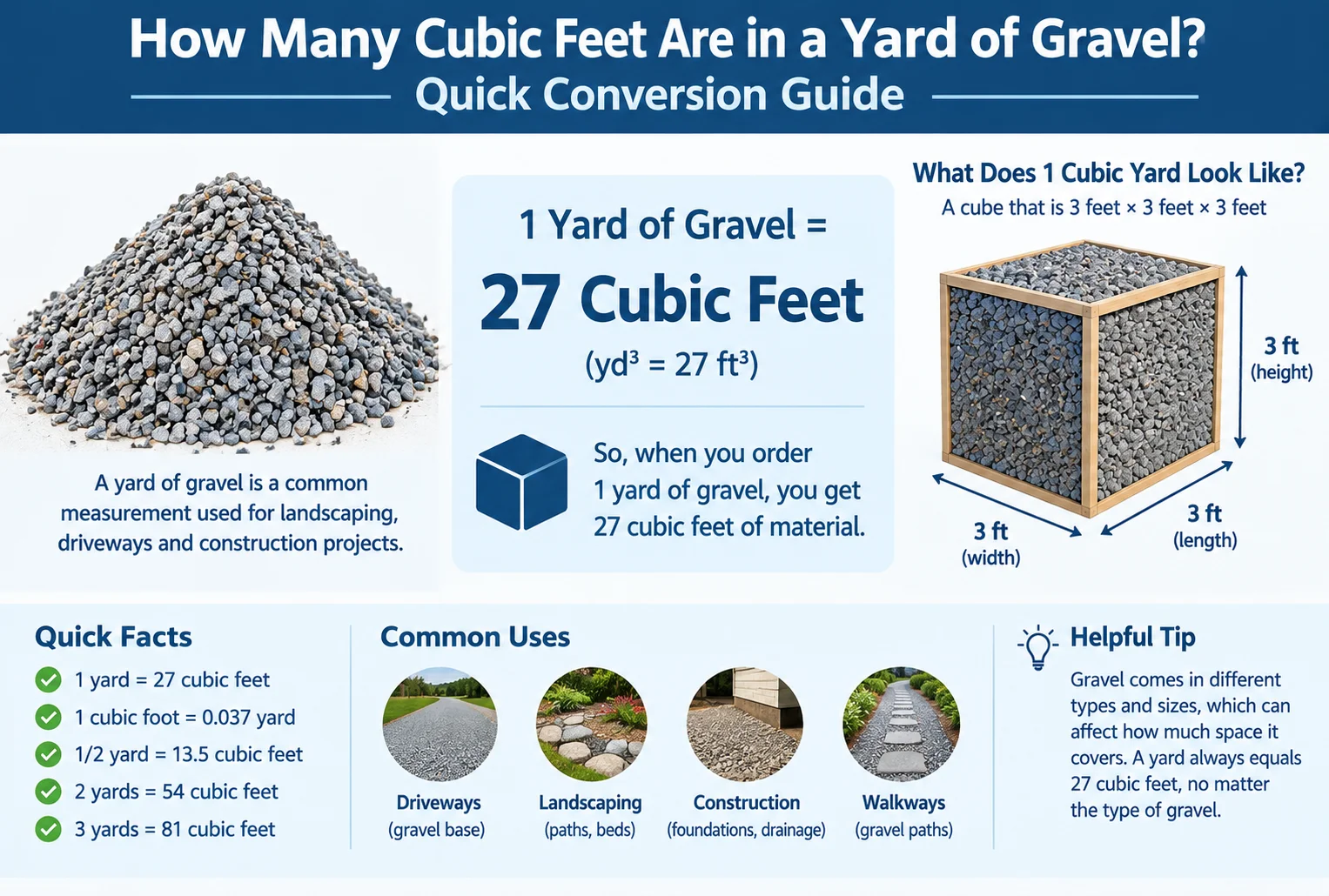
One cubic yard of gravel contains 27 cubic feet.
The calculation is:
1 cubic yard = 3 feet × 3 feet × 3 feet = 27 cubic feet
This conversion applies to the volume of gravel regardless of the gravel type. However, the weight of a cubic yard varies depending on the rock type, particle size, moisture content, and compaction.
How Many Cubic Feet Are in One Yard of Gravel?
A cubic yard of gravel contains exactly 27 cubic feet of volume.
A cubic yard is a three-dimensional measurement. It represents a space that is 3 feet long, 3 feet wide, and 3 feet high.
To calculate its volume:
3 × 3 × 3 = 27 cubic feet
When a gravel supplier sells you one cubic yard, the quantity refers to volume rather than weight.
The gravel may be loose in a delivery truck or spread across a project, but the standard conversion remains the same: one cubic yard equals 27 cubic feet.
How to Convert Cubic Yards of Gravel to Cubic Feet
To convert cubic yards into cubic feet, multiply the number of cubic yards by 27.
Formula:
Cubic feet = Cubic yards × 27
For example, if you order 3 cubic yards of gravel:
3 × 27 = 81 cubic feet
Therefore, 3 cubic yards of gravel contain 81 cubic feet.
Cubic Yards to Cubic Feet Conversion Table
| Cubic Yards of Gravel | Cubic Feet |
|---|---|
| 0.25 yd³ | 6.75 ft³ |
| 0.5 yd³ | 13.5 ft³ |
| 0.75 yd³ | 20.25 ft³ |
| 1 yd³ | 27 ft³ |
| 1.5 yd³ | 40.5 ft³ |
| 2 yd³ | 54 ft³ |
| 3 yd³ | 81 ft³ |
| 4 yd³ | 108 ft³ |
| 5 yd³ | 135 ft³ |
| 6 yd³ | 162 ft³ |
| 8 yd³ | 216 ft³ |
| 10 yd³ | 270 ft³ |
Use this table to convert a supplier’s cubic-yard quantity into cubic feet for easier project planning.
How to Convert Cubic Feet to Cubic Yards
You can also convert cubic feet into cubic yards when you know the volume of your project.
Divide the cubic-foot measurement by 27.
Formula:
Cubic yards = Cubic feet ÷ 27
For example, if a project requires 54 cubic feet of gravel:
54 ÷ 27 = 2 cubic yards
Cubic Feet to Cubic Yards Conversion Table
| Cubic Feet | Cubic Yards |
|---|---|
| 5 ft³ | 0.185 yd³ |
| 10 ft³ | 0.370 yd³ |
| 15 ft³ | 0.556 yd³ |
| 20 ft³ | 0.741 yd³ |
| 27 ft³ | 1 yd³ |
| 40 ft³ | 1.481 yd³ |
| 50 ft³ | 1.852 yd³ |
| 54 ft³ | 2 yd³ |
| 75 ft³ | 2.778 yd³ |
| 81 ft³ | 3 yd³ |
| 100 ft³ | 3.704 yd³ |
| 135 ft³ | 5 yd³ |
When purchasing gravel, ask your supplier whether partial cubic yards are available or whether orders must be rounded to a minimum quantity.
How Much Area Does One Cubic Yard of Gravel Cover?
The coverage of one cubic yard depends on how deeply you spread the gravel.
A cubic yard contains 27 cubic feet, so you can spread that volume over a larger area with a shallow layer or a smaller area with a deeper layer.
To calculate coverage, convert the desired depth into feet and divide the gravel volume by that depth.
Formula:
Coverage in square feet = Cubic feet ÷ Depth in feet
For one cubic yard:
Coverage = 27 ÷ Depth in feet
Gravel Coverage by Depth
| Gravel Depth | Approximate Coverage From 1 Cubic Yard |
|---|---|
| 1 inch | 324 sq ft |
| 2 inches | 162 sq ft |
| 3 inches | 108 sq ft |
| 4 inches | 81 sq ft |
| 5 inches | 64.8 sq ft |
| 6 inches | 54 sq ft |
| 8 inches | 40.5 sq ft |
| 12 inches | 27 sq ft |
These figures are theoretical estimates assuming an even layer and no losses. Actual coverage may differ because of uneven ground, gravel settling, compaction, and the shape of the project.
How Much Gravel Do You Need for Your Project?
The quantity you need depends on the length, width, and depth of the area you want to cover.
Follow these steps to calculate your requirement.
Step 1: Measure the Length
Measure the project area in feet. For a driveway, measure its length from one end to the other.
Step 2: Measure the Width
Measure the width in feet. If the area changes width, divide it into smaller rectangular sections and calculate each separately.
Step 3: Choose the Gravel Depth
Decide how deep the gravel layer should be. The appropriate depth depends on the project, the gravel type, soil conditions, drainage needs, and whether the surface will support vehicles.
Step 4: Calculate Cubic Feet
Multiply the length, width, and depth in feet.
Volume in cubic feet = Length × Width × Depth
Step 5: Convert Cubic Feet to Cubic Yards
Divide the cubic-foot result by 27.
Cubic yards = Cubic feet ÷ 27
Example: Gravel for a 10-by-20-Foot Area
Suppose you want to cover an area that is 10 feet wide and 20 feet long with 4 inches of gravel.
Convert the depth into feet:
4 ÷ 12 = 0.333 feet
Calculate the volume:
10 × 20 × 0.333 ≈ 66.67 cubic feet
Convert to cubic yards:
66.67 ÷ 27 ≈ 2.47 cubic yards
The theoretical requirement is approximately 2.47 cubic yards before accounting for compaction, uneven ground, or waste.
How Many Cubic Feet Are in Different Amounts of Gravel?
Gravel suppliers may quote different quantities depending on the size of the project. The following table provides quick conversions.
| Gravel Quantity | Cubic Feet |
|---|---|
| ¼ cubic yard | 6.75 ft³ |
| ½ cubic yard | 13.5 ft³ |
| ¾ cubic yard | 20.25 ft³ |
| 1 cubic yard | 27 ft³ |
| 2 cubic yards | 54 ft³ |
| 3 cubic yards | 81 ft³ |
| 4 cubic yards | 108 ft³ |
| 5 cubic yards | 135 ft³ |
| 10 cubic yards | 270 ft³ |
| 20 cubic yards | 540 ft³ |
Remember that cubic feet and square feet measure different things. Cubic feet measure volume, while square feet measure surface area.
How Much Does a Cubic Yard of Gravel Weigh?
The volume of one cubic yard is always 27 cubic feet, but its weight is not fixed.
The weight depends on the type of stone, particle size, moisture, and how tightly the material is packed.
For preliminary planning, many common gravel products weigh roughly 2,400 to 3,000 pounds per cubic yard, although some materials fall outside this range.
| Approximate Weight per Cubic Yard | Equivalent Weight |
|---|---|
| 2,400 lb | 1.2 US tons |
| 2,500 lb | 1.25 US tons |
| 2,700 lb | 1.35 US tons |
| 3,000 lb | 1.5 US tons |
These are illustrative estimates, not guaranteed weights for every gravel product. Ask the supplier for the material’s actual bulk density when estimating truckloads, trailer capacity, or delivery weight.
Does Gravel Type Affect Cubic Feet?
No. The conversion between cubic yards and cubic feet does not change with gravel type.
One cubic yard always equals 27 cubic feet.
However, different gravel products can have different weights and coverage characteristics because their particle sizes, shapes, moisture levels, and packing behavior vary.
| Material | What Can Affect Its Performance? |
|---|---|
| Pea gravel | Rounded stones may shift underfoot |
| Crushed stone | Angular pieces may interlock when compacted |
| Drainage gravel | Particle size and void spaces affect water movement |
| Decorative gravel | Stone size and appearance influence coverage |
| Road base | Blend of particles and compaction requirements affect stability |
Choose a material suited to the project rather than relying only on volume or weight.
How Many Bags of Gravel Equal One Cubic Yard?
Bag sizes vary, so check the volume printed on the packaging.
If a bag contains 0.5 cubic feet of gravel:
27 ÷ 0.5 = 54 bags
Therefore, 54 half-cubic-foot bags contain a total of 27 cubic feet, equivalent to one cubic yard.
Bagged Gravel Conversion Table
| Volume per Bag | Bags Needed for 1 Cubic Yard |
|---|---|
| 0.25 ft³ | 108 bags |
| 0.5 ft³ | 54 bags |
| 0.75 ft³ | 36 bags |
| 1 ft³ | 27 bags |
| 1.5 ft³ | 18 bags |
| 2 ft³ | 13.5 bags |
For bag sizes that do not divide evenly into 27 cubic feet, round up to a whole bag if you need at least one full cubic yard.
Bulk delivery is often more convenient for larger projects, while bags may be practical for small repairs or decorative areas.
How Much Gravel Should You Order?
Your calculated volume is a starting point. The final order may need adjustment based on the condition of the ground and the project’s requirements.
Consider these factors:
- Ground condition: Uneven or low areas may need extra material.
- Compaction: Some gravel layers settle or compact after installation.
- Gravel type: Particle size and shape affect how the material settles.
- Required depth: Driveways and load-bearing surfaces may require a designed base rather than a thin decorative layer.
- Delivery minimums: Suppliers may require a minimum order or sell only in specified increments.
Avoid automatically adding a large percentage without considering the project. Calculate the required volume first, then ask your supplier or installer how much extra is appropriate.
Common Mistakes When Measuring Gravel
Confusing Square Feet With Cubic Feet
Square feet measure area. Cubic feet measure volume.
A 100-square-foot area covered with 3 inches of gravel requires approximately 25 cubic feet, not 100 cubic feet.
Calculation:
100 × (3 ÷ 12) = 25 cubic feet
Forgetting to Convert Inches to Feet
If your depth is measured in inches, divide by 12 before using the cubic-foot formula.
For example, 6 inches equals 0.5 feet.
Assuming All Gravel Weighs the Same
One cubic yard of two different gravel products may have different weights. Use supplier-specific information for transportation and load calculations.
Ignoring Compaction and Ground Conditions
A theoretical volume calculation assumes the chosen dimensions are filled uniformly. Real projects may require adjustments for uneven ground, settling, and installation methods.
Frequently Asked Questions
How many cubic feet are in a yard of gravel?
One cubic yard of gravel contains 27 cubic feet.
Is a yard of gravel the same as a cubic yard?
In landscaping and aggregate sales, a “yard of gravel” generally means one cubic yard, or 27 cubic feet. Confirm the unit with your supplier if the quantity is unclear.
How many cubic feet are in half a yard of gravel?
Half a cubic yard equals 13.5 cubic feet because 27 ÷ 2 = 13.5.
How many cubic feet are in 2 yards of gravel?
Two cubic yards contain 54 cubic feet.
How many cubic feet are in 3 yards of gravel?
Three cubic yards contain 81 cubic feet.
How many square feet will a yard of gravel cover?
Coverage depends on depth. One cubic yard covers approximately 108 square feet at 3 inches deep, 81 square feet at 4 inches deep, or 54 square feet at 6 inches deep.
How much does one cubic yard of gravel weigh?
Many common gravel products weigh roughly 2,400 to 3,000 pounds per cubic yard, but the actual weight depends on the material and moisture content. Ask your supplier for a product-specific estimate.
How many bags of gravel make one cubic yard?
If each bag contains 0.5 cubic feet, you need 54 bags to equal one cubic yard. Other bag sizes require different quantities.
How do I calculate how many yards of gravel I need?
Multiply the area’s length by its width and depth, with all measurements expressed in feet, to obtain cubic feet. Then divide by 27 to convert the result to cubic yards.
Final Answer
One cubic yard of gravel contains exactly 27 cubic feet.
To convert cubic yards to cubic feet, multiply by 27. To convert cubic feet to cubic yards, divide by 27.
For a landscaping or construction project, calculate the required volume using the area’s length, width, and gravel depth. Then account for site conditions, compaction, and the supplier’s material specifications before placing your order.
Discover More Articles
How Many Meters in a Foot? Easy Conversion Guide