
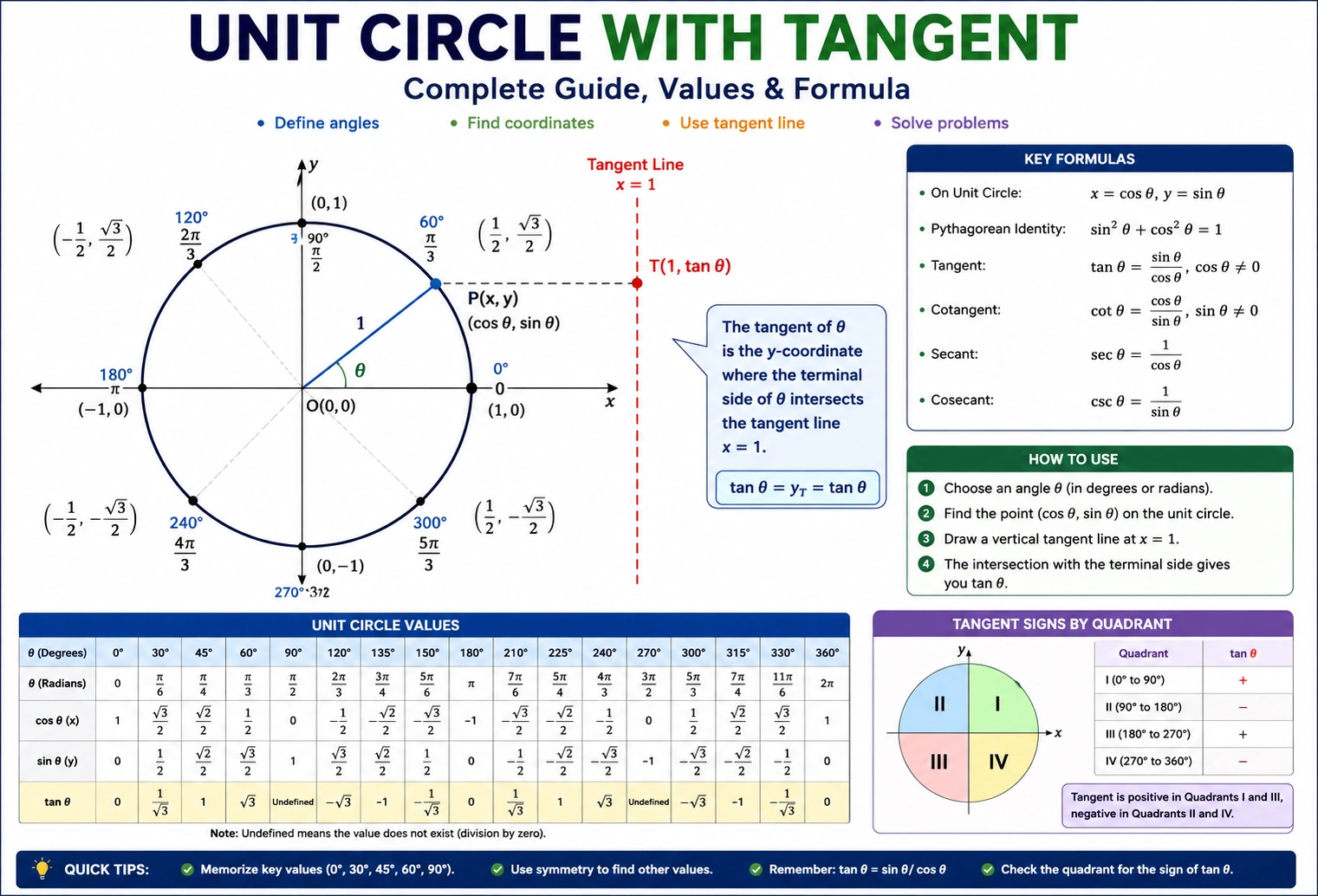
The unit circle with tangent is one of the most important concepts in trigonometry. It helps students quickly determine tangent values for common angles without using a calculator.
On the unit circle, the tangent of an angle is found using the relationship between sine and cosine.
The formula is:
tan θ = sin θ ÷ cos θ
Because the unit circle provides the sine and cosine coordinates for each angle, finding the tangent becomes straightforward whenever the cosine value is not zero.
Quick Answer
The tangent function on the unit circle is calculated using:
tan θ = sin θ / cos θ
Where:
- sin θ is the y-coordinate.
- cos θ is the x-coordinate.
If cos θ = 0, the tangent is undefined because division by zero is not possible.
What Is the Unit Circle?
A unit circle is a circle with:
- Radius = 1
- Center at (0,0)
Every point on the circle represents an angle measured from the positive x-axis.
Each point has coordinates:
(cos θ, sin θ)
These coordinates make it easy to calculate all six trigonometric functions.
Understanding Tangent
Among the six trigonometric functions, tangent is defined as the ratio of sine to cosine.
The formula is:
tan θ = sin θ / cos θ
Unlike sine and cosine, tangent does not represent a coordinate directly. Instead, it compares the y-coordinate with the x-coordinate.
Why Tangent Is Important
Tangent is commonly used in:
- Trigonometry
- Geometry
- Physics
- Engineering
- Surveying
- Architecture
- Navigation
- Computer graphics
It is especially useful when calculating:
- Slopes
- Angles
- Heights
- Distances
Tangent Formula
The tangent identity is:
tan θ = sin θ ÷ cos θ
This means:
- Divide the sine value by the cosine value.
- Simplify the result.
- If cosine equals zero, tangent is undefined.
This relationship connects the three primary trigonometric functions.
Tangent Values on the Unit Circle
Here are some of the most common tangent values.
| Angle | Radians | Tangent |
|---|---|---|
| 0° | 0 | 0 |
| 30° | π/6 | √3/3 |
| 45° | π/4 | 1 |
| 60° | π/3 | √3 |
| 90° | π/2 | Undefined |
| 120° | 2π/3 | -√3 |
| 135° | 3π/4 | -1 |
| 150° | 5π/6 | -√3/3 |
| 180° | π | 0 |
Notice that tangent becomes undefined at 90° because the cosine value equals zero.
How to Calculate Tangent Using the Unit Circle
Suppose you want the tangent of 45°.
The unit circle coordinates are:
- cos 45° = √2/2
- sin 45° = √2/2
Apply the formula:
tan 45° = (√2/2) ÷ (√2/2)
Result:
tan 45° = 1
This same process works for every angle on the unit circle where cosine is not zero.
Tangent Values in the Four Quadrants
The sign of the tangent function changes depending on the quadrant of the unit circle.
| Quadrant | Sine | Cosine | Tangent |
|---|---|---|---|
| I (0°–90°) | + | + | + |
| II (90°–180°) | + | − | − |
| III (180°–270°) | − | − | + |
| IV (270°–360°) | − | + | − |
A simple way to remember this is that tangent is positive when sine and cosine have the same sign and negative when they have opposite signs.
Why Is Tangent Undefined at 90° and 270°?
Recall the tangent formula:
tan θ = sin θ ÷ cos θ
At 90° (π/2):
- sin θ = 1
- cos θ = 0
This gives:
tan 90° = 1 ÷ 0
Division by zero is undefined, so tan 90° is undefined.
The same happens at 270° (3π/2):
- sin θ = −1
- cos θ = 0
Therefore:
tan 270° is also undefined.
Complete Unit Circle Tangent Chart
| Degrees | Radians | Tangent |
|---|---|---|
| 0° | 0 | 0 |
| 30° | π/6 | √3/3 |
| 45° | π/4 | 1 |
| 60° | π/3 | √3 |
| 90° | π/2 | Undefined |
| 120° | 2π/3 | −√3 |
| 135° | 3π/4 | −1 |
| 150° | 5π/6 | −√3/3 |
| 180° | π | 0 |
| 210° | 7π/6 | √3/3 |
| 225° | 5π/4 | 1 |
| 240° | 4π/3 | √3 |
| 270° | 3π/2 | Undefined |
| 300° | 5π/3 | −√3 |
| 315° | 7π/4 | −1 |
| 330° | 11π/6 | −√3/3 |
| 360° | 2π | 0 |
This table covers the most commonly used tangent values in trigonometry.
Easy Tricks to Remember Tangent Values
Memorize Special Angles
Focus first on:
- 0°
- 30°
- 45°
- 60°
- 90°
Most other values follow from these using quadrant signs.
Remember the Formula
Always use:
tan θ = sin θ ÷ cos θ
If you know sine and cosine, you can calculate tangent.
Watch for Undefined Angles
Whenever:
cos θ = 0
the tangent is undefined.
On the standard unit circle, this occurs at:
- 90°
- 270°
Learn the Quadrant Signs
A quick pattern is:
- Quadrant I → Positive
- Quadrant II → Negative
- Quadrant III → Positive
- Quadrant IV → Negative
Applications of Tangent
The tangent function is used in many fields, including:
- Geometry
- Physics
- Engineering
- Architecture
- Surveying
- Navigation
- Computer graphics
- Robotics
It is especially useful for finding unknown heights, distances, slopes, and angles in right triangles.
Frequently Asked Questions
What is tangent on the unit circle?
Tangent is the ratio of sine to cosine:
tan θ = sin θ ÷ cos θ
On the unit circle, sine is the y-coordinate and cosine is the x-coordinate.
Why is tangent undefined at 90°?
At 90°, the cosine value equals 0. Since division by zero is undefined, tan 90° is undefined.
What is the tangent of 45°?
The tangent of 45° (π/4) is:
1
because sine and cosine have the same value at that angle.
Where is tangent positive?
Tangent is positive in:
- Quadrant I
- Quadrant III
Why is the unit circle important in trigonometry?
The unit circle allows you to determine sine, cosine, and tangent values for standard angles without needing a calculator, making it a fundamental tool for solving trigonometric problems.
Conclusion
The unit circle with tangent is a foundational concept in trigonometry. By using the relationship tan θ = sin θ ÷ cos θ, you can quickly determine tangent values for common angles, identify where the function is undefined, and understand how tangent changes across the four quadrants.
Learning the standard angles, quadrant signs, and the tangent chart will make solving trigonometric equations faster and easier, whether you’re preparing for exams, studying calculus, or applying mathematics in science and engineering.
Discover More Articles
What Is 180 Degrees Celsius? Temperature Conversion Guide
100 km/h to MPH: Exact Speed Conversion Guide
What Is 70 Degrees Fahrenheit in Celsius? Easy Conversion Guide