
If you’re planning a chain link fence, one of the first measurements to determine is the distance between the posts. Proper post spacing helps keep the fence fabric tight, stable, and supported over time.
Quick Answer
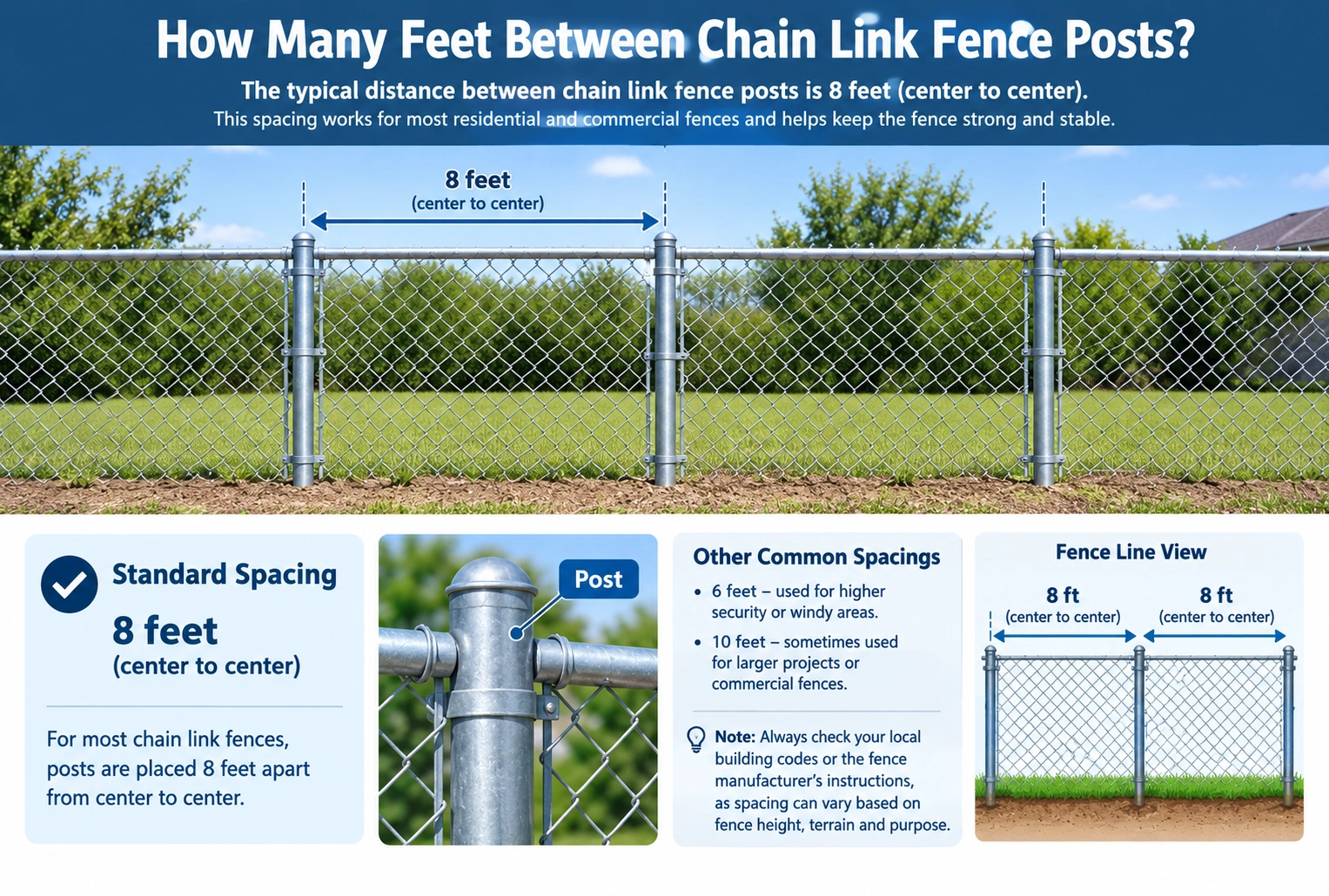
Chain link fence posts are commonly spaced about 6 to 10 feet apart, with approximately 8 feet between posts being a common planning measurement.
The exact spacing can vary depending on the fence height, wind exposure, terrain, manufacturer recommendations, and local installation requirements.
| Fence Post Spacing | Common Use |
|---|---|
| 6 feet | Shorter or heavier-duty installations |
| 7 feet | Closer support in demanding conditions |
| 8 feet | Common general-purpose spacing |
| 9 feet | Possible for suitable installations |
| 10 feet | Wider spacing where conditions allow |
For many residential chain link fences, 8 feet on center is a useful starting point for estimating materials. However, you should check the specifications for the particular chain link system you’re installing before setting the posts.
Standard Chain Link Fence Post Spacing
The distance between chain link fence posts is normally measured from the center of one post to the center of the next post. This is known as spacing “on center.”
A common installation approach is to place line posts approximately 8 feet apart.
For example, if you have a straight 80-foot fence run and use 8-foot spacing, you would divide the length by the spacing:
80 ÷ 8 = 10 spaces
Because the number of posts depends on the number of spaces plus the posts at the ends, a straight run of this length would typically require 11 line/terminal positions, before accounting for corners, gates, or other special conditions.
The actual layout may need to be adjusted so the post locations work evenly along the entire fence.
Why 8 Feet Is Common
Eight-foot spacing provides a practical balance between support and material use. Chain link fabric can withstand considerable tension, but the framework still needs enough posts to prevent excessive movement.
If posts are installed too far apart, the fence can become less rigid. If they are installed much closer together, the installation may require more posts, more concrete, and additional labor.
The goal is to select spacing appropriate for the specific fence system rather than automatically using the largest possible distance.
Why Chain Link Fence Posts Need Proper Spacing
Chain link fencing is different from some solid privacy fencing because the mesh fabric is tensioned between posts.
The fence fabric attaches to the framework, and tension is transferred through the posts and rails. This means post placement affects the overall stability of the fence.
Proper spacing helps:
- Support the chain link fabric
- Maintain consistent fence tension
- Reduce excessive movement
- Keep the fence line straight
- Provide better resistance to wind
- Support the top rail
- Reduce stress on individual posts
- Create a more uniform appearance
Spacing becomes particularly important on taller fences or properties exposed to strong winds.
A 4-foot chain link fence in a sheltered residential yard may experience very different loads from a tall fence installed in an exposed location.
How to Calculate the Number of Fence Posts
You can estimate the number of posts by dividing the fence length by your planned post spacing.
The basic calculation is:
Number of spaces = Fence length ÷ Post spacing
Then:
Number of posts = Number of spaces + 1
This works for a simple straight fence run when the length divides evenly by the selected spacing.
For example, suppose a fence is 48 feet long and you plan to use 8-foot spacing.
48 ÷ 8 = 6 spaces
You therefore need:
6 + 1 = 7 post positions
| Fence Length | Approx. Spacing | Spaces | Basic Post Positions |
|---|---|---|---|
| 24 ft | 8 ft | 3 | 4 |
| 32 ft | 8 ft | 4 | 5 |
| 40 ft | 8 ft | 5 | 6 |
| 48 ft | 8 ft | 6 | 7 |
| 56 ft | 8 ft | 7 | 8 |
| 64 ft | 8 ft | 8 | 9 |
| 72 ft | 8 ft | 9 | 10 |
| 80 ft | 8 ft | 10 | 11 |
| 100 ft | 8 ft | 12.5 | Layout must be adjusted |
The 100-foot example demonstrates why you should not simply round the number of spaces without considering the actual layout. You need whole post positions and should distribute the spacing appropriately.
Line Posts vs. Terminal Posts
Not every chain link fence post performs the same job. The location and purpose of a post can affect its size, strength, and installation requirements.
Line Posts
Line posts are the intermediate posts positioned along a straight section of fencing.
They provide support between the terminal posts and help maintain the fence’s shape.
For a typical straight run, these are the posts you are usually referring to when asking how many feet should be between chain link fence posts.
Corner Posts
Corner posts are installed where the fence changes direction.
They experience tension from fence sections running in different directions, so they are generally treated differently from ordinary line posts.
You should not simply measure a corner post as though it were another ordinary line post.
End Posts
An end post terminates a section of chain link fence.
Like corner posts, end posts are subjected to tension from the fence fabric and therefore require appropriate framework and anchoring.
Gate Posts
Gate posts support the gate hardware and the weight of the gate itself.
Because gates create additional structural demands, gate posts are usually stronger and may require larger or deeper installations than ordinary line posts.
Their spacing depends on the gate opening and the gate manufacturer’s specifications.
Factors That Affect Chain Link Fence Post Spacing
Eight feet is a useful general planning number, but it isn’t a universal requirement.
Several factors can affect the appropriate spacing.
Fence Height
A taller fence generally has greater exposure to wind and creates more leverage against its supporting framework.
For this reason, taller chain link fences may require more substantial framework or closer post spacing depending on the system and installation conditions.
Wind Exposure
Wind can put significant pressure on a fence.
Although chain link mesh allows air to pass through, wind loads can still affect the fence, particularly when the fence is tall or installed in an exposed location.
If your property experiences strong or frequent winds, follow the manufacturer’s engineering recommendations and applicable local requirements.
Fence Fabric
Chain link fabric comes in different gauges and configurations.
Heavier fabric and stronger framework can change the requirements of an installation. The mesh should be installed and tensioned according to the specifications of the particular system.
Terrain
A perfectly straight, level property is easier to lay out than sloped or irregular terrain.
On slopes, the installer may need to adjust the layout, post locations, or fence construction method.
Soil Conditions
The strength of a fence post depends partly on how well it is anchored.
Loose, sandy, rocky, or poorly compacted soil may require different installation techniques from firm soil.
Local Requirements
Building codes, zoning requirements, property restrictions, or local fence regulations may establish requirements for fence height, placement, foundations, or construction.
Always check applicable requirements before beginning a permanent fence installation.
Example Chain Link Fence Post Calculations
Example 1: 40-Foot Fence
Suppose you are installing a straight 40-foot chain link fence and plan for approximately 8-foot spacing.
40 ÷ 8 = 5 spaces
Add one post for the opposite end:
5 + 1 = 6 post positions
So a simple 40-foot straight run would require approximately 6 posts.
Example 2: 60-Foot Fence
For a 60-foot fence:
60 ÷ 8 = 7.5 spaces
You cannot install half a post space, so the layout needs to be adjusted.
One approach would be to use 8 spaces, giving an average spacing of:
60 ÷ 8 = 7.5 feet
This keeps the posts evenly distributed while remaining below the original 8-foot planning maximum.
Example 3: 100-Foot Fence
For 100 feet:
100 ÷ 8 = 12.5 spaces
A practical layout could use 13 spaces:
100 ÷ 13 ≈ 7.69 feet
That produces an average spacing of approximately 7.7 feet.
| Fence Length | Example Number of Spaces | Approx. Average Spacing |
|---|---|---|
| 40 ft | 5 | 8.0 ft |
| 50 ft | 7 | 7.14 ft |
| 60 ft | 8 | 7.5 ft |
| 80 ft | 10 | 8.0 ft |
| 100 ft | 13 | 7.69 ft |
| 120 ft | 15 | 8.0 ft |
These are planning examples rather than universal installation requirements.
How Deep Should Chain Link Fence Posts Be?
Post spacing is only one part of a stable chain link fence. The depth and size of each post hole are also important.
A commonly used rule of thumb is that a fence post should have a substantial portion of its length embedded in the ground, with the exact depth depending on fence height, soil, frost conditions, wind exposure, post dimensions, and local requirements.
For many residential installations, line posts may be buried around 2 feet deep, but this should not be treated as a universal standard.
Taller fences and demanding soil or weather conditions may require deeper foundations.
The post should also be properly anchored with concrete or an installation method specified for the particular fence system.
Chain Link Fence Installation Tips
Before digging any post holes, carefully measure and mark the entire fence layout.
1. Mark the Fence Line
Use stakes and string to establish the intended fence line.
This helps you identify corners, endpoints, gates, and changes in direction before installing anything permanently.
2. Mark Terminal Posts First
Corner, end, and gate-post locations should be established before laying out the intermediate line posts.
This gives you fixed reference points for calculating the remaining spacing.
3. Divide Long Runs Evenly
Do not assume every fence run will divide perfectly by 8 feet.
Instead, calculate the number of spaces and distribute them so the final spacing remains appropriate and visually consistent.
4. Check the Property Line
Make sure you know where the property boundary is before digging.
If the fence is near a property line, verify the location according to local requirements rather than relying on visual estimates.
5. Call Before You Dig
Underground utility lines can create serious hazards. Contact the appropriate utility-location service before excavating.
6. Keep Posts Plumb
Posts should be installed vertically and aligned with the fence layout.
A post that is noticeably out of plumb can make the finished fence look uneven and may affect how the fabric and framework attach.
Common Mistakes to Avoid
Using Exactly 8 Feet Everywhere
Eight feet is a common planning measurement, but it isn’t necessarily the correct spacing for every fence.
Use the fence manufacturer’s recommendations and account for site conditions.
Forgetting Corner and Gate Posts
A simple length calculation may underestimate the number of posts because corners and gates require additional structural posts.
Measuring From Post Edge to Post Edge
Post spacing is generally discussed on center, meaning from the center of one post to the center of the next.
Ignoring the Fence Height
A 4-foot fence and a much taller fence can have different structural requirements.
Not Adjusting the Final Spacing
If your fence length does not divide evenly by the selected spacing, don’t leave an awkward final section without checking the layout. Distribute the spaces appropriately.
Digging Before Confirming the Layout
Once concrete has been placed around a post, correcting a measurement error becomes much harder.
Measure twice and establish the complete layout before setting the posts.
Frequently Asked Questions
How many feet should be between chain link fence posts?
A common planning distance is approximately 8 feet between line posts, although spacing can vary from roughly 6 to 10 feet depending on the fence system and site conditions.
Can chain link fence posts be 10 feet apart?
They can be in some fence systems and applications, but 10-foot spacing should not automatically be used. Check the manufacturer’s specifications, fence height, wind exposure, and local requirements.
Is 6-foot spacing better for a chain link fence?
Closer spacing can provide additional support, but whether it is necessary depends on the fence design and site. It also increases the number of posts and installation materials required.
How far apart should posts be for a 4-foot chain link fence?
Approximately 8 feet on center is a common planning point for many residential applications, but the manufacturer’s specifications should determine the final spacing.
How many posts do I need for a 100-foot chain link fence?
The exact number depends on the selected spacing and the locations of corners, ends, and gates. At approximately 8-foot spacing, 100 feet requires about 12.5 spaces, so the layout would need to be adjusted to whole spaces, such as 13 spaces at approximately 7.7 feet each.
Should corner posts be closer together?
Corners are not normally treated simply as additional line posts. A corner post supports fence tension in two directions and needs to be appropriately sized and anchored for the fence design.
How far apart are chain link fence posts for a gate?
Gate posts are positioned according to the required gate opening and hardware. They are typically designed to support the gate rather than following ordinary line-post spacing.
Do chain link fence posts need concrete?
Many residential chain link fence installations use concrete to anchor the posts securely. The appropriate foundation depends on soil, fence height, post size, weather, and the installation system.
How do I calculate chain link fence post spacing?
Measure the length of each straight fence section, determine an appropriate maximum spacing, calculate the number of spaces, and then distribute those spaces evenly between the terminal posts.
Conclusion
For many chain link fence installations, about 8 feet between line posts is a useful starting point. However, the correct spacing depends on the fence height, framework, fabric, wind exposure, soil, terrain, and manufacturer’s specifications.
For accurate planning, first mark your corners, ends, and gates, then divide each straight fence section into evenly spaced post locations. Remember that post spacing is normally measured from center to center, and special posts such as corners and gate posts require separate consideration.
A careful layout before digging can help you avoid unnecessary posts, uneven spacing, and costly installation corrections.
DIscover More Articles
How Many Feet Is 158 Inches? Exact Conversion Guide