
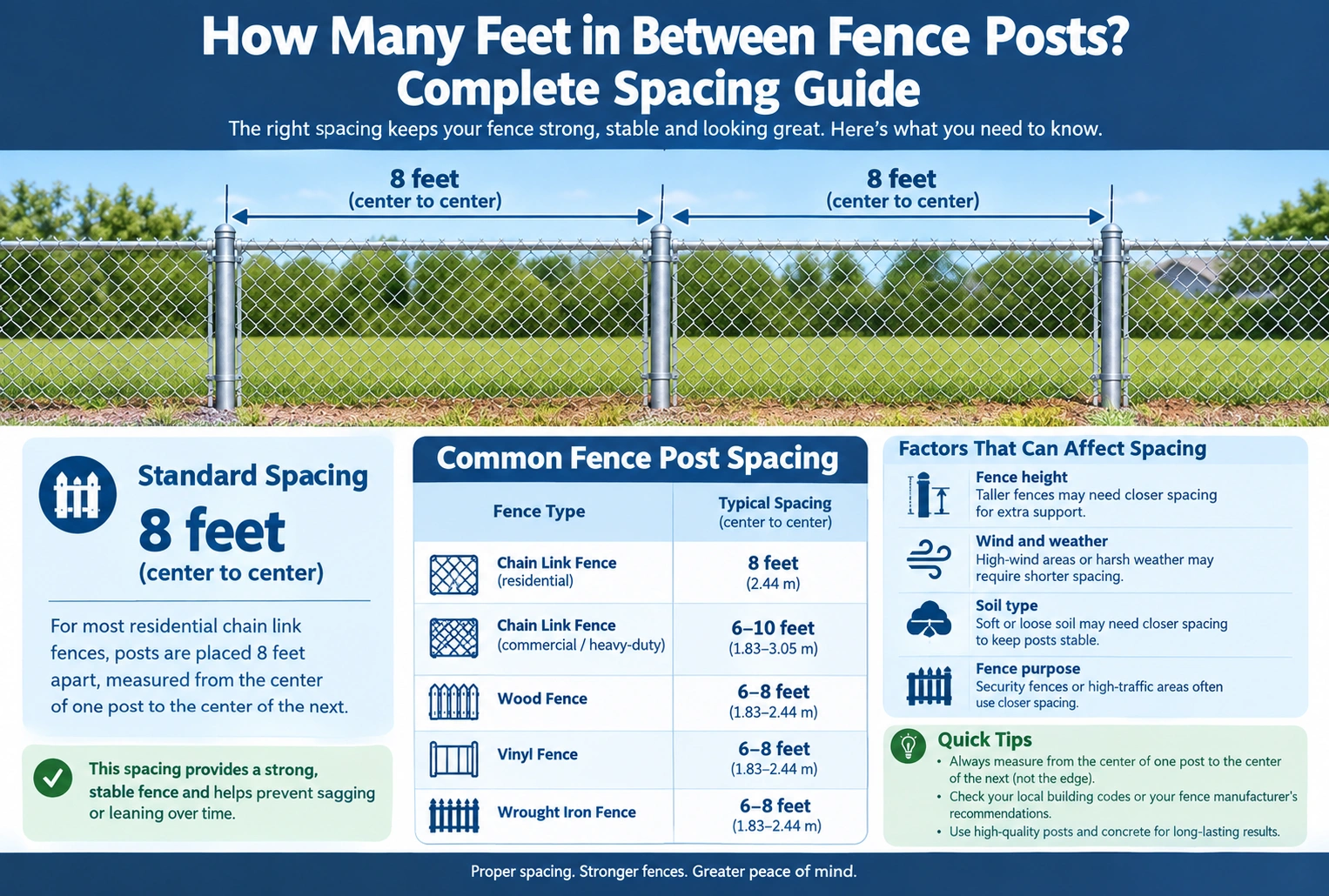
Fence posts are commonly spaced 6 to 8 feet apart, measured from the center of one post to the center of the next. However, the ideal spacing depends on the fence material, post size, fence height, wind exposure, and local building requirements.
| Fence Type | Common Post Spacing |
|---|---|
| Wood privacy fence | 6–8 ft |
| Picket fence | 6–8 ft |
| Vinyl fence | 6–8 ft |
| Chain-link fence | 6–10 ft |
| Livestock/wire fence | 8–12 ft |
| Heavy or high fence | Often 6 ft or less |
For a typical wood privacy fence, 6 to 8 feet between posts is a common starting point. Always check the fence manufacturer’s instructions and local requirements before building.
How Many Feet in Between Fence Posts?
The most common distance between fence posts is 6 to 8 feet.
For many residential wood fences, 8-foot spacing is commonly used because standard lumber lengths and fence-panel sizes can make installation convenient. However, 6-foot spacing can provide additional support, especially for heavier fence sections.
The measurement is normally taken from the center of one fence post to the center of the next, rather than from the outside edge of one post to the outside edge of another.
The correct spacing depends on the type of fence you are installing.
What Is the Standard Distance Between Fence Posts?
There is no single spacing that applies to every fence.
A lightweight fence may tolerate wider spacing, while a tall, solid privacy fence can place greater loads on its posts.
| Fence Application | Typical Spacing Range |
|---|---|
| Small garden fence | 6–8 ft |
| Wood privacy fence | 6–8 ft |
| Picket fence | 6–8 ft |
| Vinyl fence | 6–8 ft |
| Chain-link fence | 6–10 ft |
| Wire/livestock fence | 8–12 ft |
| Heavy privacy fence | 6 ft or less may be used |
These ranges are general planning guidelines. Manufacturer specifications, soil conditions, wind exposure, fence height, gates, and local codes can change the required spacing.
How Far Apart Should Wood Fence Posts Be?
For a typical residential wood fence, posts are often placed 6 to 8 feet apart.
An 8-foot spacing works well for many common fence layouts, while 6-foot spacing creates shorter fence spans and more frequent support.
Wood Fence Post Spacing
| Spacing | Support Level | General Use |
|---|---|---|
| 4 ft | Very frequent | Heavy/special applications |
| 6 ft | Frequent | Stronger support |
| 8 ft | Common | Many residential fences |
| 10 ft | Wider | Lightweight/specific designs |
For a tall, solid privacy fence, using the widest possible spacing is not always appropriate because the larger span can place more stress on the posts and rails.
Why Does Fence Post Spacing Matter?
Fence posts support the fence between the posts.
When posts are spaced too far apart, the horizontal rails or fence panels have to span a greater distance. This can increase flexing and stress.
Proper spacing helps provide:
- Structural support
- More stable fence panels
- Better resistance to wind
- Reduced sagging
- More consistent appearance
- Easier installation of rails and panels
The heavier and taller the fence, the more important proper post spacing becomes.
How Do You Measure the Distance Between Fence Posts?
Fence spacing is typically measured center-to-center.
Suppose you want posts 8 feet apart. You measure from the center of the first post to the center of the second post.
For a 4 × 4 post, this is different from measuring between the actual outside edges.
For example, if two 4-inch-wide posts have centers 8 feet apart, the clear space between their edges is approximately:
96 inches − 4 inches = 92 inches
| Measurement | Distance |
|---|---|
| Center-to-center spacing | 8 ft / 96 in |
| Approximate post width | 4 in |
| Approximate clear space | 92 in |
Actual post dimensions can vary, so use the material’s actual dimensions for precise calculations.
How Many Fence Posts Do You Need?
To estimate the number of posts, divide the total fence length by the desired post spacing and then account for the starting post.
A simple planning formula is:
Number of spaces = Fence Length ÷ Post Spacing
Then:
Number of posts = Number of spaces + 1
For example, suppose a straight fence is 100 feet long and posts are spaced every 8 feet.
100 ÷ 8 = 12.5 spaces
Because you cannot install half a fence section, you need to adjust the layout rather than simply using 12.5 spaces.
A practical layout could use 13 spaces:
13 × 7.69 ≈ 100 feet
This produces approximately 7.69-foot spacing.
Fence Post Examples
| Fence Length | Target Spacing | Approx. Spaces | Approx. Posts |
|---|---|---|---|
| 24 ft | 8 ft | 3 | 4 |
| 40 ft | 8 ft | 5 | 6 |
| 50 ft | 8 ft | 6.25 | 8 after layout adjustment |
| 80 ft | 8 ft | 10 | 11 |
| 100 ft | 8 ft | 12.5 | 14 after layout adjustment |
The final number should be based on the actual layout, including corners and gates.
How Many Feet Between Fence Posts for a 100-Foot Fence?
If you are building a 100-foot fence and want approximately 8-foot spacing, the 100-foot length does not divide evenly by 8.
100 ÷ 8 = 12.5
You therefore need to adjust the spacing so the posts fit evenly across the fence.
Using 13 spaces:
100 ÷ 13 = 7.69 feet
So you could space the posts approximately 7 feet 8 inches apart.
| Layout | Result |
|---|---|
| Fence length | 100 ft |
| Target spacing | 8 ft |
| Exact division | 12.5 spaces |
| Adjusted number of spaces | 13 |
| Adjusted spacing | 7.69 ft |
| Adjusted spacing in feet/inches | About 7 ft 8 in |
This approach produces more uniform spacing than simply leaving an unusually short section at the end.
How Many Feet Between Fence Posts for a 50-Foot Fence?
For a 50-foot fence, 8-foot spacing also does not divide evenly:
50 ÷ 8 = 6.25
You could use 7 spaces and distribute the distance evenly:
50 ÷ 7 = 7.14 feet
That is approximately 7 feet 1.7 inches between post centers.
| Fence Length | Spaces | Approx. Spacing |
|---|---|---|
| 50 ft | 6 | 8 ft 4 in |
| 50 ft | 7 | 7 ft 1.7 in |
| 50 ft | 8 | 6 ft 3 in |
The best arrangement depends on the fence design and desired structural support.
Fence Post Spacing for Different Fence Materials
Different materials have different structural characteristics.
Wood
Wood privacy fences commonly use 6–8-foot spacing.
Vinyl
Vinyl fences often use posts according to the manufacturer’s panel dimensions. Some systems require specific spacing rather than a general 6- or 8-foot rule.
Chain Link
Chain-link fence posts can commonly be spaced farther apart than posts supporting solid privacy panels, but exact spacing depends on fence height, mesh, framework, and local requirements.
Wire Fence
Agricultural wire fences may use wider spacing, particularly when the fence is designed differently from a rigid privacy fence.
| Fence Material | Typical Planning Range |
|---|---|
| Wood | 6–8 ft |
| Vinyl | Often based on panel system |
| Chain link | 6–10 ft |
| Wire/livestock | 8–12 ft |
How Far Apart Should Fence Posts Be for a 6-Foot Fence?
A 6-foot-tall fence is relatively tall, so post spacing becomes important.
For a typical wood privacy fence, 6 to 8 feet is a common planning range. In areas with high wind exposure or heavy fence construction, closer spacing may be appropriate.
A solid 6-foot fence can act like a large surface against wind, increasing the load transferred to the posts.
Before selecting spacing, consider:
- Fence material
- Post dimensions
- Soil type
- Wind exposure
- Fence design
- Post depth
- Local building requirements
How Far Apart Should Fence Posts Be for an 8-Foot Fence?
An 8-foot fence is taller and may experience greater wind loading than a shorter fence.
Because of this, simply using the maximum spacing that works for a shorter fence may not be appropriate.
For tall privacy fences, closer post spacing may be specified by the fence manufacturer, engineer, or local building requirements.
If you are installing an 8-foot fence, check the structural requirements before choosing post spacing.
Fence Post Spacing at Corners
Corners require special attention because a corner post can carry loads from fence sections running in two directions.
A corner should generally be treated as a structural point rather than simply another post in a straight line.
The same applies to:
- End posts
- Gate posts
- Changes in fence direction
- Significant changes in elevation
Gate posts may need additional support because gates add weight and movement to the structure.
How Far Apart Should Gate Posts Be?
Gate openings are different from regular fence sections.
The required distance between gate posts depends on the actual gate width and hardware.
| Gate Type | Planning Consideration |
|---|---|
| Small pedestrian gate | Smaller opening |
| Single vehicle gate | Wider opening |
| Double gate | Two leaves and center meeting point |
| Heavy gate | May require stronger posts |
Do not use standard 6- or 8-foot fence spacing to determine gate-post placement. Measure the gate and hardware requirements first.
How Deep Should Fence Posts Be?
Post depth is just as important as spacing.
The correct depth depends on fence height, soil, frost conditions, wind exposure, local requirements, and the post system being used.
A commonly cited construction guideline is to bury approximately one-third of the post length, but this is not a universal rule. Local building codes and engineering requirements should take priority.
For example, a tall fence in a windy area may require a different foundation than a short decorative fence.
Does Wider Fence Post Spacing Save Money?
Wider spacing can mean fewer posts, which may reduce the number of posts and some installation materials. However, the fence design may require closer spacing for adequate support.
| Spacing | Number of Posts | Material Consideration |
|---|---|---|
| 6 ft | More posts | More post material |
| 7 ft | Moderate | Moderate |
| 8 ft | Fewer posts | Fewer posts |
| 10 ft | Even fewer | May require fence-specific design |
The cheapest spacing is not automatically the correct spacing. Structural requirements should come first.
Common Mistakes When Spacing Fence Posts
1. Measuring From Edge to Edge
Post spacing is commonly specified center-to-center. Always confirm the measurement method for your fence system.
2. Assuming 8 Feet Works for Every Fence
Different fence materials and designs have different requirements.
3. Ignoring Corners
Corners often require stronger structural treatment than ordinary line posts.
4. Forgetting Gates
Gate posts can experience additional loads and should be planned separately.
5. Leaving an Uneven End Section
If the fence length does not divide evenly, distribute the adjustment rather than automatically creating one very short section.
6. Ignoring Local Requirements
Building codes, property restrictions, and fence manufacturers may specify different requirements.
Frequently Asked Questions
How many feet should be between fence posts?
For many residential fences, 6 to 8 feet between posts is common. The correct spacing depends on fence type, height, materials, wind, soil, and local requirements.
Is 8 feet too far between fence posts?
Not necessarily. 8 feet is common for many residential fence designs, but it may be unsuitable for some tall, heavy, or high-wind applications.
How far apart should 4×4 fence posts be?
A common planning range for many residential wood fences is 6–8 feet center-to-center. The exact spacing depends on the fence design and structural requirements.
How many fence posts do I need for 100 feet?
At an exact 8-foot spacing, 100 feet does not divide evenly. A layout using 13 spaces would produce approximately 7.69 feet between posts, requiring 14 posts for a straight run.
Should fence posts be closer for a privacy fence?
They may need to be, depending on the fence height, weight, wind exposure, and construction. A solid privacy fence can place more load on posts than a lightweight open fence.
Conclusion
So, how many feet in between fence posts? For many residential fences, 6 to 8 feet apart is a common range, with 8 feet frequently used for standard wood fence layouts.
However, there is no universal spacing that works for every fence. Material, height, post size, soil, wind exposure, corners, gates, and local requirements all matter. For the most accurate installation, follow the fence manufacturer’s specifications and applicable local building requirements.
When planning your fence, measure the entire run first and divide it into evenly distributed sections rather than assuming every fence must use exactly 8-foot spacing.
DIscover More Articles
How Many Feet Is 158 Inches? Exact Conversion Guide