

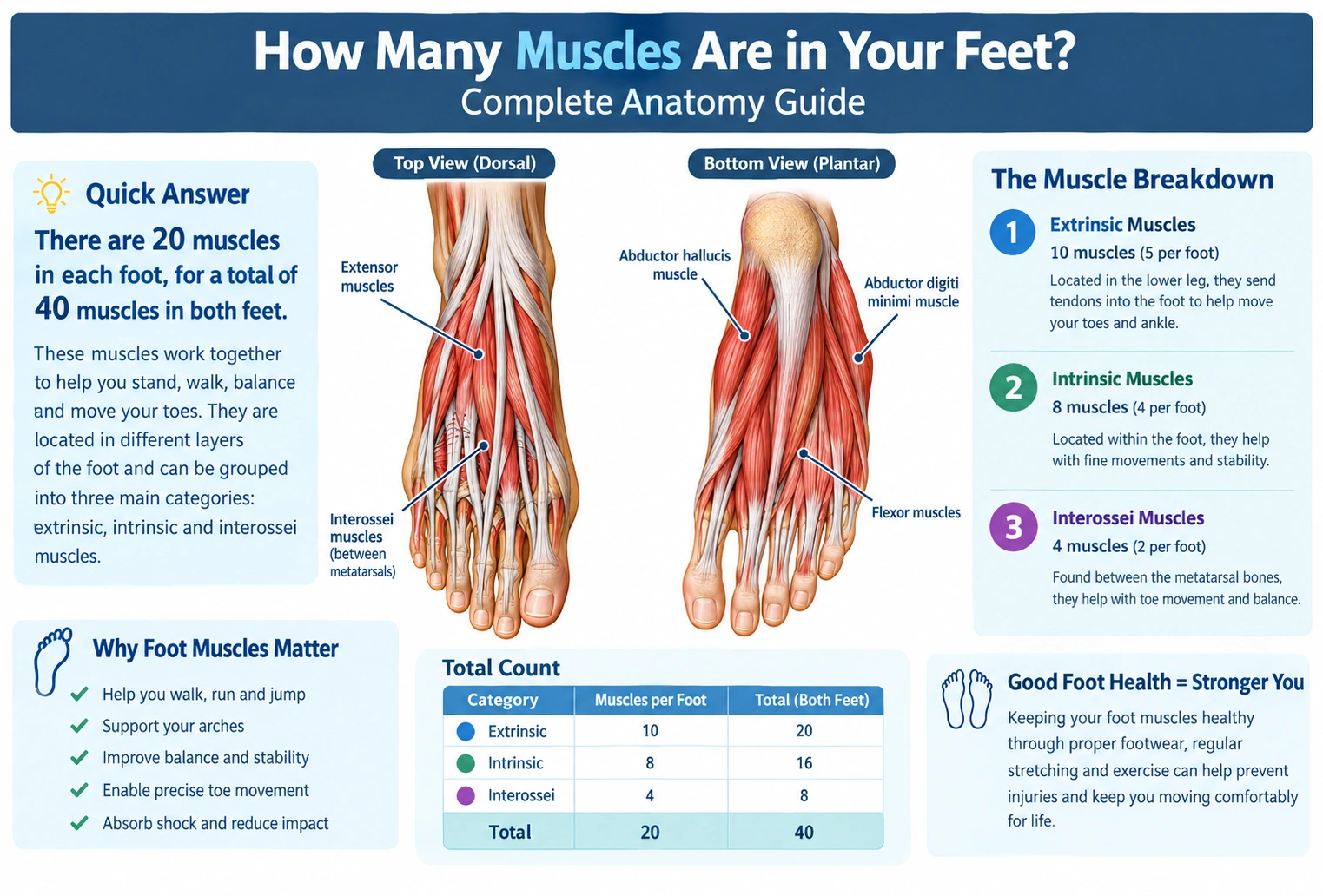
There are 20 muscles in each foot, for a total of 40 muscles in both feet. These muscles help control toe movement, support the arches, stabilize the foot, and assist with balance and walking.
| Measurement | Number of Muscles |
|---|---|
| One foot | 20 |
| Both feet | 40 |
| Intrinsic muscles in one foot | 20 |
| Intrinsic muscles in both feet | 40 |
The muscles located entirely within the foot are called intrinsic foot muscles. Muscles that begin in the lower leg and attach to the foot are called extrinsic muscles and are not included in the commonly cited count of 20 muscles per foot.
Introduction
Your feet contain a surprisingly complex network of muscles, tendons, bones, ligaments, and nerves. Although the muscles in your feet are relatively small, they play an important role in everyday movement.
From standing and walking to running and maintaining balance, your foot muscles work constantly. They also help maintain the shape and stability of the arches.
So, how many muscles are in your feet? The commonly accepted anatomical count is 20 intrinsic muscles in each foot, giving you 40 intrinsic muscles across both feet.
Understanding these muscles can make it easier to understand foot movement, arch support, balance, and some common foot problems.
How Many Muscles Are in Your Feet?
The commonly cited anatomical number is 20 intrinsic muscles in each foot.
Because you have two feet, the total is:
20 muscles × 2 feet = 40 intrinsic foot muscles
These muscles are called intrinsic because they originate and attach within the foot itself.
| Area | Muscle Count |
|---|---|
| Right foot | 20 intrinsic muscles |
| Left foot | 20 intrinsic muscles |
| Both feet | 40 intrinsic muscles |
This count refers specifically to the intrinsic muscles of the foot. It does not mean that only 20 muscles influence the movement of each foot.
Several muscles in the lower leg also control foot and ankle movements through long tendons that extend into the foot.
What Are Intrinsic Foot Muscles?
Intrinsic foot muscles are muscles that originate and insert within the foot.
They are generally smaller than the large muscles found in the lower leg, but their location allows them to perform detailed movements and provide stability.
They help with:
- Moving and controlling the toes
- Supporting the arches
- Stabilizing the foot
- Maintaining balance
- Adjusting the foot during walking
- Helping the foot adapt to different surfaces
The intrinsic muscles are arranged in layers on the sole and top of the foot.
What Are Extrinsic Foot Muscles?
Extrinsic muscles are different because they originate outside the foot, mainly in the lower leg, but their tendons extend into the foot.
These muscles are important for larger movements involving the foot and ankle.
| Muscle Group | General Location | Main Role |
|---|---|---|
| Intrinsic muscles | Within the foot | Fine control and stability |
| Extrinsic muscles | Lower leg | Larger foot and ankle movements |
For example, muscles in the lower leg can help point the foot downward, pull it upward, or move it inward and outward.
This is why counting the muscles that influence your feet can produce a different number from the commonly quoted 20 intrinsic muscles per foot.
The Four Layers of Foot Muscles
The muscles on the sole of the foot are commonly organized into four layers. This arrangement helps anatomists describe their locations and functions.
First Layer
The first layer is closest to the surface of the sole.
It contains three major muscles:
- Abductor hallucis
- Flexor digitorum brevis
- Abductor digiti minimi
These muscles help control the big toe, smaller toes, and overall stability of the sole.
Second Layer
The second layer contains muscles associated with the deeper structures of the foot.
It includes:
- Quadratus plantae
- Four lumbricals
These muscles assist with toe movement and help coordinate the actions of the long toe flexor tendons.
Third Layer
The third layer includes muscles that help control individual toes.
It contains:
- Flexor hallucis brevis
- Adductor hallucis
- Flexor digiti minimi brevis
The adductor hallucis is particularly important for controlling the big toe and contributing to the stability of the forefoot.
Fourth Layer
The deepest layer contains:
- Three plantar interossei
- Four dorsal interossei
The interossei help move the toes relative to one another and contribute to foot stability.
Together, these layers account for the commonly cited 20 intrinsic muscles in each foot.
How Many Muscles Are in One Foot?
There are 20 intrinsic muscles in one foot.
A simplified breakdown is:
| Muscle Group | Number |
|---|---|
| First layer | 3 |
| Second layer | 5 |
| Third layer | 3 |
| Fourth layer | 7 |
| Total | 18? |
However, anatomical muscle-count conventions can vary depending on how certain muscle structures are classified or subdivided. The commonly taught figure for the intrinsic muscles of one foot is 20.
For educational anatomy purposes, the key number to remember is:
20 intrinsic muscles per foot.
How Many Muscles Are in Both Feet?
If each foot has 20 intrinsic muscles, both feet have:
20 + 20 = 40 intrinsic muscles
So the simple answer is:
There are about 40 intrinsic muscles in both feet combined.
This does not include the extrinsic muscles of the lower legs that also move and control the feet.
What Do the Muscles in Your Feet Do?
Foot muscles have several important jobs. Their functions are more complex than simply moving the toes.
Toe Movement
Several muscles help bend, straighten, spread, and bring the toes together.
This allows your toes to adjust their position during movement and when your foot contacts the ground.
Arch Support
Small muscles within the foot contribute to the stability of the foot’s arches.
The major arches include:
- Medial longitudinal arch
- Lateral longitudinal arch
- Transverse arch
The muscles work together with bones, ligaments, and connective tissues to help maintain foot structure.
Balance
Your feet constantly make small adjustments when you stand or walk.
Foot muscles help respond to changes in pressure and position, allowing the foot to remain stable.
Walking
During walking, the foot needs to move through several stages.
The muscles help control how the foot contacts the ground, supports body weight, and prepares for the next step.
Foot Muscles and the Arches
The arches of the foot act as an important part of the body’s movement system.
They help distribute forces across the foot and contribute to shock absorption and stability.
The muscles of the foot work together with ligaments and other structures to maintain the foot’s shape while you move.
| Foot Structure | General Function |
|---|---|
| Medial longitudinal arch | Major arch along the inside of the foot |
| Lateral longitudinal arch | Supports the outer side of the foot |
| Transverse arch | Helps support the width of the foot |
| Intrinsic muscles | Contribute to stability and movement |
The muscles are only one part of this system. Strong muscles do not work independently of bones, tendons, ligaments, and fascia.
Foot Muscles and Balance
Your feet are your body’s primary contact with the ground when standing.
Small changes in foot position can affect your overall balance. The intrinsic muscles help make fine adjustments while you stand and move.
This becomes especially important when:
- Walking on uneven surfaces
- Standing on one foot
- Running
- Changing direction
- Climbing stairs
- Participating in sports
Foot muscles therefore contribute to both movement and stability.
Which Muscles Move Your Toes?
Both intrinsic and extrinsic muscles contribute to toe movement.
| Movement | Muscles Involved |
|---|---|
| Bending toes | Toe flexor muscles |
| Straightening toes | Toe extensor muscles |
| Moving big toe away | Abductor hallucis |
| Moving little toe away | Abductor digiti minimi |
| Spreading toes | Interossei |
| Bringing toes together | Interossei and related muscles |
The exact movement usually involves several muscles working together rather than a single muscle acting alone.
Intrinsic vs. Extrinsic Foot Muscles
One of the most important distinctions in foot anatomy is between intrinsic and extrinsic muscles.
| Feature | Intrinsic Muscles | Extrinsic Muscles |
|---|---|---|
| Origin | Within the foot | Mainly lower leg |
| Insertion | Within the foot | Foot |
| Size | Generally smaller | Often larger |
| Main role | Fine control and stability | Larger movements |
| Example | Lumbricals | Tibialis anterior |
The distinction explains why you may see different muscle counts in anatomy resources.
When someone asks how many muscles are in your feet, the answer of 20 per foot generally refers to the intrinsic muscles.
Why Foot Muscle Strength Matters
Your feet support your body every time you stand or move.
Healthy foot muscles contribute to:
- Foot stability
- Toe control
- Balance
- Walking mechanics
- Running mechanics
- Arch support
However, foot strength is only one factor affecting foot function. Footwear, mobility, joint structure, tendons, ligaments, body mechanics, and activity level can also influence how the feet perform.
Common Foot Muscle Problems
Foot muscles can become tired or strained, especially after activities that place repeated demands on the feet.
Common issues involving the muscles or surrounding structures may include:
| Issue | General Description |
|---|---|
| Muscle strain | Muscle or surrounding tissue is overstressed |
| Fatigue | Muscles become tired after prolonged activity |
| Cramping | Involuntary muscle contraction |
| Weakness | Reduced ability to produce or control movement |
| Overuse | Repeated activity exceeds the tissue’s ability to recover |
Persistent pain, significant swelling, weakness, numbness, or difficulty walking should be evaluated by an appropriate healthcare professional rather than assumed to be a simple muscle problem.
How to Keep Your Foot Muscles Strong
Regular movement can help keep the muscles of your feet active.
Simple activities can include:
- Walking regularly
- Moving your toes through comfortable ranges
- Performing controlled heel raises
- Practicing balance exercises
- Gradually increasing exercise intensity
- Wearing appropriately fitting footwear
If you are starting a new exercise program, increase activity gradually rather than suddenly adding a large amount of walking, running, or jumping.
Are Foot Muscles the Same as Leg Muscles?
No. Foot muscles and leg muscles are different groups, although they work together.
Some muscles responsible for moving the foot are located in the lower leg. Their tendons travel through the ankle and attach to bones in the foot.
This arrangement allows relatively large lower-leg muscles to control movements of the foot and toes.
Therefore, the 20-muscle figure applies to the intrinsic muscles located within each foot, not every muscle involved in moving the foot.
How Many Muscles Are in Your Feet Compared With Your Hands?
The hands and feet have some anatomical similarities, but their muscles are organized differently because they perform different jobs.
| Feature | Foot | Hand |
|---|---|---|
| Primary role | Support, movement, balance | Manipulation and fine movement |
| Intrinsic muscles | Commonly counted as 20 per foot | Different anatomical grouping |
| Contact with ground | Yes | Usually no |
| Major function | Stability and locomotion | Grip and precise movement |
The foot is designed primarily for support and efficient movement, while the hand is specialized for grasping and manipulation.
Common Mistakes About Foot Muscles
Mistake 1: Assuming There Are Only 20 Muscles Involved in Foot Movement
The number 20 generally refers to intrinsic muscles. Extrinsic muscles from the lower leg also control the foot.
Mistake 2: Thinking Every Foot Muscle Moves a Toe
Some muscles have important roles in stability and arch support rather than producing obvious toe movement.
Mistake 3: Ignoring the Tendons
Muscles produce movement through their tendons. Several important tendons travel from the lower leg into the foot.
Mistake 4: Treating the 20-Muscle Count as Universal for Every Anatomy Diagram
Anatomical references may organize or classify structures somewhat differently. When studying anatomy, always check which muscle group a source is counting.
Frequently Asked Questions
How many muscles are in one foot?
There are 20 commonly recognized intrinsic muscles in one foot. These muscles are located within the foot and contribute to toe movement, stability, and arch support.
How many muscles are in both feet?
There are 40 intrinsic foot muscles in both feet combined, based on the commonly used count of 20 intrinsic muscles per foot.
Are there 20 muscles in each foot?
Yes. In standard anatomy descriptions, each foot is commonly described as having 20 intrinsic muscles.
Do muscles in the legs control the feet?
Yes. Several muscles located in the lower leg control movements of the foot through tendons that extend into the foot.
What is the smallest muscle in the foot?
The foot contains many small muscles, and descriptions of the “smallest” can vary depending on whether individual muscle slips or anatomical structures are considered. It is better to identify a specific muscle when comparing size rather than assuming one universal smallest muscle.
Conclusion
So, how many muscles are in your feet? The commonly accepted answer is 20 intrinsic muscles in each foot, or 40 intrinsic muscles in both feet.
These muscles help control your toes, support the foot’s arches, maintain stability, and contribute to balance and walking. They work together with larger muscles in the lower leg, along with bones, tendons, ligaments, and other tissues.
Remember that the 20-per-foot figure refers to intrinsic muscles. If you include the muscles in the lower leg that also move the foot, the overall muscular system involved in foot movement is much larger.
Discover More Articles
How Many Feet in Between Fence Posts? Complete Spacing Guide