
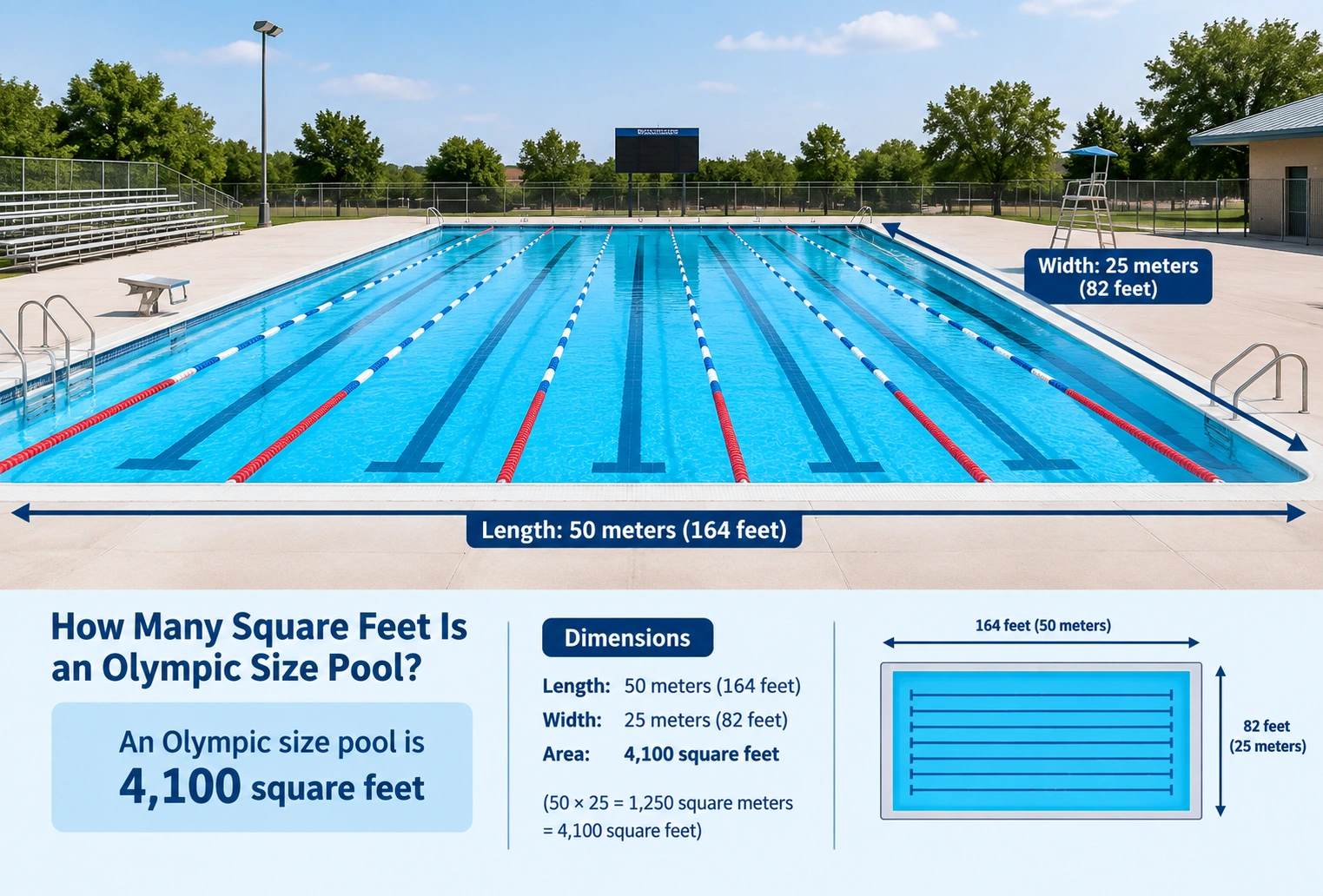
If you’re wondering how many square feet is an Olympic size pool, the answer depends on the pool dimensions being used. A standard Olympic competition pool is generally 50 meters long and 25 meters wide.
Converting those dimensions to feet gives a pool footprint of roughly 164 feet by 82 feet. Multiplying the length by the width gives a surface area of approximately 13,454 square feet.
Quick Answer
A standard Olympic-size pool measuring 50 meters × 25 meters has a surface area of approximately:
13,454 square feet
The calculation is based on:
- Length: 50 meters
- Width: 25 meters
- Length in feet: about 164.04 feet
- Width in feet: about 82.02 feet
- Surface area: about 13,454 sq ft
| Measurement | Olympic Pool Size |
|---|---|
| Length | 50 m |
| Width | 25 m |
| Length in feet | 164.04 ft |
| Width in feet | 82.02 ft |
| Surface area | 13,454 sq ft |
| Surface area in square meters | 1,250 sq m |
So, for a rectangular 50-meter by 25-meter Olympic-size pool, about 13,454 square feet of surface area is the standard calculation.
Olympic Size Pool Dimensions
The familiar Olympic competition pool is 50 meters long. A commonly used Olympic pool width is 25 meters, producing a rectangular water surface of 1,250 square meters.
The metric dimensions make the calculation simple:
50 m × 25 m = 1,250 square meters
To convert square meters to square feet, multiply by approximately 10.7639:
1,250 × 10.7639 ≈ 13,454.9 square feet
Therefore, the pool’s water surface is approximately 13,455 square feet.
Small differences can occur depending on the specific competition facility, deck configuration, or whether someone is describing the water surface versus the entire pool facility.
Water Surface vs. Entire Facility
This distinction is important.
When someone asks how many square feet an Olympic-size pool has, they are usually asking about the surface area of the water.
That does not include:
- Pool deck
- Starting platforms
- Spectator seating
- Walkways
- Locker rooms
- Mechanical areas
- Timing equipment
- Other surrounding facilities
The complete aquatic center can therefore occupy substantially more square footage than the pool itself.
How to Calculate the Square Footage
The square footage of a rectangular pool is calculated using:
Area = Length × Width
For an Olympic-size pool, first convert the dimensions to feet.
Step 1: Convert 50 Meters to Feet
One meter equals approximately 3.28084 feet.
50 × 3.28084 = 164.042 feet
So, 50 meters is approximately 164.04 feet.
Step 2: Convert 25 Meters to Feet
25 × 3.28084 = 82.021 feet
So, 25 meters is approximately 82.02 feet.
Step 3: Multiply Length by Width
164.042 × 82.021 ≈ 13,454.9 square feet
Rounded to the nearest square foot:
≈ 13,455 square feet
This is the water-surface area, not the total footprint of an Olympic aquatic facility.
Olympic Pool Surface Area in Other Units
The same pool area can be expressed in several different units.
| Unit | Approximate Area |
|---|---|
| Square meters | 1,250 sq m |
| Square feet | 13,455 sq ft |
| Square yards | 1,495 sq yd |
| Acres | 0.309 acre |
The square-meter figure is especially useful because Olympic pool dimensions are normally specified in metric units.
Why the Square-Foot Number Is Larger
The pool has an area of 1,250 square meters, but a square meter is smaller than a square foot. One square meter contains approximately 10.7639 square feet.
Therefore:
1,250 sq m × 10.7639 ≈ 13,455 sq ft
This is why the numerical value increases when converting from square meters to square feet.
How Much Water Does an Olympic Size Pool Hold?
Square footage measures the surface area of the pool. To determine how much water it holds, you also need its average depth.
A pool that is 50 meters long and 25 meters wide has a surface area of:
1,250 square meters
If the average depth were 2 meters, for example, the volume would be:
1,250 × 2 = 2,500 cubic meters
That is approximately 660,430 U.S. gallons.
However, actual competition pools can have different depths, so there is not one universal water-volume figure for every Olympic pool.
| Average Depth | Approx. Volume | Approx. U.S. Gallons |
|---|---|---|
| 1.5 m | 1,875 m³ | 495,300 gal |
| 2.0 m | 2,500 m³ | 660,400 gal |
| 2.5 m | 3,125 m³ | 825,500 gal |
| 3.0 m | 3,750 m³ | 990,600 gal |
These figures are examples based on a 50 m × 25 m rectangular water surface. Actual pool volume depends on the facility’s depth profile.
Olympic Pool Size Compared With Other Pools
An Olympic-size pool is much larger than the typical residential swimming pool.
| Pool Type | Approx. Length | Approx. Width | Approx. Surface Area |
|---|---|---|---|
| Small residential pool | 20 ft | 10 ft | 200 sq ft |
| Medium residential pool | 30 ft | 15 ft | 450 sq ft |
| Large residential pool | 40 ft | 20 ft | 800 sq ft |
| 25-meter competition pool | 82 ft | Varies | Varies |
| Olympic-size pool | 164 ft | 82 ft | 13,455 sq ft |
These residential examples are illustrative because home pools come in many shapes and sizes.
The comparison demonstrates why an Olympic pool requires a large dedicated facility.
How Many Lanes Does an Olympic Pool Have?
A competition pool can be divided into swimming lanes, with lane widths and the number of lanes determined by the applicable competition rules and facility design.
A typical Olympic competition configuration uses 10 lanes, although not every lane may be occupied by competitors in every event.
The 50-meter length is particularly important for Olympic swimming because races are conducted over standardized distances such as:
- 50 meters
- 100 meters
- 200 meters
- 400 meters
- 800 meters
- 1,500 meters
Swimmers may therefore complete one or more lengths of the pool depending on the event.
Why Olympic Pool Dimensions Matter
Standardized pool dimensions help competitive swimming events take place under consistent conditions.
A standardized pool provides a known:
- Race length
- Lane arrangement
- Turning distance
- Starting configuration
- Competition environment
- Water volume and depth requirements
For swimmers, the 50-meter length is particularly important because it determines how many lengths must be completed for a specific race.
For example, a 100-meter race requires swimmers to cover two 50-meter lengths in a standard long-course pool.
Is an Olympic Size Pool Exactly 50 by 25 Meters?
The phrase Olympic-size pool generally refers to a 50-meter competition pool, but specific facilities can have different overall dimensions and configurations.
The water area can also be affected by the exact competition setup, lane layout, timing equipment, and facility standards.
Therefore, 13,455 square feet should be understood as the approximate surface area of a rectangular 50 m × 25 m pool.
It should not be assumed that every pool associated with an Olympic facility has exactly the same usable water surface.
How Many Square Feet Is an Olympic Pool With 50 × 25 Meters?
The calculation is:
50 × 25 = 1,250 square meters
Then:
1,250 × 10.7639 ≈ 13,455 square feet
So a 50-meter by 25-meter pool has approximately 13,455 square feet of water surface.
How Big Is an Olympic Pool Compared With an Acre?
One acre contains 43,560 square feet.
An Olympic-size pool with approximately 13,455 square feet of water surface therefore covers about:
13,455 ÷ 43,560 ≈ 0.309 acre
So the water surface alone is roughly 31% of an acre.
| Measurement | Area |
|---|---|
| Olympic-size pool | ~13,455 sq ft |
| ¼ acre | 10,890 sq ft |
| ⅓ acre | 14,520 sq ft |
| ½ acre | 21,780 sq ft |
| 1 acre | 43,560 sq ft |
This comparison makes the size easier to visualize. The water surface of an Olympic-size pool is slightly smaller than one-third of an acre.
Common Questions About Olympic Size Pools
How many square feet is an Olympic size pool?
A 50-meter by 25-meter Olympic-size pool has approximately 13,455 square feet of water surface.
How many square meters is an Olympic pool?
A 50 m × 25 m pool has 1,250 square meters of surface area.
How long is an Olympic-size swimming pool?
A standard Olympic competition pool is 50 meters long, which equals approximately 164 feet.
How wide is an Olympic-size pool?
A commonly used Olympic competition pool width is 25 meters, or approximately 82 feet.
How many gallons of water are in an Olympic-size pool?
There is no single gallon capacity because pool depth varies. For example, a 50 m × 25 m pool with an average depth of 2 meters would contain approximately 660,400 U.S. gallons.
How many acres is an Olympic-size pool?
The water surface of a 50 m × 25 m pool is approximately 0.31 acre.
Is an Olympic pool bigger than a standard swimming pool?
Yes. A 50 m × 25 m competition pool is substantially larger than most residential swimming pools.
How many lanes are in an Olympic pool?
A typical Olympic competition setup uses 10 lanes, although the exact facility configuration can vary.
Does Olympic pool square footage include the deck?
No. The approximately 13,455-square-foot figure refers to the rectangular water surface. Pool decks and other surrounding areas are additional space.
Conclusion
A standard 50-meter by 25-meter Olympic-size pool has a water surface of approximately 13,455 square feet. That equals 1,250 square meters, or about 0.31 acre.
The calculation is simple: convert the 50-meter length and 25-meter width into feet, then multiply them. Keep in mind that this figure represents the pool’s water surface, not the entire aquatic facility, deck, seating, or surrounding areas.
Discover More Articles
How Many Feet in Between Fence Posts? Complete Spacing Guide