
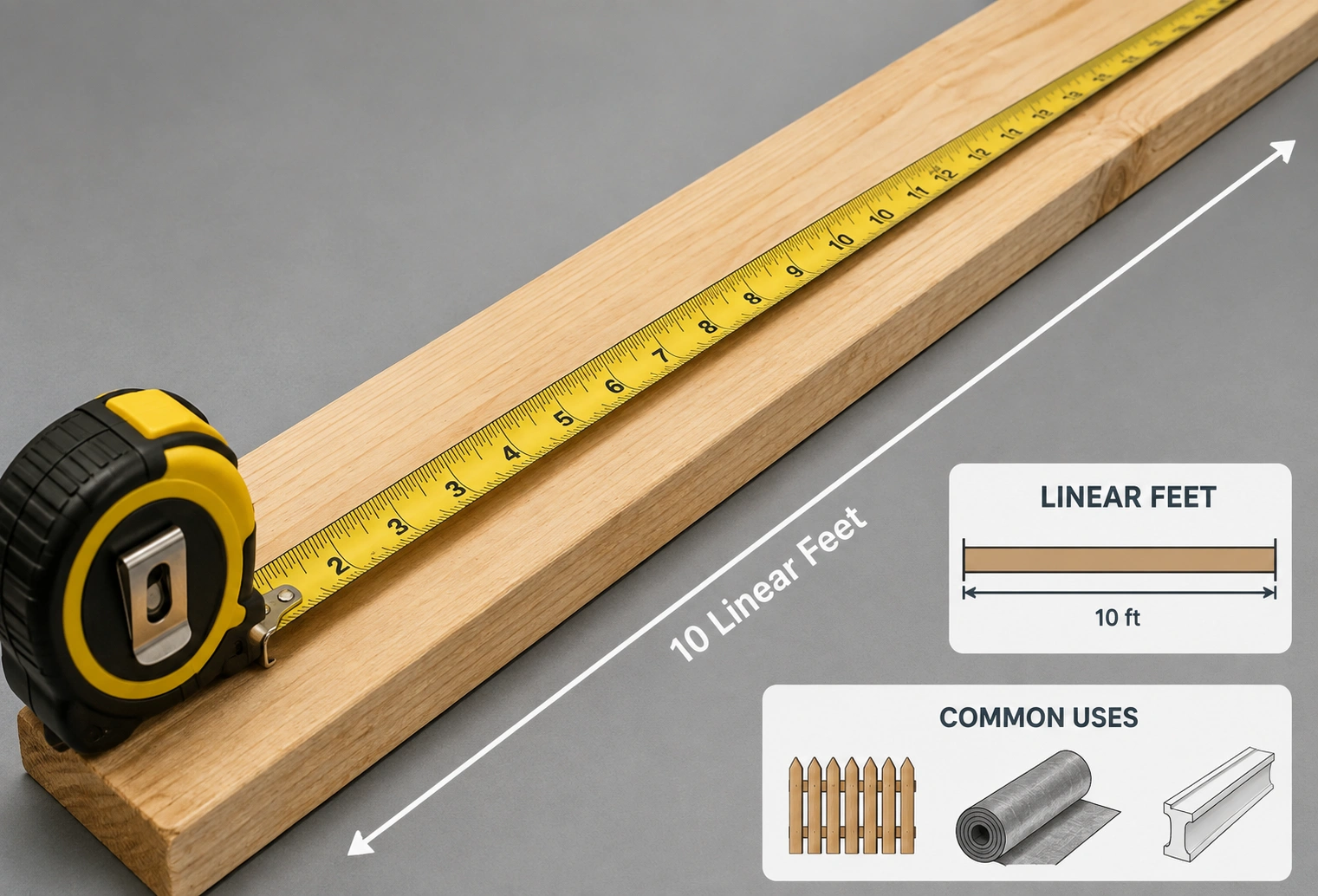
How many linear feet? A linear foot is simply one foot of length, regardless of an object’s width or thickness.
For example:
- 1 linear foot = 12 inches
- 5 linear feet = 60 inches
- 10 linear feet = 120 inches
- 20 linear feet = 240 inches
If you’re measuring a material sold by length, such as lumber, fencing, trim, countertops, flooring, fabric, or pipe, the number of linear feet tells you how long the material is.
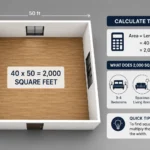
Important: Linear feet measure length, not area. If you need square footage, you must consider both length and width.
What Is a Linear Foot?
A linear foot is a measurement of length equal to exactly 12 inches.
The word “linear” simply means in a straight line.
So, if a board is 8 feet long, it contains:
8 linear feet
Its width doesn’t change the number of linear feet.
For example, a board that is 8 feet long and 6 inches wide contains 8 linear feet, while a board that is 8 feet long and 12 inches wide also contains 8 linear feet.
The length is what matters when measuring linear feet.
How Many Inches Are in a Linear Foot?
There are exactly:
12 inches = 1 linear foot
This makes linear-foot conversions easy.
| Linear Feet | Inches |
|---|---|
| 1 ft | 12 in |
| 2 ft | 24 in |
| 3 ft | 36 in |
| 4 ft | 48 in |
| 5 ft | 60 in |
| 10 ft | 120 in |
| 20 ft | 240 in |
| 50 ft | 600 in |
| 100 ft | 1,200 in |
To convert linear feet to inches, multiply by 12.
To convert inches to linear feet, divide by 12.
How Do You Calculate Linear Feet?
Calculating linear feet is usually straightforward.
If you’re measuring one continuous item, simply measure its length in feet.
Example
Suppose a countertop is 12 feet long.
It contains:
12 linear feet
If the measurement is given in inches, divide by 12.
For example:
96 inches ÷ 12 = 8 linear feet
So, 96 inches equals 8 linear feet.
Linear Feet Formula
The basic formula is:
Linear feet = total length in inches ÷ 12
If your measurements are already in feet:
Linear feet = total length in feet
For multiple pieces of material, add their lengths together.
For example:
- Piece 1 = 8 feet
- Piece 2 = 6 feet
- Piece 3 = 10 feet
Total:
8 + 6 + 10 = 24 linear feet
You would need 24 linear feet of material before accounting for waste.
Linear Feet vs. Square Feet
This is one of the most important differences to understand.
Linear feet measure length.
Square feet measure area.
A linear-foot measurement doesn’t tell you how wide something is.
For example, imagine two countertops:
- Countertop A: 10 linear feet × 2 feet wide
- Countertop B: 10 linear feet × 3 feet wide
Both contain 10 linear feet, but their areas are different.
| Measurement | Countertop A | Countertop B |
|---|---|---|
| Length | 10 ft | 10 ft |
| Width | 2 ft | 3 ft |
| Linear feet | 10 | 10 |
| Square feet | 20 sq ft | 30 sq ft |
This is why you should not use linear feet and square feet interchangeably.
How Many Linear Feet Are in a Square Foot?
There isn’t a single conversion between square feet and linear feet.
You need to know the width of the material.
For example, if material is 2 feet wide:
1 square foot ÷ 2 feet = 0.5 linear feet
But if material is 1 foot wide:
1 square foot ÷ 1 foot = 1 linear foot
So the width matters.
The formula is:
Linear feet = Square feet ÷ Width in feet
How to Convert Square Feet to Linear Feet
If you know the area and width, you can calculate the required linear feet.
Example
Suppose you need material covering 200 square feet, and the material is 4 feet wide.
Use:
200 ÷ 4 = 50 linear feet
So you need 50 linear feet of 4-foot-wide material.
| Square Feet | Material Width | Linear Feet |
|---|---|---|
| 100 sq ft | 2 ft | 50 ft |
| 100 sq ft | 4 ft | 25 ft |
| 200 sq ft | 2 ft | 100 ft |
| 200 sq ft | 4 ft | 50 ft |
| 300 sq ft | 5 ft | 60 ft |
| 500 sq ft | 5 ft | 100 ft |
How Many Linear Feet Do I Need?
The answer depends on what you’re measuring.
For a simple straight project, add the lengths of all sections.
For example, suppose you’re installing baseboard around three walls:
- Wall 1: 12 feet
- Wall 2: 10 feet
- Wall 3: 8 feet
Total:
12 + 10 + 8 = 30 linear feet
You would need 30 linear feet before adding extra material for cuts and waste.
How Many Linear Feet of Fencing Do I Need?
For fencing, linear feet usually refers to the total length of fence required.
If your property needs:
- 100 feet along one side
- 80 feet along another
- 100 feet along the third
- 80 feet along the fourth
Then:
100 + 80 + 100 + 80 = 360 linear feet
So the perimeter requires 360 linear feet of fencing.
You may want to purchase additional material for gates, corners, cuts, and installation requirements.
How Many Linear Feet of Baseboard Do I Need?
For baseboard, measure the length of each wall where the baseboard will be installed.
Add those measurements together.
For example:
| Wall | Length |
|---|---|
| Wall 1 | 14 ft |
| Wall 2 | 12 ft |
| Wall 3 | 14 ft |
| Wall 4 | 12 ft |
| Total | 52 linear ft |
You would need 52 linear feet before accounting for waste.
If you add 10% for cutting waste:
52 × 1.10 = 57.2 linear feet
So you might plan for approximately 58 linear feet.
How Many Linear Feet of Countertop Do I Need?
Countertops are commonly priced or discussed by linear foot, although the actual cost can depend heavily on countertop depth, material, edge treatment, cutouts, installation, and other factors.
Suppose a kitchen has countertop sections measuring:
- 8 feet
- 6 feet
- 4 feet
Total:
8 + 6 + 4 = 18 linear feet
So the project contains 18 linear feet of countertop.
Example Price Comparison
If a countertop material costs $50 per linear foot:
18 × $50 = $900
If another option costs $75 per linear foot:
18 × $75 = $1,350
| Price per Linear Foot | 18 Linear Feet | Material Cost |
|---|---|---|
| $40 | 18 ft | $720 |
| $50 | 18 ft | $900 |
| $60 | 18 ft | $1,080 |
| $75 | 18 ft | $1,350 |
| $100 | 18 ft | $1,800 |
These are example calculations, not current market prices. Installation and additional charges can increase the final cost.
Linear Feet for Lumber
Lumber is another common application.
If you need:
- Four 8-foot boards
- Three 10-foot boards
- Two 12-foot boards
Calculate:
(4 × 8) + (3 × 10) + (2 × 12)
32 + 30 + 24 = 86 linear feet
So the project requires 86 linear feet of lumber.
However, the number of boards you buy may be different because lumber is sold in standard lengths.
Linear Feet for Flooring
Flooring can sometimes be sold by linear foot when the material comes in a fixed width.
For example, if a flooring product is 1 foot wide and you need 200 square feet:
200 ÷ 1 = 200 linear feet
But if the same material is 2 feet wide:
200 ÷ 2 = 100 linear feet
| Required Area | Material Width | Required Linear Feet |
|---|---|---|
| 200 sq ft | 1 ft | 200 ft |
| 200 sq ft | 2 ft | 100 ft |
| 200 sq ft | 4 ft | 50 ft |
| 400 sq ft | 2 ft | 200 ft |
| 400 sq ft | 4 ft | 100 ft |
Always check the actual product width before converting.
Linear Feet for Fabric
Fabric can also be measured by linear feet.
For fabric, you must pay attention to the fabric width.
If fabric is 5 feet wide, buying 10 linear feet gives:
5 × 10 = 50 square feet
If fabric is 2 feet wide, 10 linear feet gives:
2 × 10 = 20 square feet
So the same 10 linear feet can represent very different amounts of material.
How Much Extra Material Should You Buy?
The amount of extra material depends on the project.
Cuts, corners, patterns, mistakes, and damaged pieces can create waste.
A simple example is adding 10%:
Required material × 1.10 = material with 10% waste
If you need 100 linear feet:
100 × 1.10 = 110 linear feet
So you’d plan for approximately 110 linear feet.
However, don’t automatically use 10% for every project. Some projects require more or less depending on the material and installation pattern.
Common Mistakes When Measuring Linear Feet
Mistake 1: Confusing Linear Feet With Square Feet
Linear feet measure length. Square feet measure area.
Mistake 2: Ignoring Material Width
Width matters when converting square feet into linear feet.
Mistake 3: Forgetting Waste
Buying exactly the calculated amount can leave you short after cutting.
Mistake 4: Measuring Only One Section
For projects with several walls or sections, measure and add every required length.
Mistake 5: Mixing Inches and Feet
Convert all measurements into the same unit before adding them.
For example:
8 feet + 24 inches
First convert 24 inches:
24 ÷ 12 = 2 feet
Then:
8 + 2 = 10 linear feet
Quick Linear Feet Conversion Chart
| Inches | Linear Feet |
|---|---|
| 12 in | 1 ft |
| 24 in | 2 ft |
| 36 in | 3 ft |
| 48 in | 4 ft |
| 60 in | 5 ft |
| 72 in | 6 ft |
| 84 in | 7 ft |
| 96 in | 8 ft |
| 108 in | 9 ft |
| 120 in | 10 ft |
| 240 in | 20 ft |
| 360 in | 30 ft |
| 600 in | 50 ft |
| 1,200 in | 100 ft |
Expert Tips for Measuring Linear Feet
For accurate measurements:
- Measure every section separately.
- Write down each measurement immediately.
- Convert inches to feet before adding.
- Add a reasonable waste allowance when needed.
- Check the manufacturer’s material width.
- Confirm whether the supplier sells by linear foot, square foot, board foot, or another unit.
- For irregular layouts, make a simple sketch before ordering material.
These steps can prevent costly measurement mistakes.
FAQs
1. How many feet is one linear foot?
One linear foot is exactly 1 foot, or 12 inches.
2. Is a linear foot the same as a square foot?
No. A linear foot measures length, while a square foot measures area.
3. How do I calculate linear feet?
For a simple length, measure the material in feet. For multiple sections, add all the lengths together.
4. How many linear feet are in 100 square feet?
It depends on the material width. For example, 100 square feet of material that is 2 feet wide requires 50 linear feet.
5. Why do suppliers use linear feet?
Linear feet are useful for products sold in continuous lengths, such as fencing, trim, baseboards, countertops, fabric, piping, and some flooring materials.
Conclusion
How many linear feet? A linear foot is simply a measurement of one foot in length, equal to 12 inches. Unlike square feet, it measures only length and does not account for width.
For a single straight measurement, the answer is simply the length in feet. For several sections, add their lengths together. If you’re converting from square feet, you must also know the material’s width.
The key formulas are:
Linear feet = inches ÷ 12
and
Linear feet = square feet ÷ width in feet
Whether you’re measuring fencing, lumber, countertops, baseboards, flooring, or fabric, understanding linear feet helps you estimate how much material you need and avoid ordering too little or too much.
Discover More Articles
How Many Square Feet Is 10×13? Easy Area Guide