

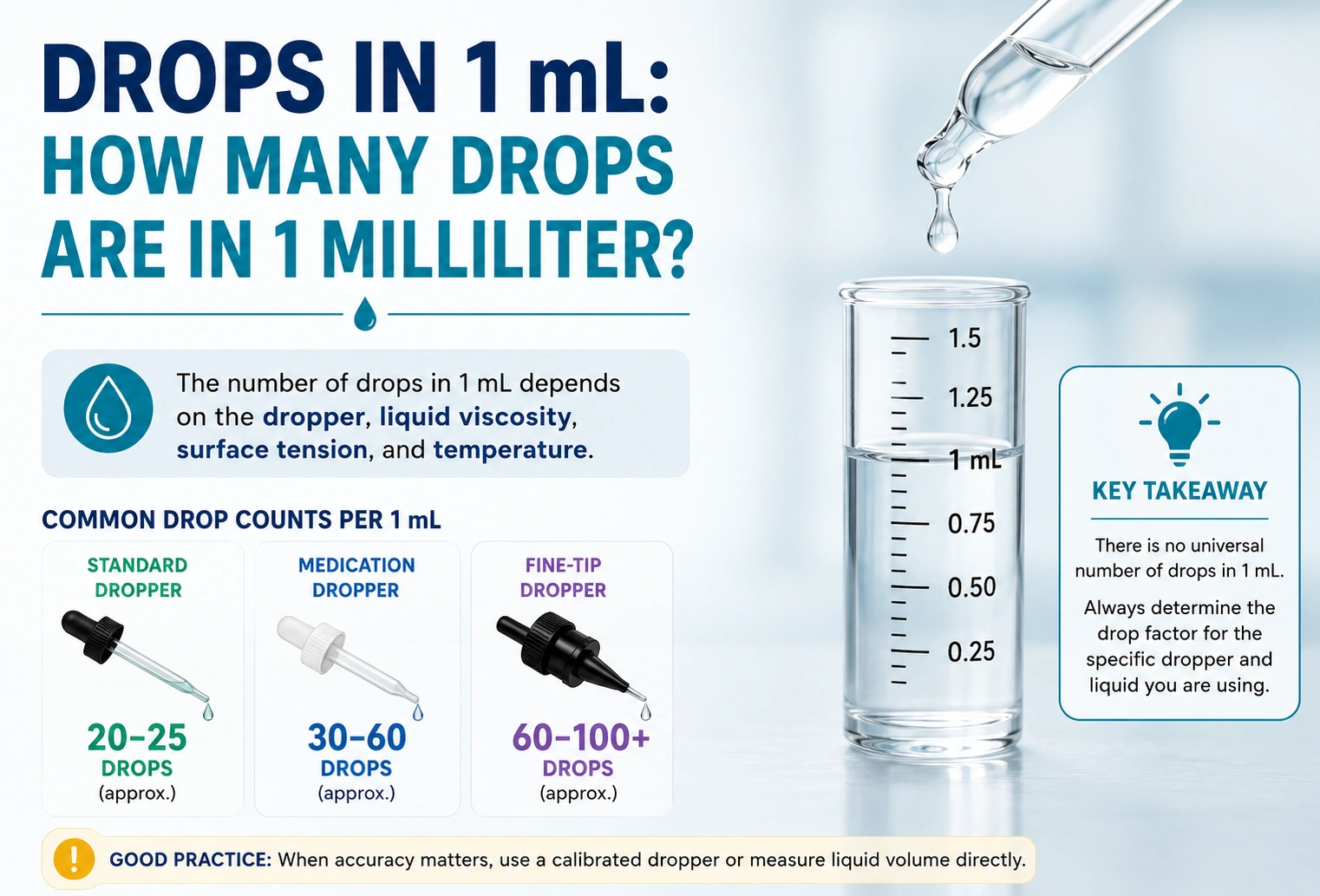
If you’re measuring liquid medicine, essential oils, or other small amounts of liquid, you may wonder how many drops are in 1 mL. While it seems like a simple question, the answer depends on the type of liquid and the dropper being used.
The standard medical conversion is:
1 milliliter (1 mL) = approximately 20 drops
This estimate is widely used in healthcare and pharmacy when a standard dropper is used.
However, the actual number of drops can vary because different liquids have different thicknesses (viscosity), and droppers can produce larger or smaller drops.
In this guide, you’ll learn the standard conversion, why drop size varies, and how to measure liquids accurately.
Quick Answer
| Measurement | Standard Conversion |
|---|---|
| 1 mL | 20 drops |
| 0.5 mL | 10 drops |
| 2 mL | 40 drops |
| 5 mL | 100 drops |
| 10 mL | 200 drops |
For most medical purposes, 1 mL is considered equal to about 20 drops.
What Is a Drop?
A drop is a very small unit of liquid volume delivered from a dropper or similar device.
Drops are commonly used for:
- Liquid medications
- Eye drops
- Ear drops
- Essential oils
- Herbal extracts
- Laboratory solutions
Unlike milliliters, a drop is not a fixed unit of measurement. Its size depends on several factors, including the liquid’s properties and the design of the dropper.
How Many Drops Are in 1 mL?
The standard conversion used in medicine is:
1 mL = 20 drops
This means:
- 1 drop = 0.05 mL
- 20 drops = 1 mL
This standard applies when using a calibrated medical dropper.
Why the Number of Drops Can Vary
Not all liquids produce the same drop size.
Several factors affect the number of drops in 1 mL.
Liquid Thickness (Viscosity)
Thicker liquids usually form larger drops, resulting in fewer drops per milliliter.
Examples include:
- Honey
- Syrups
- Some essential oils
Thinner liquids, such as water or alcohol, often produce smaller drops.
Dropper Design
Different droppers have different opening sizes.
A medicine dropper may produce different-sized drops than an essential oil bottle or laboratory pipette.
Surface Tension
Liquids with different chemical properties form drops differently, affecting the total number of drops in a milliliter.
Temperature
Temperature can slightly change a liquid’s viscosity, which may affect drop size.
Standard mL to Drops Conversion Chart
Using the standard medical conversion:
| Milliliters | Approximate Drops |
|---|---|
| 0.25 mL | 5 drops |
| 0.5 mL | 10 drops |
| 0.75 mL | 15 drops |
| 1 mL | 20 drops |
| 2 mL | 40 drops |
| 3 mL | 60 drops |
| 5 mL | 100 drops |
| 10 mL | 200 drops |
This chart provides quick estimates for many everyday situations.
Common Uses for Drop Measurements
Liquid Medications
Many prescription and over-the-counter medicines include dosage instructions in drops.
Eye Drops
Eye medications are typically administered one or two drops at a time.
Essential Oils
Aromatherapy recipes often specify the number of drops rather than milliliters.
Laboratory Work
Scientists frequently measure very small liquid volumes using droppers or pipettes.
DIY Projects
Homemade cosmetics and cleaning solutions may require precise drop measurements.
How to Measure 1 mL Accurately
For the most accurate results, use one of these tools.
Oral Syringe
An oral syringe marked in milliliters provides the highest accuracy for medications.
Graduated Dropper
Some droppers have measurement markings, making it easier to dispense exactly 1 mL.
Pipette
Laboratories often use pipettes for highly accurate liquid measurements.
Measuring Cup
For larger volumes, a graduated measuring cup may be appropriate, though it is less accurate for very small amounts.
Common Conversion Mistakes
Assuming Every Drop Is the Same Size
Drop size varies depending on the liquid and the dropper.
Using Kitchen Droppers for Medicine
Medical dosing should always use the dropper or syringe supplied with the medication.
Confusing Drops and Milliliters
Drops are estimates, while milliliters are standardized units of volume.
Ignoring Manufacturer Instructions
Some medications specify a different number of drops per milliliter based on the product’s formulation.
Always follow the instructions provided with the medication.
Expert Tips
- Use a calibrated oral syringe whenever possible for medication dosing.
- Keep droppers clean to maintain consistent drop size.
- Store medications according to the manufacturer’s recommendations.
- Never substitute one dropper for another unless instructed.
- When accuracy is critical, rely on milliliter measurements rather than counting drops.
Quick Conversion Summary
| Measurement | Approximate Value |
|---|---|
| 1 Drop | 0.05 mL |
| 20 Drops | 1 mL |
| 100 Drops | 5 mL |
| 200 Drops | 10 mL |
9. Frequently Asked Questions
1. How many drops are in 1 mL?
The standard medical estimate is 20 drops per 1 milliliter when using a calibrated dropper.
2. Does every liquid have 20 drops per mL?
No. The actual number varies depending on the liquid’s viscosity, surface tension, and the type of dropper.
3. Is 1 drop always 0.05 mL?
Approximately, under the standard medical conversion. However, actual drop sizes can differ.
4. What’s the most accurate way to measure 1 mL?
A calibrated oral syringe or graduated pipette is much more accurate than counting drops.
5. Should I count drops for medicine?
Only if the medication instructions specifically direct you to do so. Otherwise, use the measuring device provided with the medicine for the most accurate dose.
10. Conclusion
Understanding drops in 1 mL is helpful for medication dosing, essential oils, laboratory work, and other situations that require measuring small amounts of liquid. As a general guideline, 1 milliliter equals approximately 20 drops when using a standard medical dropper.
However, the exact number of drops can vary depending on the liquid’s properties and the design of the dropper. For the most accurate results—especially when administering medication—always use a calibrated measuring device and follow the manufacturer’s instructions rather than relying solely on drop counts.
Discover More Articles
Pringles Dimensions: Can Sizes & Chip Measurements
Water Bottle Dimensions: Standard Sizes and Measurement Guide