
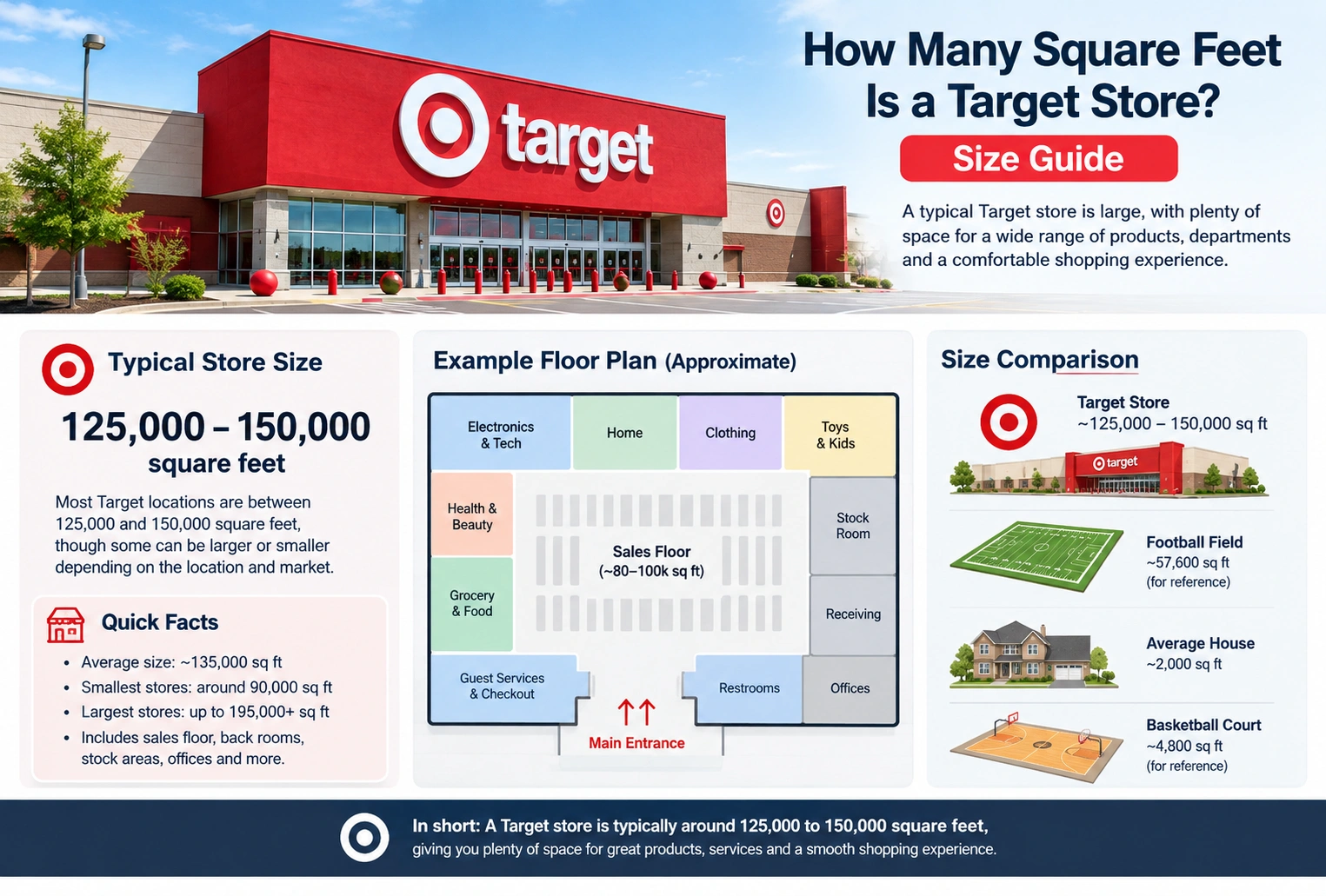
A typical Target store is about 125,000 square feet.
However, Target stores are not all the same size. The company operates stores ranging from less than 50,000 square feet to more than 170,000 square feet, with some locations exceeding 200,000 square feet in total size.
Target’s current store portfolio includes a mixture of standard, small-format, and large-format locations.
As a simple reference:
| Target Store Type | Approximate Size |
|---|---|
| Small-format Target | Under 50,000 sq ft |
| Typical Target store | About 125,000 sq ft |
| Large-format Target | 150,000 sq ft or more |
| Very large Target | 170,000+ sq ft |
| Some exceptional locations | 200,000+ sq ft |
So, if you are trying to visualize a normal Target, 125,000 square feet is a useful estimate.
How Big Is the Average Target Store?
Target says its typical stores across much of the United States average approximately 125,000 square feet.
That is a substantial retail space. To put the number into perspective, 125,000 square feet is roughly equivalent to a rectangular building measuring:
| Example Dimensions | Total Area |
|---|---|
| 250 ft × 500 ft | 125,000 sq ft |
| 300 ft × 417 ft | 125,100 sq ft |
| 350 ft × 357 ft | 124,950 sq ft |
| 400 ft × 312.5 ft | 125,000 sq ft |
The actual dimensions of a Target building vary by location. A store may be wider and shallower, longer and narrower, or designed around an existing shopping-center building.
The 125,000-square-foot figure is therefore best understood as a retail-space estimate, rather than the exact physical dimensions of every Target building.
Target Store Sizes by Format
Target operates several different store sizes rather than using one standard building design everywhere.
This allows the company to serve large suburban markets while also operating locations in dense urban areas, college communities, and other places where a traditional large store may not fit.
Small-Format Target Stores
Small-format stores are substantially smaller than the traditional Target format.
A small Target can have less than 50,000 square feet of retail space. Some locations have historically been around 15,000–20,000 square feet, while others are considerably larger.
These stores are designed around the needs of their particular neighborhoods.
For example, an urban Target may not need the same amount of space for bulk merchandise, parking, inventory, or large household products as a suburban location.
Typical Target Stores
The typical Target store is approximately 125,000 square feet.
This format provides enough space for a broad merchandise assortment, grocery products, household goods, clothing, electronics, beauty products, seasonal merchandise, and fulfillment operations.
It is the size most people should have in mind when they picture a conventional Target location.
Large-Format Target Stores
Target has increasingly invested in larger stores.
Large-format locations can reach approximately 150,000 square feet or more, providing additional space for expanded merchandise selections and fulfillment operations.
Some newer stores have been designed at roughly 150,000 square feet.
Very Large Target Stores
Target also operates locations measuring 170,000 square feet or more.
According to Target’s 2025 annual reporting, 273 stores were in the 170,000-square-foot-or-more category as of January 31, 2026.
Target’s reporting also showed that most stores fall into the 50,000-to-169,999-square-foot category.
Target Store Size Breakdown
Target’s reported retail-space categories provide a useful picture of how its stores vary.
| Retail Space Category | Number of Stores* |
|---|---|
| 170,000 sq ft or more | 273 |
| 50,000–169,999 sq ft | 1,576 |
| 49,999 sq ft or less | 146 |
| Total | 1,995 |
*Based on Target’s January 31, 2026 store data.
This shows why there is no single answer for every Target location.
Most stores are between 50,000 and 169,999 square feet, while a smaller group consists of very large stores and another group consists of small-format locations.
Why Target Stores Have Different Square Footages
Target does not need every store to have the same amount of space.
Store size depends heavily on the market and the location.
Urban Areas
Urban stores often have less available land and higher real estate costs.
A smaller store can make more sense in a dense city neighborhood where customers may walk, use public transportation, or make smaller shopping trips.
Suburban Areas
Suburban locations generally have more available land and larger shopping centers.
A larger Target can provide extensive grocery, household, clothing, electronics, home, and seasonal departments while also accommodating parking and fulfillment operations.
College Communities
Target also operates smaller stores near college campuses.
These locations can emphasize products that are particularly useful to students and nearby residents rather than carrying the complete assortment of a large suburban store.
Local Shopping Patterns
Target can also adjust its merchandise assortment based on the surrounding community.
A store serving a family-heavy suburban area may need more space for certain household and grocery products, while an urban location may prioritize convenience-oriented merchandise.
What Can Fit Inside a Target Store?
A 125,000-square-foot retail space can accommodate a very large assortment of products.
A typical Target can include departments such as:
| Department | Examples |
|---|---|
| Grocery | Food, snacks, beverages, frozen foods |
| Apparel | Men’s, women’s, children’s clothing |
| Home | Furniture, bedding, décor |
| Beauty | Cosmetics, skincare, personal care |
| Electronics | TVs, accessories, headphones, devices |
| Household | Cleaning products, paper goods, storage |
| Toys | Children’s toys and games |
| Sporting Goods | Fitness and recreational products |
| Seasonal | Holiday and seasonal merchandise |
| Pet | Pet food and supplies |
| Pharmacy/Health | Health and wellness products |
| Fulfillment | Pickup, Drive Up and online-order operations |
The store also needs space for aisles, checkout areas, employee areas, storage, inventory handling, and other operational functions.
This is one reason a 125,000-square-foot store can feel much smaller than the raw number suggests once the space is divided among different departments and operational needs.
How Big Is 125,000 Square Feet?
It can be easier to understand Target’s size by comparing it with familiar spaces.
| Space | Approximate Area |
|---|---|
| 1-acre lot | 43,560 sq ft |
| 2 acres | 87,120 sq ft |
| 3 acres | 130,680 sq ft |
| Typical Target retail space | ~125,000 sq ft |
| 5 acres | 217,800 sq ft |
| 10 acres | 435,600 sq ft |
A 125,000-square-foot Target is therefore roughly equivalent to 2.87 acres of floor area.
That does not mean the Target property itself occupies only 2.87 acres. The building is only one part of a retail property.
Target Store Square Footage vs. Building Footprint
One important distinction is the difference between retail square footage and land area.
If a Target has 125,000 square feet of retail space, that does not mean the entire property is 125,000 square feet.
The property may also include:
- Parking lots
- Drive Up spaces
- Loading areas
- Sidewalks
- Landscaping
- Access roads
- Stormwater areas
- Shopping-center common areas
- Delivery and service areas
For example, a 125,000-square-foot building could occupy approximately 2.87 acres if it were a single-story building covering the entire area.
But an actual Target property usually requires substantially more land because customers and delivery vehicles need access to the building.
How Much Land Does a Target Store Need?
There is no universal acreage requirement for every Target.
The amount of land depends on the building size, parking requirements, local zoning, site design, access roads, stormwater requirements, and whether the store is part of a shopping center.
A rough conceptual comparison looks like this:
| Component | Why It Requires Space |
|---|---|
| Store building | Houses retail and operations |
| Parking | Provides customer parking |
| Drive Up | Supports online order pickup |
| Loading area | Receives merchandise |
| Traffic lanes | Allows vehicles to enter and exit |
| Sidewalks | Provides pedestrian access |
| Landscaping | Meets site and design requirements |
| Service areas | Supports store operations |
Therefore, you should not estimate the total Target property size simply by converting its retail square footage into acres.
Why Some Target Stores Are Smaller
Small-format Target stores exist because a large 125,000-square-foot building does not work equally well in every market.
A smaller store can be useful where:
- Real estate is expensive
- Available buildings are limited
- Population density is high
- Customers make frequent smaller trips
- Parking is constrained
- The store serves a college campus
- The neighborhood requires a more convenient shopping format
Small stores can still offer many of the categories customers associate with Target, but the merchandise selection may be more carefully tailored to the local market.
Large Target Stores Can Exceed 150,000 Square Feet
Target has also been expanding its larger store format.
Large stores provide additional room for merchandise, grocery, backroom operations, and same-day fulfillment services.
Target has described newer large-format stores as being around 150,000 square feet, compared with the approximately 125,000-square-foot chain average.
That difference represents about:
150,000 − 125,000 = 25,000 square feet
So a 150,000-square-foot Target has approximately 25,000 more square feet than a 125,000-square-foot store.
| Store Size | Difference From 125,000 sq ft |
|---|---|
| 75,000 sq ft | 50,000 sq ft smaller |
| 100,000 sq ft | 25,000 sq ft smaller |
| 125,000 sq ft | Typical reference size |
| 150,000 sq ft | 25,000 sq ft larger |
| 175,000 sq ft | 50,000 sq ft larger |
| 200,000 sq ft | 75,000 sq ft larger |
How Target Uses Its Store Space
Modern Target stores do more than provide traditional shopping aisles.
Stores increasingly support online orders and same-day fulfillment.
Customers can use services such as:
- Order Pickup
- Drive Up
- Same-day delivery
- In-store shopping
- Online-order fulfillment
This means some of the store’s space needs to support activities that shoppers may not immediately notice.
For example, an employee may retrieve an online order from a backroom or fulfillment area even though the customer never sees that part of the operation.
The store therefore functions as both a retail location and an important part of Target’s fulfillment network.
How Many Square Feet Is a Target Compared With Other Stores?
Target is a large retailer, but store sizes vary widely across the retail industry.
| Retail Store Type | Typical Size Range |
|---|---|
| Small convenience store | 2,000–5,000 sq ft |
| Small grocery store | 10,000–30,000 sq ft |
| Small-format Target | Under 50,000 sq ft |
| Large grocery store | 40,000–80,000+ sq ft |
| Typical Target | ~125,000 sq ft |
| Large Target | ~150,000+ sq ft |
| Very large Target | 170,000+ sq ft |
| Large warehouse retailer | Often 100,000+ sq ft |
These ranges are general comparisons rather than fixed industry standards.
The important point is that a typical Target is considerably larger than a small grocery store or convenience store and is comparable to other major large-format retail buildings.
How Many Acres Is a 125,000-Square-Foot Target?
To convert square feet to acres, divide by 43,560.
125,000 ÷ 43,560 ≈ 2.87 acres
So 125,000 square feet equals approximately 2.87 acres of floor area.
However, remember that this is a mathematical area conversion.
It does not mean a typical Target property is only 2.87 acres. The actual property needs additional land for parking, vehicle circulation, loading, landscaping, and other site requirements.
How Many Square Feet Is a Small Target?
There is no single small-store size.
Target’s current reporting places stores of 49,999 square feet or less in its smallest reported retail-space category.
Historically, Target has operated particularly small-format locations measuring around 20,000 square feet or even less.
These stores are designed for specific environments rather than trying to replicate every feature of a large suburban Target.
How Many Square Feet Is a Large Target?
A large Target can measure approximately 150,000 square feet or more.
Some locations fall into the company’s 170,000-square-foot-or-more category.
Target has also indicated that it is focusing on larger store formats for many new locations because additional space can support expanded assortments and same-day fulfillment services.
Therefore, a reasonable size range for a large Target is approximately 150,000 to 170,000+ square feet, with some locations exceeding that range.
Common Questions About Target Store Size
Is the average Target store 125,000 square feet?
Yes. Target describes its typical stores across much of the country as averaging approximately 125,000 square feet.
How many square feet is a small Target?
Small-format Target stores can be under 50,000 square feet, and some locations are much smaller than a conventional Target.
How big is a large Target?
Large-format Target stores can be approximately 150,000 square feet or more, with some locations measuring 170,000 square feet or more.
Is every Target store the same size?
No. Target operates stores of many different sizes to fit different communities and real estate conditions.
How many acres is a 125,000-square-foot Target?
125,000 square feet equals approximately 2.87 acres when converted mathematically. The actual Target property is usually larger because it also needs parking and other site space.
What is the biggest Target store?
There is not one universally fixed “largest Target” size because stores can change and locations vary. Target reports a category of stores measuring 170,000 square feet or more, and its corporate information says some locations exceed 200,000 square feet.
Why are some Target stores so small?
Smaller Target stores are useful in dense urban areas, college communities, and locations where a large suburban-style building is impractical.
Conclusion
So, how many square feet is a Target store?
A typical Target store is approximately 125,000 square feet. However, Target operates a wide range of locations, from small-format stores under 50,000 square feet to large stores measuring 150,000 square feet or more.
Target’s reported store portfolio also includes hundreds of locations measuring 170,000 square feet or more, showing how significantly store size can vary.
For a quick reference, 125,000 square feet is the best general estimate for a typical Target store. That equals approximately 2.87 acres of floor area, although the actual property requires considerably more land for parking, traffic lanes, loading areas, landscaping, and other functions.
If you are trying to compare the physical size of a Target with another retail store, shopping center, warehouse, or building, using 125,000 square feet as the typical Target reference point is a useful starting place.
Discover More Articles
How Many Feet Is a Softball Field?