

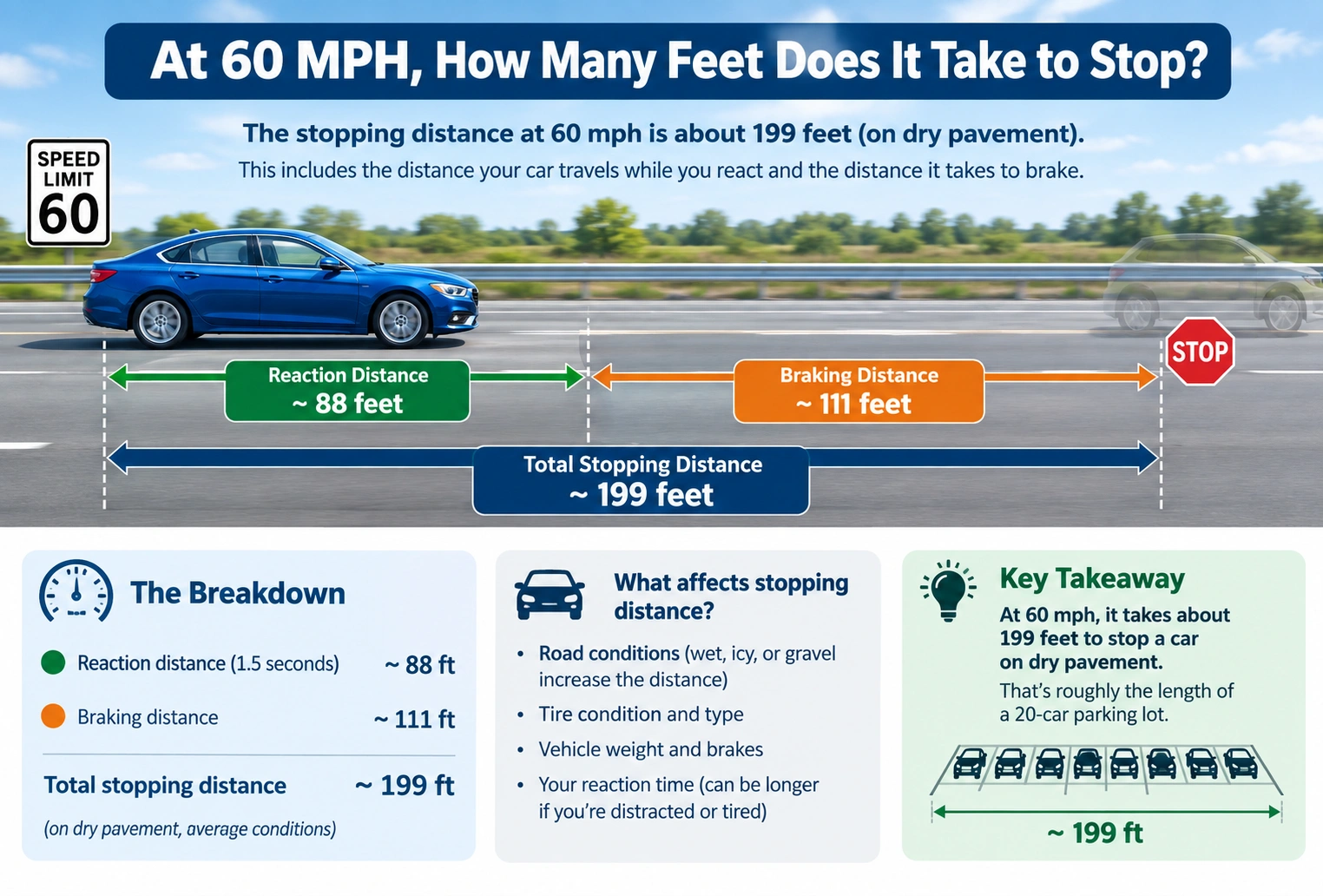
If you’re wondering at 60 mph how many feet to stop, a vehicle traveling at 60 mph may need roughly 250–300 feet to come to a complete stop under typical conditions, including both reaction distance and braking distance.
The exact stopping distance varies based on reaction time, road surface, tires, brakes, vehicle weight, weather, slope, and other conditions.
At 60 mph, the vehicle is traveling 88 feet per second. That means even a one-second reaction time adds about 88 feet before braking begins.
Quick Answer
At 60 mph, a typical passenger vehicle may need approximately 250–300 feet to stop on a dry, level road under favorable conditions.
| Stopping-Distance Component | Approximate Distance at 60 MPH |
|---|---|
| Speed | 60 mph |
| Speed in feet per second | 88 ft/s |
| Reaction distance at 1 second | 88 ft |
| Braking distance | Roughly 180 ft* |
| Total stopping distance | About 268 ft* |
*Actual braking distance varies significantly with vehicle, tires, road conditions, brakes, and testing method.
A useful planning figure is therefore about 270 feet, but drivers should not treat this as a guaranteed stopping distance.
How Far Does a Car Travel at 60 MPH?
Before calculating stopping distance, it helps to understand how quickly a vehicle covers the road at 60 mph.
One mile contains 5,280 feet, and one hour contains 3,600 seconds.
Therefore:
60 × 5,280 ÷ 3,600 = 88 feet per second
So at 60 mph, a vehicle travels approximately 88 feet every second.
| Time | Distance Traveled at 60 MPH |
|---|---|
| 0.5 second | 44 ft |
| 1 second | 88 ft |
| 1.5 seconds | 132 ft |
| 2 seconds | 176 ft |
| 3 seconds | 264 ft |
This is why reaction time has such a major effect on total stopping distance.
What Is Total Stopping Distance?
Stopping distance is not simply the distance covered while the brakes are working.
It generally consists of two major components:
Total stopping distance = reaction distance + braking distance
Reaction distance is the distance the vehicle travels while the driver recognizes a hazard and begins braking.
Braking distance is the distance traveled after braking begins until the vehicle comes to a stop.
The important concept is that you continue moving during the driver’s reaction time. The brakes cannot slow the vehicle until the driver reacts and applies them.
Reaction Distance at 60 MPH
At 60 mph, the vehicle travels about 88 feet per second.
If the driver’s reaction time is one second, the vehicle travels about 88 feet before braking starts.
| Reaction Time | Approximate Reaction Distance at 60 MPH |
|---|---|
| 0.5 sec | 44 ft |
| 0.75 sec | 66 ft |
| 1.0 sec | 88 ft |
| 1.25 sec | 110 ft |
| 1.5 sec | 132 ft |
| 2.0 sec | 176 ft |
| 2.5 sec | 220 ft |
Reaction time can increase because of distraction, fatigue, alcohol or drugs, unfamiliar situations, poor visibility, or other factors.
This is one reason following distance should provide a substantial safety margin rather than being based on the minimum distance required by an ideal test.
Braking Distance at 60 MPH
Braking distance depends heavily on how quickly the vehicle can lose speed after the brakes are applied.
Under simplified physics assumptions, braking distance is related to the square of speed. This means increasing speed can increase braking distance dramatically.
For example, if other conditions remain the same, doubling speed does not simply double braking distance—it can increase the braking distance by approximately four times.
This is why a vehicle traveling at 60 mph requires much more stopping distance than one traveling at 30 mph.
60 MPH Stopping Distance on a Dry Road
On a dry, level road with good tires and properly functioning brakes, a modern passenger vehicle can potentially stop in a shorter distance than older or poorly maintained vehicles.
However, there is no single stopping distance that applies to every vehicle.
| Condition | Effect on Stopping Distance |
|---|---|
| Dry pavement | Generally shorter |
| Good tires | Better traction |
| Properly functioning brakes | Better braking performance |
| Wet pavement | Usually longer |
| Worn tires | Longer |
| Snow or ice | Much longer |
| Driver distraction | Increases reaction distance |
The condition of the road and vehicle can change the result substantially.
How Many Feet to Stop at 60 MPH in the Rain?
A vehicle generally needs more stopping distance on wet pavement than on dry pavement.
Water reduces available tire-road friction, and worn tires can make the situation worse.
There is no reliable single number for wet-road stopping distance because rainfall intensity, standing water, tire condition, tread depth, road surface, temperature, and vehicle characteristics all matter.
For safety purposes, drivers should increase following distance when roads are wet rather than relying on a fixed stopping-distance number.
How Many Feet to Stop at 60 MPH on Snow or Ice?
Stopping on snow or ice can require dramatically more distance than stopping on dry pavement.
Reduced traction means the tires have less ability to slow the vehicle efficiently.
| Road Condition | Relative Stopping Distance |
|---|---|
| Dry pavement | Shortest under otherwise equal conditions |
| Wet pavement | Longer |
| Packed snow | Significantly longer |
| Ice | Potentially dramatically longer |
Exact distances on snow and ice can vary so much that a single number would be misleading.
If traction is poor, reducing speed is one of the most important ways to reduce stopping distance.
Why Speed Has Such a Large Effect
Speed affects stopping distance in two ways.
First, higher speed means the vehicle covers more ground during the driver’s reaction time.
Second, under simplified braking conditions, braking distance increases approximately with the square of speed.
For example, compare 30 mph and 60 mph.
| Speed | Relative Braking-Distance Factor* |
|---|---|
| 20 mph | 1× |
| 30 mph | 2.25× |
| 40 mph | 4× |
| 50 mph | 6.25× |
| 60 mph | 9× |
*Relative to 20 mph under the same simplified braking conditions.
This illustrates why a relatively small increase in speed can have a large effect on braking distance.
60 MPH Stopping Distance Compared With Other Speeds
Comparing speeds makes the difference easier to understand.
| Speed | Approx. Speed in Feet per Second | Reaction Distance at 1 Second |
|---|---|---|
| 20 mph | 29.3 ft/s | 29 ft |
| 30 mph | 44 ft/s | 44 ft |
| 40 mph | 58.7 ft/s | 59 ft |
| 50 mph | 73.3 ft/s | 73 ft |
| 60 mph | 88 ft/s | 88 ft |
| 70 mph | 102.7 ft/s | 103 ft |
At 60 mph, a one-second reaction period alone accounts for approximately 88 feet.
What Factors Affect Stopping Distance?
Many factors can affect how many feet a vehicle needs to stop.
Driver Reaction Time
A faster reaction reduces the distance traveled before braking begins.
A distracted or tired driver may take longer to respond.
Vehicle Speed
Higher speed increases reaction distance directly and can increase braking distance substantially.
Tires
Tire condition, tread depth, tire pressure, tire type, and available traction can affect braking performance.
Road Surface
Dry pavement generally provides more traction than wet, snowy, or icy pavement.
Brakes
Properly maintained brakes are essential for safe stopping. Worn or damaged braking components can affect performance.
Vehicle Weight and Load
Vehicle characteristics and loading can affect stopping behavior, although the relationship is more complicated than simply assuming that a heavier vehicle always takes a particular number of extra feet.
Road Grade
A downhill slope can increase the distance needed to stop, while an uphill slope can reduce it.
60 MPH Stopping Distance: Reaction vs. Braking
It is useful to separate the two parts of stopping distance.
Suppose a driver traveling at 60 mph takes one second to react.
The vehicle travels:
88 feet during the reaction period.
If braking then requires another approximately 180 feet under a particular set of test conditions, total stopping distance would be:
88 + 180 = 268 feet
| Component | Example Distance |
|---|---|
| Reaction distance | 88 ft |
| Braking distance | 180 ft |
| Total | 268 ft |
This is an example rather than a universal stopping-distance specification.
How Does a 2-Second Reaction Time Change Stopping Distance?
At 60 mph, two seconds of reaction time means traveling approximately 176 feet before braking begins.
If braking conditions were otherwise identical to the previous example:
176 + 180 = 356 feet
| Reaction Time | Reaction Distance | Example Braking Distance | Example Total |
|---|---|---|---|
| 1 sec | 88 ft | 180 ft | 268 ft |
| 1.5 sec | 132 ft | 180 ft | 312 ft |
| 2 sec | 176 ft | 180 ft | 356 ft |
| 2.5 sec | 220 ft | 180 ft | 400 ft |
This demonstrates how quickly total stopping distance can increase when the driver takes longer to respond.
How Many Car Lengths Is 270 Feet?
A typical passenger car is roughly 14–16 feet long, although vehicle sizes vary.
Using 15 feet as a simple comparison:
270 ÷ 15 = 18 car lengths
So 270 feet is roughly equivalent to 18 passenger-car lengths using a 15-foot vehicle as the reference.
| Distance | Approximate 15-Foot Car Lengths |
|---|---|
| 150 ft | 10 |
| 180 ft | 12 |
| 225 ft | 15 |
| 270 ft | 18 |
| 300 ft | 20 |
| 360 ft | 24 |
This comparison is only for visualization; actual vehicles have different lengths.
Common Mistakes About Stopping Distance
Mistake 1: Counting Only Braking Distance
Stopping begins with driver reaction. Ignoring reaction distance can seriously underestimate how much road is needed.
Mistake 2: Assuming 60 MPH Always Equals One Exact Distance
Stopping distance changes with road, vehicle, tires, driver, weather, and braking conditions.
Mistake 3: Ignoring Wet or Icy Conditions
A stopping distance measured on dry pavement should not be assumed to apply to rain, snow, or ice.
Mistake 4: Following Too Closely
Knowing a theoretical stopping distance does not make it safe to follow another vehicle at that distance.
Traffic conditions require a safety margin because the vehicle ahead can brake suddenly and the driver may need additional time to recognize and respond.
Frequently Asked Questions
At 60 mph, how many feet does it take to stop?
A typical passenger vehicle may require roughly 250–300 feet under favorable dry-road conditions, including reaction and braking distance. The actual distance varies substantially.
How many feet per second is 60 mph?
At 60 mph, a vehicle travels approximately 88 feet per second.
How far do you travel in one second at 60 mph?
You travel approximately 88 feet in one second at 60 mph.
How far does a car travel before stopping at 60 mph?
The total depends on reaction time and braking performance. A rough planning example is around 250–300 feet under favorable conditions, but actual stopping distances can be shorter or longer.
How much longer does it take to stop in the rain at 60 mph?
There is no single universal number. Wet pavement generally reduces available traction and can increase stopping distance, so drivers should allow additional following distance.
How far does it take to stop at 60 mph on ice?
Stopping distance on ice can be dramatically longer than on dry pavement and varies with temperature, ice condition, tires, vehicle, and braking behavior. Drivers should reduce speed substantially.
Does reaction time affect stopping distance?
Yes. At 60 mph, every additional second of reaction time adds approximately 88 feet of travel before braking begins.
Does stopping distance increase with speed?
Yes. Reaction distance increases directly with speed, while braking distance under simplified conditions increases approximately with the square of speed.
Conclusion
If you’re asking at 60 mph how many feet to stop, a reasonable general estimate for a passenger vehicle under favorable dry-road conditions is approximately 250–300 feet, including reaction and braking distance.
At 60 mph, a vehicle travels 88 feet every second, so even a one-second reaction time adds nearly 90 feet before braking begins.
However, stopping distance is not a fixed number. Wet roads, snow, ice, worn tires, poor brakes, downhill grades, heavy loads, and slower driver reactions can all increase the distance required.
The safest approach is to maintain a generous following distance, adjust your speed for road conditions, and never assume that a theoretical stopping distance guarantees that you can stop within a particular number of feet.
Discover More Articles
12×15 Is How Many Square Feet?