
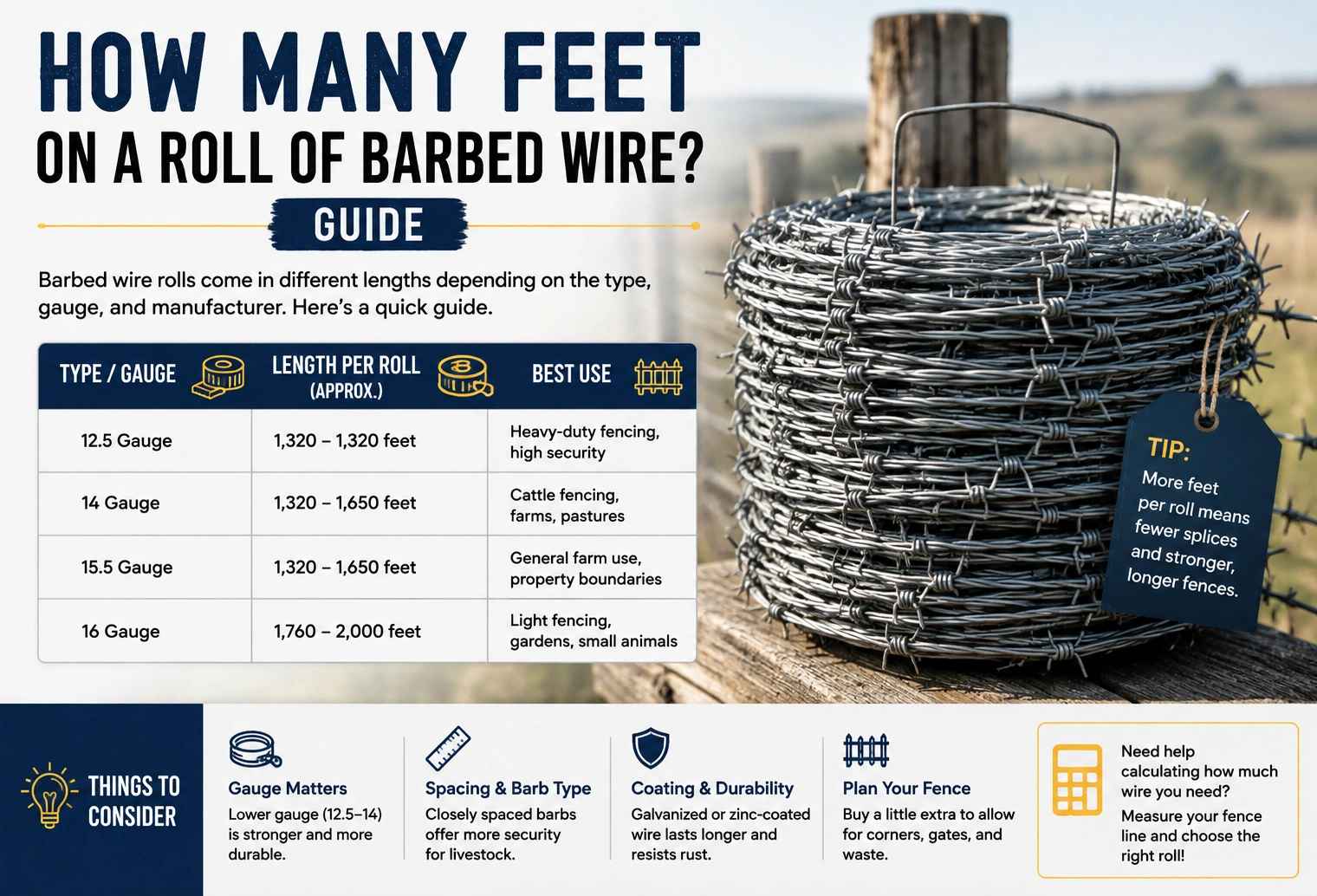
If you’re planning a fence project, one of the first questions to answer is how many feet are on a roll of barbed wire? The answer depends on the manufacturer, wire type, and roll size, but many commonly sold rolls contain 1,320 feet of barbed wire.
A 1,320-foot roll is equal to 80 rods, making it a common reference size for agricultural and livestock fencing.
However, not every roll contains 1,320 feet. Some products are sold in shorter or longer lengths, so checking the package or manufacturer’s specifications is important before calculating your total fencing needs.
Quick Answer
A common roll of barbed wire contains approximately:
| Roll Size | Length |
|---|---|
| Small roll | 330 feet |
| Medium roll | 660 feet |
| Common full roll | 1,320 feet |
| Large roll | 1,500+ feet |
Answer: A standard full-size roll of barbed wire is often 1,320 feet long.
That means one 1,320-foot roll provides 1,320 linear feet of wire if it is installed as a single strand.
If you install multiple strands, however, the actual fence-line coverage is lower.
For example, a 1,320-foot roll can cover:
| Number of Wire Strands | Approximate Fence Length |
|---|---|
| 1 strand | 1,320 ft |
| 2 strands | 660 ft |
| 3 strands | 440 ft |
| 4 strands | 330 ft |
| 5 strands | 264 ft |
| 6 strands | 220 ft |
The calculation is simple:
Fence length = Total wire ÷ Number of strands
Common Barbed Wire Roll Lengths
Barbed wire is manufactured and sold in several different roll lengths. The most appropriate size depends on the fence project and the product being purchased.
| Barbed Wire Roll | Approximate Length |
|---|---|
| Compact roll | 330 ft |
| Half roll | 660 ft |
| Full roll | 1,320 ft |
| Extended roll | 1,500–2,000+ ft |
The 1,320-foot roll is particularly common in agricultural fencing because it provides a substantial amount of wire while remaining practical to transport and install.
Keep in mind that the phrase “standard roll” does not guarantee a specific length. Manufacturers may package their products differently.
Before purchasing, look for the stated linear footage, usually printed on the label or product specifications.
How Much Fence Does One Roll Cover?
The amount of fence a roll covers depends on how many strands you plan to install.
A 1,320-foot roll does not automatically mean you can build 1,320 feet of finished fence. That’s because most barbed wire fences use several horizontal strands.
For example, suppose you’re building a fence with four strands.
You can calculate the coverage like this:
1,320 ÷ 4 = 330 feet
So one 1,320-foot roll provides approximately 330 feet of four-strand fence, before allowing for waste.
Here’s another example:
| Fence Configuration | Wire Required for 500 ft of Fence |
|---|---|
| 1 strand | 500 ft |
| 2 strands | 1,000 ft |
| 3 strands | 1,500 ft |
| 4 strands | 2,000 ft |
| 5 strands | 2,500 ft |
| 6 strands | 3,000 ft |
This is why determining the number of strands is essential when estimating how much barbed wire to buy.
How to Calculate How Many Rolls You Need
You can estimate the number of rolls using a simple formula:
Number of rolls = Fence length × Number of strands ÷ Feet per roll
For example, assume you have a 1,000-foot fence and want four strands of barbed wire.
First calculate the total wire:
1,000 × 4 = 4,000 feet
If each roll contains 1,320 feet:
4,000 ÷ 1,320 = 3.03 rolls
Since you cannot purchase 0.03 of a roll, you would need 4 rolls.
It’s also wise to include extra material for corners, gates, connections, tensioning, and cutting.
Example: 2,000-Foot Fence
Suppose your fence is 2,000 feet long and you want five strands.
2,000 × 5 = 10,000 feet
Now divide by the roll length:
10,000 ÷ 1,320 = 7.58 rolls
You would need 8 rolls at minimum, with additional material recommended if your fence has complicated sections or significant waste.
Factors That Affect Barbed Wire Coverage
The advertised length of a roll is only one part of the calculation. Several factors affect how much usable fencing you actually get.
Number of Strands
The more strands you install, the faster you use the wire.
A single-strand fence can cover the greatest distance from one roll, while a five- or six-strand fence uses considerably more material.
Fence Length
Measure the actual perimeter rather than estimating from the property size.
Irregular boundaries, curves, and changes in direction can increase the amount of wire required.
Gates
Gates create interruptions in the fence line. Depending on the installation method, additional wire may be needed around gate openings and termination points.
Corners
Corners often require additional fastening, tensioning, and connections. This can increase material requirements.
Waste
Cutting, damaged wire, mistakes, and leftover sections can reduce the usable length of a roll.
For this reason, purchasing exactly the calculated amount is generally not ideal.
Barbed Wire Roll Length by Fence Rows
The easiest way to visualize coverage is to compare the number of strands with a common 1,320-foot roll.
| Fence Strands | Coverage From 1,320-ft Roll |
|---|---|
| 1 | 1,320 ft |
| 2 | 660 ft |
| 3 | 440 ft |
| 4 | 330 ft |
| 5 | 264 ft |
| 6 | 220 ft |
| 7 | About 189 ft |
For example, if your property requires 600 feet of four-strand fencing, calculate:
600 × 4 = 2,400 feet of wire
Then:
2,400 ÷ 1,320 = 1.82 rolls
You would need 2 rolls, plus an allowance for waste and installation.
How to Measure Your Fence Line
Accurate measurements are important because even a small error can become significant when multiple strands are involved.
Start by measuring the complete perimeter of the area you want to enclose.
You can use:
- A measuring wheel
- Long measuring tape
- GPS measuring equipment
- Property survey information
- A mapping application
- Existing fence measurements
Break irregular boundaries into smaller sections and add them together.
For example:
| Fence Section | Length |
|---|---|
| North side | 500 ft |
| East side | 750 ft |
| South side | 500 ft |
| West side | 750 ft |
| Total | 2,500 ft |
If you install four strands:
2,500 × 4 = 10,000 feet of wire
At 1,320 feet per roll:
10,000 ÷ 1,320 = 7.58 rolls
You would therefore need at least 8 rolls before adding a waste allowance.
How Much Extra Wire Should You Buy?
It’s usually better to have some extra wire than to run short near the end of a project.
A common planning approach is to add approximately 5% to 10% to the calculated wire requirement, although the appropriate allowance depends on the project.
For example, if your calculation requires 10,000 feet:
10,000 × 1.05 = 10,500 feet
With a 10% allowance:
10,000 × 1.10 = 11,000 feet
You can then divide the adjusted requirement by the length of each roll.
For a 1,320-foot roll:
| Required Wire | With 5% Extra | With 10% Extra |
|---|---|---|
| 5,000 ft | 5,250 ft | 5,500 ft |
| 7,500 ft | 7,875 ft | 8,250 ft |
| 10,000 ft | 10,500 ft | 11,000 ft |
| 15,000 ft | 15,750 ft | 16,500 ft |
Adding extra material can help account for cutting, splicing, corners, gates, and installation mistakes.
Common Mistakes When Estimating Barbed Wire
Mistake 1: Assuming Every Roll Has 1,320 Feet
Although 1,320 feet is a common roll length, products vary.
Always verify the actual footage printed on the product label.
Mistake 2: Forgetting Multiple Strands
A 1,000-foot fence does not necessarily require only 1,000 feet of wire.
A four-strand fence requires approximately:
1,000 × 4 = 4,000 feet
Mistake 3: Ignoring Waste
Your mathematical calculation may be exact, but installation rarely is.
Allow some extra material for practical installation needs.
Mistake 4: Measuring the Property Instead of the Fence Line
A property’s acreage does not tell you the exact length of fence required.
A long, narrow property can require considerably more fencing than a compact property with the same area.
Mistake 5: Not Checking the Wire Specification
Barbed wire products can differ in gauge, strand construction, coating, barb spacing, and strength.
Make sure the selected product is appropriate for your intended fence.
Barbed Wire Roll Calculation Examples
Here are several common scenarios.
| Fence Length | Strands | Total Wire | 1,320-ft Rolls Needed |
|---|---|---|---|
| 500 ft | 2 | 1,000 ft | 1 |
| 500 ft | 4 | 2,000 ft | 2 |
| 1,000 ft | 3 | 3,000 ft | 3 |
| 1,000 ft | 4 | 4,000 ft | 4 |
| 2,000 ft | 4 | 8,000 ft | 7 |
| 2,500 ft | 5 | 12,500 ft | 10 |
| 5,000 ft | 4 | 20,000 ft | 16 |
These figures represent mathematical minimums based on 1,320-foot rolls. Actual purchasing requirements may be higher once waste and installation conditions are considered.
What Does 1,320 Feet Equal?
It can also help to understand the length of a 1,320-foot roll in other units.
| Measurement | Equivalent |
|---|---|
| Feet | 1,320 ft |
| Yards | 440 yd |
| Miles | 0.25 mile |
| Meters | 402.34 m |
| Kilometers | 0.402 km |
Interestingly, 1,320 feet equals exactly one-quarter of a mile.
This makes the 1,320-foot roll particularly easy to remember:
1 roll = 1,320 ft = 440 yd = ¼ mile
FAQs
How many feet are on a standard roll of barbed wire?
A common full-size roll contains 1,320 feet of barbed wire, although roll lengths vary by manufacturer and product.
How many feet of fence will a 1,320-foot roll cover?
If you install one strand, it can cover 1,320 feet. With four strands, it covers approximately 330 feet of fence.
How many rolls of barbed wire do I need for 1,000 feet?
For a four-strand fence, you need 4,000 feet of wire. With 1,320-foot rolls, that requires 4 rolls, before adding extra material for waste.
Is 1,320 feet the same as a quarter mile?
Yes. 1,320 feet equals exactly 0.25 mile, or one-quarter of a mile.
How many yards are in a 1,320-foot roll?
There are 440 yards in 1,320 feet because one yard equals three feet.
Should I buy extra barbed wire?
Yes. Extra wire can account for corners, gates, connections, cutting, damaged sections, and installation waste. A 5% to 10% allowance is often useful for planning.
Does barbed wire roll length vary?
Yes. Barbed wire is available in different roll sizes, so always check the manufacturer’s stated footage rather than assuming every roll contains 1,320 feet.
Conclusion
So, how many feet are on a roll of barbed wire? A common full-size roll contains 1,320 feet, which equals 440 yards or one-quarter of a mile.
The actual amount of fence that one roll can cover depends on how many strands you install. A 1,320-foot roll covers about 330 feet of four-strand fence, 440 feet of three-strand fence, or 660 feet of two-strand fence.
To estimate your total requirement, multiply the fence-line length by the number of strands, divide by the footage per roll, and round up to the next whole roll. Adding approximately 5% to 10% extra can also help account for installation waste and unexpected requirements.
Before purchasing, always verify the actual roll length, wire specifications, and intended fencing configuration for your particular project.
Discover More Articles
How Many Square Feet Is 30 x 30? Easy Area Guide