
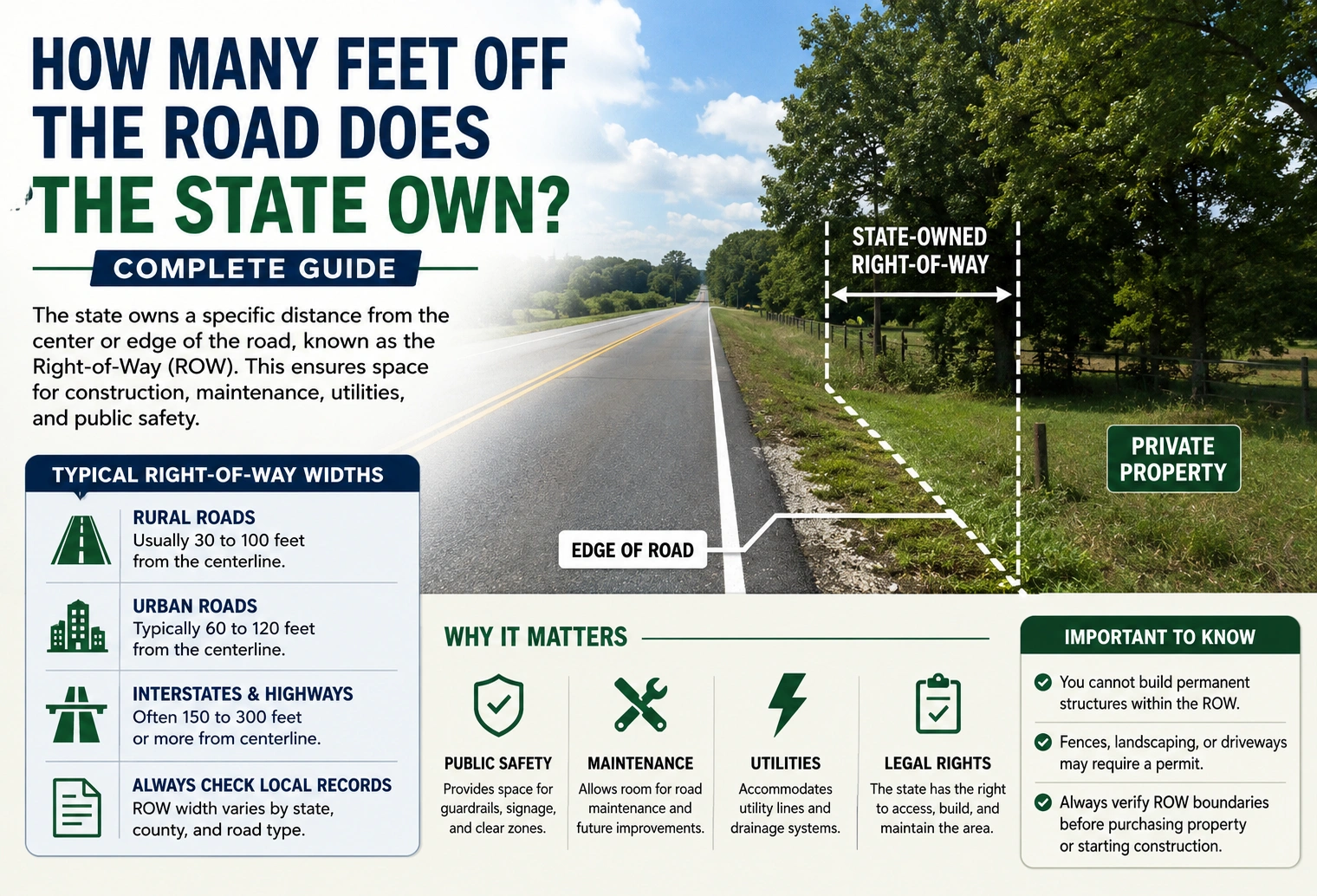
If you’re wondering how many feet off the road the state owns, there is no single number that applies to every road or property.
A state may own or control a road right-of-way that extends beyond the paved portion of the road. However, the width of that right-of-way can vary significantly depending on the state’s laws, the road’s classification, when the road was established, property records, and the specific right-of-way documents.
In some locations, the road right-of-way may extend only a limited distance beyond the pavement. In other locations, a highway corridor can be substantially wider.
The important distinction is that the edge of the pavement is not necessarily the property boundary.
If you need to know exactly how many feet of land the state owns or controls next to your property, you generally need to check the recorded property documents, right-of-way records, or an official survey.
Quick Answer
There is no universal number of feet that the state owns off every road.
A road may have a right-of-way extending beyond the pavement, but the exact width depends on the specific road and location.
| Question | General Answer |
|---|---|
| Does state road property always end at the pavement? | No |
| Is there one standard right-of-way width? | No |
| Can the right-of-way extend onto private property? | Yes |
| Does a right-of-way always mean the state owns the land? | No |
| Best way to find the exact boundary | Property records and a survey |
For example, if the pavement ends 15 feet from your property line, you should not automatically assume that the state owns or controls exactly 15 feet.
The legal road boundary could be farther away or closer, depending on the recorded right-of-way.
Why There Is No Standard Number of Feet
Roads are established under different circumstances, and their right-of-way boundaries can vary.
Several factors may affect the width:
- State law
- County or local regulations
- Road classification
- Original highway plans
- Recorded easements
- Deeds
- Plats
- Historical road acquisitions
- Property subdivisions
- Highway expansion
- Official surveys
A major state highway may have a very different right-of-way from a small rural road.
Even two roads that appear similar can have different legal boundaries.
This is why an estimate based only on how far the pavement extends from your property is unreliable.
What Is a Road Right-of-Way?
A right-of-way is a legal right allowing a government agency, utility, or another party to use a particular portion of land for a specified purpose.
For public roads, the right-of-way generally provides the legal corridor needed for the roadway and related transportation facilities.
It can include more than the actual driving surface.
Depending on the road, a right-of-way may contain:
- Travel lanes
- Shoulders
- Drainage areas
- Ditches
- Slopes
- Medians
- Guardrails
- Signs
- Utility facilities
- Future road improvements
- Maintenance areas
As a result, the visible pavement may represent only part of the overall road corridor.
How Wide Can a Road Right-of-Way Be?
There is no single width that applies to every state highway.
The total right-of-way can vary from one road to another.
| Road Situation | Possible Right-of-Way Characteristics |
|---|---|
| Small local road | Often narrower |
| Rural road | May include substantial roadside areas |
| County highway | Width depends on local records and acquisition |
| State highway | May have a wider transportation corridor |
| Major highway | Can require significant land beyond pavement |
| Road planned for expansion | May have additional reserved land |
These are general categories rather than guaranteed measurements.
A particular road’s legal right-of-way must be determined from the records applicable to that road.
Does the State Actually Own the Land?
This is one of the most important questions.
Owning land and having a right-of-way are not necessarily the same thing.
In some cases, the government owns the land within the road corridor.
In other cases, a private property owner may retain ownership of the underlying land while the government has a legal easement or right-of-way over it.
That means you cannot determine ownership simply by looking at the road.
| Situation | Who May Own the Underlying Land? | Government Rights |
|---|---|---|
| State-owned highway property | State | Road and maintenance rights |
| Highway easement | Private owner | Specified roadway rights |
| Dedicated public road | Depends on dedication and records | Public roadway rights |
| County right-of-way | County or another owner | Transportation and maintenance rights |
| Private road easement | Private owner | Easement holder has specified rights |
The exact legal arrangement depends on the documents establishing the road.
How to Find the Exact Road Right-of-Way Boundary
If you own property next to a state road, the most reliable approach is to research the actual records for that property and road.
Check Your Property Deed
Start with your deed.
Look for descriptions involving:
- Road frontage
- Highway
- Right-of-way
- Easement
- Boundary lines
- Reservations
- Rights retained by the government
A deed may reference a road or right-of-way without giving you an obvious measurement in feet.
Look at the Recorded Plat
A recorded subdivision plat or survey may show the road and its right-of-way.
Look for labels such as:
- R/W
- ROW
- Right-of-way
- Highway right-of-way
- Easement
- Road easement
If dimensions are shown, they can provide useful information about the width of the corridor.
Contact the Transportation Department
For a state-maintained highway, the state’s transportation or highway agency may have records showing the official right-of-way.
These records can be particularly useful when the road has been widened, relocated, or modified over time.
Hire a Licensed Land Surveyor
If the question affects a property purchase, fence, building, driveway, addition, or other significant project, a licensed land surveyor is often the safest option.
A survey can establish the location of property lines and identify relevant easements and rights-of-way based on the available legal records and field evidence.
State-Owned Road vs County-Owned Road
Another common mistake is assuming that every public road is owned by the state.
That’s not necessarily true.
Roads can be maintained or controlled by different government entities.
| Road Type | Possible Responsible Agency |
|---|---|
| Interstate highway | State and/or federal transportation system |
| State highway | State transportation agency |
| County road | County government |
| Municipal street | City or town |
| Private road | Private owner or association |
The government entity responsible for maintaining a road can help you determine where to look for right-of-way records, but maintenance responsibility alone does not necessarily establish ownership of every inch of land alongside the road.
Can You Build or Fence in the Road Right-of-Way?
You should not assume that you can build, fence, plant permanent landscaping, or place structures in an apparent roadside area simply because you own the adjacent property.
A public right-of-way may restrict what can be placed within the corridor.
Potentially restricted activities can include:
- Building structures
- Installing fences
- Planting large trees
- Placing signs
- Constructing retaining walls
- Installing certain driveways
- Excavating
- Adding permanent landscaping
The specific restrictions vary by jurisdiction and the type of right-of-way involved.
Before installing anything near a suspected road boundary, verify the right-of-way and applicable regulations.
Why the Pavement Edge Is Not the Property Line
A common misconception is:
“The state owns everything from the pavement to a certain number of feet.”
That isn’t a reliable rule.
The pavement may be located within a much larger right-of-way.
For example, imagine a road where the paved surface is 24 feet wide. That does not automatically mean the government owns only the 24 feet of pavement.
The legal corridor could extend beyond both sides of the paved roadway.
The additional land may be needed for shoulders, drainage, slopes, signs, maintenance, or future improvements.
Common Mistakes About Road Right-of-Way
Mistake 1: Assuming Every State Road Has the Same Width
Different roads can have different right-of-way widths.
There is no universal measurement that can be applied to every property.
Mistake 2: Measuring From the Pavement
Measuring a certain number of feet from the pavement edge may give you a rough physical measurement, but it does not establish the legal boundary.
Mistake 3: Assuming the State Owns the Entire Right-of-Way
A right-of-way can be an easement rather than outright ownership.
The government may have rights to use and maintain the area without owning the underlying land in the same way as a private property owner.
Mistake 4: Relying Only on a Property App
Online property maps can be useful for general reference, but they should not be treated as a precise legal survey.
Property lines shown on mapping websites may be approximate.
Mistake 5: Building Before Checking the Boundary
Installing a fence, shed, driveway, retaining wall, or other improvement too close to a road can create problems if it falls within the right-of-way or violates local requirements.
FAQs
How many feet off the road does the state own?
There is no universal number of feet. The state’s ownership or right-of-way may extend beyond the pavement, and the exact distance depends on the specific road and legal records.
How far does a state road right-of-way extend?
It varies by road and location. The right-of-way may extend beyond the paved roadway to include shoulders, drainage, slopes, signs, utilities, and other transportation needs.
Does the state own the land next to my property?
Not necessarily. The state may own the land, or it may have a right-of-way or easement over land that remains privately owned.
How do I find out where the state road right-of-way ends?
Start by checking your deed, recorded plat, property survey, and county records. You can also contact the relevant state transportation agency. For an exact boundary determination, a licensed land surveyor can review the legal records and locate the boundary in the field.
Is the road right-of-way the same as the property line?
Not always. A property line and a public road right-of-way are separate legal concepts. A right-of-way can cross or border private property without necessarily changing who owns the underlying land.
Can I put a fence next to a state road?
Possibly, but you should verify the road’s right-of-way and applicable state or local regulations first. A fence placed inside the public right-of-way may have to be removed.
Does the state own 33 feet from the center of the road?
You should not assume that a specific measurement such as 33 feet applies to your property. Road right-of-way widths differ, and the controlling boundary should be established from the applicable legal records.
Can a road right-of-way be wider than the road itself?
Yes. A right-of-way can include land beyond the pavement for shoulders, drainage, slopes, maintenance, signs, utilities, and potential transportation improvements.
Are online property maps accurate enough to determine the road boundary?
Online maps can be useful for general research, but they should not normally be treated as a substitute for a recorded survey or official right-of-way documentation when an exact legal boundary matters.
Conclusion
There is no standard number of feet that the state owns off every road.
The legal road corridor may extend beyond the pavement, but the exact width depends on the particular road, government agency, property records, easements, deeds, plats, and other legal documents.
It is also important to distinguish ownership from a right-of-way. In some situations, the government owns the land. In others, a private owner may own the underlying property while the government has rights to use and maintain the roadway corridor.
If you’re trying to determine whether a specific fence, building, driveway, or other improvement is inside the road right-of-way, don’t rely on a general number of feet. Check the recorded documents and, when precision is important, have a licensed land surveyor establish the applicable boundary.
Discover More Articles
How Many Cubic Feet in an 80 lb Bag of Concrete?