
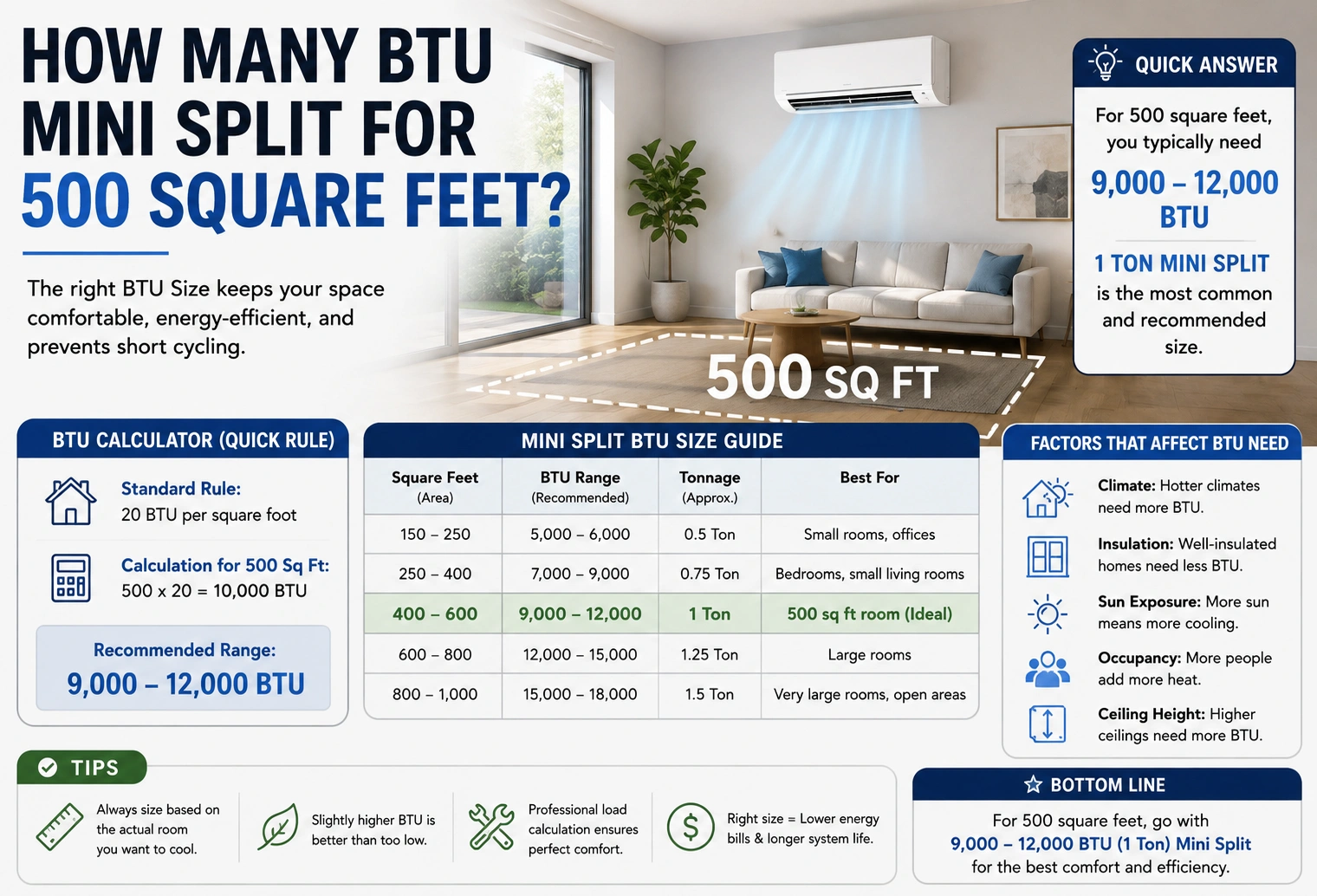
For a 500-square-foot room or area, a mini split typically needs around 12,000 BTUs of cooling capacity. A well-insulated space with average ceiling height may work well with a 12,000 BTU mini split, while rooms with high ceilings, poor insulation, strong sun exposure, or very hot climates may require additional capacity.
| Area Size | Typical Mini Split Size |
|---|---|
| 300 sq ft | 7,000–9,000 BTU |
| 400 sq ft | 9,000–12,000 BTU |
| 500 sq ft | 12,000 BTU |
| 600 sq ft | 12,000–15,000 BTU |
| 700 sq ft | 15,000–18,000 BTU |
| 800 sq ft | 18,000 BTU |
Introduction
Choosing the right mini split size is important for keeping a 500-square-foot space comfortable without wasting energy. If the system is too small, it may run continuously without reaching the desired temperature. If it is too large, it can cycle on and off too frequently and may not remove humidity effectively.
For many typical 500-square-foot spaces, 12,000 BTUs is a practical starting point. However, the ideal size depends on several factors, including climate, insulation, windows, ceiling height, sunlight, and how the room is used.
How Many BTU Mini Split for 500 Square Feet?
A 12,000 BTU mini split is generally a good choice for a 500-square-foot area under average conditions.
A common rule of thumb is to estimate roughly 20–30 BTUs per square foot, although actual HVAC sizing should account for the building’s heat gain and local conditions.
For a basic estimate:
500 sq ft × 20–24 BTUs = 10,000–12,000 BTUs
This puts a 12,000 BTU mini split in the practical range for many homes.
| Condition | Approximate BTU Range for 500 sq ft |
|---|---|
| Excellent insulation, mild climate | 9,000–12,000 BTU |
| Average insulation | 12,000 BTU |
| Hot climate or significant sunlight | 12,000–15,000 BTU |
| Poor insulation/high ceilings | 15,000+ BTU may be needed |
The exact requirement should ideally be determined through a proper heating and cooling load calculation rather than square footage alone.
Why 12,000 BTUs Is Common for 500 Square Feet
BTU stands for British thermal unit. In air conditioning, BTU capacity indicates how much heat the system can remove from a space over time.
A 12,000 BTU-per-hour air conditioner is commonly described as a 1-ton air conditioner.
| Cooling Capacity | Approximate AC Size |
|---|---|
| 6,000 BTU | 0.5 ton |
| 9,000 BTU | 0.75 ton |
| 12,000 BTU | 1 ton |
| 18,000 BTU | 1.5 tons |
| 24,000 BTU | 2 tons |
For a typical 500-square-foot space, 12,000 BTUs provides a useful balance between cooling capacity and efficiency.
Factors That Affect Mini Split Size for 500 Square Feet
Square footage is only one part of the sizing equation. Two 500-square-foot rooms can have very different cooling requirements.
1. Climate
Climate is one of the biggest factors. A 500-square-foot room in a mild climate may need less cooling than the same room in a very hot region.
| Climate/Condition | Possible 500 sq ft Requirement |
|---|---|
| Mild climate | 9,000–12,000 BTU |
| Moderate climate | Around 12,000 BTU |
| Hot climate | 12,000–15,000 BTU |
| Extremely hot conditions | 15,000+ BTU may be considered |
Hot outdoor temperatures increase the amount of heat the mini split must remove.
2. Insulation
Good insulation helps prevent outdoor heat from entering the building.
A well-insulated 500-square-foot room may be comfortable with a smaller system, while a poorly insulated space may require more capacity.
| Insulation Quality | Effect on Cooling |
|---|---|
| Excellent | Lower cooling demand |
| Good | Usually near standard sizing |
| Average | Around 12,000 BTU may work |
| Poor | Higher BTU capacity may be necessary |
3. Ceiling Height
Standard calculations often assume a ceiling around 8 feet high. Higher ceilings increase the volume of air that needs to be conditioned.
For example, a 500-square-foot room with an 8-foot ceiling contains approximately:
500 × 8 = 4,000 cubic feet
With a 10-foot ceiling:
500 × 10 = 5,000 cubic feet
That is a substantial increase in conditioned air volume.
4. Windows and Sun Exposure
Large windows can add considerable heat to a room, particularly when they face south or west and receive direct afternoon sunlight.
A 500-square-foot room with several large, sunny windows may need more cooling capacity than a similarly sized room with small, shaded windows.
5. Number of Occupants
People generate body heat. A room regularly occupied by several people can therefore require more cooling.
| Occupancy | Cooling Impact |
|---|---|
| 1–2 people | Low |
| 3–4 people | Moderate |
| 5+ people | Higher cooling demand |
This can matter in offices, classrooms, entertainment rooms, and commercial spaces.
6. Appliances and Electronics
Televisions, computers, refrigerators, cooking appliances, lighting, and other electrical equipment can generate heat.
A 500-square-foot home office filled with computers may have a different cooling requirement from a bedroom of the same size.
500 Square Feet Mini Split BTU Calculation
You can make a basic estimate using the square-footage method.
Step 1: Determine the Area
The space is:
500 square feet
Step 2: Choose an Estimated BTU Factor
For a basic estimate, assume approximately 20–24 BTUs per square foot.
Step 3: Multiply
Using 20 BTUs:
500 × 20 = 10,000 BTUs
Using 24 BTUs:
500 × 24 = 12,000 BTUs
So the estimated range is:
10,000–12,000 BTUs
Since mini splits are commonly sold in standard capacity sizes, a 12,000 BTU unit is often the closest practical choice.
Is a 9,000 BTU Mini Split Enough for 500 Square Feet?
A 9,000 BTU mini split may be enough for some 500-square-foot spaces, particularly when the room has excellent insulation, low heat gain, standard ceilings, and a mild climate.
However, it may struggle in a poorly insulated space or a hot climate.
| 9,000 BTU for 500 sq ft | Result |
|---|---|
| Excellent insulation | May work |
| Mild climate | May work |
| Standard 8-ft ceilings | Favorable |
| Large sunny windows | Less favorable |
| Poor insulation | Often undersized |
| Very hot climate | May be undersized |
For average conditions, 12,000 BTUs is generally the safer starting point.
Is a 15,000 BTU Mini Split Too Big for 500 Square Feet?
A 15,000 BTU mini split can be appropriate in some 500-square-foot spaces, but it may be oversized if the room has average conditions.
Oversizing is not always beneficial.
| System Size | Potential Advantage | Potential Concern |
|---|---|---|
| 9,000 BTU | Lower capacity and potentially efficient | May struggle with high heat |
| 12,000 BTU | Good balance for many spaces | May need adjustment for extreme conditions |
| 15,000 BTU | More capacity for high heat loads | Could be oversized for average rooms |
| 18,000 BTU | Strong cooling capacity | Usually excessive for typical 500 sq ft |
An oversized system may reach the target temperature quickly and shut off before adequately removing humidity. However, modern inverter-driven mini splits can modulate capacity, making them more flexible than traditional fixed-capacity systems.
12,000 vs. 15,000 BTU Mini Split for 500 Square Feet
When deciding between nearby capacities, consider the conditions of the space.
| Factor | 12,000 BTU | 15,000 BTU |
|---|---|---|
| Typical 500 sq ft room | Excellent fit | Potentially oversized |
| Average insulation | Good | More than usually needed |
| Poor insulation | May be borderline | Better suited |
| Large windows | Usually suitable | May provide extra capacity |
| Hot climate | Often suitable | May be preferable |
| Energy efficiency | Depends on model/load | Depends on model/load |
The best choice is not simply the unit with the highest BTU rating. Proper sizing matters more.
How Many BTUs for 500 Square Feet in a Hot Climate?
In a hot climate, a 500-square-foot space may need more than the basic 10,000–12,000 BTU estimate.
A 12,000 BTU mini split may still work well if the building is well insulated and has reasonable solar exposure. A 15,000 BTU system may be more appropriate when heat gain is high.
Factors that can push the requirement upward include:
- Poor insulation
- Large uncovered windows
- Direct sunlight
- High ceilings
- Air leakage
- Multiple occupants
- Heat-producing appliances
- Very high outdoor temperatures
Rather than automatically increasing the BTU rating, it is better to evaluate the actual heat load.
What Size Mini Split for 500 Square Feet With 8-Foot Ceilings?
For a typical 500-square-foot room with 8-foot ceilings, average insulation, and moderate heat exposure, a 12,000 BTU mini split is usually a reasonable choice.
The standard ceiling height keeps the room’s volume relatively manageable.
| Room Size | Ceiling Height | Typical Starting Capacity |
|---|---|---|
| 500 sq ft | 8 ft | 12,000 BTU |
| 500 sq ft | 9 ft | 12,000 BTU |
| 500 sq ft | 10 ft | 12,000–15,000 BTU |
| 500 sq ft | 12 ft | 15,000 BTU or load calculation |
These are planning estimates, not a substitute for professional HVAC sizing.
What Size Mini Split for a 500 Sq Ft Garage?
A garage can require more cooling than a finished living area because garages often have:
- Less insulation
- Large garage doors
- Concrete floors and walls
- Direct solar exposure
- Air leakage
- Vehicles and equipment generating heat
Because of these factors, a 500-square-foot garage may need a larger system than a similarly sized bedroom or living room.
| 500 Sq Ft Space | Possible Starting Range |
|---|---|
| Well-insulated living space | 9,000–12,000 BTU |
| Average finished room | Around 12,000 BTU |
| Insulated garage | 12,000–15,000 BTU |
| Poorly insulated garage | 15,000+ BTU |
The actual load should determine the final size.
How Much Area Does a 12,000 BTU Mini Split Cover?
A 12,000 BTU mini split is often marketed for spaces around 400–600 square feet, depending on climate and building conditions.
| Mini Split Capacity | Approximate Coverage Range |
|---|---|
| 9,000 BTU | 300–450 sq ft |
| 12,000 BTU | 400–600 sq ft |
| 15,000 BTU | 500–750 sq ft |
| 18,000 BTU | 600–900 sq ft |
| 24,000 BTU | 800–1,200 sq ft |
Manufacturer ratings vary, so always check the specifications for the particular mini split.
Can a Mini Split Both Heat and Cool 500 Square Feet?
Yes. Many mini splits are heat pump systems that provide both cooling and heating.
The required heating capacity can differ from the cooling requirement, especially in colder climates.
| System Type | Cooling | Heating |
|---|---|---|
| Cooling-only mini split | Yes | No |
| Heat pump mini split | Yes | Yes |
| Cold-climate heat pump | Yes | Yes, optimized for colder temperatures |
If heating is important, check the system’s heating capacity at the outdoor temperatures expected in your area rather than looking only at its cooling BTU rating.
Common Mistakes When Choosing a Mini Split
Choosing Based Only on Square Footage
Square footage provides a starting point, but it does not account for windows, insulation, climate, ceiling height, or occupancy.
Automatically Buying the Largest Unit
More BTUs do not automatically mean better performance. Oversizing can create comfort and humidity-control issues.
Ignoring Insulation
A poorly insulated building can have dramatically higher cooling demand.
Forgetting Solar Exposure
Large windows facing direct sunlight can increase heat gain significantly.
Ignoring Heating Requirements
If the mini split will also heat the room, compare its heating performance at your local winter temperatures.
Not Checking Manufacturer Specifications
Different models can have different efficiency ratings, operating ranges, and capacity specifications. Always check the actual manufacturer’s data.
Quick Mini Split Size Guide
Use this table as a starting point when comparing common room sizes.
| Area | Typical Starting BTU |
|---|---|
| 200 sq ft | 5,000–6,000 BTU |
| 300 sq ft | 7,000–9,000 BTU |
| 400 sq ft | 9,000–12,000 BTU |
| 500 sq ft | 12,000 BTU |
| 600 sq ft | 12,000–15,000 BTU |
| 700 sq ft | 15,000–18,000 BTU |
| 800 sq ft | 18,000 BTU |
| 1,000 sq ft | 18,000–24,000 BTU |
These ranges are general estimates and should be adjusted based on the actual building.
Expert Tips for Choosing a 500 Sq Ft Mini Split
- Start with 12,000 BTUs for an average 500-square-foot space.
- Consider 9,000 BTUs only when conditions are favorable and the manufacturer’s coverage rating supports it.
- Consider 15,000 BTUs or more when heat gain is unusually high.
- Improve insulation before increasing equipment size.
- Reduce direct sunlight with blinds, shades, or appropriate window treatments.
- Choose an inverter-driven model when variable-speed operation is desirable.
- Check both cooling and heating ratings if the system will operate year-round.
- Have an HVAC professional perform a load calculation when accurate sizing is important.
Frequently Asked Questions
1. How many BTU mini split for 500 square feet?
A 12,000 BTU mini split is a common starting point for a typical 500-square-foot space. The exact size depends on insulation, climate, windows, ceiling height, and other heat-load factors.
2. Is 12,000 BTU enough for 500 square feet?
Yes, 12,000 BTUs is often enough for 500 square feet under average conditions. A well-insulated space may need less, while a very hot or poorly insulated space may require more.
3. Can a 9,000 BTU mini split cool 500 square feet?
It can in some situations, especially with excellent insulation and mild outdoor temperatures. However, 9,000 BTUs may be insufficient for a poorly insulated or heavily sun-exposed 500-square-foot space.
4. Is 15,000 BTU too much for 500 square feet?
Not necessarily. A 15,000 BTU system may be appropriate when the space has substantial heat gain, poor insulation, high ceilings, or a very hot climate. For an average 500-square-foot room, however, 12,000 BTUs is often a better starting point.
5. How many tons is a 12,000 BTU mini split?
A 12,000 BTU-per-hour mini split is approximately 1 ton of cooling capacity. One ton equals 12,000 BTUs per hour in conventional HVAC sizing.
Conclusion
For most typical 500-square-foot spaces, a 12,000 BTU mini split is a good starting point. It provides approximately 1 ton of cooling capacity and fits the common sizing range for an average room.
However, the correct capacity depends on more than floor area. Climate, insulation, ceiling height, windows, sunlight, occupancy, and appliances can all change the cooling requirement.
If your 500-square-foot space is well insulated and has moderate heat exposure, 12,000 BTUs will often be suitable. For a poorly insulated garage, high-ceiling room, or extremely hot environment, a larger system may be necessary. The most accurate approach is a proper HVAC load calculation.
Discover More Articles
How Many Cubic Feet in an 80 lb Bag of Concrete?