
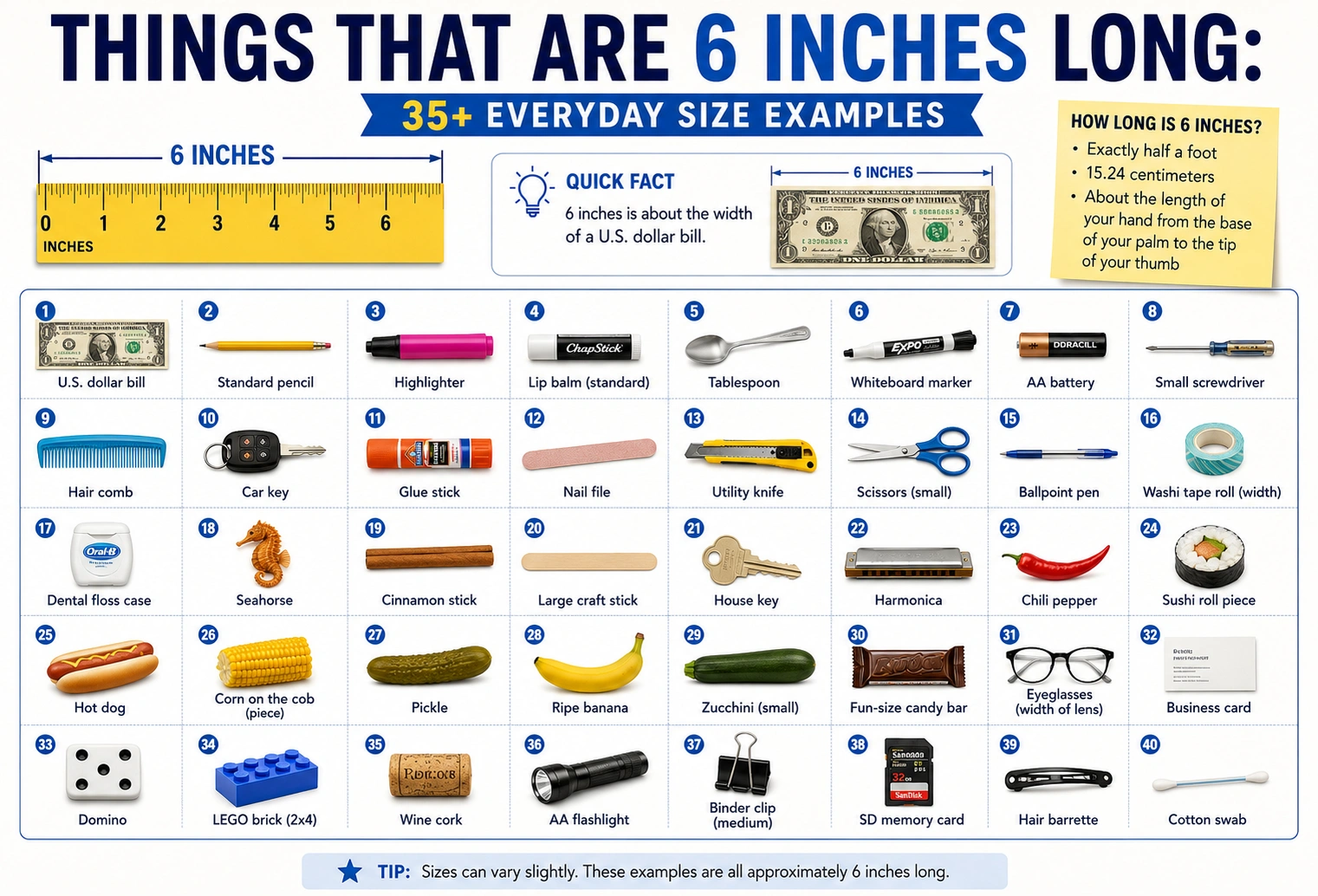
Knowing things that are 6 inches long can make it much easier to estimate measurements when you don’t have a ruler nearby. Whether you’re shopping online, working on a DIY project, helping with schoolwork, or measuring space around your home, having familiar six-inch references is incredibly useful.
Six inches is a common measurement found in household products, office supplies, kitchen tools, and even objects in nature. By comparing everyday items to this length, you can quickly visualize what six inches looks like.
This guide covers more than 35 common examples, along with conversions, measuring tips, and practical uses.
Quick Answer
6 inches equals:
- 0.5 feet
- 15.24 centimeters
- 152.4 millimeters
- 0.167 yards
- 0.1524 meters
It is exactly half of one foot, making it one of the easiest measurements to estimate.
How Long Is 6 Inches?
Six inches is considered a medium-sized measurement.
Since one foot contains 12 inches, six inches is exactly half a foot.
Many rulers also make this easy to identify because the 6-inch mark sits directly in the middle of a standard 12-inch ruler.
6 Inches in Other Units
| Unit | Equivalent |
|---|---|
| Inches | 6 |
| Feet | 0.5 |
| Centimeters | 15.24 |
| Millimeters | 152.4 |
| Meters | 0.1524 |
| Yards | 0.167 |
These conversions are useful when working with both imperial and metric measurements.
35+ Things That Are 6 Inches Long
Below are common objects that are approximately six inches long. Some dimensions vary slightly depending on the brand or model.
Household Items
- A standard wooden ruler (half its length)
- A dollar bill (about 6.14 inches long)
- A TV remote control (many compact models)
- A toothbrush
- A small flashlight
- A dinner knife
- A paperback book’s shorter edge (many editions)
- A small picture frame
- A lint roller handle
- A hand whisk
Office Supplies
- A standard pencil
- A large marker
- A pair of scissors (small office size)
- A stapler (compact model)
- A letter opener
- A clipboard width (small sizes)
- A document holder
- A craft knife
- A glue gun (mini version)
- A notebook’s shorter side (some pocket notebooks)
Kitchen Items
- A butter knife
- A spatula handle (small versions)
- A vegetable peeler
- A small serving spoon
- A kitchen timer
- A reusable straw
- A rolling pin handle (mini)
- A chef’s utility knife blade (approximately 6 inches)
Tools and DIY Items
- A screwdriver
- A paint scraper
- A putty knife
- A utility knife
- A small wrench
- A measuring gauge
- A woodworking square
Nature Examples
- A medium banana
- A cucumber (small variety)
- A large pine cone
- A mature ear of corn (small variety)
- A large leaf from certain plants
Natural objects vary significantly in size, so these examples are approximate.
Why Visual Comparisons Help
Many people struggle to picture measurements.
Comparing six inches with familiar objects allows you to:
- Estimate sizes quickly
- Shop online with confidence
- Improve DIY accuracy
- Understand product dimensions
- Teach children about measurements
Visual references are especially helpful when a ruler isn’t available.
How to Measure 6 Inches
Using a Ruler
Place the object at the zero mark and read to the 6-inch line.
Using a Tape Measure
A tape measure provides accurate measurements for larger objects.
Estimating Without a Measuring Tool
You can estimate six inches by comparing it to:
- The length of a dollar bill (slightly over 6 inches)
- Half of a standard 12-inch ruler
- A standard pencil
- A compact TV remote
For precision work, always use a ruler or tape measure.
Practical Uses for Knowing 6 Inches
Six-inch measurements are common in everyday life.
Examples include:
- Craft projects
- Home improvement
- Gardening
- Cooking utensils
- School assignments
- Product dimensions
- Sewing and quilting
- Woodworking
Understanding this length helps you make more accurate estimates.
Common Measuring Mistakes
Guessing Without a Reference
Visual estimates improve when compared with familiar objects.
Confusing Inches with Centimeters
Six inches equals 15.24 centimeters, not 6 centimeters.
Measuring from the Edge of a Ruler
Always start from the zero mark.
Ignoring Product Variations
Objects like remotes and toothbrushes come in many sizes, so they are useful only as rough references.
Expert Tips
Memorize a Few Common References
Knowing a dollar bill and half a ruler are about six inches makes estimation much easier.
Keep a Small Ruler Nearby
A pocket ruler is inexpensive and provides accurate measurements.
Double-Check Before Buying
Always verify product dimensions when shopping online.
Learn Basic Conversions
Remember:
6 inches = 15.24 centimeters = 0.5 feet
This helps when switching between measurement systems.
9. FAQs
What are some things that are 6 inches long?
Examples include a standard pencil, a compact TV remote, a toothbrush, a butter knife, and about half of a standard ruler.
How long is 6 inches?
Six inches equals 0.5 feet, 15.24 centimeters, or 152.4 millimeters.
Is a dollar bill 6 inches long?
A U.S. dollar bill is approximately 6.14 inches long, making it a useful reference for estimating six inches.
What household item is close to 6 inches?
A toothbrush, compact flashlight, butter knife, or standard pencil are all close to six inches in length.
How can I estimate 6 inches without a ruler?
Compare the length to half of a standard ruler, a dollar bill, or another familiar object that’s approximately six inches long.
10. Conclusion
If you’re looking for things that are 6 inches long, there are plenty of everyday objects that can serve as helpful references. Items such as a standard pencil, a toothbrush, a compact TV remote, a butter knife, and a U.S. dollar bill are all close to this measurement. Since 6 inches equals exactly half a foot or 15.24 centimeters, it’s one of the easiest lengths to visualize. Whether you’re completing a DIY project, shopping online, teaching measurements, or estimating dimensions without a ruler, these real-world comparisons make understanding and recognizing six inches much simpler.
Discover More Articles
How Big Is 10 Inches? Size Guide With Everyday Examples