
If you’re following a recipe, conducting a science experiment, or measuring ingredients, you may need to convert milliliters to grams. While the conversion seems simple, there’s one important fact to remember:
Milliliters (mL) measure volume, while grams (g) measure weight (mass).
Because they measure different things, there isn’t one universal conversion. The number of grams depends on the density of the substance being measured.
For example:
- 1 mL of water = 1 gram
- 1 mL of cooking oil ≈ 0.92 grams
- 1 mL of honey ≈ 1.42 grams
This guide explains how to convert milliliters to grams accurately, provides easy-to-use charts, and includes common kitchen ingredient conversions.
Quick Answer
For water and liquids with a density close to water:
- 1 mL = 1 gram
- 100 mL = 100 grams
- 250 mL = 250 grams
- 500 mL = 500 grams
- 1,000 mL = 1,000 grams (1 kilogram)
For other ingredients, use their specific density.
Understanding Milliliters and Grams
Before converting, it’s helpful to understand these units.
What Is a Milliliter?
A milliliter (mL) measures volume.
It’s commonly used for:
- Water
- Milk
- Juice
- Cooking oil
- Medicine
- Laboratory liquids
There are:
- 1,000 milliliters in 1 liter
What Is a Gram?
A gram (g) measures mass (weight).
Grams are commonly used for:
- Flour
- Sugar
- Butter
- Coffee
- Spices
- Food portions
Since volume and mass are different, you must know the density to convert between them.
Why Milliliters Don’t Always Equal Grams
Different substances have different densities.
For example:
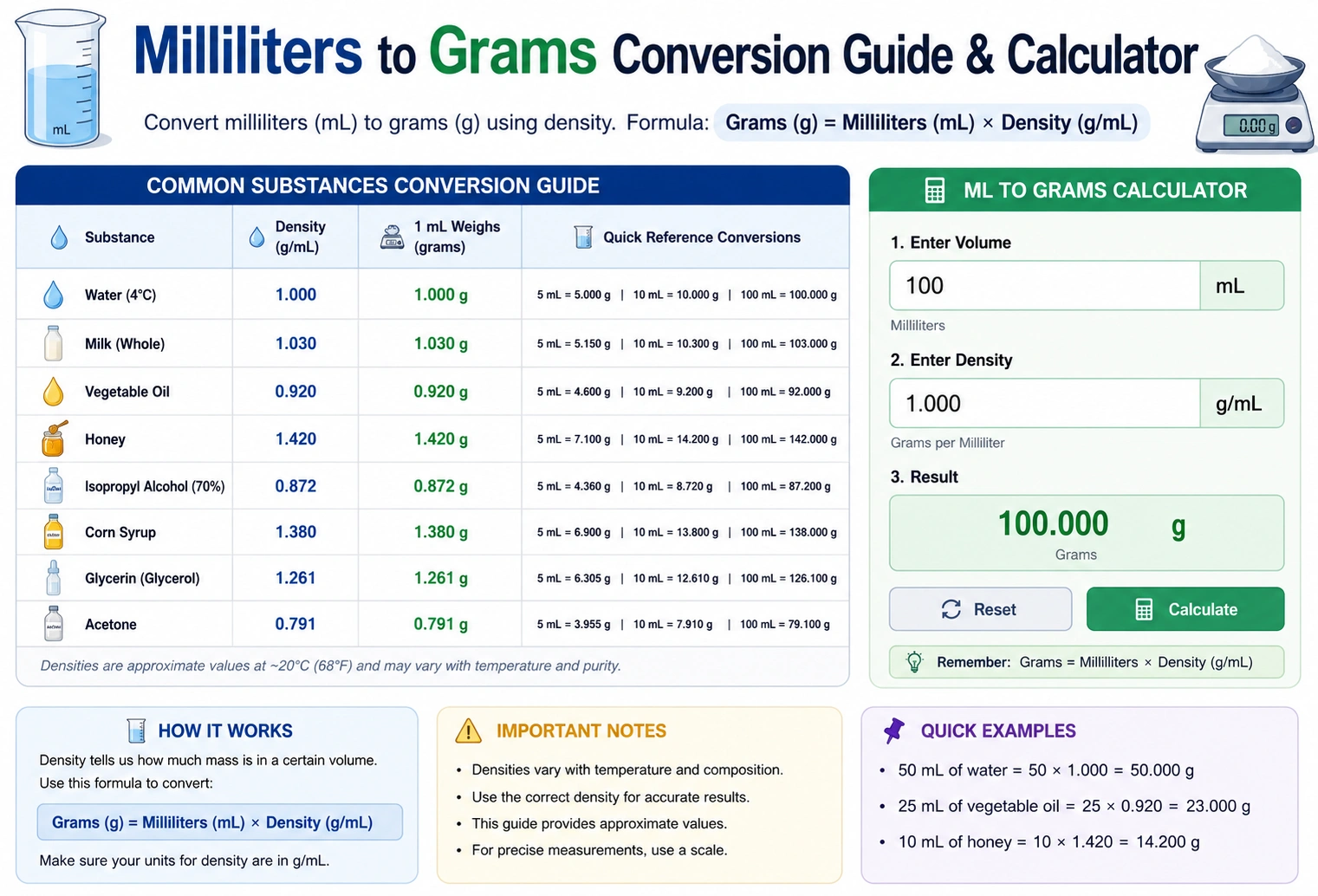
| Ingredient | Approximate Density | 100 mL Equals |
|---|---|---|
| Water | 1.00 g/mL | 100 g |
| Milk | 1.03 g/mL | 103 g |
| Vegetable Oil | 0.92 g/mL | 92 g |
| Honey | 1.42 g/mL | 142 g |
| Syrup | 1.33 g/mL | 133 g |
That’s why 100 mL of oil does not weigh the same as 100 mL of honey.
Milliliters to Grams Formula
Use this simple formula:
Grams = Milliliters × Density
For example:
Water
250 × 1.00 = 250 grams
Milk
250 × 1.03 = 257.5 grams
Honey
250 × 1.42 = 355 grams
Knowing the density is essential for an accurate conversion.
Common Milliliters to Grams Conversion Chart (Water)
Because water has a density of 1 g/mL, the conversion is straightforward.
| Milliliters | Grams |
|---|---|
| 1 mL | 1 g |
| 5 mL | 5 g |
| 10 mL | 10 g |
| 25 mL | 25 g |
| 50 mL | 50 g |
| 100 mL | 100 g |
| 150 mL | 150 g |
| 200 mL | 200 g |
| 250 mL | 250 g |
| 500 mL | 500 g |
| 750 mL | 750 g |
| 1,000 mL | 1,000 g |
Ingredient Conversion Table
Different ingredients produce different weights.
| Ingredient | 100 mL | 250 mL |
|---|---|---|
| Water | 100 g | 250 g |
| Whole Milk | 103 g | 258 g |
| Vegetable Oil | 92 g | 230 g |
| Honey | 142 g | 355 g |
| Corn Syrup | 133 g | 333 g |
Note: Dry ingredients such as flour and sugar have different densities than liquids, so they require separate conversion values.
Real-Life Examples
Example 1: Water
Recipe requires:
300 mL water
Conversion:
300 × 1 = 300 grams
Example 2: Milk
Recipe requires:
500 mL milk
500 × 1.03 = 515 grams
Example 3: Honey
Need:
100 mL honey
100 × 1.42 = 142 grams
Example 4: Cooking Oil
Need:
200 mL vegetable oil
200 × 0.92 = 184 grams
How to Convert Milliliters to Grams Step by Step
Step 1: Identify the Ingredient
Determine what you’re measuring.
Step 2: Find the Density
Use a reliable density chart or product label if available.
Step 3: Apply the Formula
Grams = Milliliters × Density
Step 4: Round if Necessary
For cooking, rounding to the nearest gram is usually sufficient.
For scientific work, use the required level of precision.
Common Kitchen Conversions
Here are some useful everyday conversions.
| Measurement | Water (g) |
|---|---|
| 15 mL (1 tbsp) | 15 g |
| 30 mL | 30 g |
| 60 mL | 60 g |
| 125 mL (½ cup) | 125 g |
| 250 mL (1 cup) | 250 g |
| 500 mL | 500 g |
These values apply to water and liquids with similar density.
Why Accurate Conversions Matter
Correct measurements improve results in many situations.
Baking
Small differences in weight can affect:
- Texture
- Moisture
- Rise
- Flavor
Cooking
Consistent measurements help recipes turn out the same every time.
Science Experiments
Accurate conversions are essential for reliable results and safety.
Nutrition Tracking
Many food labels list serving sizes in grams rather than milliliters.
Common Conversion Mistakes
Assuming 1 mL Always Equals 1 Gram
This is only true for water and substances with nearly identical density.
Ignoring Ingredient Density
Oil, honey, milk, and syrup all weigh differently.
Confusing Weight and Volume
Milliliters measure volume.
Grams measure mass.
Using Dry Measuring Cups for Liquids
Use appropriate measuring tools for greater accuracy.
Expert Tips for Accurate Measurements
- Use a digital kitchen scale whenever possible.
- Measure liquids at eye level.
- Check the density of uncommon ingredients.
- Follow recipe measurements exactly when baking.
- Keep a printable conversion chart in your kitchen for quick reference.
9. Frequently Asked Questions
1. Is 1 milliliter equal to 1 gram?
Only for water and substances with a density close to 1 g/mL. Other ingredients require density-based conversions.
2. How do I convert milliliters to grams?
Use this formula:
Grams = Milliliters × Density
3. Why doesn’t the conversion always stay the same?
Because different substances have different densities, the same volume can have different weights.
4. How many grams is 250 mL of water?
250 milliliters of water equals 250 grams.
5. Can I use the same conversion for flour and sugar?
No. Dry ingredients have different densities, so each requires its own conversion values.
10. Conclusion
Understanding milliliters to grams is essential for accurate cooking, baking, scientific work, and everyday measurements. Since milliliters measure volume and grams measure mass, the conversion depends on the density of the substance.
For water, the process is simple because 1 milliliter equals 1 gram. However, ingredients like milk, oil, honey, and syrup require density-based calculations. By using the formula Grams = Milliliters × Density, along with the conversion charts and examples in this guide, you can confidently convert milliliters to grams for a wide range of ingredients and applications.
Discover More Articles
How Long Until 3:30 PM? Easy Time Calculator Guide
Years Ago Calculator: Find the Date from Any Number of Years