

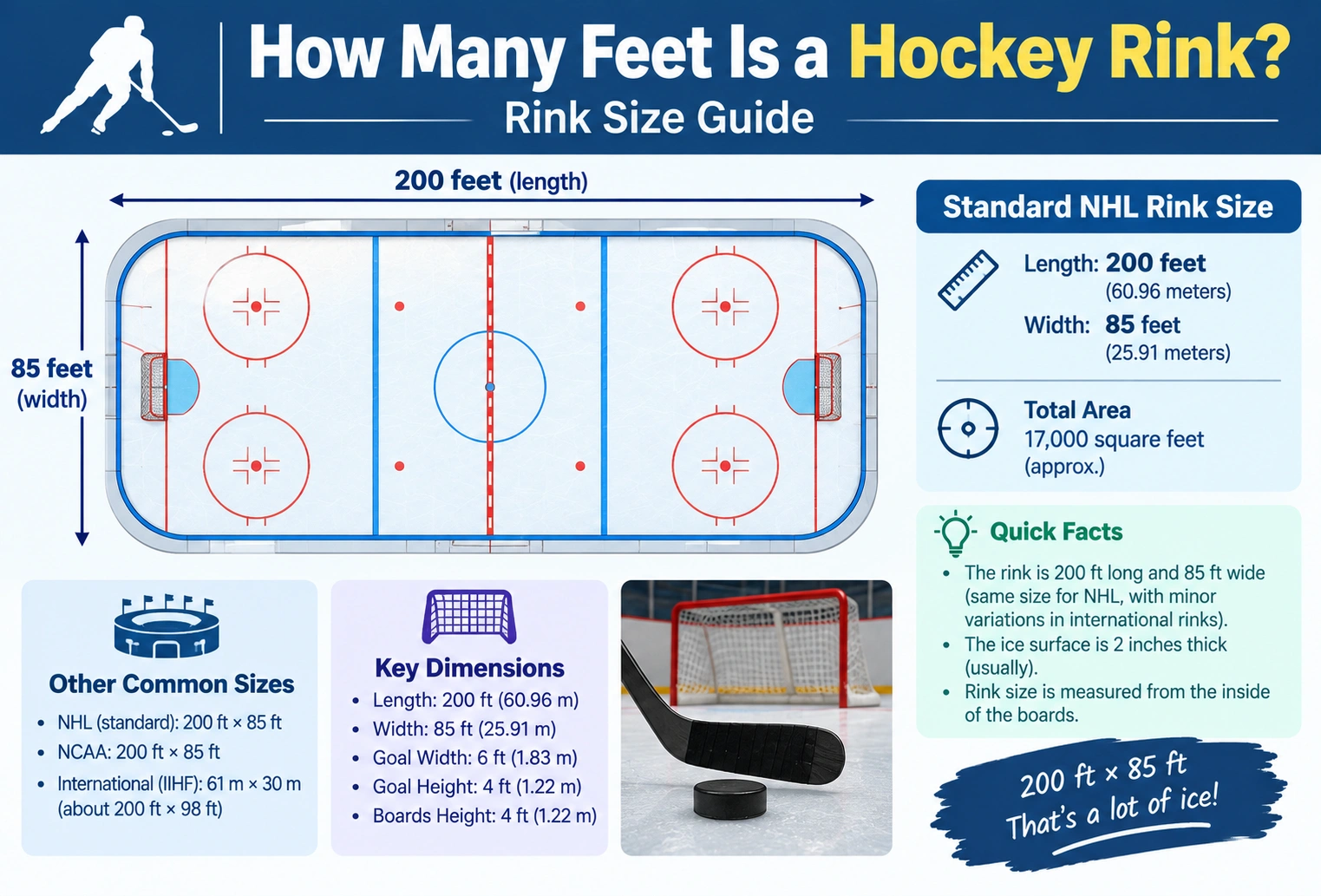
A standard NHL hockey rink is 200 feet long and 85 feet wide.
That means the playing surface has approximately:
200 × 85 = 17,000 square feet
So, when someone asks how many feet is a hockey rink, the most common answer is:
- Length: 200 feet
- Width: 85 feet
- Area: 17,000 square feet
The exact dimensions can vary depending on the league and country. International hockey rinks are generally wider than NHL rinks.
| Hockey Rink Type | Length | Width | Approx. Area |
|---|---|---|---|
| NHL | 200 ft | 85 ft | 17,000 sq ft |
| International/Olympic | About 197 ft | About 98 ft | About 19,306 sq ft |
Standard NHL Hockey Rink Dimensions
The standard professional hockey rink used in the NHL measures 200 feet from end to end and 85 feet across.
The rectangular playing surface is surrounded by boards and protective glass.
The basic dimensions are:
| Measurement | NHL Size |
|---|---|
| Length | 200 feet |
| Width | 85 feet |
| Length in yards | 66.67 yards |
| Width in yards | 28.33 yards |
| Area | 17,000 sq ft |
| Perimeter | 570 feet |
The rink’s 200-foot length makes it significantly longer than its 85-foot width. This creates the familiar elongated rectangular shape used for NHL games.
How Long Is a Hockey Rink?
A standard NHL hockey rink is 200 feet long.
The 200-foot measurement runs from one end of the ice surface to the opposite end.
In other units, 200 feet equals:
- 66.67 yards
- 2,400 inches
- 60.96 meters
This length provides enough space for players to build speed while allowing the rink to be divided into different zones.
The center red line separates the two halves of the rink, while blue lines divide the playing surface into offensive, defensive, and neutral zones.
How Long Is an International Hockey Rink?
International hockey rinks can have different dimensions from NHL rinks.
A commonly used international rink size is approximately 197 feet long, which corresponds to about 60 meters.
The difference in length is relatively small, but international rinks are generally noticeably wider.
How Wide Is a Hockey Rink?
A standard NHL hockey rink is 85 feet wide.
The width is measured across the ice from one side of the rink to the other.
In other units, 85 feet equals:
- 28.33 yards
- 1,020 inches
- 25.91 meters
The 85-foot width gives NHL players a relatively compact playing area compared with wider international rinks.
Why Is the Width Important?
Rink width affects how much room players have to:
- Carry the puck
- Pass
- Create scoring opportunities
- Defend
- Position themselves
- Move around opponents
A wider rink can provide more lateral space and influence how teams use the ice.
How Many Square Feet Is a Hockey Rink?
To calculate the area of a rectangular hockey rink, multiply its length by its width.
For a standard NHL rink:
Area = Length × Width
Area = 200 × 85
Area = 17,000 square feet
Therefore, the nominal rectangular area of an NHL hockey rink is 17,000 square feet.
This is the basic rectangular area calculation. The actual ice surface has rounded corners rather than four perfectly square corners, so the exact geometric ice area is somewhat different from simply multiplying 200 by 85.
Hockey Rink Area in Other Units
The approximate 17,000-square-foot figure can also be converted into other area units.
| Unit | Approximate Area |
|---|---|
| Square feet | 17,000 sq ft |
| Square yards | 1,888.89 sq yd |
| Square meters | 1,579.35 sq m |
| Acres | 0.39 acres |
The square-foot figure is useful for general comparisons, while facility planners may use more precise measurements based on the actual rink design.
NHL Rink vs. International Hockey Rink
One of the biggest differences between hockey rinks is their width.
An NHL rink is approximately 200 × 85 feet, while an international rink is commonly around 197 × 98 feet.
| Feature | NHL Rink | International Rink |
|---|---|---|
| Length | 200 ft | About 197 ft |
| Width | 85 ft | About 98 ft |
| Width difference | — | About 13 ft wider |
| Approx. rectangular area | 17,000 sq ft | About 19,306 sq ft |
| Length in meters | 60.96 m | About 60 m |
| Width in meters | 25.91 m | About 30 m |
The international rink is therefore slightly shorter but substantially wider.
That extra width provides more lateral space for players and can affect skating lanes, passing opportunities, defensive positioning, and overall game strategy.
Key Measurements on a Hockey Rink
The rink is not simply an empty 200-by-85-foot rectangle. Several important markings divide the ice into specific areas.
Center Ice
The center of the rink contains the center faceoff circle and center red line.
This area is used for the opening faceoff and faceoffs after goals.
Blue Lines
Two blue lines divide the rink into three main zones:
- Defensive zone
- Neutral zone
- Offensive zone
These lines are important for determining offside plays.
Goal Lines
Each end of the rink has a goal line located near the boards.
The goals sit within the playing area at opposite ends.
Faceoff Circles
Faceoff circles are marked in several locations throughout the rink.
These markings identify where certain faceoffs take place during a game.
Goal Crease
The goal crease is the marked area immediately in front of each goal.
It identifies the area around the net and helps officials determine certain plays involving the goaltender.
What Does a Hockey Rink Look Like Compared With Other Sports Fields?
Comparing a hockey rink with familiar sports facilities can make its dimensions easier to visualize.
A standard NHL rink is 200 feet long and 85 feet wide.
| Sports Surface | Approximate Length | Approximate Width |
|---|---|---|
| NHL hockey rink | 200 ft | 85 ft |
| Basketball court | 94 ft | 50 ft |
| Tennis court, doubles | 78 ft | 36 ft |
| Soccer field | Varies | Varies |
| American football field | 360 ft including end zones | 160 ft |
An NHL rink is therefore much longer than a basketball or tennis court, but considerably smaller than an American football field.
The comparison also shows why hockey can feel fast-paced: players have a large surface to cover while traveling at high skating speeds.
How Much Ice Is on a Hockey Rink?
The amount of ice can be considered in terms of surface area and thickness.
The surface area of an NHL rink is approximately 17,000 square feet when using its nominal rectangular dimensions.
However, the actual ice surface has rounded corners, so the precise area is lower than the simple 200 × 85 calculation.
The ice itself is also built in layers rather than being an extremely thick solid block of ice. Arenas carefully maintain the playing surface so it remains suitable for skating and puck movement.
Why Hockey Rink Dimensions Matter
Rink dimensions affect both gameplay and facility design.
Gameplay
The size of the ice surface influences:
- Skating distance
- Passing lanes
- Player spacing
- Defensive coverage
- Offensive strategies
- Puck movement
A narrower rink can create a different style of play from a wider rink.
Arena Construction
The rink is only part of the space required for a hockey facility.
An arena also needs room for:
- Player benches
- Penalty boxes
- Locker rooms
- Spectator seating
- Concession areas
- Walkways
- Protective barriers
- Mechanical and refrigeration equipment
Therefore, an arena cannot be planned by assuming that 17,000 square feet is the total space required for the building.
Hockey Rink Perimeter
If you treat an NHL rink as a simple 200-by-85-foot rectangle, you can calculate its perimeter using:
Perimeter = 2 × (Length + Width)
For an NHL rink:
Perimeter = 2 × (200 + 85)
Perimeter = 570 feet
So the rectangular approximation has a perimeter of 570 feet.
Because actual rink corners are rounded, the exact perimeter of the boards is different from this simple rectangular calculation.
Hockey Rink Dimensions in Meters
People outside the United States and Canada may commonly encounter hockey rink measurements in meters.
The standard NHL dimensions convert approximately to:
| Measurement | Feet | Meters |
|---|---|---|
| Length | 200 ft | 60.96 m |
| Width | 85 ft | 25.91 m |
| Approx. rectangular area | 17,000 sq ft | 1,579 sq m |
The familiar NHL dimensions are therefore approximately 61 meters long by 26 meters wide.
Common Mistakes When Measuring a Hockey Rink
Mistake 1: Assuming Every Hockey Rink Is the Same Size
Not every hockey rink has identical dimensions.
Professional, international, collegiate, youth, and recreational facilities may use different specifications.
Mistake 2: Confusing Length With Width
For a standard NHL rink:
- Length = 200 feet
- Width = 85 feet
The 200-foot measurement is the longer dimension.
Mistake 3: Assuming 200 × 85 Is the Exact Ice Area
Multiplying 200 by 85 gives 17,000 square feet, but this is a rectangular approximation.
Hockey rinks have rounded corners, so the actual ice area is somewhat smaller.
Mistake 4: Confusing the Rink With the Arena
The rink is the ice playing surface. The arena is the entire facility surrounding it.
A hockey arena therefore occupies considerably more space than the ice surface alone.
FAQs
How many feet is a hockey rink?
A standard NHL hockey rink is 200 feet long and 85 feet wide.
How many feet long is an NHL hockey rink?
An NHL hockey rink is 200 feet long.
How many feet wide is an NHL hockey rink?
An NHL hockey rink is 85 feet wide.
How many square feet is an NHL hockey rink?
Using its nominal rectangular dimensions, a standard NHL rink is approximately 17,000 square feet.
Is an international hockey rink bigger than an NHL rink?
International hockey rinks are generally wider than NHL rinks. A commonly used international size is about 197 feet long and 98 feet wide.
How many yards long is a hockey rink?
A 200-foot NHL rink is approximately 66.67 yards long because 200 ÷ 3 = 66.67.
How many meters is a 200-foot hockey rink?
Two hundred feet equals approximately 60.96 meters.
How big is a hockey rink compared with a football field?
An NHL rink is approximately 200 feet long and 85 feet wide, while an American football field is 360 feet long including the end zones and 160 feet wide. A football field therefore covers much more area.
Why are international hockey rinks wider?
The wider playing surface provides more lateral space for skating, passing, positioning, and tactical movement. This can contribute to differences in playing style between competitions.
Conclusion
A standard NHL hockey rink is 200 feet long and 85 feet wide.
Using those nominal dimensions, the rectangular area is:
200 × 85 = 17,000 square feet
The key measurements are:
| Measurement | Standard NHL Size |
|---|---|
| Length | 200 feet |
| Width | 85 feet |
| Approx. area | 17,000 sq ft |
| Length in meters | 60.96 m |
| Width in meters | 25.91 m |
| Approx. perimeter | 570 ft |
International rinks are generally wider, commonly measuring about 197 feet by 98 feet. Other hockey facilities may also use different dimensions depending on the league, level of play, and facility specifications.
So, for the standard NHL rink, the simplest answer to “how many feet is a hockey rink?” is 200 feet long and 85 feet wide.
Discover More Articles
How Many Feet Is 40 Square Feet? Area Guide