

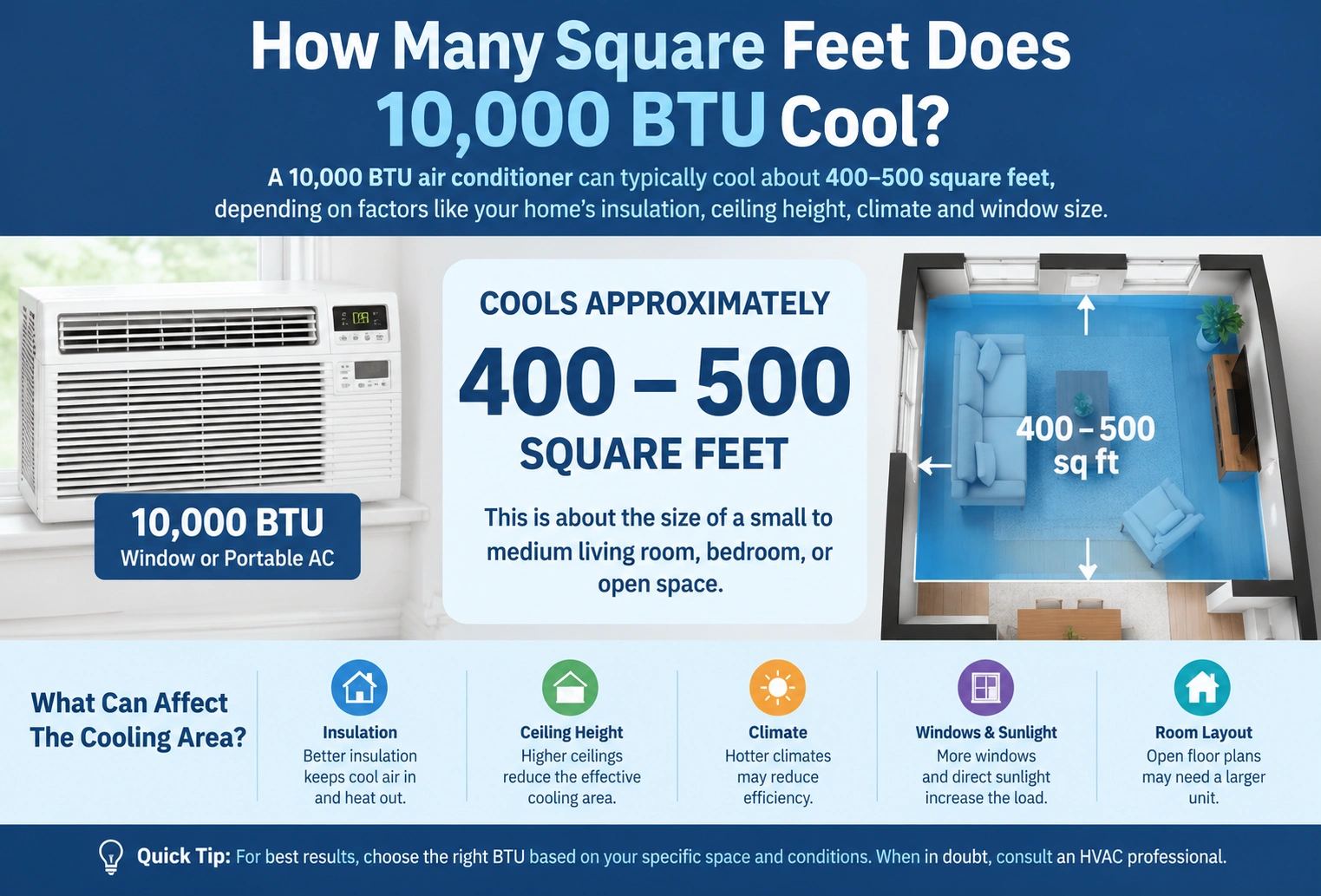
A 10,000 BTU air conditioner can typically cool about 400–450 square feet under average conditions. The exact coverage depends on ceiling height, insulation, sunlight, climate, windows, and how many people use the room.
| Room Conditions | Approximate Coverage for 10,000 BTU |
|---|---|
| Well-insulated, mild climate | 450–500 sq ft |
| Average room | 400–450 sq ft |
| Hot climate or sunny room | 300–400 sq ft |
| Poor insulation or high heat load | 250–350 sq ft |
For a typical room, 400 square feet is a safe starting point for a 10,000 BTU AC.
Introduction
If you’re asking how many square feet does 10,000 BTU cool, the short answer is around 400–450 square feet in average conditions.
However, choosing an air conditioner based only on square footage can lead to an undersized or oversized unit. Room height, insulation, sunlight, windows, climate, and occupancy can all change the cooling requirement.
What Does 10,000 BTU Mean?
BTU stands for British thermal unit. In air conditioning, BTUs describe the amount of heat an air conditioner can remove from a space over time.
A 10,000 BTU air conditioner has a cooling capacity of approximately 10,000 BTUs per hour.
The larger the cooling load of a room, the more BTUs you need.
| AC Capacity | Approximate Room Size |
|---|---|
| 5,000 BTU | 150–250 sq ft |
| 6,000 BTU | 200–300 sq ft |
| 8,000 BTU | 300–350 sq ft |
| 10,000 BTU | 400–450 sq ft |
| 12,000 BTU | 450–550 sq ft |
| 14,000 BTU | 550–700 sq ft |
| 18,000 BTU | 700–1,000 sq ft |
These are general estimates. Actual sizing should account for the conditions of the room.
How Many Square Feet Can 10,000 BTU Cool?
A 10,000 BTU unit is commonly suitable for approximately 400–450 square feet.
For example, if you have a room measuring 20 × 20 feet:
20 × 20 = 400 square feet
A 10,000 BTU AC would generally be a reasonable size for a 400-square-foot room under average conditions.
But a 400-square-foot room with large sunny windows and poor insulation may need more cooling capacity than a shaded, well-insulated room of the same size.
10,000 BTU AC Room Size Chart
The following chart provides a simple way to estimate whether a 10,000 BTU air conditioner is appropriate.
| Room Size | 10,000 BTU AC |
|---|---|
| 200 sq ft | More than enough in most cases |
| 250 sq ft | More than enough |
| 300 sq ft | Very suitable |
| 350 sq ft | Suitable |
| 400 sq ft | Ideal range |
| 450 sq ft | Usually suitable |
| 500 sq ft | May be undersized |
| 550 sq ft | Usually too small |
| 600 sq ft | Generally undersized |
For rooms above approximately 450–500 square feet, you should consider whether a larger unit is more appropriate.
Is 10,000 BTU Enough for 500 Square Feet?
A 10,000 BTU AC may not be enough for a 500-square-foot room, particularly in a hot climate.
The unit might cool the space if conditions are favorable, but it may run continuously and struggle to maintain the desired temperature when outdoor temperatures are high.
| 500-Sq-Ft Room Condition | 10,000 BTU Suitability |
|---|---|
| Excellent insulation | Possibly suitable |
| Moderate insulation | Borderline |
| Lots of direct sunlight | Likely undersized |
| Poor insulation | Usually undersized |
| Hot climate | Likely undersized |
| High ceilings | May be undersized |
For a 500-square-foot space, a unit around 12,000 BTU may be a more appropriate starting point, depending on the conditions.
Is 10,000 BTU Enough for 300 Square Feet?
Yes. A 10,000 BTU air conditioner is generally more than sufficient for a 300-square-foot room under typical conditions.
For example:
15 × 20 = 300 square feet
A 10,000 BTU unit can provide substantial cooling for this size room.
However, an oversized unit is not automatically better. An AC should be appropriately sized so that it can cool and dehumidify the room effectively.
Is 10,000 BTU Enough for 400 Square Feet?
Yes. 400 square feet is within the typical coverage range of a 10,000 BTU AC.
For example:
20 × 20 = 400 square feet
If the room has average ceiling height, reasonable insulation, and a moderate heat load, 10,000 BTUs can be a good match.
Is 10,000 BTU Enough for 600 Square Feet?
For most situations, 10,000 BTUs is not enough for 600 square feet.
A 600-square-foot area requires more cooling capacity, especially in hot climates or rooms with large windows.
| Room Size | General BTU Range |
|---|---|
| 300 sq ft | 8,000–10,000 BTU |
| 400 sq ft | 9,000–10,000 BTU |
| 500 sq ft | 10,000–12,000 BTU |
| 600 sq ft | 12,000–14,000+ BTU |
| 700 sq ft | 14,000–16,000+ BTU |
These figures are starting estimates rather than a substitute for a professional cooling-load calculation.
Factors That Affect 10,000 BTU Coverage
Square footage is only one part of AC sizing.
1. Climate
A room in a hot climate generally requires more cooling capacity than the same room in a mild climate.
If outdoor temperatures are consistently very high, a 10,000 BTU unit may cool a smaller area than it would in a moderate climate.
2. Ceiling Height
Standard ceiling height is often around 8 feet. A room with a 10- or 12-foot ceiling contains significantly more air.
| Ceiling Height | Effect on Cooling |
|---|---|
| 8 ft | Standard |
| 9 ft | Slightly higher cooling demand |
| 10 ft | Higher cooling demand |
| 12 ft | Significantly higher air volume |
3. Insulation
Good insulation keeps cooled air inside and reduces heat entering the room.
Poor insulation can increase the cooling load and reduce the effective coverage of a 10,000 BTU AC.
4. Windows
Large windows can allow considerable heat from sunlight into a room.
A heavily sun-exposed room may need more BTUs than a similarly sized room with limited windows.
5. Number of People
People generate heat. A room occupied by several people can therefore require more cooling than a room normally occupied by one or two people.
6. Appliances
Computers, televisions, refrigerators, cooking appliances, lighting, and other electronics can add heat to the space.
10,000 BTU Coverage in Hot Weather
If you live in a particularly hot area, don’t automatically assume that 10,000 BTUs will cool 450 square feet.
The cooling load can increase significantly when:
- Outdoor temperatures are very high
- The room receives direct afternoon sun
- Windows are large or poorly insulated
- The roof receives intense sunlight
- Walls have limited insulation
- Several people occupy the room
- Appliances produce significant heat
In these situations, a professional load calculation can provide a more accurate answer.
How to Calculate the Square Footage of Your Room
Before choosing an AC, calculate the room’s floor area.
Use:
Length × Width = Square Feet
Example 1: 20 × 20 Room
20 × 20 = 400 sq ft
A 10,000 BTU AC is generally appropriate under average conditions.
Example 2: 15 × 25 Room
15 × 25 = 375 sq ft
This is also within a reasonable range for a 10,000 BTU unit.
Example 3: 20 × 25 Room
20 × 25 = 500 sq ft
This is near or beyond the typical range, so you may need a larger unit depending on the room’s heat load.
10,000 BTU for Different Room Types
The same BTU rating can work differently depending on the type of room.
| Room Type | Typical Size | 10,000 BTU Suitability |
|---|---|---|
| Small bedroom | 150–250 sq ft | More than sufficient |
| Large bedroom | 250–350 sq ft | Excellent |
| Living room | 300–450 sq ft | Usually suitable |
| Home office | 150–300 sq ft | More than sufficient |
| Studio apartment | 300–450 sq ft | Often suitable |
| Large open room | 450–600 sq ft | May be undersized |
Open floor plans can be more difficult to cool because air spreads across connected spaces.
10,000 BTU Window AC vs. Portable AC
The stated BTU rating can be interpreted differently depending on the type of air conditioner.
| AC Type | Important Consideration |
|---|---|
| Window AC | BTU rating is commonly used directly for sizing |
| Portable AC | Performance can vary based on rating standard |
| Mini-split | Sizing depends on the complete cooling load |
| Central AC | Requires whole-home load calculation |
For portable air conditioners, check the manufacturer’s specifications carefully because different rating methods can produce different numbers.
Can a 10,000 BTU AC Cool Multiple Rooms?
It depends on the layout.
A 10,000 BTU unit can cool an open area totaling around 400–450 square feet under suitable conditions, but cooling several separated rooms is more difficult.
Walls and closed doors restrict airflow.
| Layout | Expected Performance |
|---|---|
| One open 400-sq-ft room | Good |
| Two connected open spaces | Potentially good |
| Two rooms with open doorway | Variable |
| Several closed rooms | Poor |
| Large open-plan area | May require larger capacity |
For multiple enclosed rooms, separate cooling equipment may be more effective.
Should You Buy a Larger AC?
Not necessarily.
An oversized air conditioner can cool the air quickly without running long enough to properly remove humidity. This can leave a room feeling cool but damp.
An undersized AC, on the other hand, may run continuously and struggle to reach the desired temperature.
The goal is proper sizing, not simply buying the largest available unit.
Energy Efficiency and 10,000 BTU Air Conditioners
A properly sized AC can potentially operate more efficiently because it does not have to work unnecessarily hard to maintain the desired temperature.
Look at the unit’s efficiency ratings as well as its BTU capacity.
| Factor | Why It Matters |
|---|---|
| BTU capacity | Determines cooling output |
| Efficiency rating | Affects electricity use |
| Room size | Determines basic cooling requirement |
| Insulation | Affects heat entering the room |
| Windows | Can increase solar heat gain |
| Thermostat settings | Affect operating time |
| Maintenance | Dirty filters can restrict airflow |
Cleaning filters regularly and maintaining good airflow can help an air conditioner perform properly.
Common Mistakes When Choosing a 10,000 BTU AC
Mistake 1: Using Only Square Footage
Two rooms with the same floor area can have very different cooling requirements.
Mistake 2: Ignoring Climate
A 10,000 BTU unit may cover a smaller area in an extremely hot climate.
Mistake 3: Forgetting Ceiling Height
Tall ceilings increase the volume of air that needs to be conditioned.
Mistake 4: Buying the Biggest Unit
More BTUs do not automatically mean better performance.
Mistake 5: Ignoring Sun Exposure
A room with large south- or west-facing windows can have a substantially higher heat load.
Mistake 6: Forgetting Insulation
Poor insulation can make even a correctly sized air conditioner struggle.
Frequently Asked Questions
How many square feet does a 10,000 BTU AC cool?
A 10,000 BTU air conditioner can generally cool about 400–450 square feet under average conditions. Hot, sunny, or poorly insulated rooms may require more capacity.
Will a 10,000 BTU AC cool 500 square feet?
It may, but 500 square feet is at or beyond the typical range. A larger unit may be more appropriate, especially in a hot climate or a room with high heat gain.
Is 10,000 BTU enough for 400 square feet?
Yes. 400 square feet is generally a good size for a 10,000 BTU AC under average conditions.
How many BTUs do I need for 600 square feet?
A 600-square-foot room may need approximately 12,000–14,000 BTUs or more, depending on climate, insulation, windows, ceiling height, and occupancy.
Does a 10,000 BTU AC use a lot of electricity?
Electricity use depends on the unit’s efficiency, operating time, electricity rate, thermostat setting, and room conditions. The BTU rating alone does not determine the exact cost.
Conclusion
So, how many square feet does 10,000 BTU cool? In average conditions, a 10,000 BTU air conditioner can generally cool about 400–450 square feet.
A 400-square-foot room is a particularly good starting point for this capacity. A 300-square-foot room should generally be easier to cool, while a 500- to 600-square-foot space may require a larger unit.
For the best result, consider room size, climate, insulation, ceiling height, sunlight, windows, and occupancy rather than choosing an AC based on square footage alone.
Discover More Articles
How Many Feet Is a Hockey Rink? Rink Size Guide