
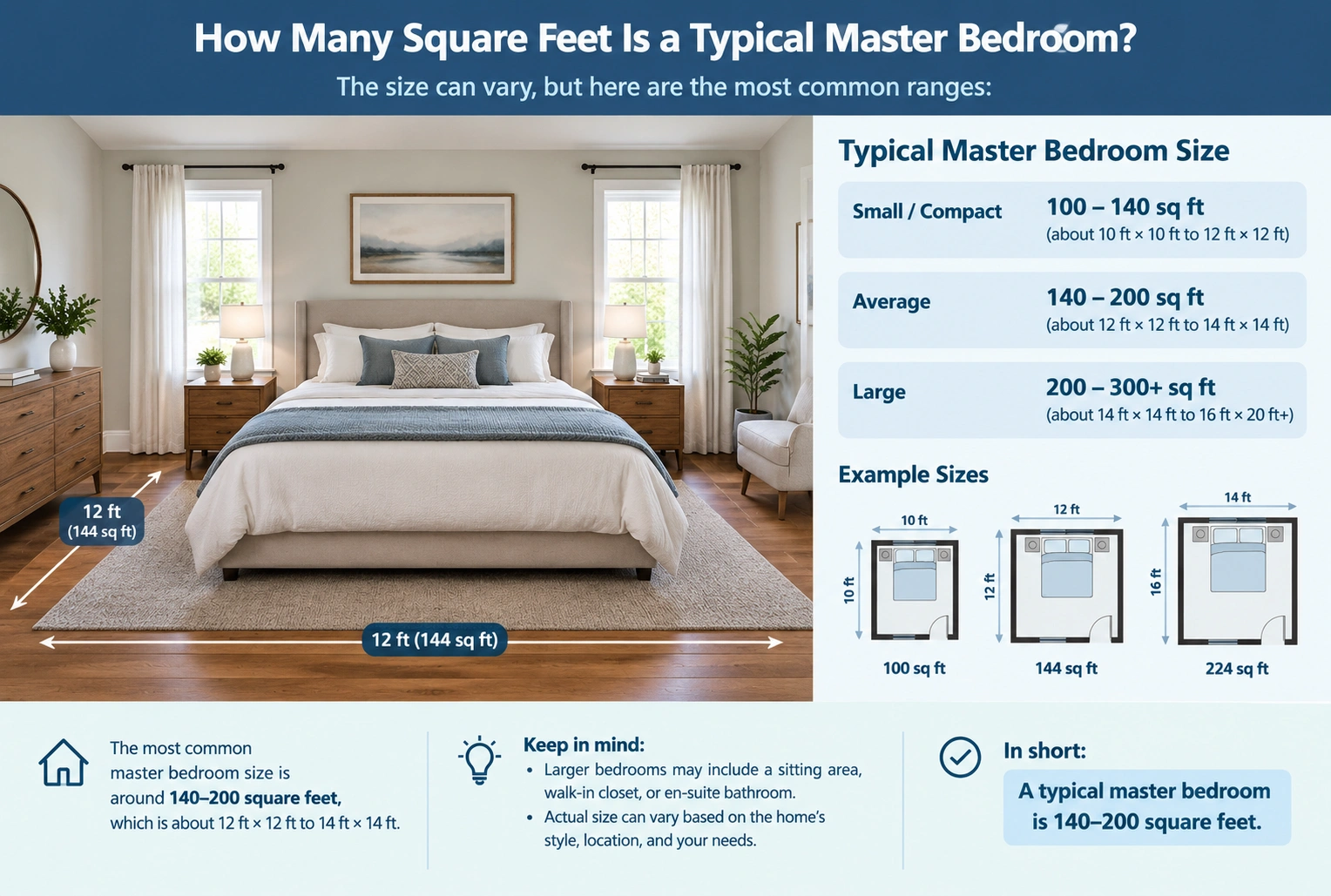
A typical master bedroom is about 200 to 300 square feet, although the actual size varies significantly depending on the home’s overall size, layout, location, and whether the bedroom includes a sitting area or other dedicated spaces.
A common master bedroom might measure 12 × 14 feet, 12 × 15 feet, 14 × 16 feet, or 15 × 15 feet.
Here are some common examples:
| Master Bedroom Dimensions | Square Feet |
|---|---|
| 10 × 12 ft | 120 sq ft |
| 11 × 12 ft | 132 sq ft |
| 12 × 14 ft | 168 sq ft |
| 12 × 15 ft | 180 sq ft |
| 14 × 14 ft | 196 sq ft |
| 14 × 16 ft | 224 sq ft |
| 15 × 15 ft | 225 sq ft |
| 15 × 16 ft | 240 sq ft |
| 16 × 18 ft | 288 sq ft |
| 18 × 20 ft | 360 sq ft |
For many homes, around 200–250 square feet provides a comfortable balance between sleeping space, furniture placement, and walking room.
What Is the Typical Master Bedroom Size?
There is no single standard size for every master bedroom. The appropriate square footage depends on the home’s total floor area and the way the bedroom is designed.
In newer homes, the master bedroom is often larger than secondary bedrooms because it may be designed to accommodate a larger bed, nightstands, dressers, seating, and access to a private bathroom or closet.
A practical range is:
| Bedroom Size Category | Approximate Square Feet |
|---|---|
| Small master bedroom | 120–170 sq ft |
| Average/typical | 170–250 sq ft |
| Comfortable large | 250–350 sq ft |
| Very large | 350+ sq ft |
A 170–250 square-foot bedroom can provide enough room for a bed and essential furniture without requiring an oversized floor plan.
A bedroom of 250–350 square feet offers more flexibility for larger furniture, seating, storage, or a more spacious layout.
Common Master Bedroom Dimensions and Square Footage
The dimensions of a room are just as important as its total square footage. Two rooms can have the same area but feel very different because of their proportions.
For example, a 10 × 20-foot bedroom has the same 200 square feet as a 14 × 14.3-foot room, but the furniture arrangement will be different.
Here are common rectangular bedroom dimensions:
| Dimensions | Area |
|---|---|
| 10 × 12 ft | 120 sq ft |
| 11 × 13 ft | 143 sq ft |
| 12 × 14 ft | 168 sq ft |
| 12 × 15 ft | 180 sq ft |
| 13 × 15 ft | 195 sq ft |
| 14 × 14 ft | 196 sq ft |
| 14 × 16 ft | 224 sq ft |
| 15 × 15 ft | 225 sq ft |
| 15 × 16 ft | 240 sq ft |
| 16 × 18 ft | 288 sq ft |
| 16 × 20 ft | 320 sq ft |
| 18 × 20 ft | 360 sq ft |
For a comfortable master bedroom, dimensions such as 14 × 16 feet or 15 × 15 feet provide a useful amount of floor space without making the room excessively large.
Master Bedroom Sizes by Home Type
The size of a master bedroom is strongly influenced by the size of the house.
A smaller home generally has a more compact primary bedroom, while a larger home may have a much bigger bedroom with separate sitting, dressing, or bathroom areas.
| Home Type | Common Master Bedroom Range |
|---|---|
| Small house | 120–180 sq ft |
| Average-sized house | 170–250 sq ft |
| Large house | 225–350 sq ft |
| Luxury/very large home | 300–500+ sq ft |
These are general planning ranges rather than strict industry standards. Individual floor plans can vary considerably.
A 150-square-foot master bedroom may work well in a smaller home, while a 300-square-foot bedroom may be expected in a larger property.
What Can Fit in a Typical Master Bedroom?
The amount of usable space depends on the furniture selected and the room’s shape.
A typical master bedroom may include:
- Queen- or king-size bed
- Two nightstands
- Dresser
- Chest of drawers
- Bench
- Accent chair
- Small seating area
- Television
- Wardrobe or other storage
A 200-square-foot bedroom, for example, can accommodate a substantial bed and several pieces of furniture while still leaving walking space.
The key is not simply maximizing furniture. A comfortable bedroom needs enough open floor area for movement.
Master Bedroom Size for a King-Size Bed
A king-size bed is approximately 76 × 80 inches, or about 6.3 × 6.7 feet.
The bed itself takes up roughly 42 square feet, but the bedroom needs considerably more space because you also need room around it for walking, nightstands, doors, and other furniture.
For a comfortable king-bedroom layout, room dimensions around 12 × 14 feet or larger can work, depending on the door and window placement.
Larger dimensions provide considerably more flexibility.
| Bedroom Size | Area | King Bed Suitability |
|---|---|---|
| 10 × 12 ft | 120 sq ft | Tight |
| 11 × 13 ft | 143 sq ft | Compact |
| 12 × 14 ft | 168 sq ft | Practical |
| 14 × 14 ft | 196 sq ft | Comfortable |
| 14 × 16 ft | 224 sq ft | Very comfortable |
| 16 × 18 ft | 288 sq ft | Spacious |
A king bed does not automatically require a huge master bedroom, but larger rooms make furniture placement and circulation easier.
Master Bedroom Size for a Queen-Size Bed
A queen-size bed is approximately 60 × 80 inches, making it smaller than a king.
Because it takes up less floor area, a queen bed can work well in a smaller master bedroom.
| Bedroom Size | Area | Queen Bed Suitability |
|---|---|---|
| 10 × 12 ft | 120 sq ft | Compact |
| 11 × 12 ft | 132 sq ft | Practical |
| 12 × 12 ft | 144 sq ft | Comfortable |
| 12 × 14 ft | 168 sq ft | Spacious |
| 14 × 14 ft | 196 sq ft | Very spacious |
If the bedroom will also contain a large dresser, seating area, or additional storage, additional square footage becomes useful.
Small, Average, and Large Master Bedrooms
Thinking about master bedrooms in size categories can make floor-plan comparisons easier.
Small Master Bedroom
A small master bedroom may be around 120–170 square feet.
Examples include:
| Dimensions | Area |
|---|---|
| 10 × 12 ft | 120 sq ft |
| 11 × 13 ft | 143 sq ft |
| 12 × 14 ft | 168 sq ft |
These rooms can work well when the furniture is carefully selected. A queen-size bed may provide more comfortable circulation than a king in the smallest layouts.
Average Master Bedroom
An average or moderately sized master bedroom may fall around 170–250 square feet.
Common examples include:
| Dimensions | Area |
|---|---|
| 12 × 15 ft | 180 sq ft |
| 14 × 14 ft | 196 sq ft |
| 14 × 16 ft | 224 sq ft |
| 15 × 16 ft | 240 sq ft |
This range offers substantially more flexibility for bed placement, storage, and furniture.
Large Master Bedroom
A large master bedroom may be 250–350 square feet or more.
Examples include:
| Dimensions | Area |
|---|---|
| 16 × 18 ft | 288 sq ft |
| 16 × 20 ft | 320 sq ft |
| 18 × 20 ft | 360 sq ft |
Large rooms can accommodate seating areas, larger wardrobes, dressers, desks, or other furniture without making the sleeping area feel crowded.
Does a Master Bedroom Include a Bathroom or Closet?
One important detail when comparing floor plans is whether the quoted square footage refers only to the bedroom or to the entire primary suite.
A master suite can include:
- Sleeping area
- Walk-in closet
- Ensuite bathroom
- Dressing area
- Sitting area
The bedroom’s square footage generally refers to the sleeping room itself, while the total primary suite can be substantially larger.
For example:
| Space | Example Area |
|---|---|
| Master bedroom | 225 sq ft |
| Walk-in closet | 50 sq ft |
| Ensuite bathroom | 80 sq ft |
| Total primary suite | 355 sq ft |
These figures are examples rather than universal standards.
When comparing homes, check the floor plan carefully to determine whether the listed bedroom dimensions include closets, bathrooms, or other spaces.
How to Calculate Master Bedroom Square Footage
Calculating the square footage of a rectangular bedroom is straightforward.
Use this formula:
Square feet = length × width
For example, if your master bedroom is 14 feet long and 16 feet wide:
14 × 16 = 224 square feet
So, a 14 × 16-foot master bedroom has 224 square feet.
If the bedroom has an irregular shape, divide it into smaller rectangles, calculate each section separately, and then add the areas together.
For example:
| Section | Dimensions | Area |
|---|---|---|
| Main bedroom | 14 × 14 ft | 196 sq ft |
| Additional section | 4 × 6 ft | 24 sq ft |
| Total | — | 220 sq ft |
This method can help when measuring an existing bedroom that does not form a perfect rectangle.
What Is a Good Master Bedroom Size?
A good master bedroom size depends on how you intend to use it.
For a basic sleeping room with a queen bed and essential furniture, around 150–180 square feet can be sufficient.
For a king bed with nightstands, dresser, and comfortable walking space, around 180–225 square feet is often more flexible.
If you want a sitting area, additional storage, or room for larger furniture, 225–300+ square feet can provide greater comfort.
| Intended Use | Practical Planning Range |
|---|---|
| Basic bedroom | 120–150 sq ft |
| Queen bed + furniture | 150–180 sq ft |
| King bed + furniture | 180–225 sq ft |
| King bed + larger furniture | 225–300 sq ft |
| Bedroom + sitting area | 300+ sq ft |
There is no universal number that makes a bedroom comfortable. Layout, ceiling height, windows, doors, closets, and furniture placement all influence how large a room feels.
Why Room Shape Matters
Square footage alone does not tell the entire story.
A 200-square-foot bedroom could be:
- 10 × 20 feet
- 12 × 16.7 feet
- Approximately 14 × 14.3 feet
All three provide roughly the same floor area, but the layouts can feel very different.
A very narrow bedroom may make it difficult to position a king bed, while a more balanced room can provide better circulation.
When comparing floor plans, consider:
- Width of the room
- Length of the room
- Door location
- Window location
- Closet placement
- Bathroom access
- Furniture dimensions
- Walking paths
A slightly smaller room with an efficient layout can sometimes feel more comfortable than a larger room with awkward proportions.
Common Master Bedroom Size Mistakes
Assuming Bigger Is Always Better
More square footage does not automatically create a better bedroom. A poorly planned large room can feel empty or inconvenient.
Ignoring Furniture Dimensions
Before selecting a room size, measure the bed, nightstands, dressers, and other furniture you plan to use.
Forgetting Door Swing and Walkways
Doors can take up valuable usable floor space. Make sure doors can open without interfering with furniture.
Confusing Bedroom Size With Suite Size
A listing may advertise a large primary suite that includes the bedroom, bathroom, closet, and other areas. Do not assume all of that square footage belongs to the sleeping area.
Focusing Only on Square Footage
A room’s proportions can be just as important as its total area. Always look at the actual length and width.
FAQs
How many square feet is a typical master bedroom?
A typical master bedroom is often around 170–250 square feet, although many homes have primary bedrooms ranging from approximately 120 to 350 square feet or more.
Is 200 square feet a good size for a master bedroom?
Yes. 200 square feet is a comfortable size for many master bedrooms and can usually accommodate a queen or king bed, nightstands, and additional furniture when the layout is efficient.
Is 150 square feet big enough for a master bedroom?
Yes. A 150-square-foot bedroom can work well, particularly with a queen bed and appropriately sized furniture. A king bed may make the room feel more crowded.
Is 300 square feet large for a master bedroom?
Yes. 300 square feet is generally considered a spacious master bedroom and provides room for larger furniture or a small sitting area.
What is a common master bedroom dimension?
Common dimensions include 12 × 14 feet, 12 × 15 feet, 14 × 14 feet, and 14 × 16 feet.
How many square feet is a 12 × 14 master bedroom?
A 12 × 14-foot bedroom has 168 square feet.
How many square feet is a 14 × 16 master bedroom?
A 14 × 16-foot bedroom has 224 square feet.
What size master bedroom is good for a king bed?
A king bed can fit in several bedroom layouts, but a room around 180–225 square feet or larger generally provides more flexibility for the bed, nightstands, furniture, and walking space.
Does master bedroom square footage include the bathroom?
Usually, the bedroom’s stated square footage refers to the bedroom itself rather than the ensuite bathroom. However, real estate listings and floor plans can present spaces differently, so check the specific measurements.
What is the difference between a master bedroom and a primary bedroom?
“Master bedroom” is a traditional term for the largest or main bedroom in a home. “Primary bedroom” is now widely used as an alternative term. The size and function are generally similar.
Conclusion
A typical master bedroom is about 170–250 square feet, although the ideal size depends on the home’s overall floor plan and how the room will be used. Smaller primary bedrooms can be around 120–170 square feet, while spacious rooms may exceed 250–300 square feet.
Common dimensions such as 12 × 14 feet, 12 × 15 feet, 14 × 14 feet, and 14 × 16 feet provide useful reference points when comparing homes or planning a new bedroom.
When deciding whether a master bedroom is large enough, don’t look at square footage alone. Consider the room’s length and width, bed size, furniture, closet, doors, windows, and available walking space.
For many homeowners, a bedroom around 200–225 square feet offers a practical combination of comfort and usable floor space without requiring an excessively large home.
Discover More Articles
How Many BTU Do I Need to Heat 1,000 Square Feet?