
Choosing the right BTU capacity for a 600-square-foot room is important for keeping your home comfortable and managing energy costs. Whether you are buying an air conditioner, a mini-split, or a heating system, the capacity you need depends on your climate, insulation, ceiling height, windows, and how much heat the room gains or loses.
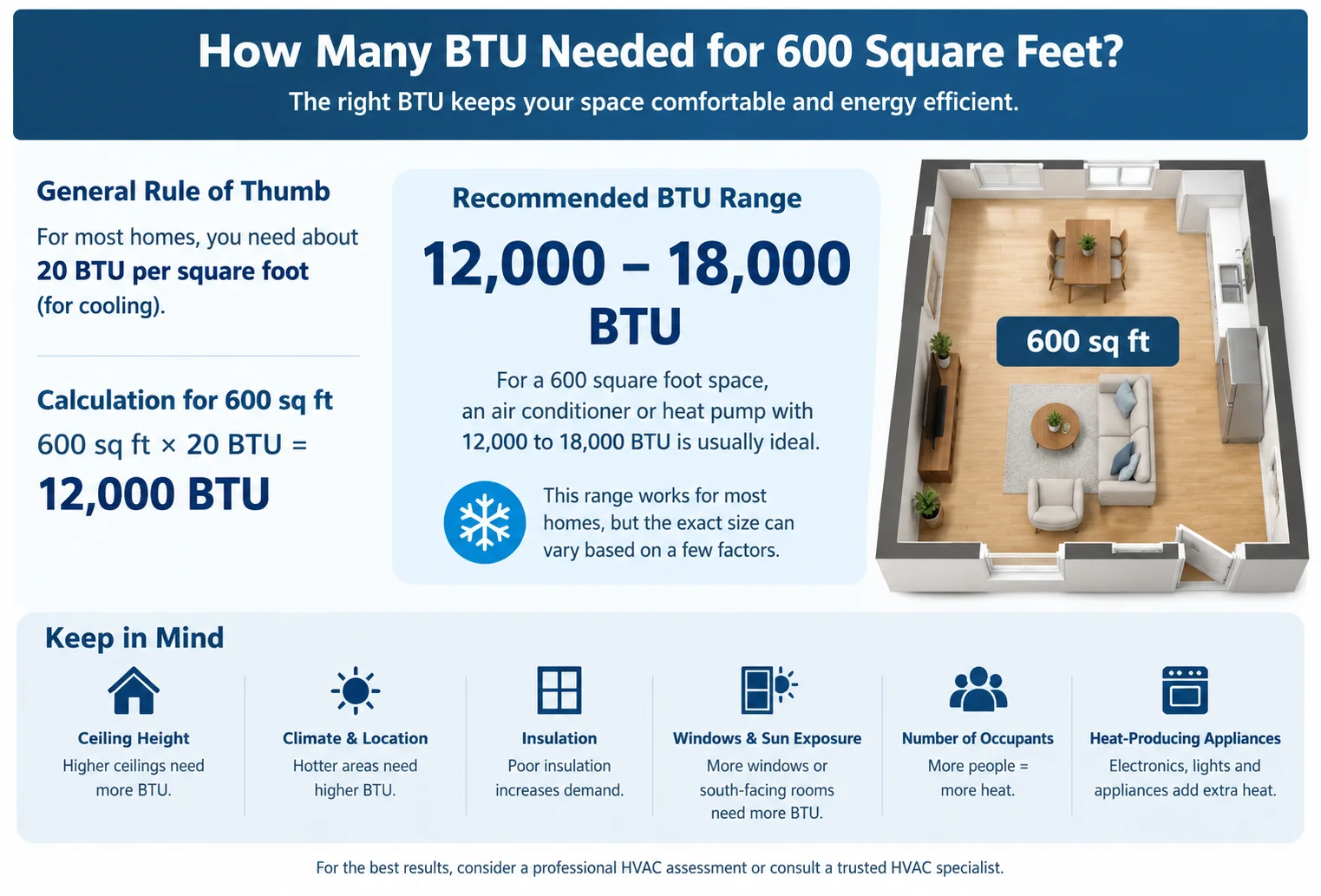
As a general starting point, a 600-square-foot room may need around 12,000–14,000 BTU per hour for cooling and approximately 12,000–24,000 BTU per hour for heating, depending on local conditions. Heating requirements can fall outside this range in very cold climates or highly efficient buildings, so these figures are estimates rather than universal recommendations.
Quick Answer: How Many BTU Are Needed for 600 Square Feet?
The answer depends on whether you want to heat or cool the space.
| Application | Approximate BTU per Hour | Typical Equipment Consideration |
|---|---|---|
| Air conditioning | 12,000–14,000 BTU/h | Around 1 to 1.2 tons of cooling |
| Mini-split for cooling | 12,000–18,000 BTU/h | Depends on climate, insulation, and model availability |
| Heating in mild conditions | 12,000–18,000 BTU/h | May suit a well-insulated space |
| Heating in moderate conditions | 15,000–24,000 BTU/h | Depends on the room’s heat loss |
| Heating in very cold conditions | 24,000 BTU/h or more may be necessary | Requires a location-specific heating calculation |
These ranges are for initial planning, not final equipment selection. Heating and cooling capacities are not interchangeable in every system, particularly heat pumps whose heating output changes with outdoor temperature.
How to Calculate BTU for 600 Square Feet
A simple way to estimate cooling capacity is to multiply the room’s square footage by an approximate BTU requirement per square foot.
Formula:
Required BTU per hour = Room area × Estimated BTU per square foot
For a basic cooling estimate using 20 BTU per square foot:
600 × 20 = 12,000 BTU/h.
Therefore, the simple estimate is 12,000 BTU per hour for 600 square feet.
This is a starting point, not a precise heating or cooling load calculation. The actual requirement depends on the building and local weather.
Example Calculation
Suppose you have a rectangular room that is 20 feet long and 30 feet wide.
Step 1: Calculate the floor area.
20 × 30 = 600 square feet.
Step 2: Estimate the cooling capacity.
600 × 20 = 12,000 BTU/h.
Step 3: Adjust for the room’s conditions.
If the room has a high ceiling, large sun-facing windows, poor insulation, or significant air leakage, it may require more cooling. A shaded, well-insulated room may require less.
For a window air conditioner, published room-size guidance may suggest a different capacity than the simple 20-BTU-per-square-foot rule. Always compare the estimate with the manufacturer’s sizing chart.
How Many BTU Are Needed to Cool 600 Square Feet?
For air conditioning, a useful initial estimate is approximately 12,000–14,000 BTU per hour for a 600-square-foot space.
The appropriate size depends on the room’s heat gain. Sunlight, occupants, appliances, cooking, and outdoor temperatures all affect the cooling load.
| Room Conditions | Preliminary Cooling Estimate |
|---|---|
| Shaded, well-insulated room | Around 12,000 BTU/h may be sufficient |
| Typical room with average insulation | Around 12,000–14,000 BTU/h |
| Sunny room with large windows | May require more capacity |
| High-ceiling room or open-plan area | Requires an adjusted calculation |
| Room with substantial cooking or equipment heat | May need additional capacity |
These are estimates, not guaranteed recommendations. An oversized air conditioner can cool the room quickly but may cycle too frequently and remove less humidity than expected. An undersized unit may struggle to maintain the desired temperature on hot days.
Is a 12,000 BTU Air Conditioner Enough for 600 Square Feet?
A 12,000 BTU/h air conditioner may be enough for a well-insulated 600-square-foot room under suitable conditions. However, some room-air-conditioner sizing charts place 600 square feet in a range that calls for approximately 14,000 BTU/h.
Before purchasing, consider the manufacturer’s recommended room area, local summer temperatures, ceiling height, sunlight, and the number of people regularly using the room.
Is an 18,000 BTU Air Conditioner Too Big for 600 Square Feet?
An 18,000 BTU/h unit may be larger than necessary for a typical 600-square-foot room, but some spaces have higher cooling loads. Large windows, strong sunlight, high ceilings, and connected kitchen areas can increase the required capacity.
Do not automatically choose a larger unit as a precaution. Correct sizing helps balance comfort, humidity control, efficiency, and equipment life.
How Many BTU Are Needed to Heat 600 Square Feet?
Heating requirements depend on how quickly a room loses heat. A room in a mild climate with good insulation may need considerably less heating output than an older, drafty room in a region with severe winters.
For a rough estimate, you can use a range of BTU per hour per square foot, then multiply it by 600.
| Assumed Heating Requirement | Calculation | Estimated Heating Capacity |
|---|---|---|
| 20 BTU/h per sq ft | 600 × 20 | 12,000 BTU/h |
| 25 BTU/h per sq ft | 600 × 25 | 15,000 BTU/h |
| 30 BTU/h per sq ft | 600 × 30 | 18,000 BTU/h |
| 40 BTU/h per sq ft | 600 × 40 | 24,000 BTU/h |
| 50 BTU/h per sq ft | 600 × 50 | 30,000 BTU/h |
These figures illustrate how different heat-loss assumptions affect the result. They are not universal climate-zone requirements. For an accurate heating estimate, the calculation must account for the local winter design temperature, insulation, windows, air leakage, and desired indoor temperature.
What Size Heater Is Best for 600 Square Feet?
The best heater is one that can supply the room’s calculated heating load under the coldest conditions for which it is designed.
- A well-insulated room in a mild climate may need relatively little heating capacity.
- A room with average insulation may need a moderate amount of heating output.
- A drafty room in a cold climate may need significantly more capacity.
Check whether the heater’s listed BTU rating represents fuel input or useful heat output. These are not always the same. For electric heaters, wattage is also useful when estimating electricity consumption.
What Size Mini-Split Is Needed for 600 Square Feet?
A mini-split’s required size depends on whether it is being used primarily for cooling, heating, or both.
| Mini-Split Capacity | Approximate Tonnage Equivalent | Possible Application |
|---|---|---|
| 9,000 BTU/h | 0.75 ton | Smaller spaces or low-load rooms |
| 12,000 BTU/h | 1 ton | Some well-insulated 600 sq ft rooms |
| 15,000 BTU/h | 1.25 tons | May suit rooms with moderate cooling needs |
| 18,000 BTU/h | 1.5 tons | May suit higher-load rooms or certain layouts |
| 24,000 BTU/h | 2 tons | Higher-load applications requiring careful sizing |
The tonnage figures are mathematical equivalents based on 12,000 BTU/h per ton of cooling. They do not mean that a particular unit is suitable for every 600-square-foot space.
When selecting a mini-split heat pump, check both its cooling capacity and its heating capacity at the outdoor temperatures typical of your location. Some systems lose heating capacity as outdoor temperatures fall.
Factors That Affect BTU Requirements
Square footage is only one part of the calculation. Several additional factors can change the capacity required for a 600-square-foot room.
1. Insulation Quality
Good insulation slows heat transfer through walls, ceilings, and floors. It can reduce the amount of heating or cooling needed to maintain a comfortable temperature.
Poor insulation allows heat to enter during summer and escape during winter, increasing the load on the HVAC system.
2. Ceiling Height
A 600-square-foot room with an 8-foot ceiling contains less air volume than one with a 12-foot ceiling.
| Floor Area | Ceiling Height | Room Volume |
|---|---|---|
| 600 sq ft | 8 ft | 4,800 cubic ft |
| 600 sq ft | 9 ft | 5,400 cubic ft |
| 600 sq ft | 10 ft | 6,000 cubic ft |
| 600 sq ft | 12 ft | 7,200 cubic ft |
A higher ceiling does not automatically require a fixed percentage increase in BTUs, but it can affect heating and cooling performance. The building envelope and air movement also matter.
3. Windows and Sunlight
Large windows can increase solar heat gain during summer and heat loss during winter. A room with strong afternoon sunlight may need more cooling than a similar room facing a shaded direction.
Window quality, orientation, curtains, and external shading can all affect the result.
4. Local Climate
A cooling system in a hot climate must handle higher outdoor temperatures and greater heat gain. A heating system in a cold climate must replace more heat lost through the building envelope.
Choose equipment based on the actual weather conditions in your location rather than relying solely on a general square-footage chart.
5. Number of Occupants and Appliances
People, computers, televisions, cooking equipment, and other appliances release heat. A room used by several people or containing heat-producing equipment may need more cooling than an otherwise similar room.
6. Room Layout
An enclosed 600-square-foot room is different from a 600-square-foot open area connected to a kitchen, hallway, or additional rooms. Heat can move between connected spaces, changing the total area the system must serve.
How Much Electricity Does a 12,000 BTU Air Conditioner Use?
BTU capacity measures cooling output, not the electricity consumed. The electricity required depends on the unit’s efficiency, operating conditions, and how long it runs.
For an illustrative example, suppose a 12,000 BTU/h air conditioner has an energy-efficiency ratio (EER) of 10.
Electrical power input = Cooling output ÷ EER
12,000 ÷ 10 = 1,200 watts.
If the unit operated continuously at that input for 8 hours:
1.2 kW × 8 hours = 9.6 kWh.
This is an illustrative calculation, not a prediction of daily consumption. Actual electricity use varies with outdoor temperature, thermostat settings, room heat gain, compressor cycling, and the unit’s efficiency at real operating conditions.
Common Mistakes When Choosing BTU Capacity
Avoid these mistakes when sizing a heating or cooling system for 600 square feet.
- Using the same BTU estimate for heating and cooling: Heating and cooling loads can be very different.
- Ignoring insulation: A drafty room can require much more capacity than an insulated room of the same size.
- Choosing a unit based only on its maximum rating: Equipment performance can vary with operating conditions.
- Buying an oversized air conditioner: Excess capacity can reduce humidity control and cause frequent cycling.
- Ignoring ceiling height and windows: Both can affect the room’s heating and cooling requirements.
- Confusing input and output BTUs: A fuel-burning heater’s input rating may be higher than the heat it delivers indoors.
- Skipping a load calculation for a permanent system: A proper HVAC assessment is more dependable than a general rule of thumb.
Frequently Asked Questions
1. How many BTU are needed for 600 square feet?
For cooling, a preliminary estimate is approximately 12,000–14,000 BTU/h. Heating requirements vary more widely and may range from around 12,000 to 24,000 BTU/h or more, depending on insulation and climate.
2. Is 12,000 BTU enough for 600 square feet?
It may be enough for cooling a well-insulated room under suitable conditions. However, a sunny room, a high ceiling, or a hot climate may require additional cooling capacity.
3. Is 15,000 BTU enough for 600 square feet?
A 15,000 BTU/h unit may be suitable for many 600-square-foot spaces, depending on whether it is designed for heating or cooling and the conditions in which it operates. Confirm the manufacturer’s room-size guidance and actual capacity.
4. How many BTUs are needed to heat a 600-square-foot garage?
A garage may need more heating capacity than an insulated room of the same size because garage doors, concrete floors, and uninsulated walls can increase heat loss. Estimate the heating load using the garage’s construction, climate, and desired indoor temperature before selecting equipment.
5. How many BTUs are needed to cool a 600-square-foot apartment?
A starting estimate is around 12,000–14,000 BTU/h, but the correct size depends on the apartment’s insulation, windows, sunlight, ceiling height, and connected spaces. A room-specific sizing chart or HVAC assessment can help narrow the choice.
6. How many tons of AC are needed for 600 square feet?
A 12,000 BTU/h air conditioner is equivalent to 1 ton of cooling. A 14,000 BTU/h unit is approximately 1.17 tons, while an 18,000 BTU/h unit is 1.5 tons. The appropriate size depends on the actual cooling load.
7. Does a higher BTU rating always mean better performance?
No. A larger rating means greater nominal capacity, not necessarily better comfort or efficiency. A properly sized unit can maintain temperature more consistently and, for air conditioning, may provide better humidity control.
8. How can I calculate the exact BTU requirement for 600 square feet?
For an accurate result, calculate the heating or cooling load using the building’s dimensions, insulation, windows, air leakage, occupancy, climate, and other relevant factors. HVAC professionals commonly use established load-calculation methods for permanent systems.
Conclusion
For a 600-square-foot room, 12,000–14,000 BTU/h is a useful preliminary estimate for cooling, while heating requirements depend heavily on climate and heat loss. A well-insulated room may need less capacity than a drafty space, and high ceilings or large windows can change the result.
Measure the room, assess its insulation and sunlight, and compare your estimate with the manufacturer’s recommendations. For a permanent HVAC system or a room with unusual conditions, a professional heating or cooling load calculation is the most reliable way to select the right capacity.
Discover More Articles
How Many Feet Is 189 Inches? Exact Conversion Guide