
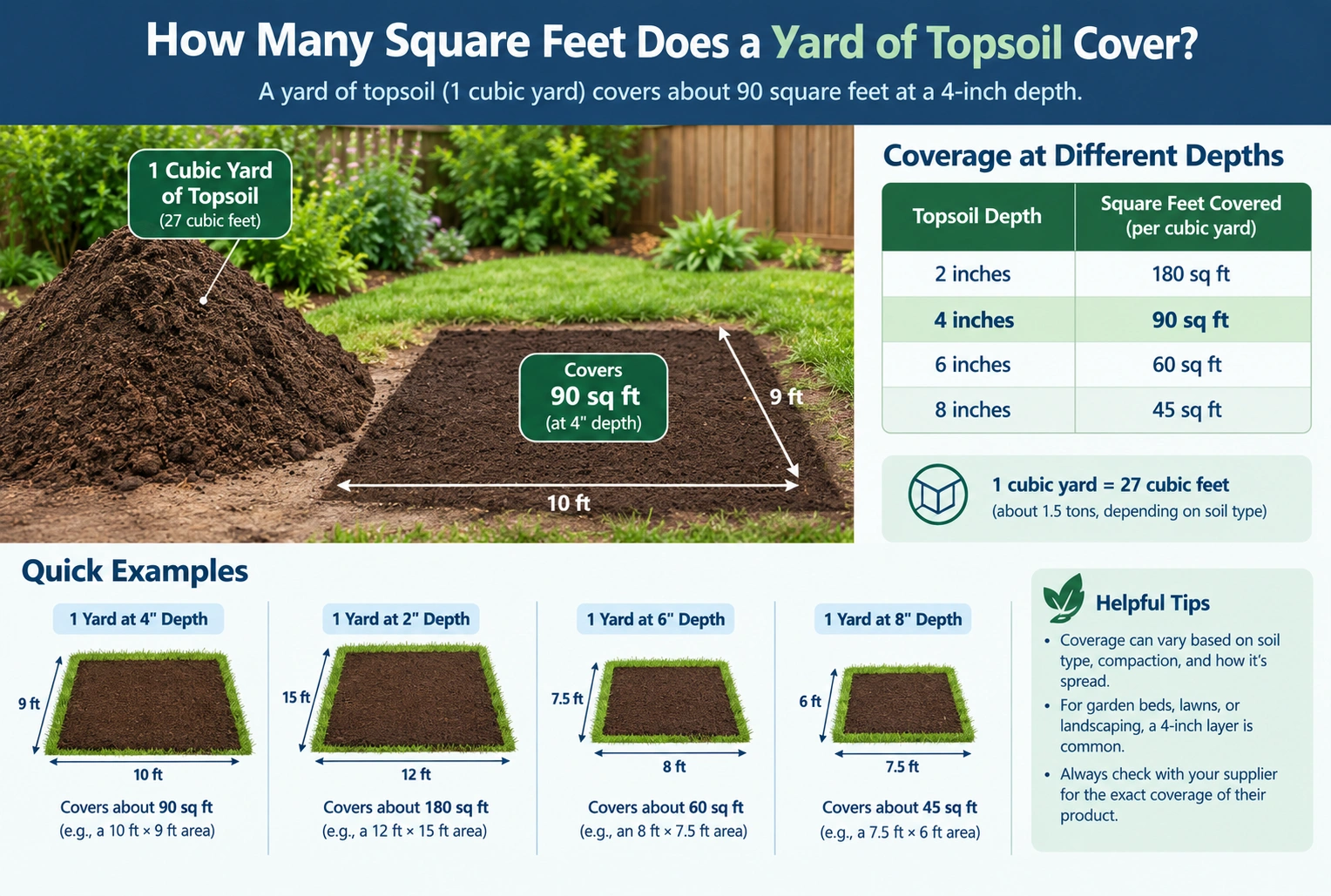
One cubic yard of topsoil can cover approximately 324 square feet at 1 inch deep, 162 square feet at 2 inches deep, 108 square feet at 3 inches deep, and 81 square feet at 4 inches deep.
The exact coverage depends on how thickly you spread the topsoil. The deeper the layer, the fewer square feet one yard will cover.
| Topsoil Depth | Coverage From 1 Cubic Yard |
|---|---|
| 1 inch | 324 sq ft |
| 2 inches | 162 sq ft |
| 3 inches | 108 sq ft |
| 4 inches | 81 sq ft |
| 5 inches | 64.8 sq ft |
| 6 inches | 54 sq ft |
| 8 inches | 40.5 sq ft |
| 12 inches | 27 sq ft |
What Is a Yard of Topsoil?
When people ask about a “yard of topsoil,” they usually mean one cubic yard.
A cubic yard is a volume measurement equal to:
3 feet × 3 feet × 3 feet = 27 cubic feet
So:
1 cubic yard = 27 cubic feet
Topsoil is commonly sold by the cubic yard because landscaping projects can require large quantities of soil.
A cubic yard does not represent a fixed number of square feet. Instead, its square-foot coverage depends on the depth of the soil layer.
How Many Square Feet Does a Yard of Topsoil Cover?
The coverage of one cubic yard changes with application depth.
The basic formula is:
Coverage = 324 ÷ Depth in Inches
For example, at a depth of 2 inches:
324 ÷ 2 = 162 square feet
Therefore, one cubic yard of topsoil covers approximately 162 square feet at 2 inches deep.
| Depth | Approximate Coverage |
|---|---|
| 1 inch | 324 sq ft |
| 2 inches | 162 sq ft |
| 3 inches | 108 sq ft |
| 4 inches | 81 sq ft |
| 5 inches | 64.8 sq ft |
| 6 inches | 54 sq ft |
| 8 inches | 40.5 sq ft |
| 10 inches | 32.4 sq ft |
| 12 inches | 27 sq ft |
These calculations assume exactly one cubic yard and even distribution.
How Is the 324-Square-Foot Figure Calculated?
A cubic yard contains 27 cubic feet.
At a depth of 1 inch, convert 1 inch to feet:
1 ÷ 12 = 0.0833 feet
Then divide the volume by the depth:
27 ÷ 0.0833 ≈ 324 square feet
So:
1 cubic yard of topsoil covers about 324 square feet at 1 inch deep.
This is the foundation for calculating coverage at other depths.
How Many Square Feet Does a Yard of Topsoil Cover at 2 Inches?
At 2 inches deep:
324 ÷ 2 = 162 square feet
Therefore, one cubic yard covers approximately 162 square feet at a 2-inch depth.
This depth can be useful for some lawn and garden applications, depending on the project and existing soil conditions.
How Many Square Feet Does a Yard of Topsoil Cover at 3 Inches?
At 3 inches:
324 ÷ 3 = 108 square feet
Therefore, one cubic yard of topsoil covers approximately 108 square feet at 3 inches deep.
A 3-inch layer is commonly considered when adding a substantial layer of soil to a garden or preparing certain planting areas.
How Many Square Feet Does a Yard of Topsoil Cover at 4 Inches?
At 4 inches:
324 ÷ 4 = 81 square feet
Therefore, one cubic yard covers approximately 81 square feet at 4 inches deep.
For example, if you have an area of 80 square feet and want approximately 4 inches of topsoil, one cubic yard is almost exactly the theoretical amount required.
How Many Square Feet Does a Yard of Topsoil Cover at 6 Inches?
At 6 inches:
324 ÷ 6 = 54 square feet
So, one cubic yard of topsoil covers approximately 54 square feet at a 6-inch depth.
A 6-inch layer uses substantially more soil than a 2- or 3-inch layer.
How Many Square Feet Does a Yard of Topsoil Cover at 12 Inches?
At 12 inches, the soil layer is one foot deep.
Because one cubic yard contains 27 cubic feet:
27 ÷ 1 = 27 square feet
Therefore, one cubic yard covers exactly 27 square feet at a 12-inch depth, assuming no settling or material loss.
How Much Topsoil Do You Need for Your Yard?
To determine how many cubic yards you need, first calculate the area’s square footage.
Then determine the desired depth.
The formula is:
Cubic Yards Needed = Square Feet × Depth in Inches ÷ 324
Example: 500-Square-Foot Area
Suppose you have a 500-square-foot garden and want 3 inches of topsoil.
500 × 3 ÷ 324 = 4.63 cubic yards
You would need approximately 4.63 cubic yards theoretically.
In practice, you would normally order a little extra to account for settling, uneven ground, and material loss.
| Area | 2-Inch Depth | 3-Inch Depth | 4-Inch Depth |
|---|---|---|---|
| 100 sq ft | 0.62 yd³ | 0.93 yd³ | 1.23 yd³ |
| 250 sq ft | 1.54 yd³ | 2.31 yd³ | 3.09 yd³ |
| 500 sq ft | 3.09 yd³ | 4.63 yd³ | 6.17 yd³ |
| 750 sq ft | 4.63 yd³ | 6.94 yd³ | 9.26 yd³ |
| 1,000 sq ft | 6.17 yd³ | 9.26 yd³ | 12.35 yd³ |
| 2,000 sq ft | 12.35 yd³ | 18.52 yd³ | 24.69 yd³ |
Values are theoretical cubic-yard requirements before adding an allowance for waste or settling.
How Many Yards of Topsoil Do You Need for 1,000 Square Feet?
For 1,000 square feet, the required amount depends on depth.
| Depth | Topsoil Needed for 1,000 sq ft |
|---|---|
| 1 inch | 3.09 cubic yards |
| 2 inches | 6.17 cubic yards |
| 3 inches | 9.26 cubic yards |
| 4 inches | 12.35 cubic yards |
| 6 inches | 18.52 cubic yards |
| 8 inches | 24.69 cubic yards |
| 12 inches | 37.04 cubic yards |
This demonstrates why measuring the depth before ordering topsoil is important.
How Many Yards of Topsoil Do You Need for a Lawn?
The amount needed for a lawn depends on whether you are:
- Starting a new lawn
- Leveling an existing lawn
- Improving poor soil
- Top-dressing an established lawn
- Filling low areas
For a relatively thin top-dressing layer, the required volume can be much lower than for completely rebuilding the soil profile.
| Application | Typical Depth Range |
|---|---|
| Light top dressing | ¼–½ inch |
| General lawn improvement | ½–1 inch |
| Soil addition | 1–3 inches |
| New planting area | Often 3+ inches |
The appropriate depth depends on the existing soil and the type of grass or plants being grown.
How Many Yards of Topsoil Do You Need for a Garden?
Garden beds may require more soil than a lawn top-dressing application.
If you have a 100-square-foot garden and want 4 inches of topsoil:
100 × 4 ÷ 324 = 1.23 cubic yards
You would therefore need about 1.23 cubic yards theoretically.
If topsoil is sold only in whole cubic-yard quantities, you may need to order 2 cubic yards, depending on the supplier’s minimum order and delivery options.
Topsoil Coverage by Common Yard Sizes
If you are ordering several cubic yards, the coverage increases proportionally.
At 2 inches deep:
| Topsoil Quantity | Approximate Coverage |
|---|---|
| 1 cubic yard | 162 sq ft |
| 2 cubic yards | 324 sq ft |
| 3 cubic yards | 486 sq ft |
| 4 cubic yards | 648 sq ft |
| 5 cubic yards | 810 sq ft |
| 10 cubic yards | 1,620 sq ft |
At 4 inches deep:
| Topsoil Quantity | Approximate Coverage |
|---|---|
| 1 cubic yard | 81 sq ft |
| 2 cubic yards | 162 sq ft |
| 3 cubic yards | 243 sq ft |
| 4 cubic yards | 324 sq ft |
| 5 cubic yards | 405 sq ft |
| 10 cubic yards | 810 sq ft |
How to Calculate Topsoil Coverage Yourself
You can calculate the amount of topsoil required in a few simple steps.
Step 1: Measure the Area
For a rectangular area:
Length × Width = Square Feet
For example:
20 ft × 30 ft = 600 sq ft
Step 2: Choose the Soil Depth
Suppose you want 3 inches of topsoil.
Step 3: Use the Formula
600 × 3 ÷ 324 = 5.56 cubic yards
You would need approximately 5.56 cubic yards before accounting for extra material.
Step 4: Add an Allowance
Consider ordering additional topsoil if:
- The ground is uneven
- The soil will settle
- Some soil will be lost during installation
- The area contains low spots
- You need to level the surface
What Factors Affect Topsoil Coverage?
The theoretical calculations are straightforward, but actual coverage can vary.
Soil Depth
This is the biggest factor. A deeper layer requires more cubic yards.
Uneven Ground
Low spots can require significantly more soil than a perfectly level surface.
Settling
Loose topsoil can settle after placement, especially after rain or watering.
Soil Quality
Different topsoil products may contain different proportions of organic matter, sand, clay, and other materials.
Spreading Method
Hand-spreading, wheelbarrows, loaders, and other methods can result in different amounts of material being lost or left in piles.
Topsoil vs Compost vs Mulch Coverage
These materials are all sold by volume, but they serve different purposes.
| Material | Common Purpose | Coverage Depends On |
|---|---|---|
| Topsoil | Growing medium and soil improvement | Application depth |
| Compost | Organic matter and soil amendment | Application depth |
| Mulch | Moisture retention and weed suppression | Application depth |
| Garden soil | Planting beds and containers | Application depth |
A cubic yard of each material contains the same volume, but the recommended application depth may differ.
Cubic Yard vs Square Yard of Topsoil
These terms can be confusing.
A square yard measures area.
A cubic yard measures volume.
| Measurement | Meaning |
|---|---|
| 1 square yard | 9 square feet of area |
| 1 cubic yard | 27 cubic feet of volume |
Topsoil is normally ordered by cubic yards, not square yards, because soil has both area and depth.
How Much Does a Yard of Topsoil Weigh?
The weight of a cubic yard of topsoil varies considerably depending on:
- Moisture
- Soil composition
- Organic matter
- Compaction
Because of these variations, there is no single universal weight for a cubic yard of topsoil.
| Condition | Effect on Weight |
|---|---|
| Dry soil | Generally lighter |
| Moist soil | Heavier |
| Wet soil | Significantly heavier |
| Compacted soil | Denser |
| Organic-rich soil | Can have different density |
If you’re concerned about trailer or truck capacity, use the supplier’s stated weight rather than relying on a generic estimate.
Tips for Ordering Topsoil
Before ordering, calculate the area carefully.
Measure Multiple Sections
If your yard has several shapes, calculate each section separately and add them together.
Measure the Desired Depth
Don’t estimate depth by eye. Use a tape measure or marked measuring stick.
Account for Settling
Freshly delivered soil may settle after spreading.
Ask About the Supplier’s Volume
Confirm whether the supplier sells by a true cubic yard and whether the delivered volume is measured loose or otherwise specified.
Buy Based on Your Actual Project
Ordering significantly more soil than needed can create extra handling and disposal work.
Common Mistakes When Calculating Topsoil
Mistake 1: Confusing Square Yards With Cubic Yards
A square yard measures area, while a cubic yard measures volume.
Mistake 2: Ignoring Depth
You cannot determine topsoil coverage without knowing the desired depth.
Mistake 3: Using the Wrong Formula
For cubic yards:
Square Feet × Inches of Depth ÷ 324
Mistake 4: Assuming One Yard Always Covers the Same Area
One cubic yard covers different areas at different depths.
Mistake 5: Forgetting Settling and Uneven Areas
The theoretical amount may not be enough for an uneven or settling site.
Frequently Asked Questions
How many square feet does a yard of topsoil cover?
One cubic yard of topsoil covers approximately 324 square feet at 1 inch deep, 162 square feet at 2 inches, 108 square feet at 3 inches, or 81 square feet at 4 inches.
How much area does 1 yard of topsoil cover at 2 inches?
One cubic yard covers approximately 162 square feet at a 2-inch depth.
How much area does 1 yard of topsoil cover at 4 inches?
At 4 inches deep, one cubic yard covers approximately 81 square feet.
How many cubic yards of topsoil do I need for 1,000 square feet?
At 2 inches deep, you need about 6.17 cubic yards. At 3 inches, about 9.26 cubic yards. At 4 inches, about 12.35 cubic yards.
Is a yard of topsoil the same as a cubic yard?
Usually, yes. When landscaping suppliers refer to a “yard” of topsoil, they generally mean one cubic yard, which equals 27 cubic feet.
Conclusion
So, how many square feet does a yard of topsoil cover? It depends on the depth. One cubic yard covers approximately 324 square feet at 1 inch deep, 162 square feet at 2 inches, 108 square feet at 3 inches, and 81 square feet at 4 inches.
The basic formula is:
Cubic Yards Needed = Square Feet × Depth in Inches ÷ 324
For accurate project planning, measure your area, choose the desired soil depth, calculate the cubic yards required, and allow for settling and uneven areas when appropriate.
Discover More Articles
How Many BTU Do I Need to Heat 1,000 Square Feet?