

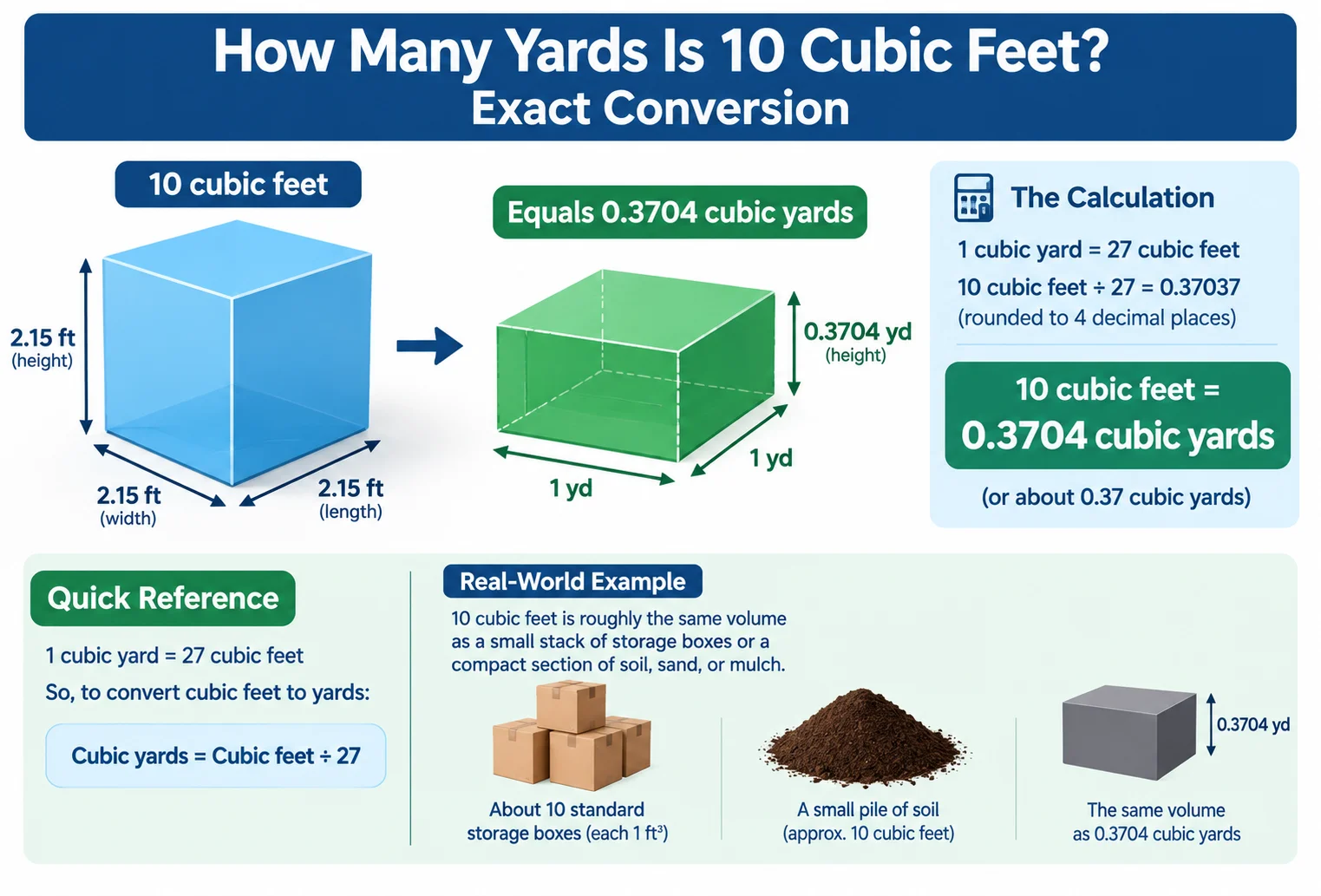
If you’re wondering how many yards 10 cubic feet is, the answer is approximately 0.37 cubic yards.
More precisely, 10 cubic feet equals 0.37037 cubic yards. This conversion is useful when measuring mulch, soil, gravel, concrete, and other materials sold by the cubic yard.
Remember that cubic feet measure volume, so the correct conversion is to cubic yards, not regular linear yards.
Quick Answer
10 cubic feet = 0.37037 cubic yards, or approximately 0.37 cubic yards.
The conversion is based on:
- 1 cubic yard = 27 cubic feet
- 1 cubic foot = 0.037037 cubic yards
- 10 cubic feet ÷ 27 = 0.37037 cubic yards
| Measurement | Equivalent |
|---|---|
| Cubic feet | 10 ft³ |
| Cubic yards | 0.37037 yd³ |
| Rounded cubic yards | 0.37 yd³ |
| Cubic inches | 17,280 in³ |
| Cubic meters | 0.28317 m³ |
| Liters | 283.17 L |
This means 10 cubic feet is a little more than one-third of a cubic yard.
How to Convert 10 Cubic Feet to Cubic Yards
Converting cubic feet into cubic yards is simple once you know the correct conversion factor.
One cubic yard contains exactly 27 cubic feet because a yard measures 3 feet in length, width, and height.
The calculation is:
3 × 3 × 3 = 27 cubic feet
The Conversion Formula
Cubic yards = Cubic feet ÷ 27
For 10 cubic feet:
10 ÷ 27 = 0.37037
Therefore:
10 cubic feet = 0.37037 cubic yards
You can use the same formula to convert any volume measured in cubic feet into cubic yards.
For example, if you have 54 cubic feet of gravel:
54 ÷ 27 = 2 cubic yards
This formula is particularly helpful when comparing bagged materials with bulk materials sold by the cubic yard.
10 Cubic Feet in Other Volume Units
Converting 10 cubic feet into other volume units can help when working with different measurement systems.
| Volume Unit | Equivalent to 10 Cubic Feet |
|---|---|
| Cubic feet | 10 ft³ |
| Cubic yards | 0.37037 yd³ |
| Cubic inches | 17,280 in³ |
| Cubic meters | 0.28317 m³ |
| Liters | 283.17 L |
| U.S. gallons | Approximately 74.8 gal |
These conversions can be useful for construction, landscaping, storage, and international product specifications.
Cubic Feet to Cubic Yards Conversion Table
If you frequently work with landscaping or construction materials, a conversion table makes it easier to estimate quantities without repeating the calculation.
| Cubic Feet | Cubic Yards |
|---|---|
| 1 ft³ | 0.03704 yd³ |
| 5 ft³ | 0.18519 yd³ |
| 10 ft³ | 0.37037 yd³ |
| 15 ft³ | 0.55556 yd³ |
| 20 ft³ | 0.74074 yd³ |
| 25 ft³ | 0.92593 yd³ |
| 27 ft³ | 1 yd³ |
| 30 ft³ | 1.11111 yd³ |
| 40 ft³ | 1.48148 yd³ |
| 50 ft³ | 1.85185 yd³ |
| 54 ft³ | 2 yd³ |
| 81 ft³ | 3 yd³ |
The most important reference is 27 cubic feet = 1 cubic yard.
How Much Space Is 10 Cubic Feet?
Ten cubic feet describes the amount of three-dimensional space an object or material occupies.
One way to visualize this volume is to imagine a rectangular container measuring:
- 2 feet long
- 2 feet wide
- 2.5 feet high
Its volume would be:
2 × 2 × 2.5 = 10 cubic feet
Another possible container could measure 5 feet long, 2 feet wide, and 1 foot high.
5 × 2 × 1 = 10 cubic feet
| Length | Width | Height | Total Volume |
|---|---|---|---|
| 2 ft | 2 ft | 2.5 ft | 10 ft³ |
| 5 ft | 2 ft | 1 ft | 10 ft³ |
| 4 ft | 2.5 ft | 1 ft | 10 ft³ |
| 10 ft | 1 ft | 1 ft | 10 ft³ |
All these containers hold the same volume, even though their shapes and dimensions are different.
What Can 10 Cubic Feet of Material Cover?
The coverage of 10 cubic feet depends on the depth at which you spread the material.
This is especially important when purchasing mulch, soil, compost, gravel, or other landscaping products.
The formula is:
Coverage area = Volume ÷ Depth
Both measurements must use the same units. For example, if volume is in cubic feet, convert the spreading depth into feet.
Here is how much area 10 cubic feet can cover at different depths:
| Material Depth | Approximate Coverage |
|---|---|
| 1 inch | 120 sq ft |
| 2 inches | 60 sq ft |
| 3 inches | 40 sq ft |
| 4 inches | 30 sq ft |
| 5 inches | 24 sq ft |
| 6 inches | 20 sq ft |
| 8 inches | 15 sq ft |
| 12 inches | 10 sq ft |
These figures assume an even layer and no material loss from uneven ground, settling, or spillage.
Example: Mulch Coverage
Suppose you have 10 cubic feet of mulch and want to spread it 2 inches deep.
First, convert 2 inches into feet:
2 ÷ 12 = 0.1667 feet
Then divide the volume by the depth:
10 ÷ 0.1667 ≈ 60 square feet
So, 10 cubic feet of mulch can cover approximately 60 square feet at a depth of 2 inches.
How to Calculate Material Needed for a Project
If you know the length, width, and desired depth of an area, you can calculate the volume of material required.
The Formula
Cubic feet = Length × Width × Depth
Make sure all dimensions are measured in feet.
For example, imagine a garden bed that is:
- 10 feet long
- 5 feet wide
- 2 inches deep
Convert the depth into feet:
2 ÷ 12 = 0.1667 feet
Calculate the volume:
10 × 5 × 0.1667 = 8.335 cubic feet
Now convert cubic feet into cubic yards:
8.335 ÷ 27 ≈ 0.309 cubic yards
You would need approximately 8.34 cubic feet, or 0.31 cubic yards, of material before allowing for waste or settling.
Common Project Volume Examples
| Project Area | Depth | Required Volume |
|---|---|---|
| 10 × 5 ft garden bed | 2 in | 8.33 ft³ |
| 10 × 10 ft garden area | 2 in | 16.67 ft³ |
| 10 × 10 ft garden area | 3 in | 25 ft³ |
| 10 × 20 ft area | 2 in | 33.33 ft³ |
| 10 × 20 ft area | 4 in | 66.67 ft³ |
Actual material quantities may need to be adjusted for uneven surfaces, compaction, settling, and installation requirements.
Is 10 Cubic Feet the Same as 10 Cubic Yards?
No. These are very different volumes.
One cubic yard equals 27 cubic feet, so 10 cubic yards is much larger than 10 cubic feet.
| Measurement | Equivalent Volume |
|---|---|
| 1 cubic foot | 1 ft³ |
| 10 cubic feet | 10 ft³ |
| 1 cubic yard | 27 ft³ |
| 10 cubic yards | 270 ft³ |
Therefore, 10 cubic yards is 27 times the volume of 10 cubic feet.
This distinction matters when ordering bulk materials. Confusing the two units could result in ordering far more or far less material than a project requires.
Common Conversion Mistakes
Mistake 1: Dividing by 3 Instead of 27
A yard contains 3 feet, but a cubic yard contains 27 cubic feet.
Because volume has three dimensions, the conversion factor must be cubed:
3 × 3 × 3 = 27
The correct calculation is:
10 ÷ 27 = 0.37037 cubic yards
Mistake 2: Confusing Cubic Yards With Linear Yards
A linear yard measures length, while a cubic yard measures volume.
You cannot directly convert cubic feet into linear yards without knowing the width and height of the material or space.
Mistake 3: Forgetting Material Depth
Ten cubic feet does not always cover the same surface area.
A thin layer covers more ground than a thick layer. Always calculate coverage using the intended depth.
Mistake 4: Ignoring Compaction and Settling
Materials such as soil and gravel may settle or compact after installation. The delivered volume and the final installed volume may differ.
For projects where the finished depth matters, consider the material’s specifications and allow for an appropriate quantity adjustment.
Mistake 5: Ordering Without Checking the Product Label
A bag labeled 10 cubic feet contains a stated volume, while bulk suppliers may sell by cubic yards. Confirm the unit before comparing prices or ordering materials.
FAQs
How many cubic yards are in 10 cubic feet?
10 cubic feet equals approximately 0.37037 cubic yards, or about 0.37 cubic yards.
What is the formula for converting cubic feet to cubic yards?
Divide the number of cubic feet by 27.
Cubic yards = Cubic feet ÷ 27
Is 10 cubic feet more or less than one cubic yard?
It is less. One cubic yard contains 27 cubic feet, so 10 cubic feet is approximately 37% of a cubic yard.
How many cubic feet are in one cubic yard?
There are exactly 27 cubic feet in one cubic yard.
How many square feet can 10 cubic feet cover?
Coverage depends on the depth of the material. At a 2-inch depth, 10 cubic feet covers approximately 60 square feet. At a 4-inch depth, it covers approximately 30 square feet.
How many liters are in 10 cubic feet?
Ten cubic feet equals approximately 283.17 liters.
Is 10 cubic feet enough for a garden?
It depends on the garden’s dimensions and the desired soil or mulch depth. For example, 10 cubic feet can cover about 60 square feet at a 2-inch depth.
How many bags of 10 cubic feet make one cubic yard?
One cubic yard contains 27 cubic feet.
27 ÷ 10 = 2.7 bags
So, 2.7 bags of 10 cubic feet would equal one cubic yard by volume. In practice, you would need 3 full bags to have at least one cubic yard.
Conclusion
10 cubic feet equals 0.37037 cubic yards, or approximately 0.37 cubic yards. To convert cubic feet into cubic yards, simply divide the volume by 27.
This conversion is useful when estimating mulch, soil, gravel, concrete, and other bulk materials. If you are calculating how much material a project needs, remember to account for the area, spreading depth, and possible settling or waste.
Discover More Articles
How Many Feet Away for Darts? Official Distance Guide