
If you’re setting up a dartboard at home, one of the most important measurements is the distance between the dartboard and the throwing line. Standing too close or too far away can affect your game and make your setup different from standard competition conditions.
Quick Answer
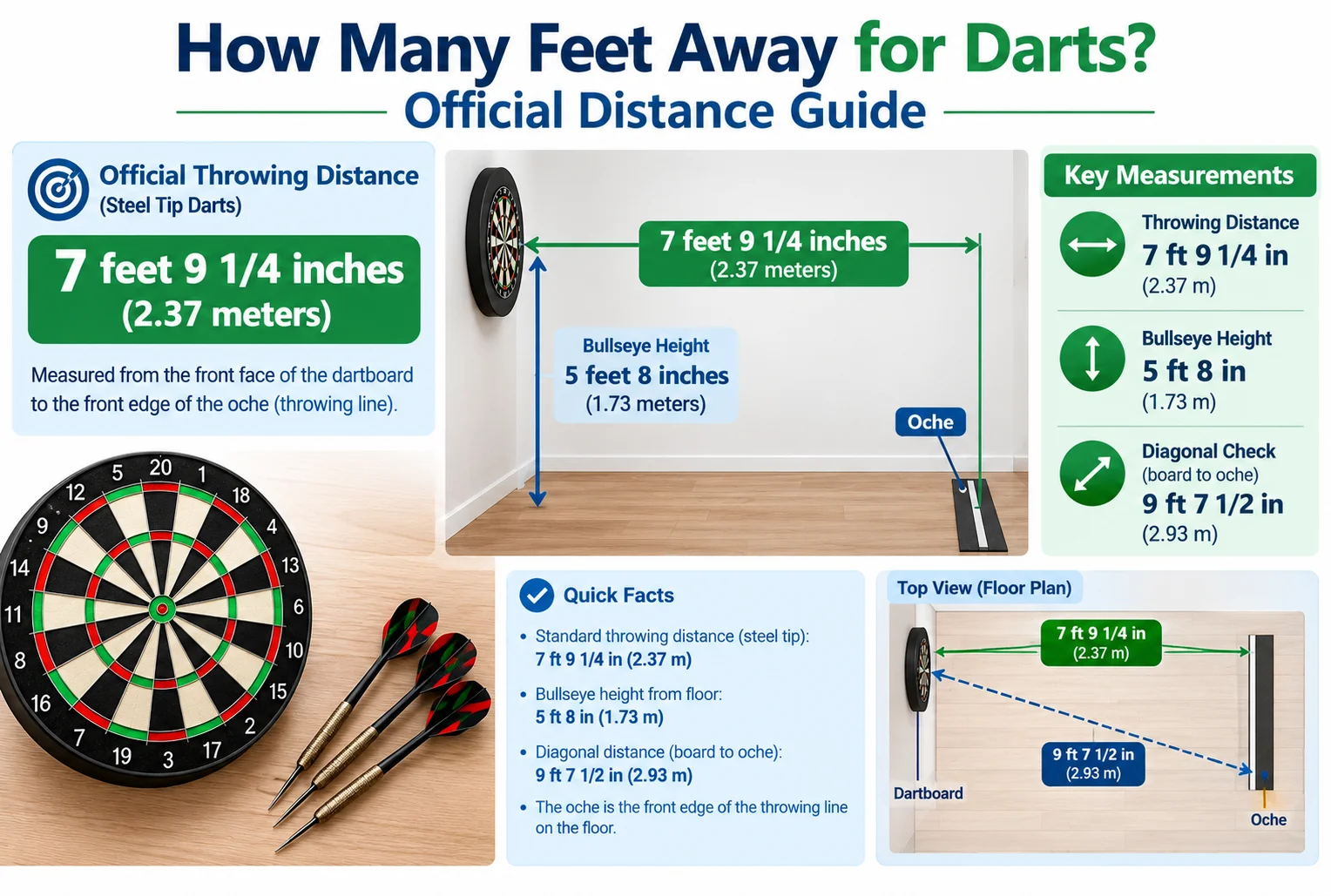
For standard steel-tip darts, you should stand 7 feet 9¼ inches away from the face of the dartboard, which is 7.77 feet or 2.37 meters.
The distance is measured horizontally from the front of the dartboard to the throwing line, commonly called the oche.
| Dartboard Measurement | Standard Distance |
|---|---|
| Throwing distance | 7 ft 9¼ in |
| Decimal feet | 7.77 ft |
| Meters | 2.37 m |
| Centimeters | 237 cm |
| Inches | 93¼ in |
For a standard setup, the center of the bullseye is also positioned 5 feet 8 inches above the floor.
What Is the Standard Distance for Darts?
The standard throwing distance for traditional steel-tip darts is 7 feet 9¼ inches.
This measurement is used for regulation-style dartboard setups and gives players a consistent distance from which to throw. Whether you’re practicing at home or preparing a board for organized play, using the standard distance makes your setup more representative of competitive conditions.
The distance should be measured from the front surface of the dartboard to the throwing line.
It is important not to measure from the wall behind the dartboard. The dartboard itself has some thickness, so measuring from the wall can make your actual throwing distance slightly different.
How Far Away Do You Stand From a Dartboard?
You stand 7 feet 9¼ inches from the front of the dartboard when playing standard steel-tip darts.
That is approximately:
- 7.77 feet
- 93.25 inches
- 2.37 meters
- 237 centimeters
The throwing line should be clearly marked on the floor. Your feet should remain behind this line when throwing.
If you’re installing a dartboard at home, measuring carefully is worthwhile because even a few inches can change the playing distance.
Standard Dartboard Setup Measurements
The throwing distance is only one part of a proper dartboard setup. The height of the board and position of the bullseye are also important.
| Measurement | Standard Size |
|---|---|
| Throwing distance | 7 ft 9¼ in |
| Bullseye height | 5 ft 8 in |
| Bullseye height in inches | 68 in |
| Throwing distance in inches | 93¼ in |
| Throwing distance in meters | 2.37 m |
The 5-foot-8-inch measurement refers to the height of the center of the bullseye from the floor, not the top of the dartboard.
How to Measure 7 Feet 9¼ Inches
If you’re setting up a dartboard, measuring 7 feet 9¼ inches may seem awkward at first. You can convert the measurement into inches to make the process easier.
There are 12 inches in a foot.
First, convert 7 feet into inches:
7 × 12 = 84 inches
Then add 9¼ inches:
84 + 9¼ = 93¼ inches
So the standard dart throwing distance is:
93¼ inches
You can use a tape measure to mark this distance from the front of the dartboard to the throwing line.
Why Is the Dart Distance 7 Feet 9¼ Inches?
The standard distance provides a consistent playing environment. When every player throws from the same distance, scores and performance can be compared under similar conditions.
A standardized distance also affects the trajectory of the dart. A player must judge the same approximate combination of distance, angle, power, and release point on every throw.
For casual games, you can technically choose a different distance. However, if you want your home setup to match a standard steel-tip dart setup, 7 feet 9¼ inches is the measurement to use.
How High Should a Dartboard Be?
The center of the bullseye should be 5 feet 8 inches above the floor in a standard setup.
That equals:
68 inches
or approximately:
1.73 meters
The measurement is taken from the floor directly up to the center of the bullseye.
| Bullseye Height Conversion | Measurement |
|---|---|
| Feet and inches | 5 ft 8 in |
| Inches | 68 in |
| Decimal feet | 5.67 ft |
| Meters | 1.73 m |
| Centimeters | 173 cm |
This measurement is different from the throwing distance. The 5 feet 8 inches measurement tells you how high to mount the board, while 7 feet 9¼ inches tells you how far away the player should stand.
How to Set Up a Dartboard at Home
Setting up a dartboard correctly involves a few basic steps.
1. Choose a Suitable Wall
Select a sturdy wall with enough open space around the dartboard. Darts can miss the board, especially when beginners are playing, so the surrounding area should be protected.
Avoid placing the board where people regularly walk behind the throwing area.
2. Mark the Bullseye Height
Measure 5 feet 8 inches from the floor and mark the wall.
This point represents the center of the bullseye.
Mount the dartboard so that the center of the bullseye lines up with this mark.
3. Measure the Throwing Distance
From the front face of the dartboard, measure 7 feet 9¼ inches along the floor.
Mark this location as the throwing line or oche.
4. Mark the Oche Clearly
The throwing line should be easy to see. You can use floor tape, a raised oche, paint, or another suitable marker.
The player should keep their feet behind the line while throwing.
5. Check the Measurements
Before playing, measure the setup again.
| Setup Check | Target |
|---|---|
| Bullseye from floor | 5 ft 8 in |
| Oche from board | 7 ft 9¼ in |
| Oche from board in inches | 93¼ in |
| Oche from board in meters | 2.37 m |
Does Dartboard Thickness Affect the Distance?
Yes. This is one reason it is important to understand exactly where the measurement starts.
The standard throwing distance is measured from the front of the dartboard, rather than simply measuring from the wall.
Suppose the dartboard is mounted against a wall and the board has some thickness. If you measure 7 feet 9¼ inches from the wall instead of the board’s front face, the player could actually be standing slightly farther away than the intended distance.
For the most accurate setup, place your tape measure at the appropriate front surface of the board and measure outward to the throwing line.
How Many Feet Away for Soft-Tip Darts?
Soft-tip darts can use different throwing distances depending on the rules, equipment, and organization running the game.
Unlike standard steel-tip darts, soft-tip setups do not always use exactly the same distance.
| Dart Type | Common Standard |
|---|---|
| Steel-tip darts | 7 ft 9¼ in |
| Steel-tip distance in meters | 2.37 m |
| Soft-tip darts | Can vary by rules and machine |
| Casual home darts | Player can choose the distance |
If you’re playing on an electronic dart machine, follow the manufacturer’s or venue’s specified throwing distance rather than automatically using the steel-tip measurement.
Steel-Tip vs. Soft-Tip Dart Distance
The main difference is that steel-tip darts are commonly associated with the 7 feet 9¼ inch throwing distance, while electronic soft-tip games can have different specifications.
| Feature | Steel-Tip Darts | Soft-Tip Darts |
|---|---|---|
| Dart tip | Metal point | Plastic tip |
| Typical board | Bristle board | Electronic board |
| Standard distance | 7 ft 9¼ in | Varies by rules |
| Distance in meters | 2.37 m | Depends on setup |
| Scoring | Usually manual/electronic options | Usually electronic |
Always check the specific rules for organized soft-tip play.
How Far Is 7 Feet 9¼ Inches in Other Units?
Converting the dart distance into different units can make setup easier if your measuring equipment uses metric or another system.
| Unit | Equivalent |
|---|---|
| Feet | 7.7708 ft |
| Feet and inches | 7 ft 9¼ in |
| Inches | 93.25 in |
| Yards | 2.59 yd |
| Meters | 2.37 m |
| Centimeters | 237 cm |
| Millimeters | 2,370 mm |
For most home installations, measuring 93¼ inches or 2.37 meters is the easiest option.
What Is the Oche in Darts?
The oche is the throwing line that marks the point behind which a player must stand when throwing darts.
Depending on the type of dart setup, the oche can be a simple line on the floor or a raised structure.
The important thing is that the player knows exactly where the legal throwing position begins.
For a standard steel-tip setup, the oche is positioned 7 feet 9¼ inches from the front of the dartboard.
Can You Stand Closer When Playing at Home?
Yes, if you’re only playing casually.
There is no requirement for a recreational home game to use the regulation distance. You might choose to stand closer if children or beginners are learning to throw.
However, changing the distance changes the difficulty and playing conditions.
If your goal is to practice for standard steel-tip darts, keeping the oche at 7 feet 9¼ inches gives you a consistent practice environment.
How Much Space Do You Need Around a Dartboard?
The board itself does not require a huge amount of space, but a dart setup should include enough room for throwing and safe movement.
You need space for:
- The dartboard
- The throwing distance
- The player
- Safe access around the area
- Protection around the wall and floor
The throwing distance alone is 7 feet 9¼ inches, but the total room depth should be greater because players need room behind the oche and other people may need to move around the area.
A dartboard should also be positioned where people are unlikely to cross in front of the player while darts are being thrown.
Common Dart Distance Mistakes
Several simple mistakes can cause a dartboard setup to be measured incorrectly.
Measuring From the Wall
Measure from the wall instead of the front of the board can produce an incorrect throwing distance.
Measuring the Wrong Height
The 5 feet 8 inches measurement applies to the center of the bullseye. It does not mean the top of the dartboard should be 5 feet 8 inches high.
Forgetting the Throwing Line
Simply measuring the distance is not enough. Mark the exact position of the oche so every player throws from the same location.
Using the Steel-Tip Distance for Every Dart Game
Different dart formats can use different setup requirements. Electronic soft-tip dart machines may specify their own distance.
Quick Dartboard Measurement Chart
Here is a simple reference you can save for your dartboard setup.
| Measurement | Feet | Inches | Meters |
|---|---|---|---|
| Throwing distance | 7.77 ft | 93¼ in | 2.37 m |
| Bullseye height | 5.67 ft | 68 in | 1.73 m |
The two measurements should not be confused. One controls how far away you stand, while the other controls how high the dartboard is mounted.
Frequently Asked Questions
How many feet away do you stand for darts?
For standard steel-tip darts, you stand 7 feet 9¼ inches away from the front of the dartboard. This equals approximately 7.77 feet or 2.37 meters.
How far is the dart throwing line from the board?
The standard steel-tip throwing line, or oche, is 7 feet 9¼ inches from the front of the dartboard.
How high should a dartboard be?
The center of the bullseye is normally positioned 5 feet 8 inches, or 68 inches, above the floor.
Is darts distance measured from the wall?
No. For the standard setup, the throwing distance is measured from the front face of the dartboard to the throwing line.
How many inches away is a dartboard throwing line?
The standard throwing distance is 93¼ inches from the front of the dartboard to the oche.
How many meters away do you stand for darts?
For standard steel-tip darts, the distance is 2.37 meters.
Can I use a different distance at home?
Yes. Casual players can choose a different distance, but if you want a regulation-style steel-tip setup, use 7 feet 9¼ inches.
Conclusion
The standard distance for throwing steel-tip darts is 7 feet 9¼ inches, or approximately 7.77 feet (2.37 meters) from the front of the dartboard to the throwing line. The center of the bullseye should be 5 feet 8 inches above the floor.
Using these measurements gives you a consistent dartboard setup and makes home practice closer to standard playing conditions. If you’re installing a board, measure from the front of the board rather than the wall, clearly mark the oche, and verify the bullseye height before starting your game.
Discover More Articles
How Many Feet Is a Box Truck? Size Guide