

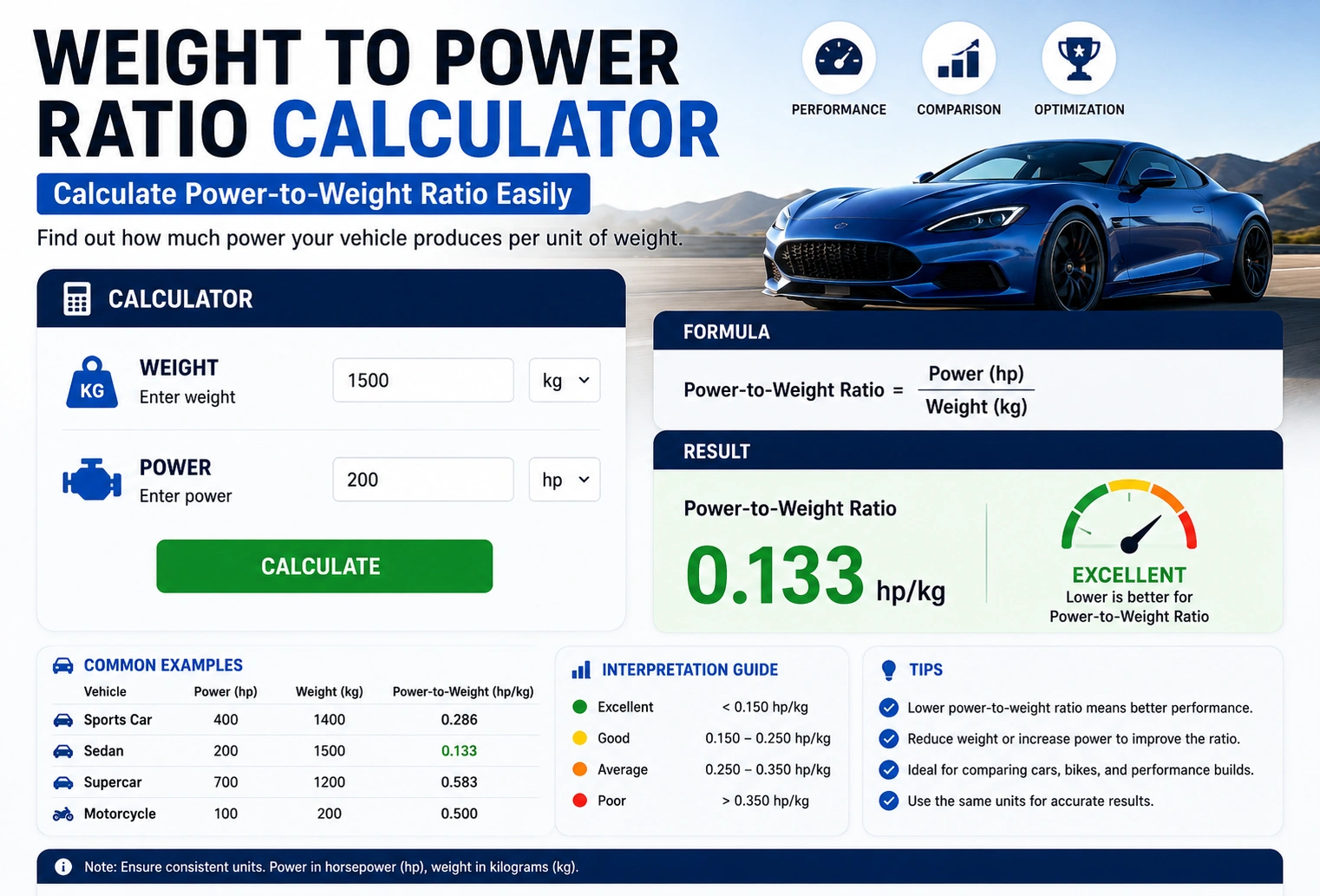
A weight to power ratio calculator helps determine how much power is available for every unit of a vehicle’s weight. This measurement is one of the most useful indicators of overall vehicle performance because it combines two critical factors—engine power and vehicle weight—into a single value.
In general, vehicles with a higher power-to-weight ratio accelerate faster and often deliver better performance than heavier vehicles with the same engine output.
Whether you’re comparing sports cars, motorcycles, trucks, electric vehicles, or race cars, calculating the weight-to-power ratio provides valuable insight into real-world performance beyond horsepower alone.
This guide explains how the calculation works, the formulas used, and how to interpret the results.
Quick Answer
The basic formula is:
Power-to-Weight Ratio = Engine Power ÷ Vehicle Weight
Depending on the units used, the result may be expressed as:
- Horsepower per pound (hp/lb)
- Horsepower per ton (hp/ton)
- Kilowatts per kilogram (kW/kg)
- Watts per kilogram (W/kg)
For example:
- Vehicle weight: 3,500 lb
- Engine power: 350 hp
Calculation:
350 ÷ 3,500 = 0.10 hp per pound
This can also be expressed as approximately 200 horsepower per US ton.
What Is a Weight-to-Power Ratio?
The weight-to-power ratio, often called the power-to-weight ratio, measures how much engine power is available relative to the vehicle’s weight.
It is commonly used to compare:
- Cars
- Motorcycles
- Trucks
- Race cars
- Electric vehicles
- Aircraft
- Heavy equipment
Because lighter vehicles require less power to move, two vehicles with the same horsepower can perform very differently if their weights differ significantly.
Why Is It Important?
Horsepower alone does not determine how fast a vehicle accelerates.
A lightweight sports car with 250 horsepower may outperform a heavy SUV with 350 horsepower simply because it carries less weight.
A good power-to-weight ratio generally contributes to:
- Faster acceleration
- Improved responsiveness
- Better climbing ability
- Enhanced overall performance
- Greater driving enjoyment
However, other factors such as traction, gearing, aerodynamics, tire grip, and drivetrain efficiency also affect real-world performance.
Weight-to-Power Ratio Formula
Several formulas are commonly used depending on the preferred units.
Horsepower per Pound
Power-to-Weight = Horsepower ÷ Vehicle Weight (lb)
Example:
- 300 hp
- 3,000 lb
Result:
0.10 hp/lb
Horsepower per US Ton
Since one US ton equals 2,000 pounds, the formula becomes:
Horsepower ÷ (Weight in Pounds ÷ 2,000)
Example:
- 400 hp
- 4,000 lb
Calculation:
Weight in tons:
4,000 ÷ 2,000 = 2 tons
Power-to-weight:
400 ÷ 2 = 200 hp/ton
Kilowatts per Kilogram
Metric calculations often use:
Power (kW) ÷ Weight (kg)
Example:
- 150 kW
- 1,500 kg
Result:
0.10 kW/kg
How to Use a Weight-to-Power Ratio Calculator
Using a calculator is simple.
Step 1: Enter Vehicle Weight
Input the vehicle’s weight using either:
- Pounds (lb)
- Kilograms (kg)
- Tons
Use the curb weight unless another specification is required.
Step 2: Enter Engine Power
Enter the engine’s output using:
- Horsepower (hp)
- Kilowatts (kW)
Most manufacturers publish these figures in the vehicle specifications.
Step 3: Select the Desired Unit
Many calculators allow results in multiple formats, such as:
- hp/lb
- hp/ton
- kW/kg
- W/kg
Choose the unit that best matches your application.
Step 4: Calculate
The calculator instantly displays the vehicle’s power-to-weight ratio, allowing easy comparison with other vehicles.
Example Calculations
Here are a few examples using common vehicle types.
| Vehicle | Weight | Power | Ratio |
|---|---|---|---|
| Sports Car | 3,200 lb | 400 hp | 0.125 hp/lb |
| Sedan | 3,500 lb | 250 hp | 0.071 hp/lb |
| Pickup Truck | 5,000 lb | 400 hp | 0.080 hp/lb |
| Motorcycle | 450 lb | 100 hp | 0.222 hp/lb |
Although the motorcycle has the lowest horsepower, its very low weight gives it the highest power-to-weight ratio.
What Is Considered a Good Power-to-Weight Ratio?
While there is no single standard, the following ranges provide a general guideline for passenger vehicles.
| Power-to-Weight Ratio | Performance Level |
| Under 100 hp/ton | Slow |
| 100–150 hp/ton | Average |
| 150–250 hp/ton | Good |
| 250–400 hp/ton | High Performance |
| Over 400 hp/ton | Supercar / Race Car |
These ranges help compare vehicles, but actual performance also depends on factors such as transmission, tires, and traction.
Factors That Affect the Weight-to-Power Ratio
Although the formula is straightforward, several factors influence a vehicle’s overall power-to-weight ratio and its real-world performance.
Vehicle Weight
Weight has a major impact on acceleration and handling. Reducing unnecessary weight improves the ratio without increasing engine power.
Examples of added weight include:
- Passengers
- Cargo
- Roof racks
- Towing equipment
- Aftermarket accessories
A lighter vehicle generally requires less power to achieve the same level of performance.
Engine Power
Increasing engine output improves the power-to-weight ratio.
Power increases may come from:
- Engine tuning
- Turbochargers or superchargers
- Performance exhaust systems
- ECU remapping
- Engine upgrades
More horsepower generally leads to a better ratio, provided vehicle weight remains similar.
Drivetrain Efficiency
Not all engine power reaches the wheels. Manual transmissions, automatic transmissions, and all-wheel-drive systems each have different drivetrain losses.
A vehicle with the same horsepower but lower drivetrain losses may perform better.
Aerodynamics
Power-to-weight ratio measures available power relative to weight, but aerodynamics also affect acceleration and top speed, especially at highway speeds.
Vehicles with better aerodynamic design often make more efficient use of their available power.
How to Improve Your Power-to-Weight Ratio
Improving this ratio doesn’t always require buying a more powerful vehicle.
Reduce Vehicle Weight
Removing unnecessary weight is often one of the most cost-effective improvements.
Possible methods include:
- Removing unused cargo
- Installing lightweight wheels
- Using lighter performance seats
- Replacing heavy components with lightweight alternatives
Increase Engine Output
Performance upgrades can improve horsepower.
Examples include:
- ECU tuning
- Cold-air intake systems
- Performance exhaust
- Turbocharger upgrades (where applicable)
Always ensure modifications comply with local laws and manufacturer recommendations.
Choose Lightweight Performance Parts
Modern aftermarket components made from aluminum, carbon fiber, or other lightweight materials can reduce overall vehicle weight while maintaining strength.
Maintain Your Vehicle
Regular maintenance helps the engine produce its intended power.
This includes:
- Clean air filters
- Fresh spark plugs
- Proper tire pressure
- Timely oil changes
- Fuel system maintenance
Practical Applications
Power-to-weight calculations are useful in many situations beyond comparing sports cars.
Buying a Vehicle
Comparing the power-to-weight ratio helps buyers understand real-world performance instead of relying only on horsepower figures.
Motorsport
Race teams closely monitor the ratio because it has a direct effect on acceleration and lap times.
Many racing categories also have minimum weight requirements.
Vehicle Modifications
Enthusiasts use power-to-weight calculations to evaluate whether upgrades provide meaningful performance gains.
Engineering and Design
Automotive engineers analyze power-to-weight ratios when developing new vehicles to balance performance, efficiency, and safety.
Common Calculation Mistakes
Using Gross Vehicle Weight Instead of Curb Weight
Most comparisons use curb weight, which represents the vehicle with standard equipment and fluids but without passengers or cargo.
Using gross vehicle weight (GVWR) may produce misleading results.
Mixing Measurement Units
Avoid combining:
- Horsepower with kilograms
- Kilowatts with pounds
Use consistent units or convert them before performing the calculation.
Forgetting Unit Conversions
If calculating horsepower per ton, remember:
1 US ton = 2,000 pounds
If calculating metric values:
1 metric ton = 1,000 kilograms
Ignoring Other Performance Factors
A high power-to-weight ratio does not guarantee the fastest vehicle.
Other important factors include:
- Tire grip
- Transmission gearing
- Suspension
- Aerodynamics
- Launch control
- Road conditions
Expert Tips
Compare Similar Vehicle Types
Power-to-weight ratios are most meaningful when comparing vehicles in the same category, such as sports cars, sedans, or motorcycles.
Use Manufacturer Specifications
Whenever possible, use official horsepower and curb-weight figures for more accurate calculations.
Consider Real-World Driving
A vehicle’s acceleration depends on more than horsepower. Balance power-to-weight data with reviews, performance tests, and reliability.
Recalculate After Modifications
If you add or remove weight or increase engine output, calculate the ratio again to see the actual improvement.
Keep Units Consistent
Whether using pounds and horsepower or kilograms and kilowatts, consistent units are essential for accurate results.
Frequently Asked Questions
What is a weight-to-power ratio calculator?
A weight-to-power ratio calculator determines how much engine power is available for each unit of vehicle weight, making it easier to compare performance.
What is considered a good power-to-weight ratio?
For passenger cars, 150–250 horsepower per ton is generally considered good, while 250 horsepower per ton or more is typical of high-performance vehicles.
Does a higher power-to-weight ratio mean a faster car?
Generally, yes. A higher ratio often results in better acceleration, but traction, gearing, aerodynamics, and drivetrain efficiency also influence overall performance.
Can reducing weight improve performance?
Yes. Lowering vehicle weight improves the power-to-weight ratio and can enhance acceleration, braking, handling, and fuel efficiency.
Which is more important: horsepower or weight?
Both matter. Horsepower determines how much power the engine produces, while weight affects how much mass that power must move. The balance between the two is what makes the power-to-weight ratio such a valuable performance metric.
Conclusion
A weight to power ratio calculator is a practical tool for evaluating vehicle performance by comparing engine output to vehicle weight. Whether expressed as horsepower per pound, horsepower per ton, or kilowatts per kilogram, the ratio provides a clearer picture of acceleration potential than horsepower alone.
By understanding the formula, using accurate vehicle specifications, and keeping measurement units consistent, you can confidently compare cars, motorcycles, trucks, and other vehicles. Whether you’re buying a new vehicle, planning performance upgrades, or simply exploring automotive performance, calculating the power-to-weight ratio is one of the most effective ways to measure real-world capability.
Discover More Articles
What Is 175 Degrees Celsius in Fahrenheit?
Calculate Percent: Easy Formulas, Examples & Calculator Guide