
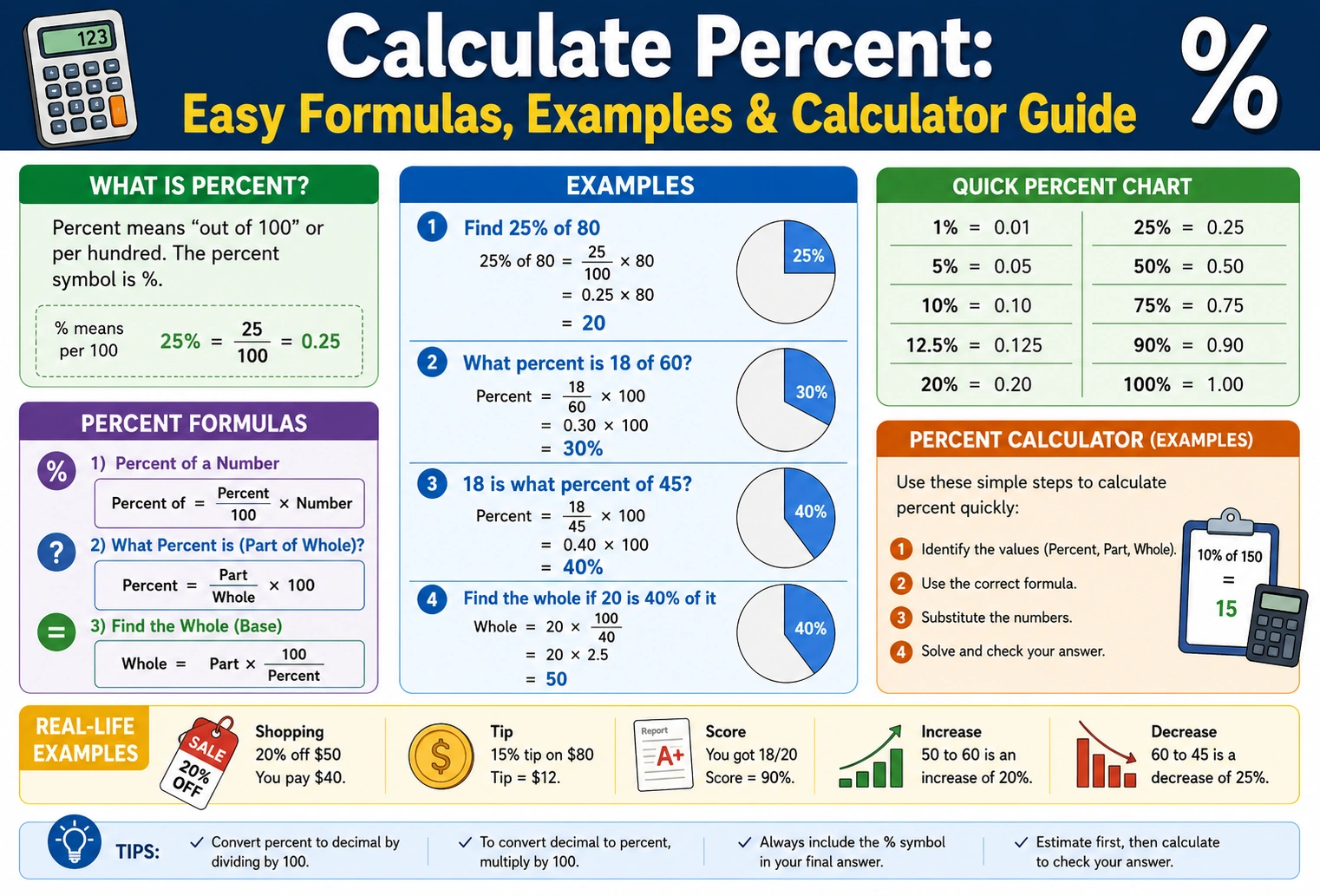
Knowing how to calculate percent is one of the most useful math skills in everyday life. Percentages are used for shopping discounts, test scores, taxes, tips, investments, business reports, and many other situations.
The good news is that percentage calculations are simple once you know the basic formula.
In this guide, you’ll learn how to calculate percent step by step, including percentage increase, decrease, and comparisons between numbers.
Quick Answer
Basic Percentage Formula
Use this formula to calculate a percentage:
Percentage = (Part ÷ Whole) × 100
Example:
25 out of 100:
(25 ÷ 100) × 100 = 25%
Answer: 25%
What Is a Percentage?
A percentage means “per hundred”.
For example:
- 50% = 50 out of 100
- 75% = 75 out of 100
- 100% = the entire amount
Percentages make it easy to compare values of different sizes.
How to Calculate Percent
Use these three steps:
- Identify the part.
- Identify the whole.
- Divide the part by the whole and multiply by 100.
Percentage Formula
Percentage Formula
Calculate a percentage from a part and a whole.
Percentage = (Part ÷ Whole) × 100
Example: (30 ÷ 120) × 100 = 25%
How to Find the Percentage of a Number
Example 1: What is 20% of 150?
Convert the percent to a decimal:
20% = 0.20
Multiply:
150 × 0.20 = 30
Answer: 20% of 150 is 30.
How to Calculate Percentage Increase
Use this formula:
Percentage Increase
Compare a new value to an old value.
((New − Old) ÷ Old) × 100
Example
Price increases from $50 to $65.
Increase = 65 − 50 = 15
Percentage increase:
(15 ÷ 50) × 100 = 30%
Answer: 30% increase.
How to Calculate Percentage Decrease
Use this formula:
Percentage Decrease
Measure how much a value goes down.
((Old − New) ÷ Old) × 100
Example
Price drops from $80 to $60.
Decrease = 80 − 60 = 20
Percentage decrease:
(20 ÷ 80) × 100 = 25%
Answer: 25% decrease.
How to Calculate Percent Between Two Numbers
Suppose you scored 45 out of 60.
(45 ÷ 60) × 100 = 75%
Answer: 75%.
Common Percentage Calculations
Quick Reference Table
| Calculation | Result |
|---|---|
| 10% of 200 | 20 |
| 25% of 80 | 20 |
| 50% of 150 | 75 |
| 75% of 120 | 90 |
| 15 out of 20 | 75% |
| 18 out of 25 | 72% |
Real-Life Examples
Shopping Discount
A $100 item is 20% off.
Discount = 100 × 0.20 = $20
Final price = $80
School Grade
Score: 42 out of 50.
(42 ÷ 50) × 100 = 84%
Restaurant Tip
Bill: $60
Tip: 15%
60 × 0.15 = $9
Investment Growth
Investment grows from $1,000 to $1,150.
Gain = $150
(150 ÷ 1000) × 100 = 15%
Common Mistakes
- Using the wrong whole number.
- Forgetting to multiply by 100.
- Mixing percentage increase and decrease formulas.
- Converting percentages incorrectly.
- Rounding too early.
Expert Tips
- 10% of a number is easy: move the decimal one place left.
- 5% is half of 10%.
- 25% equals one-quarter.
- 50% equals one-half.
- Use a calculator for large numbers to avoid mistakes.
9. Frequently Asked Questions
1. How do I calculate percent?
Use the formula:
Percentage = (Part ÷ Whole) × 100
2. How do I find 20% of a number?
Multiply the number by 0.20.
Example: 20% of 150 = 30.
3. How do I calculate percentage increase?
Use:
((New − Old) ÷ Old) × 100
4. How do I calculate percentage decrease?
Use:
((Old − New) ÷ Old) × 100
5. What is 25 out of 40 as a percent?
(25 ÷ 40) × 100 = 62.5%
10. Conclusion
Learning how to calculate percent is a valuable skill for school, business, shopping, and everyday life. The key formula is simple:
Percentage = (Part ÷ Whole) × 100
Once you understand this formula, you can easily calculate discounts, grades, taxes, tips, profits, percentage increases, and decreases.
With the examples and charts in this guide, you’ll be able to calculate percentages quickly and confidently in almost any situation.
Discover More Articles
How Big Is 2mm? Size Guide With Everyday Examples
Pokémon God Packs: What They Are, Odds, and How to Find Them
Convert 190 Degrees Celsius to Fahrenheit (190°C to °F Guide)