

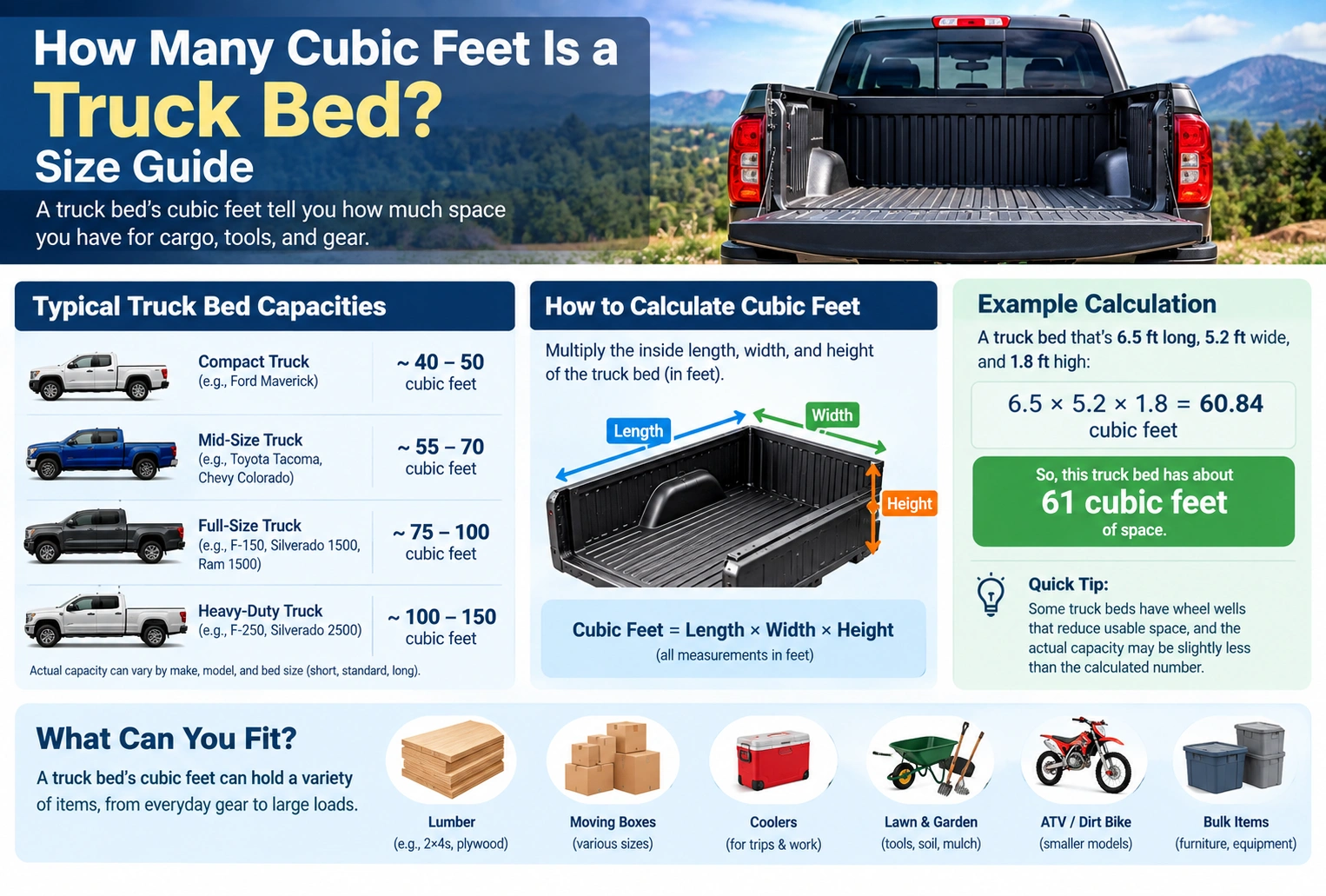
A typical pickup truck bed holds approximately 25 to 70 cubic feet, depending on the truck’s bed length, width, and depth.
For many full-size pickup trucks, a practical estimate is around 50–65 cubic feet of volume when measuring the bed as a simple rectangular container.
| Truck Bed Type | Approximate Cubic-Foot Volume |
|---|---|
| Small pickup bed | 25–40 cu ft |
| Short full-size bed | 35–50 cu ft |
| Standard full-size bed | 45–60 cu ft |
| Long full-size bed | 55–75 cu ft |
| Large/heavy-duty bed | 60–80+ cu ft |
These are approximate volumes. Actual capacity depends on the truck’s interior bed dimensions and whether wheel wells, a tonneau cover, bed liner, or other equipment reduces usable space.
It is also important to distinguish volume from payload capacity. A truck may physically have room for a certain number of cubic feet of material but still be unable to safely carry that material’s weight.
How to Calculate Truck Bed Cubic Feet
The basic calculation is straightforward:
Length × Width × Average Depth = Cubic Feet
When measurements are in feet, multiply them directly.
For example, suppose a truck bed measures:
- 6.5 feet long
- 5 feet wide
- 1.5 feet deep
The estimated volume is:
6.5 × 5 × 1.5 = 48.75 cubic feet
So that truck bed has approximately 48.75 cubic feet of geometric volume.
If your measurements are in inches, convert them to feet first, or use the cubic-inch formula:
Length × Width × Depth ÷ 1,728 = Cubic Feet
because there are 1,728 cubic inches in one cubic foot.
Why Truck Bed Capacity Varies
There is no universal truck-bed volume because pickup trucks come in many different sizes.
Even two trucks advertised with a 6.5-foot bed can have different:
- Interior widths
- Bed-wall heights
- Wheel-well dimensions
- Tailgate designs
- Bed-floor lengths
- Available cargo space
The manufacturer’s published dimensions are therefore the best source when you need an exact capacity.
For general planning, however, calculating the volume from the bed’s dimensions provides a useful estimate.
Truck Bed Capacity by Bed Length
Truck beds are commonly described by their approximate length.
| Bed Length | Typical Description | Approximate Volume |
|---|---|---|
| 5–5.5 ft | Short bed | 30–45 cu ft |
| 6–6.5 ft | Standard bed | 40–60 cu ft |
| 7 ft | Extended bed | 50–65 cu ft |
| 8 ft | Long bed | 55–75+ cu ft |
These ranges are estimates rather than specifications for every truck.
A 5.5-foot bed from one manufacturer can have a different width and depth from another manufacturer’s 5.5-foot bed.
Common Pickup Truck Bed Dimensions
A typical full-size pickup bed is often around 5.5 to 8 feet long, with the interior width commonly around 5 feet or slightly less between the bed walls.
Bed depth frequently falls around 1.5 to 1.7 feet.
Here are example calculations:
| Bed Dimensions | Estimated Volume |
|---|---|
| 5.5 × 5 × 1.5 ft | 41.25 cu ft |
| 6 × 5 × 1.5 ft | 45 cu ft |
| 6.5 × 5 × 1.5 ft | 48.75 cu ft |
| 7 × 5 × 1.5 ft | 52.5 cu ft |
| 8 × 5 × 1.5 ft | 60 cu ft |
| 8 × 5 × 1.7 ft | 68 cu ft |
These calculations treat the truck bed like a rectangular box.
The actual usable volume can be lower because the wheel wells take up space inside the bed.
How Many Cubic Feet of Material Fits in a Truck Bed?
If you’re using your truck to transport mulch, soil, gravel, firewood, or other loose materials, cubic feet can help estimate how much you can carry.
However, volume alone does not tell you how much material you should load.
The material’s weight is equally important.
For example, a truck bed might have 50 cubic feet of physical space, but filling all 50 cubic feet with a dense material could exceed the truck’s payload rating.
For planning purposes:
| Material | Why Weight Matters |
|---|---|
| Mulch | Relatively lightweight |
| Topsoil | Much heavier |
| Compost | Weight varies with moisture |
| Gravel | Very heavy |
| Sand | Very heavy |
| Firewood | Weight varies by species and moisture |
| Leaves | Lightweight |
| Snow | Weight varies greatly with moisture |
This is why a truck can sometimes carry a full-looking load of mulch but should not necessarily be filled to the same level with gravel.
How Many Cubic Feet of Mulch Fits in a Truck Bed?
A typical pickup truck bed may hold approximately 40–60 cubic feet of mulch by geometric volume, depending on the bed dimensions.
For example, a 6.5-foot bed measuring approximately 5 feet wide and 1.5 feet deep has:
6.5 × 5 × 1.5 = 48.75 cubic feet
That equals approximately:
48.75 ÷ 27 = 1.81 cubic yards
So the bed’s geometric volume is roughly 1.8 cubic yards.
However, you should not automatically load 1.8 cubic yards of mulch without checking your truck’s payload rating.
How Many Cubic Feet of Soil Fits in a Truck Bed?
Soil is considerably heavier than many types of mulch.
A truck bed with approximately 50 cubic feet of volume could theoretically contain about 1.85 cubic yards if filled completely.
But the weight of that amount of soil may be too high for some pickups.
| Truck Bed Volume | Equivalent Cubic Yards |
|---|---|
| 27 cu ft | 1.00 yd³ |
| 40 cu ft | 1.48 yd³ |
| 50 cu ft | 1.85 yd³ |
| 60 cu ft | 2.22 yd³ |
| 70 cu ft | 2.59 yd³ |
| 80 cu ft | 2.96 yd³ |
Before hauling soil, check the truck’s payload rating and estimate the material’s actual weight.
Truck Bed Cubic Feet vs. Payload Capacity
This distinction is one of the most important things to understand.
Cubic feet measure space. Payload measures weight.
For example, imagine a truck bed has a geometric capacity of 50 cubic feet.
That does not mean you can safely put any 50 cubic feet of material into it.
Fifty cubic feet of dry leaves is dramatically lighter than 50 cubic feet of wet soil or gravel.
| Measurement | What It Tells You |
|---|---|
| Cubic feet | How much space the material occupies |
| Cubic yards | Volume used for bulk materials |
| Pounds | Weight of the material |
| Payload rating | Maximum cargo weight the truck is designed to carry |
| GVWR | Maximum allowed loaded vehicle weight |
When hauling heavy materials, payload capacity is often the limiting factor rather than bed volume.
How Many Cubic Feet Is a Half-Ton Truck Bed?
A half-ton pickup can have a bed volume of roughly 35–65 cubic feet, depending on its bed length and configuration.
A short-bed half-ton truck might have around 35–50 cubic feet of geometric volume, while a 6.5- or 8-foot bed can provide considerably more.
The term “half-ton” refers to a truck class rather than a precise measurement of bed volume.
Therefore, you should use the truck’s actual bed dimensions when calculating cubic feet.
How Many Cubic Feet Is a ¾-Ton or 1-Ton Truck Bed?
A ¾-ton or 1-ton pickup does not necessarily have a dramatically larger bed than a half-ton pickup.
The main differences between these truck classes often involve:
- Payload capacity
- Suspension
- Chassis
- Axles
- Towing capacity
- Available configurations
Bed volume still depends primarily on the physical dimensions of the bed.
| Truck Class | Typical Bed Volume Range |
|---|---|
| Half-ton pickup | ~35–65 cu ft |
| ¾-ton pickup | ~40–70 cu ft |
| 1-ton pickup | ~40–75+ cu ft |
These are broad planning ranges, not manufacturer specifications.
A ¾-ton truck with a short bed can have less cubic-foot volume than a half-ton truck with a long bed.
How Many Cubic Feet Are in a Truck Bed Compared With a Cubic Yard?
Bulk materials such as mulch, soil, compost, gravel, and sand are often sold by the cubic yard.
One cubic yard equals:
27 cubic feet
That makes conversion easy.
| Truck Bed Volume | Cubic Yards |
|---|---|
| 27 cu ft | 1 yd³ |
| 36 cu ft | 1.33 yd³ |
| 45 cu ft | 1.67 yd³ |
| 54 cu ft | 2 yd³ |
| 60 cu ft | 2.22 yd³ |
| 72 cu ft | 2.67 yd³ |
| 81 cu ft | 3 yd³ |
To convert cubic feet to cubic yards:
Cubic yards = cubic feet ÷ 27
To convert cubic yards to cubic feet:
Cubic feet = cubic yards × 27
Does a Truck Bed Really Hold Its Full Calculated Volume?
Not necessarily.
A simple length × width × depth calculation assumes the entire bed is a rectangular box.
Real truck beds contain features that reduce usable space.
These include:
- Wheel wells
- Sloped or irregular bed walls
- Tie-down hardware
- Bed liners
- Toolboxes
- Bed dividers
- Tonneau covers
- Uneven loads
Loose materials can also settle differently.
For example, mulch poured into a bed may form a mound above the bed rails, while a level load will occupy less total volume.
Therefore, a calculated 50 cubic feet should be treated as a geometric estimate, not necessarily the exact amount of usable cargo.
How to Measure Your Truck Bed
For a more accurate estimate, measure the inside of the bed.
Step 1: Measure the Length
Measure from the inside of the front wall to the inside of the tailgate.
Step 2: Measure the Width
Measure the interior width of the bed.
If you are calculating volume around the wheel wells, measure the width of the usable area rather than simply using the overall bed width.
Step 3: Measure the Depth
Measure from the bed floor to the top of the bed wall.
Step 4: Calculate the Volume
Multiply:
Length × Width × Depth
If the measurements are in feet, your answer will be in cubic feet.
For irregular beds, use several measurements or the manufacturer’s published cargo-volume information for a more accurate estimate.
Common Mistakes When Estimating Truck Bed Capacity
Mistake 1: Assuming Every Pickup Has the Same Volume
A 5.5-foot bed and an 8-foot bed can have significantly different capacities.
Mistake 2: Ignoring Wheel Wells
Wheel wells occupy valuable space inside the bed and reduce the actual usable volume.
Mistake 3: Confusing Cubic Feet With Payload
A volume calculation tells you how much material can physically fit. It does not tell you whether the truck can safely carry its weight.
Mistake 4: Treating a Cubic Yard as 100 Cubic Feet
One cubic yard is 27 cubic feet, not 100.
Mistake 5: Filling the Bed Without Checking Weight
Heavy materials such as gravel, sand, and wet soil can exceed a truck’s payload limit before the bed is physically full.
FAQs
How many cubic feet is a typical truck bed?
A typical pickup truck bed can hold approximately 25–70 cubic feet, depending on its dimensions. Many full-size beds fall around 40–65 cubic feet.
How many cubic feet are in a 6-foot truck bed?
A 6-foot truck bed may contain roughly 40–55 cubic feet of geometric volume, depending on its width and depth.
How many cubic feet are in an 8-foot truck bed?
An 8-foot pickup bed may have approximately 55–75 cubic feet of geometric volume, depending on its dimensions.
How many cubic yards fit in a truck bed?
A typical pickup bed may have roughly 1.5–2.5 cubic yards of geometric volume, but the amount you can safely haul depends on the material’s weight and the truck’s payload rating.
How many cubic feet is a truck bed of mulch?
Depending on the truck, approximately 40–60 cubic feet of mulch may fit within the bed’s geometric volume.
How many cubic feet are in a cubic yard?
One cubic yard equals 27 cubic feet.
Can I fill my truck bed completely with soil?
Not necessarily. Soil is heavy, so you need to check your truck’s payload capacity before loading a full bed.
Does truck bed length determine cubic-foot capacity?
Bed length is one major factor, but width and depth also affect total volume. The best estimate uses all three dimensions.
Conclusion
So, how many cubic feet is a truck bed?
A typical pickup truck bed has approximately 25–70 cubic feet of geometric volume, while many full-size pickup beds fall around 40–65 cubic feet.
The exact number depends on the bed’s length, width, depth, wheel wells, and other design features.
For example, a 6.5-foot bed measuring 5 feet wide and 1.5 feet deep would have approximately 48.75 cubic feet of simple rectangular volume. That equals about 1.81 cubic yards.
However, cubic-foot capacity is only part of the calculation when hauling materials. Payload capacity is equally important, particularly for heavy materials such as soil, sand, gravel, and wet compost.
For the most accurate answer, measure the inside dimensions of your truck bed and calculate the volume, then compare the expected load weight with the truck manufacturer’s payload rating.
Discover More Articles
How Many Feet Is a Softball Field?