
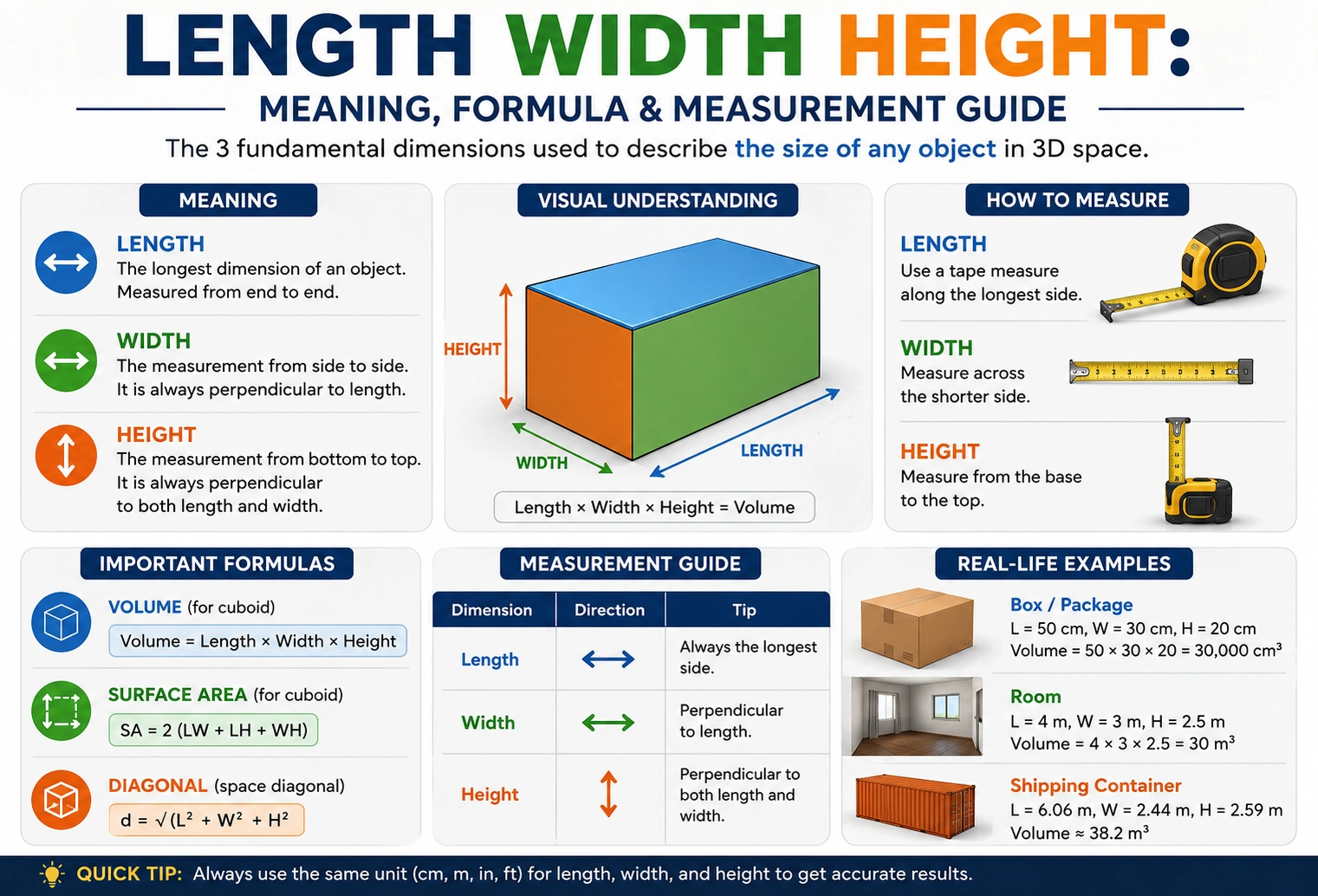
Length, width, and height are the three primary dimensions used to describe the size of an object. These measurements are used in mathematics, construction, engineering, shipping, furniture design, packaging, and many everyday situations.
Understanding these dimensions helps you calculate:
- Area
- Volume
- Storage space
- Shipping size
- Room dimensions
- Product specifications
Although the terms are closely related, each represents a different measurement.
Quick Answer
- Length = the longest side of an object.
- Width = the side measured from left to right (or side to side).
- Height = the vertical measurement from bottom to top.
Together, these three dimensions describe the overall size of a three-dimensional object.
What Is Length?
Length refers to the longest horizontal dimension of an object.
For example:
- A table may be 72 inches long.
- A room may be 20 feet long.
- A shipping box may be 24 inches long.
Length is often written first when dimensions are listed.
What Is Width?
Width measures the object from side to side.
It is usually the shorter horizontal dimension.
Examples include:
- A table that is 36 inches wide
- A room that is 15 feet wide
- A package that is 18 inches wide
Width is sometimes called breadth, especially in mathematics and engineering.
What Is Height?
Height is the vertical measurement, extending from the bottom to the top of an object.
Examples include:
- A door that is 80 inches high
- A cabinet that is 72 inches tall
- A shipping box that is 12 inches high
Height tells you how tall an object is when standing upright.
Difference Between Length, Width, and Height
| Dimension | Measures |
|---|---|
| Length | Front to back or longest side |
| Width | Side to side |
| Height | Bottom to top |
Although different industries sometimes use slightly different conventions, these definitions are the most common.
How to Measure Length, Width, and Height
Measuring an object accurately is straightforward.
Step 1
Measure the longest side.
This is the length.
Step 2
Measure the shorter side across the object.
This is the width.
Step 3
Measure from the base to the highest point.
This is the height.
Using a tape measure or ruler ensures accurate results.
Common Formulas
Length, width, and height are used in many mathematical formulas.
Area of a Rectangle
Area = Length × Width
Example:
10 ft × 12 ft = 120 square feet
Volume of a Rectangular Box
Volume = Length × Width × Height
Example:
10 × 5 × 4 = 200 cubic feet
These formulas are commonly used in construction, packaging, storage, and geometry.
Real-Life Examples of Length, Width, and Height
Understanding length, width, and height becomes easier when you see them in everyday objects.
| Object | Length | Width | Height |
|---|---|---|---|
| Shipping Box | Longest side | Side to side | Bottom to top |
| Dining Table | Long edge | Short edge | Floor to tabletop |
| Refrigerator | Front to back | Side to side | Floor to top |
| Bedroom | Long wall | Short wall | Floor to ceiling |
| Storage Bin | Front to back | Left to right | Base to lid |
These three dimensions describe the complete size of an object and are commonly listed as L × W × H.
Why Length, Width, and Height Matter
These measurements are used in many industries and everyday situations.
Construction
Builders use dimensions to calculate room sizes, flooring materials, wall areas, and building volumes.
Shipping
Courier companies require package dimensions to calculate shipping costs and determine whether parcels meet size restrictions.
Furniture
Manufacturers list furniture dimensions so buyers can verify that items fit through doorways and into available spaces.
Storage
Knowing the dimensions of storage boxes, closets, and shelves helps maximize available space.
Online Shopping
Product listings often include L × W × H so customers know exactly how large an item is before purchasing.
Common Measurement Mistakes
Measuring in the Wrong Order
Many products list dimensions as:
Length × Width × Height (L × W × H)
Always verify the measurement order, especially when comparing products from different manufacturers.
Mixing Measurement Units
Use the same unit throughout your calculations.
For example:
- Feet with feet
- Inches with inches
- Centimeters with centimeters
Mixing units can produce incorrect results.
Measuring at an Angle
For the most accurate dimensions, measure along straight edges rather than diagonally across the object.
Forgetting Protruding Parts
Handles, wheels, lids, or other protruding components may affect the overall dimensions and should be included when required, particularly for shipping.
Tips for Measuring Accurately
Use the Right Tool
A tape measure works well for larger objects, while a ruler is suitable for smaller items.
Measure Twice
Double-check your measurements before ordering materials, furniture, or shipping boxes.
Record Measurements Clearly
Write dimensions in the standard order:
Length × Width × Height
Example:
24 × 18 × 12 inches
Include Units
Always specify whether your measurements are in:
- Inches
- Feet
- Centimeters
- Meters
This helps prevent costly mistakes.
Frequently Asked Questions
What is the difference between length, width, and height?
Length is usually the longest side, width is the side-to-side measurement, and height is the vertical measurement from bottom to top.
What does L × W × H mean?
It stands for:
- L = Length
- W = Width
- H = Height
This is the standard format used for product dimensions and packaging.
Which dimension comes first?
Most manufacturers list dimensions as:
Length × Width × Height (L × W × H)
However, it’s always a good idea to check the manufacturer’s specifications, as some industries may use different conventions.
Why are length, width, and height important?
These measurements help calculate area, volume, shipping size, storage capacity, and the amount of materials needed for construction or manufacturing projects.
How do you measure a box?
Measure:
- The longest side for the length.
- The shorter side for the width.
- The distance from the base to the top for the height.
Conclusion
Length, width, and height are the three fundamental dimensions used to describe the size of an object. Whether you’re measuring a room, a piece of furniture, a shipping box, or a storage container, understanding these dimensions allows you to calculate area, volume, storage space, and shipping requirements accurately.
By measuring carefully, using consistent units, and following the standard L × W × H format, you can avoid common errors and make better decisions for construction, shopping, packaging, and everyday projects.
Discover More Articles
How Long Is 15 Inches? Size Comparison Guide