
If you’re wondering what half of 3/4 is, the answer is:
3/8
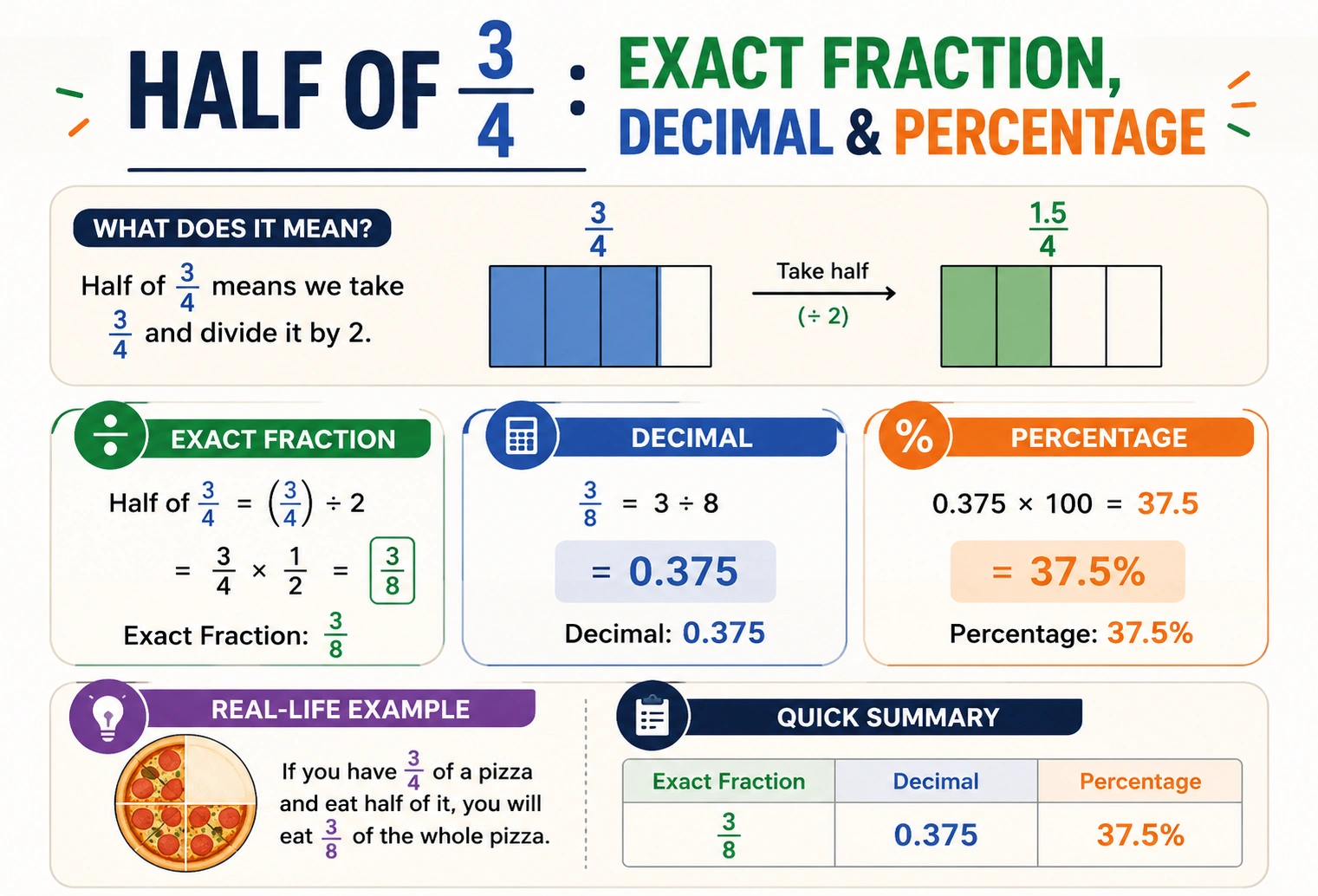
To find half of a fraction, multiply the fraction by 1/2.
So:
3/4 × 1/2 = 3/8
This is the simplified fraction and the correct answer.
Quick Answer
| Calculation | Answer |
|---|---|
| Half of 3/4 | 3/8 |
| Decimal | 0.375 |
| Percentage | 37.5% |
Step-by-Step Calculation
Finding half of 3/4 is simple.
Step 1
Write the original fraction:
3/4
Step 2
Multiply by 1/2 because “half” means divide by two.
3/4 × 1/2
Step 3
Multiply the numerators:
3 × 1 = 3
Multiply the denominators:
4 × 2 = 8
Result:
3/8
Since 3 and 8 have no common factors other than 1, the fraction is already in its simplest form.
Formula for Finding Half of a Fraction
To find half of any fraction, use this formula:
Fraction × 1/2
For example:
- Half of 1/2 = 1/4
- Half of 2/3 = 1/3
- Half of 3/4 = 3/8
- Half of 5/6 = 5/12
This method works for all fractions.
Decimal and Percentage
You can also express 3/8 in other forms.
Decimal
Divide:
3 ÷ 8 = 0.375
Percentage
Multiply the decimal by 100:
0.375 × 100 = 37.5%
Therefore:
- Fraction: 3/8
- Decimal: 0.375
- Percentage: 37.5%
Real-Life Examples
Knowing that half of 3/4 is 3/8 is useful in many everyday situations.
Cooking and Baking
If a recipe calls for 3/4 cup of milk but you’re making half the recipe, you’ll need 3/8 cup.
DIY Projects
If a board measures 3/4 foot and you need half that length, the result is 3/8 foot.
School Math
Fraction multiplication problems often ask students to find half of another fraction, making this a common classroom example.
Common Fraction Mistakes
When finding half of 3/4, students often make a few common errors.
Dividing Only the Numerator
Some people incorrectly divide only the numerator:
3 ÷ 2 = 1.5
This is not the correct method because both parts of the fraction must be considered.
Instead, multiply the entire fraction by 1/2:
3/4 × 1/2 = 3/8
Forgetting to Simplify
After multiplying fractions, always check whether the result can be simplified.
For 3/8, no further simplification is possible because 3 and 8 share no common factors other than 1.
Confusing Division and Multiplication
Finding half is equivalent to dividing by 2, which is the same as multiplying by 1/2.
Remember:
Divide by 2 = Multiply by 1/2
Fraction Comparison Chart
Here are several common “half of” fraction calculations.
| Original Fraction | Half |
|---|---|
| 1/2 | 1/4 |
| 2/3 | 1/3 |
| 3/4 | 3/8 |
| 4/5 | 2/5 |
| 5/6 | 5/12 |
| 7/8 | 7/16 |
This table can help you quickly compare common fraction calculations.
More Practice Examples
Example 1
Half of 1/2
1/2 × 1/2 = 1/4
Example 2
Half of 5/8
5/8 × 1/2 = 5/16
Example 3
Half of 9/10
9/10 × 1/2 = 9/20
Example 4
Half of 7/12
7/12 × 1/2 = 7/24
Practicing with different fractions makes it easier to understand the multiplication rule.
Why Learning Fraction Halves Is Useful
Knowing how to find half of a fraction is helpful in many everyday situations, including:
- Cooking and baking
- Measuring ingredients
- Carpentry and woodworking
- Sewing and crafts
- Construction projects
- School math assignments
- DIY home improvement
Understanding fractions makes measurements more accurate and calculations easier.
Frequently Asked Questions
What is half of 3/4?
Half of 3/4 is 3/8.
How do you calculate half of 3/4?
Multiply 3/4 by 1/2:
3/4 × 1/2 = 3/8
What is 3/8 as a decimal?
Divide 3 by 8:
3 ÷ 8 = 0.375
What percentage is 3/8?
Multiply the decimal by 100:
0.375 × 100 = 37.5%
Can 3/8 be simplified?
No. The fraction 3/8 is already in its simplest form because 3 and 8 have no common factor greater than 1.
Conclusion
If you’re wondering what half of 3/4 is, the correct answer is 3/8. You can find this by multiplying 3/4 × 1/2, which equals 3/8. This fraction is already simplified and can also be written as 0.375 or 37.5%.
Whether you’re solving math problems, adjusting a recipe, or working on a DIY project, understanding how to find half of a fraction is a useful skill. The same method—multiplying by 1/2—works for any fraction, making it easy to calculate halves accurately.
Discover More Articles
Length and Width: Definition, Differences & Examples