
Understanding length and width is one of the first steps in learning measurement and geometry. These two dimensions are used every day to describe the size of objects, rooms, furniture, land, screens, packages, and countless other items.
Whether you’re measuring a bedroom for new flooring, calculating the area of a garden, buying a rug, or helping with a school assignment, knowing the difference between length and width is essential.
In simple terms:
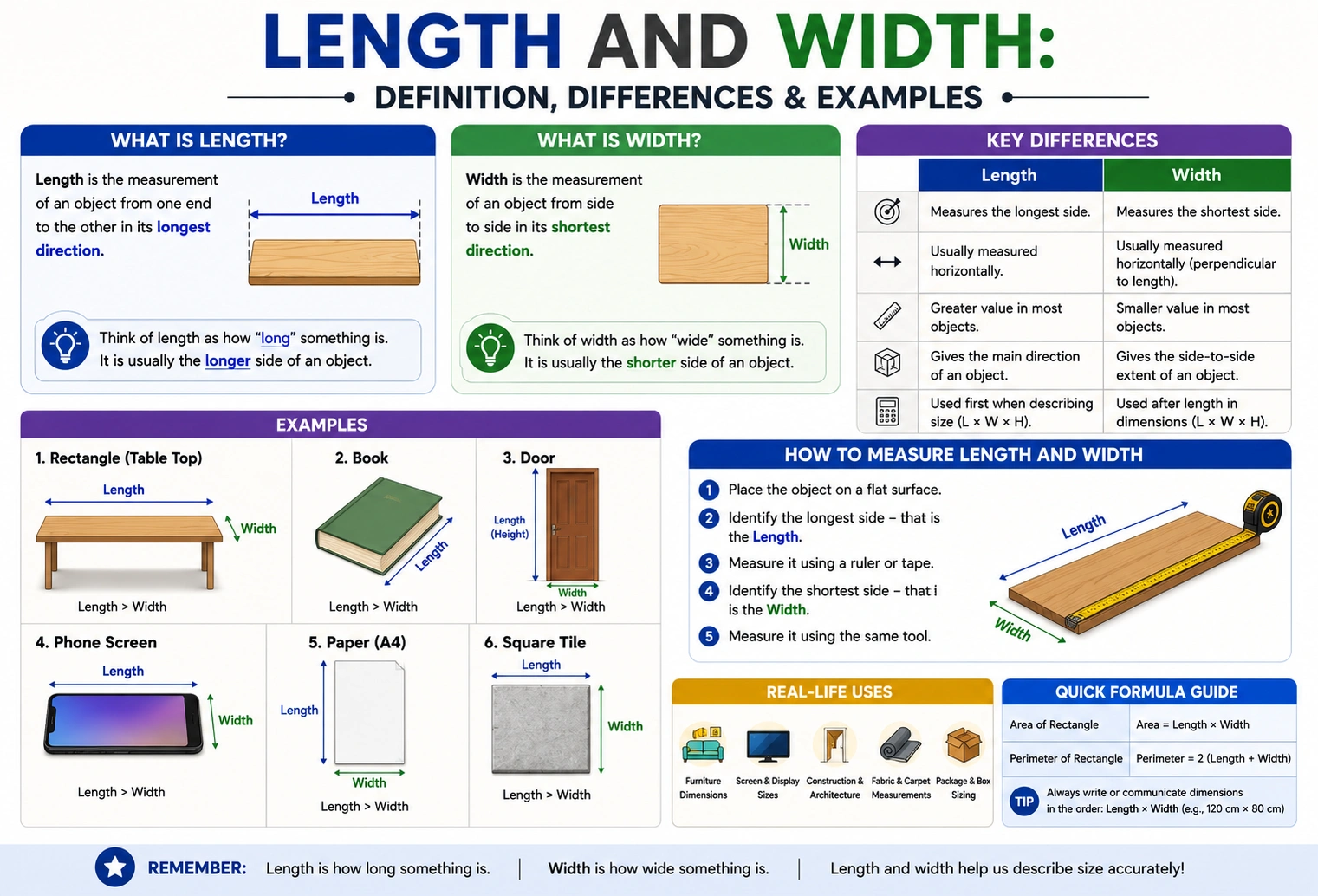
- Length is usually the longer side of an object.
- Width is usually the shorter side, measured from side to side.
Although these definitions are common, the labels can vary depending on the shape or how an object is oriented.
This guide explains what length and width are, how they differ, how to measure them accurately, and how they are used in everyday calculations.
Quick Answer
Here’s a simple way to remember the difference:
- Length: The longest dimension of an object.
- Width: The shorter dimension measured across the object.
For example, if a table measures 6 feet by 3 feet:
- Length = 6 feet
- Width = 3 feet
These two measurements are often used together to calculate the object’s area.
What Is Length?
Length is the measurement of an object from one end to the other.
It usually represents the longest side of a shape or object.
Examples include:
- The length of a room
- The length of a table
- The length of a swimming pool
- The length of a vehicle
- The length of a book
Length is commonly measured in:
- Inches
- Feet
- Yards
- Centimeters
- Meters
What Is Width?
Width is the measurement from one side of an object to the other.
It is often the shorter side of a rectangle or other flat object.
Examples include:
- The width of a doorway
- The width of a bed
- The width of a television
- The width of a road
- The width of a desk
Like length, width can be measured using inches, feet, meters, centimeters, or other units.
Length vs Width: What’s the Difference?
Although both measure distance, they describe different dimensions.
| Feature | Length | Width |
|---|---|---|
| Definition | Distance from end to end | Distance from side to side |
| Usually Represents | Longer dimension | Shorter dimension |
| Symbol | L | W |
| Used In | Area, perimeter, volume | Area, perimeter, volume |
For rectangles, the distinction is straightforward. For squares, all sides are equal, so the terms length and width can be used interchangeably.
How to Measure Length and Width
Measuring accurately is important for construction, home improvement, and school projects.
Step 1: Choose the Right Tool
Use an appropriate measuring tool, such as:
- Tape measure
- Ruler
- Meter stick
- Laser distance measurer
Step 2: Measure the Length
Place the measuring tool along the longest side and record the measurement.
Step 3: Measure the Width
Measure the shorter side at a right angle to the length.
Step 4: Record the Units
Always include the unit of measurement, such as inches, feet, centimeters, or meters.
Length and Width Formulas
Length and width are used in several basic geometry formulas.
Area of a Rectangle
Area = Length × Width
Example:
Length = 12 feet
Width = 8 feet
Area = 12 × 8 = 96 square feet
Perimeter of a Rectangle
Perimeter = 2 × (Length + Width)
Example:
Length = 12 feet
Width = 8 feet
Perimeter = 2 × (12 + 8)
Perimeter = 40 feet
Finding a Missing Dimension
If you know the area and one side, you can find the other.
Width = Area ÷ Length
Example:
Area = 120 square feet
Length = 15 feet
Width = 120 ÷ 15 = 8 feet
Common Shapes and Dimensions
Rectangle
Has one length and one width.
Square
All four sides are equal, so length and width are the same.
Circle
A circle has no length or width in the same sense as a rectangle. Instead, it is described by its diameter and radius.
Triangle
Triangles are typically measured using base and height rather than length and width.
Real-World Examples
Understanding length and width is useful in many everyday situations.
Buying Flooring
Knowing a room’s length and width helps calculate how much flooring you need.
Purchasing Furniture
Measure both dimensions to ensure furniture fits through doors and into the intended space.
Landscaping
Garden dimensions determine the amount of soil, grass seed, or mulch required.
Construction
Builders rely on accurate measurements for framing, roofing, and interior layouts.
Packaging and Shipping
Boxes are often described by their length, width, and height.
Common Measurement Mistakes
Mixing Up Length and Width
Always identify the longer side before labeling it as the length.
Using Different Units
Measure both dimensions using the same unit to avoid calculation errors.
Forgetting to Square the Units
Area should be expressed in square units, such as:
- Square feet
- Square meters
- Square inches
Measuring From the Wrong Starting Point
Start measurements from the exact edge of the object for the most accurate results.
Expert Tips
- Double-check all measurements before cutting materials.
- Use a metal tape measure for greater accuracy.
- Measure twice and cut once when working on DIY projects.
- Draw a simple sketch and label the length and width before calculating area.
- Keep measurements in the same unit throughout your calculations.
9. FAQs
1. What is the difference between length and width?
Length usually refers to the longer side of an object, while width refers to the shorter side measured across it.
2. How do you measure length and width?
Measure the longest side for the length and the shorter side for the width using a ruler, tape measure, or other measuring tool.
3. Which comes first: length or width?
The standard order is length × width. For example, a room measuring 15 feet by 12 feet is written as 15 × 12.
4. How do you calculate area using length and width?
Multiply the two measurements:
Area = Length × Width
5. Can length and width be the same?
Yes. In a square, all sides are equal, so the length and width have the same measurement.
10. Conclusion
Understanding length and width is essential for measuring objects, calculating area, planning construction projects, and completing everyday tasks. In most cases, length refers to the longer dimension, while width is the shorter measurement across an object.
By learning how to measure these dimensions accurately and apply simple formulas, you can confidently calculate area, perimeter, and other important measurements for home improvement, education, landscaping, shopping, and many other real-world applications.
Discover More Articles
What Is 180 Degrees Celsius? Temperature Conversion Guide