
If you have ever worked on a gardening, construction, or DIY project, you have probably wondered: how many cubic feet in a 5 gallon bucket? This is one of the most common volume conversion questions because 5 gallon buckets are widely used for mixing concrete, carrying soil, storing tools, and transporting liquids.
The quick answer is simple:
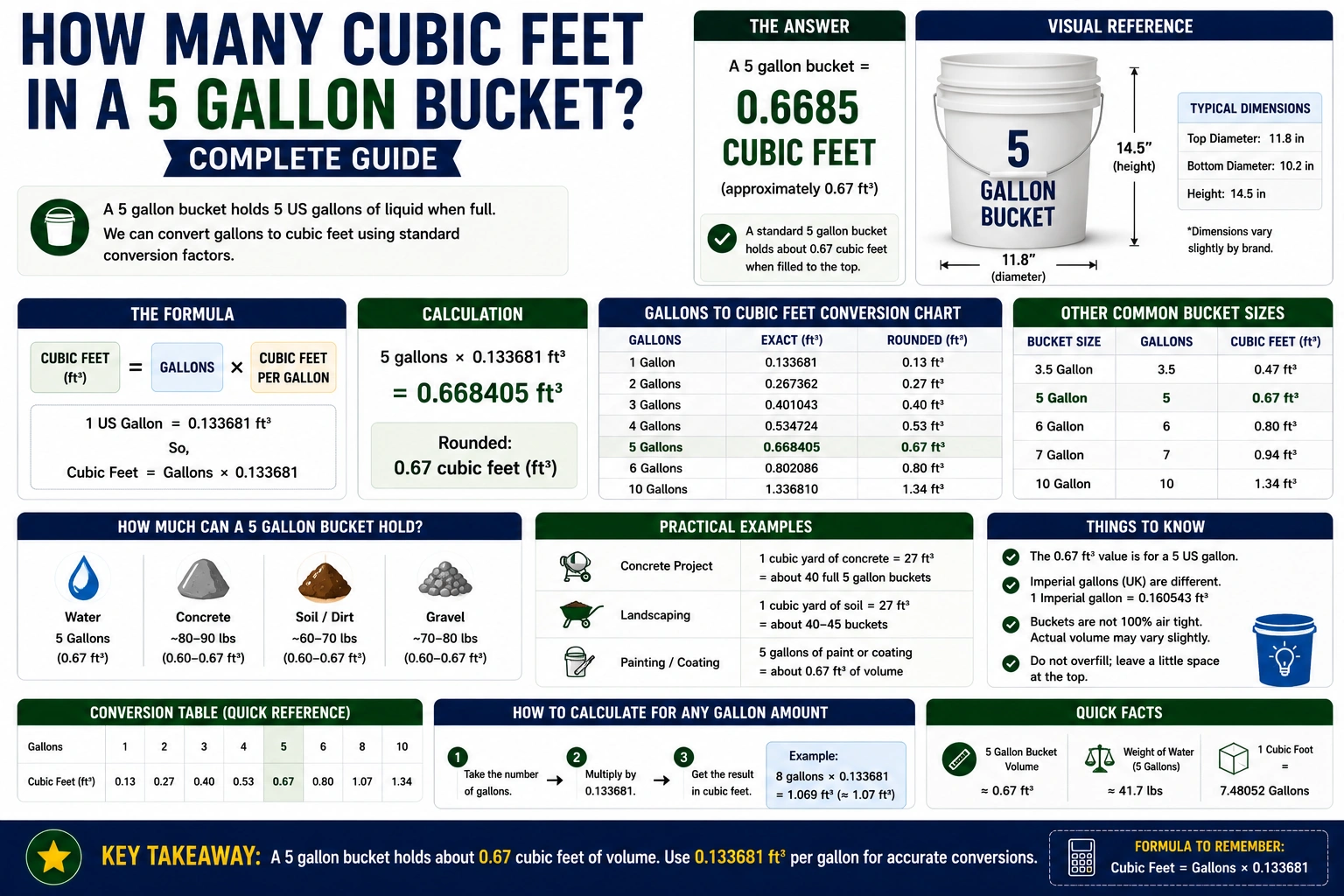
5 gallons≈0.67 cubic feet
A standard 5 gallon bucket holds about 0.67 cubic feet of material. In other words, it takes roughly one and a half 5 gallon buckets to equal one cubic foot.
Understanding this conversion can help you estimate material quantities more accurately, reduce waste, and save money on projects. In this guide, you will learn the exact formula, practical examples, conversion charts, and expert tips for using a 5 gallon bucket effectively.
Understanding Gallons and Cubic Feet
Before calculating how many cubic feet are in a 5 gallon bucket, it helps to understand the measurements involved.
What Is a Gallon?
A gallon is a unit of liquid volume commonly used in the United States. Most standard utility buckets are measured in US gallons.
One US gallon equals:
- 231 cubic inches
- 3.785 liters
- About 0.134 cubic feet
What Is a Cubic Foot?
A cubic foot measures three-dimensional space. It represents the volume of a cube that is:
- 1 foot wide
- 1 foot long
- 1 foot high
Cubic feet are commonly used for:
- Soil
- Gravel
- Concrete
- Mulch
- Compost
- Storage calculations
Because many construction materials are sold by cubic feet or cubic yards, converting gallons to cubic feet becomes extremely useful.
How Many Cubic Feet in a 5 Gallon Bucket?
The exact conversion is:
5×0.133681=0.668405 cubic feet
So, a standard 5 gallon bucket contains approximately:
- 0.67 cubic feet
- 0.668 cubic feet
- About two-thirds of a cubic foot
For quick estimating, most people round this to 0.67 cubic feet.
Quick Rule to Remember
- 1 cubic foot ≈ 7.48 gallons
- 5 gallons ≈ 0.67 cubic feet
This makes estimating materials much easier on job sites or during home projects.
Gallons to Cubic Feet Conversion Formula
Converting gallons to cubic feet is straightforward once you know the formula.
Standard Conversion Formula
Cubic Feet=Gallons×0.133681
You simply multiply the number of gallons by 0.133681.
Example Calculation for a 5 Gallon Bucket
5×0.133681=0.668405
Rounded to two decimal places:
- 5 gallons ≈ 0.67 cubic feet
This formula works for any gallon amount.
Quick Conversion Chart
Here is a helpful gallons-to-cubic-feet conversion chart for common bucket sizes.
| Gallons | Cubic Feet |
|---|---|
| 1 gallon | 0.134 cubic feet |
| 2 gallons | 0.267 cubic feet |
| 3 gallons | 0.401 cubic feet |
| 4 gallons | 0.535 cubic feet |
| 5 gallons | 0.668 cubic feet |
| 6 gallons | 0.802 cubic feet |
| 7 gallons | 0.936 cubic feet |
| 10 gallons | 1.337 cubic feet |
This chart is useful for landscaping, gardening, and material planning.
Real-World Uses of a 5 Gallon Bucket
A 5 gallon bucket is one of the most versatile tools available. Understanding its cubic foot capacity helps with accurate planning.
Gardening
Gardeners frequently use 5 gallon buckets for:
- Mixing potting soil
- Carrying compost
- Growing vegetables
- Measuring mulch
Since one bucket equals about 0.67 cubic feet, you can estimate how many buckets are needed for raised beds or containers.
For example:
- 3 buckets ≈ 2 cubic feet
- 6 buckets ≈ 4 cubic feet
This helps when buying soil bags labeled in cubic feet.
Concrete Mixing
Concrete projects often rely on bucket measurements.
A 5 gallon bucket can help measure:
- Cement
- Sand
- Gravel
- Water
Knowing the cubic foot equivalent allows better mixing ratios and more accurate batching.
Painting Projects
Painters use 5 gallon buckets to:
- Store paint
- Mix colors
- Transport materials
Understanding volume prevents overfilling and waste.
Storage and Transport
Buckets are also used for:
- Animal feed
- Water storage
- Cleaning supplies
- Ice melt
- Construction debris
The cubic foot measurement helps estimate carrying capacity.
How Much Material Fits in a 5 Gallon Bucket?
Different materials have different densities, so the weight inside a 5 gallon bucket changes even though the volume stays the same.
A 5 gallon bucket always equals about 0.67 cubic feet, but the amount of material by weight varies.
Soil
A 5 gallon bucket holds approximately:
- 0.67 cubic feet of soil
- Around 40–60 pounds depending on moisture
Moist soil weighs significantly more than dry soil.
Sand
A bucket filled with sand may weigh:
- 60–80 pounds
Sand is dense and compact.
Gravel
Gravel weight varies by rock size but generally ranges between:
- 70–75 pounds per bucket
Concrete Mix
Wet concrete is extremely heavy.
A full 5 gallon bucket of wet concrete may weigh:
- 90–100 pounds
Always lift carefully to avoid injury.
5 Gallon Bucket Dimensions Explained
Most standard 5 gallon buckets have similar dimensions.
Typical measurements include:
| Dimension | Approximate Size |
|---|---|
| Height | 14–15 inches |
| Top Diameter | 11–12 inches |
| Bottom Diameter | 10–11 inches |
The exact dimensions vary by manufacturer, but the total volume remains close to 5 gallons.
Why Dimensions Matter
Bucket dimensions affect:
- Stacking
- Storage
- Material mixing
- Transportation
- Space calculations
Professionals often rely on consistent bucket sizes for repeatable measurements.
Common Mistakes When Converting Gallons to Cubic Feet
Even simple conversions can lead to errors if you are not careful.
Using the Wrong Gallon Type
There are different gallon measurements:
- US gallon
- UK imperial gallon
This article uses the US gallon, which is standard in the United States.
Confusing Dry and Liquid Volume
Some people assume dry materials behave exactly like liquids. However, dry materials can settle or compact differently.
For example:
- Loose mulch occupies more space than compacted mulch
- Wet sand weighs more than dry sand
Rounding Errors
Small rounding mistakes can become large problems on big projects.
For best accuracy:
- Use 0.668 cubic feet for precise calculations
- Use 0.67 for quick estimates
Expert Tips for Accurate Measurements
Professionals use several tricks to improve measurement accuracy.
Use Level Buckets
Always fill the bucket evenly and level the top for consistent measurements.
Avoid Overpacking Materials
Packing soil or sand tightly changes actual volume.
For more reliable results:
- Fill naturally
- Do not compress materials unless required
Measure Moisture Content
Wet materials weigh more and sometimes settle differently.
This is especially important for:
- Concrete
- Soil
- Sand
Label Buckets Clearly
Many contractors mark buckets for:
- Water lines
- Mixing ratios
- Partial measurements
This speeds up repetitive tasks.
Why Cubic Feet Matter in Construction and Landscaping
Many building materials are sold in cubic feet or cubic yards.
Examples include:
- Mulch
- Gravel
- Concrete
- Compost
- Topsoil
Knowing how many cubic feet are in a 5 gallon bucket helps you estimate materials quickly.
Example
Suppose you need:
- 2 cubic feet of soil
Since one bucket equals about 0.67 cubic feet:
2÷0.67≈3
You would need roughly 3 full buckets.
This makes project planning much easier.
Cubic Feet vs Cubic Yards
Some larger projects use cubic yards instead of cubic feet.
Here is the relationship:
1 cubic yard=27 cubic feet
Because a 5 gallon bucket holds 0.67 cubic feet:
27÷0.67≈40
It takes about 40 standard 5 gallon buckets to equal one cubic yard.
This estimate is extremely useful for landscaping and concrete work.
FAQs
1. How many cubic feet does a standard 5 gallon bucket hold?
A standard 5 gallon bucket holds approximately 0.67 cubic feet.
2. How many 5 gallon buckets make one cubic foot?
Since one bucket equals about 0.67 cubic feet, it takes around 1.5 buckets to make one cubic foot.
3. How many 5 gallon buckets are in a cubic yard?
A cubic yard contains 27 cubic feet, so you need about 40 buckets to equal one cubic yard.
4. Can a 5 gallon bucket hold exactly 5 gallons?
Most standard utility buckets are designed to hold close to 5 US gallons, though actual usable capacity may vary slightly.
5. Why is cubic feet measurement important?
Cubic feet measurements help estimate the amount of soil, concrete, mulch, gravel, and other materials needed for projects.
Conclusion
Understanding how many cubic feet in a 5 gallon bucket is extremely helpful for gardening, construction, landscaping, and DIY work. A standard 5 gallon bucket holds approximately 0.67 cubic feet, making it a convenient measuring tool for many projects.
By learning the gallons-to-cubic-feet conversion formula, using accurate measurements, and understanding material density, you can estimate quantities more confidently and avoid costly mistakes. Whether you are mixing concrete, filling raised beds, or transporting gravel, this simple conversion can save time, effort, and money.
Keep this rule handy:
5 gallon bucket≈0.67 cubic feet
It is one of the most practical volume conversions every DIYer and contractor should know.
Discover More Articles
How Many Inches Is 9 Feet? Complete Guide