
sure can restrict movement and make it harder for animals to avoid conflict. Providing more space, multiple hiding places, and separate access to food and water can improve their living environment.
Guinea pigs are social animals and generally should not be kept alone unless a veterinarian or qualified welfare professional recommends separation for a specific reason. A compatible companion is important, but the enclosure must be large enough for both animals to live comfortably.
How to Calculate Square Feet for a Guinea Pig Cage
You can calculate the floor area of a rectangular or square enclosure using its length and width.
Formula:
Square feet = Length in feet × Width in feet
For example, a cage that measures 4 feet long and 2 feet wide provides:
4 × 2 = 8 square feet
That means the cage has 8 square feet of floor area before accounting for accessories.
Cage size examples
| Cage Length | Cage Width | Total Floor Area |
|---|---|---|
| 3 ft | 2 ft | 6 sq ft |
| 4 ft | 2 ft | 8 sq ft |
| 4 ft | 2.5 ft | 10 sq ft |
| 5 ft | 2 ft | 10 sq ft |
| 5 ft | 2.5 ft | 12.5 sq ft |
| 6 ft | 2.5 ft | 15 sq ft |
| 6 ft | 3 ft | 18 sq ft |
These calculations assume the listed dimensions represent the actual usable interior floor dimensions. Exterior measurements may overstate the space available inside a cage.
What if the cage measurements are in inches?
First, multiply the length by the width in inches. Then divide the result by 144 because one square foot contains 144 square inches.
Formula:
Square feet = (Length in inches × Width in inches) ÷ 144
For example, a cage measuring 48 inches by 24 inches has:
48 × 24 = 1,152 square inches
1,152 ÷ 144 = 8 square feet
The cage therefore provides 8 square feet of floor area.
How Many Square Feet Does One Guinea Pig Need?
A commonly cited minimum is 7.5 square feet for one guinea pig. However, keeping a single guinea pig alone is generally not recommended because these animals benefit from companionship.
If you temporarily care for one guinea pig, provide a spacious enclosure with enough room for a hideout, hay, food, water, and open movement space. A larger enclosure gives the animal more opportunities to exercise and explore.
| Floor Area | Example Cage Dimensions | General Assessment |
|---|---|---|
| 6 sq ft | 3 × 2 ft | Smaller than the commonly cited minimum |
| 7.5 sq ft | 5 × 1.5 ft | Meets the commonly cited area figure, but shape and usable space matter |
| 8 sq ft | 4 × 2 ft | Above the commonly cited minimum for one |
| 10 sq ft | 5 × 2 ft | More room to arrange accessories |
| 12 sq ft | 6 × 2 ft | A more spacious option |
The dimensions in this table are examples of area calculations, not a guarantee that every cage of that size is suitable. Very narrow enclosures can restrict movement even when their total area seems adequate.
How Many Square Feet Do Two Guinea Pigs Need?
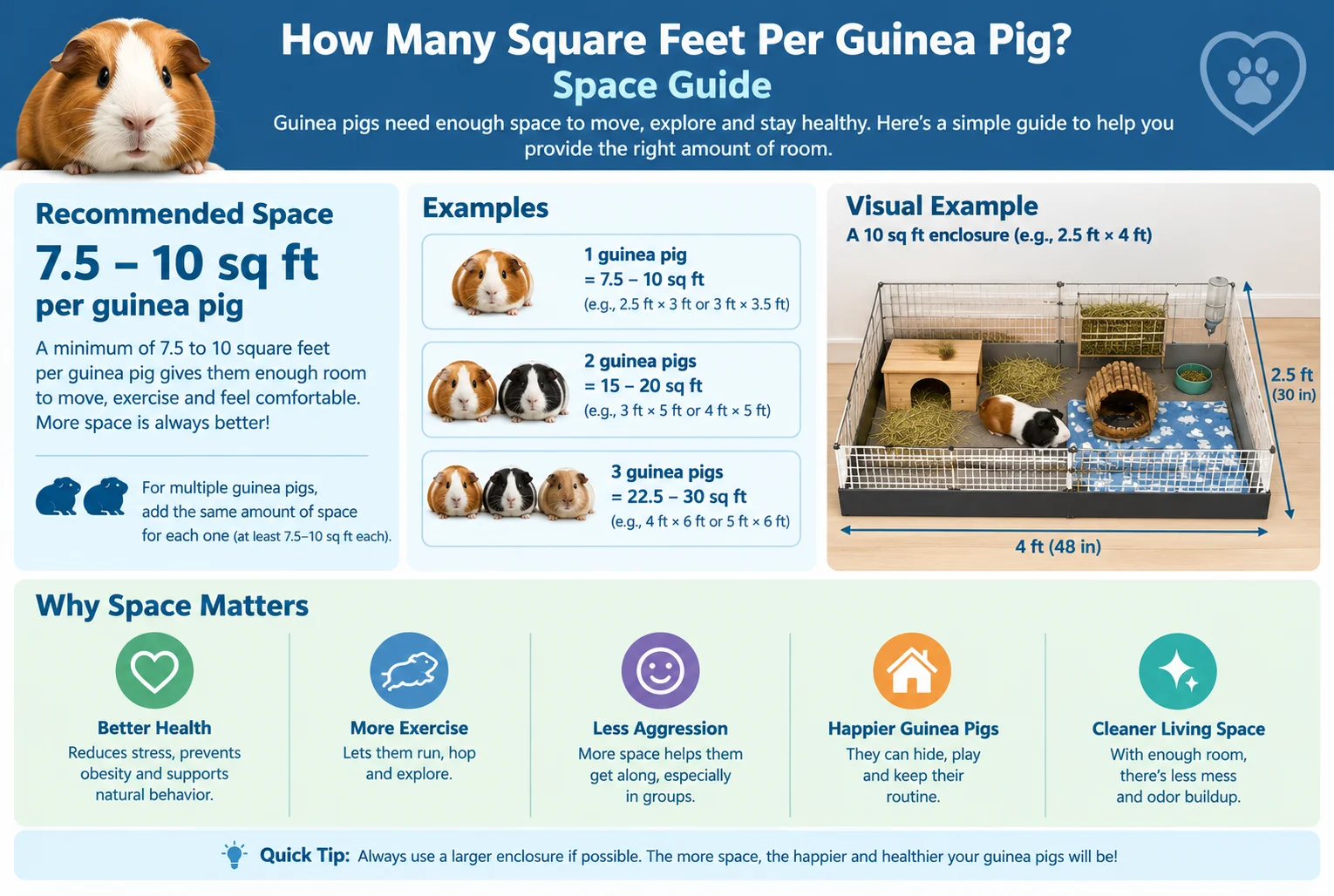
Two compatible guinea pigs need enough space to move together and separately. A commonly used minimum guideline is 10.5 square feet for a pair, although a larger enclosure of around 13 square feet or more is a useful goal when space allows.
For example, a cage measuring 5 feet by 2 feet provides 10 square feet, which falls below that 10.5-square-foot guideline. A cage measuring 5 feet by 2.5 feet provides 12.5 square feet.
| Cage Dimensions | Floor Area | Suitability for Two |
|---|---|---|
| 4 × 2 ft | 8 sq ft | Below the common guideline |
| 5 × 2 ft | 10 sq ft | Slightly below 10.5 sq ft |
| 5 × 2.5 ft | 12.5 sq ft | Meets the guideline |
| 6 × 2.5 ft | 15 sq ft | Provides more room |
| 6 × 3 ft | 18 sq ft | A spacious option |
For a pair, provide at least two suitable hiding places, ideally with two exits so one guinea pig cannot easily trap the other. Multiple hay-feeding locations and separate access to water and food can also reduce competition.
How Much Space Do Three or Four Guinea Pigs Need?
As the number of guinea pigs increases, the enclosure should become larger. More animals need more room to move, rest, eat, and avoid unwanted interactions.
The following figures reflect commonly cited minimum guidelines. They should be treated as starting points rather than ideal targets.
| Number of Guinea Pigs | Common Minimum Area | Example Dimensions That Meet or Exceed It |
|---|---|---|
| 1 | 7.5 sq ft | 5 × 1.5 ft = 7.5 sq ft |
| 2 | 10.5 sq ft | 5 × 2.5 ft = 12.5 sq ft |
| 3 | 13 sq ft | 6 × 2.25 ft = 13.5 sq ft |
| 4 | 16 sq ft | 6 × 3 ft = 18 sq ft |
| 5 | 20 sq ft or more | 8 × 2.5 ft = 20 sq ft |
These are area examples, not automatic recommendations for group compatibility. The shape of the enclosure, the animals’ relationships, and the placement of accessories all matter.
Before keeping three or more guinea pigs together, consider their sex, whether they are neutered where appropriate, their existing relationships, and the risk of fighting. Seek advice from a qualified veterinarian or guinea pig rescue if you are unsure whether a group can live together safely.
Does a Bigger Guinea Pig Cage Make a Difference?
Yes. A larger enclosure usually makes it easier to provide exercise space and create a comfortable layout. Guinea pigs can walk between different areas without constantly encountering bowls, tunnels, and hideouts.
A larger cage also gives you more flexibility to place multiple resources around the enclosure. This can be particularly helpful when keeping a pair or a group.
Benefits of a larger enclosure include:
- More room for walking and exploring.
- Space for tunnels, hideouts, and enrichment.
- Better separation between resting and feeding areas.
- More opportunities for guinea pigs to move away from one another.
- Greater flexibility when arranging hay, water, and food.
However, size alone does not make an enclosure suitable. It must also be secure, well ventilated, easy to clean, and fitted with safe flooring and appropriate bedding.
What Cage Dimensions Are Best for Guinea Pigs?
Floor area is important, but length and width also matter. Guinea pigs benefit from a long, continuous area where they can walk and run rather than an enclosure that relies mainly on height.
A wide, low enclosure often works better than a tall, narrow cage. Guinea pigs are not natural climbers, and ramps or elevated platforms do not replace adequate ground-level floor space.
| Cage Shape | Example Dimensions | Floor Area | Main Consideration |
|---|---|---|---|
| Square | 3 × 3 ft | 9 sq ft | Easy to arrange, but length may limit running space |
| Rectangular | 4 × 2 ft | 8 sq ft | Useful shape, but below the common pair guideline |
| Long rectangular | 5 × 2.5 ft | 12.5 sq ft | Provides a longer walking area |
| Wide rectangular | 6 × 3 ft | 18 sq ft | Offers substantial space for multiple resources |
| Narrow rectangular | 8 × 1.5 ft | 12 sq ft | Total area is useful, but the narrow width may restrict layout |
When comparing cages, measure the interior floor rather than relying only on the manufacturer’s product description. Also check whether dividers, built-in shelves, or inaccessible corners reduce the usable area.
What Should Be Included Inside a Guinea Pig Enclosure?
A suitable enclosure needs more than empty floor space. It should provide the essential resources guinea pigs need while preserving enough room for movement.
| Essential Item | Purpose | Space-Planning Tip |
|---|---|---|
| Hay | Provides essential fiber and supports normal chewing | Keep hay readily available without blocking the main walking area |
| Water bottle or suitable water bowl | Provides access to fresh water | Position it where it is easy to reach and clean |
| Food bowl | Holds appropriate guinea pig pellets | Avoid placing it where it obstructs movement |
| Hideouts | Offer shelter and a place to rest | Provide enough hideouts for all animals, preferably with two exits |
| Bedding or safe flooring | Provides a comfortable, absorbent surface | Choose material that is safe, dry, and easy to maintain |
| Tunnels and enrichment | Encourage exploration and activity | Leave open space between accessories |
| Separate feeding locations | Help reduce competition | Provide multiple accessible hay and water locations when housing a pair or group |
Guinea pigs should have unlimited access to suitable grass hay, fresh water, and a balanced diet appropriate for their needs. Clean the enclosure regularly and remove wet or soiled bedding to maintain a healthy environment.
Do Guinea Pigs Need Extra Exercise Space Outside Their Cage?
A secure exercise area can provide additional opportunities for movement and exploration. However, extra playtime should not be used as a substitute for an appropriately sized main enclosure.
If you provide an exercise pen, ensure the area is protected from electrical cords, toxic plants, other pets, and objects that guinea pigs could chew or swallow. The flooring should provide good traction, and the area should be supervised.
| Exercise Setup | Main Benefit | Safety Consideration |
|---|---|---|
| Indoor playpen | Offers extra room to explore | Secure the perimeter and remove hazards |
| Guinea pig-proofed room | Allows more freedom of movement | Block gaps, cords, and unsafe objects |
| Outdoor run | Provides supervised outdoor enrichment | Protect against predators, overheating, cold, and escape |
Never leave guinea pigs outdoors in an unsecured area. Temperature changes, predators, and other environmental hazards can put them at risk.
Common Mistakes When Choosing a Guinea Pig Cage
Choosing an enclosure based only on appearance or price can lead to insufficient space. Before buying, check the actual interior dimensions and consider how the cage will function once fully furnished.
1. Choosing a cage that is too small
A compact cage may look convenient, but it can leave little room for walking once the accessories are installed. Calculate the actual floor area before purchasing.
2. Counting height as floor space
A tall cage does not provide the same benefit as a large ground-level area. Elevated shelves may add enrichment, but they do not replace the required main floor area.
3. Forgetting about accessories
Food bowls, hideouts, and hay racks take up room. Plan the layout so that guinea pigs still have clear paths to walk and explore.
4. Keeping multiple guinea pigs in a cramped enclosure
Guinea pigs need space to avoid one another when they want to rest. Provide multiple hideouts and feeding locations, and increase the enclosure size as the group grows.
5. Assuming exercise time fixes a small cage
Exercise outside the enclosure is beneficial, but guinea pigs spend much of their time in their main living area. Their regular enclosure should be spacious enough for daily movement and normal behavior.
How to Choose the Right Cage for Your Guinea Pigs
Use these steps before buying or building an enclosure:
- Count the guinea pigs. Plan for their current number and any responsible future changes.
- Set a minimum floor-area target. Use an established animal-welfare guideline and aim for more space where possible.
- Measure the interior dimensions. Multiply length by width to calculate square feet.
- Check the shape. Prefer a practical, open floor layout over a narrow or heavily divided design.
- Plan the accessories. Make sure hideouts, hay, food, and water will fit without filling the entire floor.
- Consider compatibility. A larger cage cannot guarantee that every group will get along.
- Plan for cleaning and safety. Choose an enclosure with secure sides, suitable flooring, and easy access for daily care.
If you already have a cage, measure it and calculate its usable floor area. If it is smaller than the recommended amount, consider upgrading or expanding the enclosure.
Frequently Asked Questions
Is 4 square feet enough for one guinea pig?
No. Four square feet is below the commonly cited minimum of 7.5 square feet for one guinea pig. A larger enclosure is recommended, and guinea pigs generally benefit from living with a compatible companion.
Is 8 square feet enough for two guinea pigs?
Eight square feet is below the commonly cited minimum guideline of 10.5 square feet for a pair. A larger enclosure would be a better choice.
Is a 2 × 4 foot cage big enough for guinea pigs?
A 2 × 4 foot cage provides 8 square feet. It may exceed the commonly cited minimum for one guinea pig, but it falls below the common guideline for two. Since guinea pigs generally do best with companionship, choose a larger enclosure for a compatible pair.
How many guinea pigs can live in 10 square feet?
There is no single answer based on floor area alone. Ten square feet is above the commonly cited minimum for one guinea pig but below the common 10.5-square-foot guideline for two. The enclosure’s dimensions, layout, and the animals’ needs must also be considered.
Do two guinea pigs need two cages?
Not necessarily. Compatible guinea pigs can usually share a suitably sized enclosure. They need enough room, multiple hiding places, and accessible food and water resources. If they fight or cannot live together safely, seek advice from a qualified veterinarian or experienced guinea pig rescue.
Does a two-story cage count as double the floor space?
Not for the purpose of replacing the main floor area. Upper levels may provide additional enrichment, but the ground-level enclosure should still meet an appropriate floor-space recommendation.
What is the best cage size for two guinea pigs?
A common minimum guideline is 10.5 square feet, but a larger enclosure of around 13 square feet or more is a practical goal when possible. A 5 × 2.5 foot cage provides 12.5 square feet, while a 6 × 2.5 foot cage provides 15 square feet.
Can guinea pigs live in a small pet-store cage?
Some cages marketed for guinea pigs are smaller than commonly recommended welfare guidelines. Always check the actual usable floor dimensions rather than relying on the product label.
Conclusion
Guinea pigs need adequate floor space to move, explore, eat, and rest comfortably. A commonly used minimum guideline is 7.5 square feet for one guinea pig, 10.5 square feet for two, 13 square feet for three, and 16 square feet for four. These are starting points rather than ideal targets, and more space is generally better.
Measure the enclosure before buying it, allow room for essential accessories, and provide a safe, enriching environment. A spacious enclosure and a compatible companion can help support your guinea pigs’ comfort and well-being.
Discover More Articles
How Many Feet Is 189 Inches? Exact Conversion Guide