
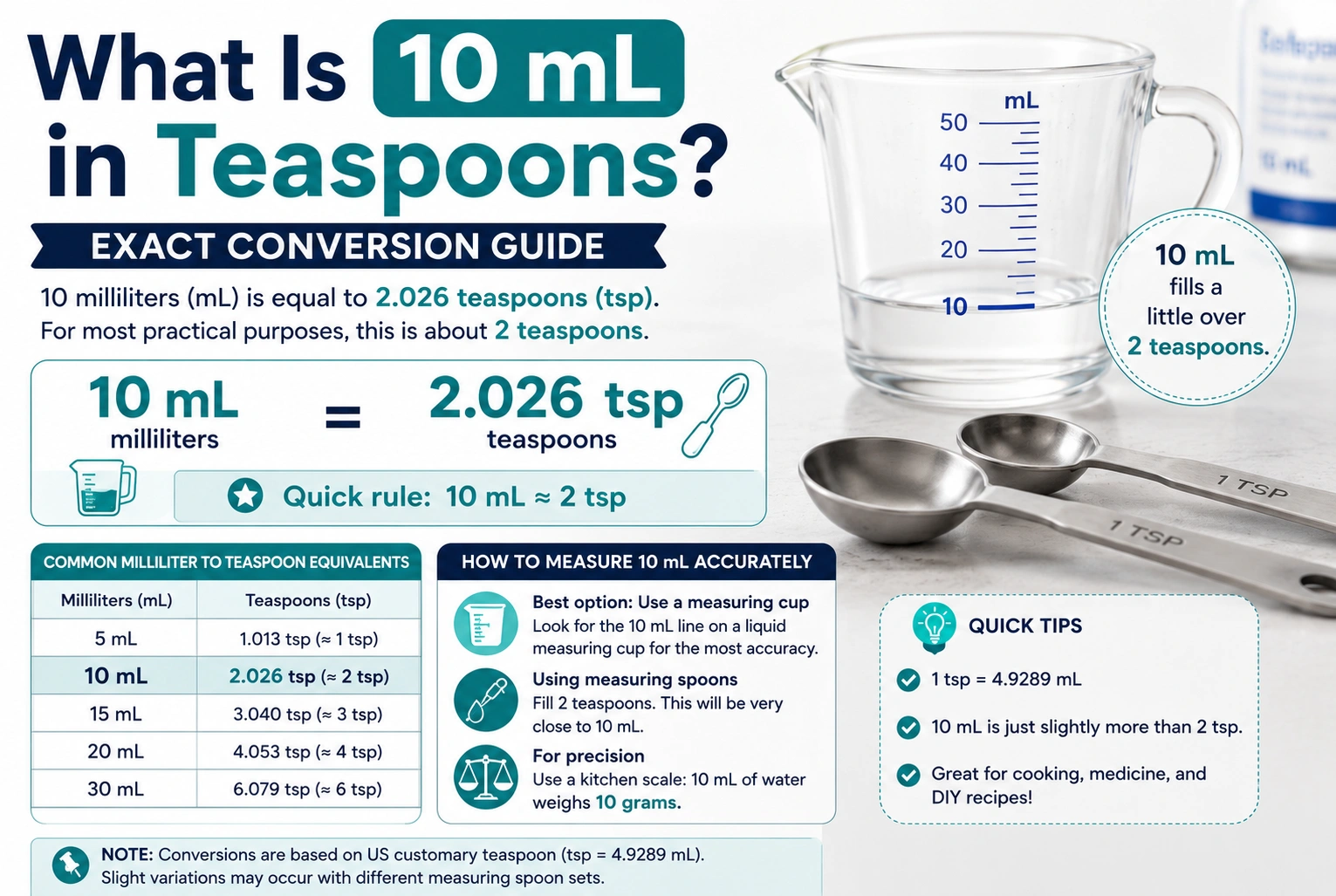
If you’re wondering what is 10 mL in teaspoons, the answer is:
10 mL = approximately 2 teaspoons
In standard kitchen and medical measurements:
- 1 teaspoon (tsp) = 5 milliliters (mL)
Therefore:
10 ÷ 5 = 2 teaspoons
This conversion is commonly used in cooking, baking, and measuring liquid medicines.
Quick Answer
| Milliliters | Teaspoons |
|---|---|
| 10 mL | 2 teaspoons |
So:
10 mL = 2 teaspoons
Understanding the Conversion
Milliliters are part of the metric system, while teaspoons are commonly used in cooking and medicine, especially in the United States.
The standard conversion is:
- 1 teaspoon = 5 mL
Because of this relationship:
- 5 mL = 1 teaspoon
- 10 mL = 2 teaspoons
- 15 mL = 3 teaspoons (1 tablespoon)
Learning these common conversions makes measuring liquids much easier.
Conversion Formula
The formula for converting milliliters into teaspoons is:
Teaspoons = Milliliters ÷ 5
For 10 mL:
10 ÷ 5 = 2 teaspoons
This simple formula works for any milliliter measurement.
Step-by-Step Calculation
Let’s calculate 10 mL in teaspoons.
Step 1
Write the formula:
Teaspoons = mL ÷ 5
Step 2
Substitute the value:
10 ÷ 5
Step 3
Calculate:
2
Therefore:
10 mL = 2 teaspoons
mL to Teaspoon Conversion Chart
Here are some common kitchen conversions.
| Milliliters | Teaspoons |
| 2.5 mL | ½ tsp |
| 5 mL | 1 tsp |
| 7.5 mL | 1½ tsp |
| 10 mL | 2 tsp |
| 12.5 mL | 2½ tsp |
| 15 mL | 3 tsp (1 tbsp) |
| 20 mL | 4 tsp |
| 25 mL | 5 tsp |
This chart is especially helpful when following recipes or measuring medication.
Common Uses for 10 mL
A 10 mL measurement is frequently used in everyday life.
Examples include:
- Liquid medicines
- Children’s medication (when prescribed)
- Cooking ingredients
- Baking extracts
- Food flavorings
- Liquid supplements
- Laboratory measurements
Many medicine dosing cups and oral syringes include 10 mL markings for accurate measurement.
Why Accurate Measurement Matters
Using the correct amount is important, especially when measuring medicine or ingredients.
Accurate measurements help:
- Ensure recipes turn out correctly.
- Prevent over- or under-measuring ingredients.
- Follow medication directions precisely.
- Improve consistency in baking.
- Reduce waste during cooking.
Whenever possible, use a measuring spoon or medicine syringe rather than a regular household spoon, which may not hold a standard teaspoon amount.
More Real-Life Examples
Knowing that 10 mL equals 2 teaspoons is useful in many everyday situations.
Measuring Liquid Medicine
Many liquid medications are labeled in milliliters. If the prescribed dose is 10 mL, you’ll need 2 standard teaspoons, though healthcare providers generally recommend using a medicine syringe, dosing cup, or oral dosing spoon for greater accuracy instead of a household teaspoon.
Cooking Recipes
Some recipes list ingredients in milliliters, while others use teaspoons.
For example:
- 10 mL vanilla extract = 2 teaspoons
- 10 mL lemon juice = 2 teaspoons
- 10 mL olive oil = 2 teaspoons
This makes it easy to follow recipes from different countries.
Baking
Accurate measurements are especially important when baking.
Using the correct amount of ingredients such as:
- Vanilla extract
- Almond extract
- Food coloring
- Flavorings
helps produce consistent results every time.
Science and School
Students frequently convert between metric and U.S. customary units in science labs and math classes.
Remembering that:
10 mL = 2 teaspoons
can make basic conversion exercises easier.
Common Conversion Mistakes
Using Household Spoons
A regular eating spoon is not the same as a standardized measuring teaspoon.
For accurate measurements, use:
- Measuring spoons
- Oral syringes
- Medicine dosing cups
Confusing Teaspoons with Tablespoons
A common mistake is mixing up teaspoons (tsp) and tablespoons (tbsp).
Remember:
- 1 teaspoon = 5 mL
- 1 tablespoon = 15 mL
- 3 teaspoons = 1 tablespoon
So:
10 mL = 2 teaspoons, not 2 tablespoons.
Forgetting the Conversion Factor
Always remember the basic relationship:
1 teaspoon = 5 mL
This single fact allows you to convert most common kitchen measurements quickly.
Rounding Incorrectly
For 10 mL, the conversion is exactly 2 teaspoons based on the standard kitchen measurement of 5 mL per teaspoon.
Tips for Measuring Liquids Accurately
Use Standard Measuring Tools
Choose proper measuring spoons or graduated measuring cups instead of ordinary tableware.
Read Measurements at Eye Level
When using a measuring cup or medicine cup, place it on a flat surface and read the liquid level at eye level for greater accuracy.
Follow Medical Instructions Carefully
For medications, follow the dosage provided by your healthcare professional or the product label. Use the measuring device supplied with the medication whenever possible.
Keep a Conversion Chart Handy
Having a simple conversion chart in your kitchen can make cooking and baking much easier.
Quick Kitchen Conversion Table
| Milliliters (mL) | Teaspoons (tsp) | Tablespoons (tbsp) |
|---|---|---|
| 2.5 | ½ tsp | — |
| 5 | 1 tsp | — |
| 10 | 2 tsp | — |
| 15 | 3 tsp | 1 tbsp |
| 30 | 6 tsp | 2 tbsp |
| 45 | 9 tsp | 3 tbsp |
This chart covers some of the most common liquid measurements used in recipes and medication instructions.
Frequently Asked Questions
What is 10 mL in teaspoons?
10 mL equals 2 teaspoons.
Is 10 mL exactly 2 teaspoons?
Using the standard measurement of 1 teaspoon = 5 mL, yes—10 mL is exactly 2 teaspoons.
Can I use a regular spoon instead of a measuring teaspoon?
It’s best not to. Household spoons vary in size and may not provide accurate measurements. Use a standard measuring spoon or medicine dosing device whenever accuracy is important.
How many tablespoons is 10 mL?
Since 1 tablespoon = 15 mL, 10 mL is about two-thirds (⅔) of a tablespoon.
Why are milliliters used on medicine labels?
Milliliters provide a standardized and precise way to measure liquid medications, helping reduce dosing errors.
Conclusion
If you’re asking what is 10 mL in teaspoons, the answer is 2 teaspoons. This conversion is based on the standard relationship of 1 teaspoon = 5 milliliters. Whether you’re following a recipe, measuring liquid medicine, or working with metric measurements, knowing this simple conversion can save time and improve accuracy.
For the best results, always use proper measuring tools such as measuring spoons, oral syringes, or dosing cups, especially when measuring medications or ingredients where precision matters.
Discover More Articles
What Is 23 Degrees Celsius in Fahrenheit? Guide