

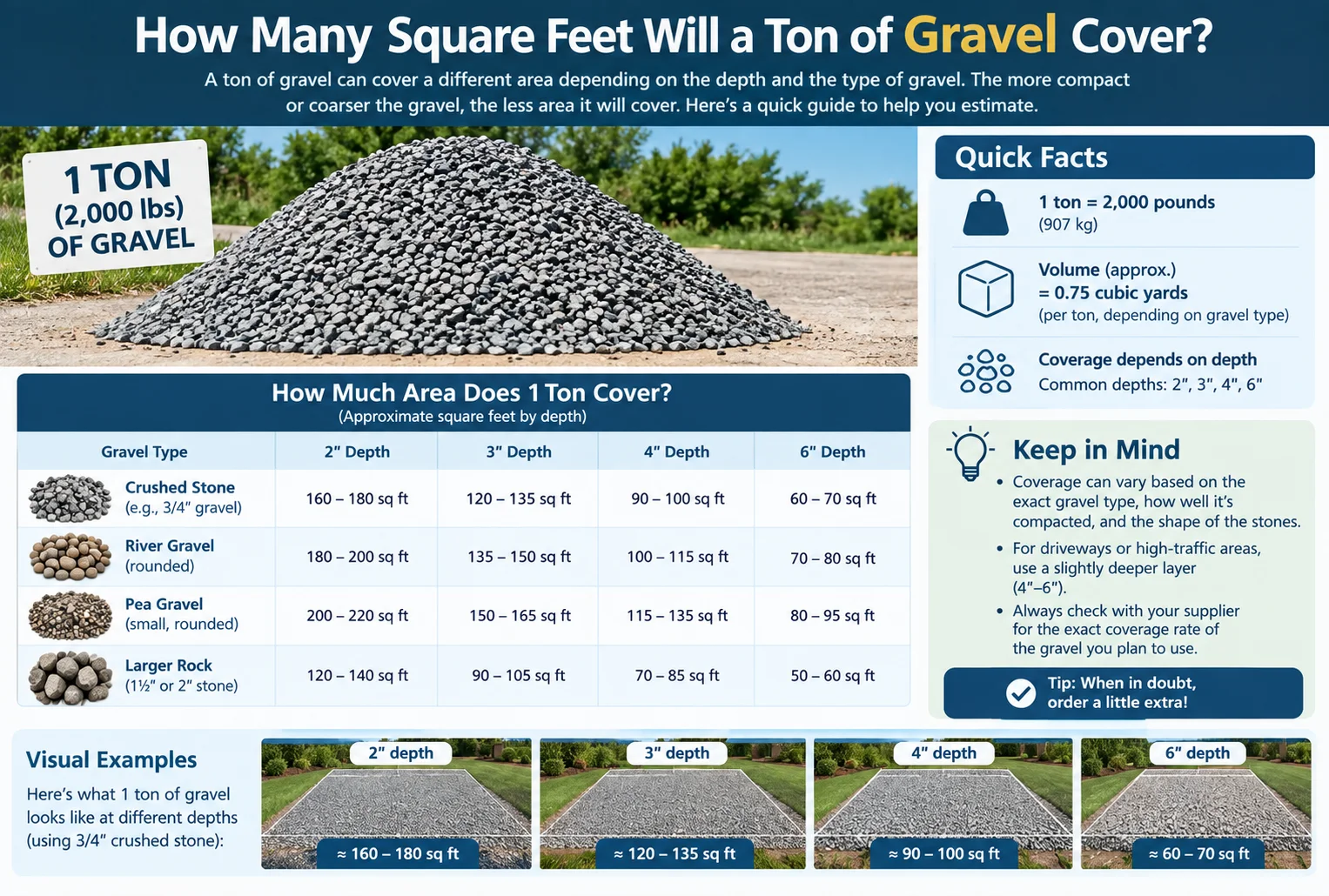
A ton of gravel can cover a surprisingly large area, but the exact coverage depends mainly on how deep you spread the gravel. A thin layer covers more square feet, while a deeper layer covers less.
For most landscaping and driveway projects, gravel is commonly spread at depths of about 2 to 4 inches. At those depths, one ton of gravel may cover roughly 80 to 240 square feet, depending on the gravel’s density and the depth.
Quick Answer
A ton of gravel typically covers approximately:
| Gravel Depth | Approximate Coverage Per Ton |
|---|---|
| 1 inch | 240–260 sq ft |
| 2 inches | 120–130 sq ft |
| 3 inches | 80–85 sq ft |
| 4 inches | 60–65 sq ft |
| 5 inches | 48–52 sq ft |
| 6 inches | 40–43 sq ft |
These are practical estimates. Actual coverage varies because different types of gravel have different densities, and gravel can settle after installation.
For a common 2-inch layer, you can generally plan on about 120–130 square feet per ton.
What Determines How Much Area a Ton of Gravel Covers?
The biggest factor is depth.
Imagine spreading the same ton of gravel over a driveway. If you spread it 1 inch deep, it will cover a much larger area than if you spread it 4 inches deep.
Other factors include:
- Gravel type
- Gravel density
- Stone size
- Moisture content
- Compaction
- How evenly the gravel is spread
- Amount of settling after installation
This is why there isn’t one universal square-foot coverage number for every ton of gravel.
How Many Square Feet Does 1 Ton of Gravel Cover?
For a commonly used aggregate density of roughly 1.4–1.5 tons per cubic yard, one ton of gravel provides approximately 0.67–0.71 cubic yards.
Since:
1 cubic yard = 27 cubic feet
one ton may provide roughly:
18–19 cubic feet of gravel
Using approximately 18.5 cubic feet as a planning figure, coverage can be estimated at different depths.
| Depth | Approximate Coverage |
|---|---|
| 1 inch | ~222 sq ft |
| 2 inches | ~111 sq ft |
| 3 inches | ~74 sq ft |
| 4 inches | ~55.5 sq ft |
| 6 inches | ~37 sq ft |
Because gravel density varies, these calculations can differ from supplier coverage charts. For practical ordering, use the density or coverage information supplied by your gravel provider.
A Practical Gravel Coverage Chart
For many residential projects, the following range is useful for planning.
| Gravel Depth | Approximate Square Feet Per Ton |
|---|---|
| 1 inch | 200–260 sq ft |
| 2 inches | 100–130 sq ft |
| 3 inches | 65–85 sq ft |
| 4 inches | 50–65 sq ft |
| 5 inches | 40–52 sq ft |
| 6 inches | 33–43 sq ft |
The table shows why depth is so important. Doubling the depth roughly cuts the coverage area in half.
How to Calculate Gravel Coverage
You can calculate gravel coverage using a simple formula.
First, determine the volume of gravel in cubic feet.
Then divide that volume by the thickness of the gravel layer in feet.
The basic formula is:
Coverage = Gravel volume ÷ Depth
For example, suppose one ton of gravel provides approximately 18 cubic feet and you want a 2-inch layer.
Convert 2 inches to feet:
2 ÷ 12 = 0.167 feet
Then:
18 ÷ 0.167 ≈ 108 square feet
So one ton would cover approximately 108 square feet at 2 inches deep using this particular density assumption.
How Much Gravel Do I Need for 100 Square Feet?
The amount needed for 100 square feet depends on the desired depth.
| Area | Depth | Approximate Gravel Needed |
|---|---|---|
| 100 sq ft | 1 inch | ~0.4–0.5 ton |
| 100 sq ft | 2 inches | ~0.8–1.0 ton |
| 100 sq ft | 3 inches | ~1.2–1.5 tons |
| 100 sq ft | 4 inches | ~1.5–2.0 tons |
| 100 sq ft | 6 inches | ~2.3–3.0 tons |
These figures are planning estimates. The actual amount depends on the gravel’s density.
For a typical decorative landscaping layer around 2 inches deep, about 1 ton for 100 square feet is a useful starting estimate.
How Much Gravel Do I Need for 200 Square Feet?
For twice the area, you generally need twice as much gravel when the depth stays the same.
| Depth | Approximate Gravel Needed for 200 sq ft |
|---|---|
| 1 inch | 0.8–1.0 ton |
| 2 inches | 1.6–2.0 tons |
| 3 inches | 2.4–3.0 tons |
| 4 inches | 3.0–4.0 tons |
| 6 inches | 4.6–6.0 tons |
If you’re ordering gravel in whole tons, it is generally better to account for some extra material rather than ending up short.
How Much Gravel Do I Need for 500 Square Feet?
A 500-square-foot project is common for patios, pathways, landscaping areas, and some driveway applications.
| Depth | Approximate Gravel Needed |
|---|---|
| 1 inch | 2–2.5 tons |
| 2 inches | 4–5 tons |
| 3 inches | 6–7.5 tons |
| 4 inches | 7.5–10 tons |
| 6 inches | 11.5–15 tons |
For a 500-square-foot area covered 2 inches deep, planning for approximately 4–5 tons is reasonable for many common gravel types.
How Much Gravel Does a Ton Cover at 2 Inches Deep?
At a depth of 2 inches, a ton of gravel commonly covers around 100–130 square feet.
A useful midpoint estimate is approximately:
115 square feet per ton
However, supplier specifications may produce a different number.
For example, if the gravel is relatively dense, one ton may cover less area. Lighter aggregate can cover more area because the same weight occupies greater volume.
How Much Gravel Does a Ton Cover at 3 Inches Deep?
At 3 inches, one ton generally covers around 65–85 square feet.
A planning estimate of approximately 75 square feet per ton works well for a quick calculation.
For a 300-square-foot area:
300 ÷ 75 = 4 tons
So you would need approximately 4 tons at a 3-inch depth under that assumption.
How Much Gravel Does a Ton Cover at 4 Inches Deep?
At 4 inches deep, one ton typically covers about 50–65 square feet.
A practical midpoint is around 55–60 square feet per ton.
For example:
500 sq ft ÷ 55 sq ft per ton ≈ 9.1 tons
You might therefore plan for roughly 9–10 tons, depending on the material and supplier specifications.
How Many Tons of Gravel Do I Need?
A simple way to estimate the amount of gravel needed is:
Tons needed = Area × Depth × Gravel density
When using cubic feet, remember that the depth must be converted from inches to feet.
For example, suppose you have:
- Area = 400 sq ft
- Depth = 3 inches
- Gravel density = 100 lb per cubic foot
First convert the depth:
3 ÷ 12 = 0.25 feet
Calculate volume:
400 × 0.25 = 100 cubic feet
Calculate weight:
100 × 100 = 10,000 lb
Convert pounds to tons:
10,000 ÷ 2,000 = 5 tons
So this example requires approximately 5 tons.
The actual answer changes if the gravel’s density is different.
Gravel Coverage for Driveways
Driveways usually require more gravel than decorative garden areas because they need a stronger and deeper base.
A driveway may use multiple layers, including:
- Compacted base material
- Intermediate aggregate
- Surface gravel
The required depth depends on soil conditions, drainage, vehicle traffic, and the type of gravel.
For a simple surface layer, these approximate coverage figures can help:
| Surface Depth | Coverage Per Ton |
|---|---|
| 2 inches | ~100–130 sq ft |
| 3 inches | ~65–85 sq ft |
| 4 inches | ~50–65 sq ft |
For a new driveway, however, don’t assume that adding one 2- or 3-inch layer is sufficient. The underlying base and local soil conditions can significantly affect the required material.
Gravel Coverage for Landscaping
Decorative gravel used around flower beds, trees, walkways, and other landscaping features is often installed in thinner layers.
A common decorative layer might be around 1.5–3 inches, depending on the material and project.
| Landscaping Depth | Approximate Coverage Per Ton |
|---|---|
| 1 inch | 200–260 sq ft |
| 2 inches | 100–130 sq ft |
| 3 inches | 65–85 sq ft |
Before ordering, check the recommended installation depth for the particular gravel product.
Why Gravel Density Matters
Two piles of gravel can have the same weight but occupy different amounts of space.
Density is affected by:
- Rock type
- Particle size
- Shape
- Moisture
- Compaction
- Amount of fine material
For example, one ton of a dense crushed stone may occupy less volume than one ton of a lighter aggregate.
This is why gravel suppliers often sell material by weight in tons but provide coverage information based on the product’s specific density.
Should You Order Extra Gravel?
It is often sensible to allow some extra material for a project.
Gravel can:
- Settle into the soil
- Fill low areas
- Spread unevenly
- Be displaced by traffic
- Require additional material around edges
A common planning approach is to add around 5–10% extra when estimating an order, although the appropriate allowance depends on the project.
For example, if your calculation says you need exactly 5 tons:
5 × 1.10 = 5.5 tons
You could therefore plan for approximately 5.5 tons if your supplier allows that quantity.
The amount of extra material needed depends on site conditions and how accurately the area and depth were measured.
How Many Cubic Yards Is a Ton of Gravel?
The conversion depends on density.
A commonly used planning range is:
1 ton of gravel ≈ 0.67–0.71 cubic yards
This is not a fixed conversion because different gravel products have different weights per cubic yard.
For example:
| Gravel Density | Approximate Cubic Yards Per Ton |
|---|---|
| 2,600 lb/yd³ | 0.77 yd³ |
| 2,800 lb/yd³ | 0.71 yd³ |
| 3,000 lb/yd³ | 0.67 yd³ |
| 3,200 lb/yd³ | 0.63 yd³ |
Always use the supplier’s stated density when available.
How Many Square Feet Does a Cubic Yard of Gravel Cover?
One cubic yard contains 27 cubic feet.
Coverage depends on depth.
| Depth | Coverage From 1 Cubic Yard |
|---|---|
| 1 inch | 324 sq ft |
| 2 inches | 162 sq ft |
| 3 inches | 108 sq ft |
| 4 inches | 81 sq ft |
| 6 inches | 54 sq ft |
This is a useful conversion when a supplier sells gravel by cubic yard rather than by the ton.
Ton vs. Cubic Yard of Gravel
Tons measure weight, while cubic yards measure volume.
| Measurement | Measures |
|---|---|
| Ton | Weight |
| Cubic yard | Volume |
| Square foot | Area |
| Inch | Depth |
This distinction is important when calculating coverage.
You need all three pieces of information to estimate coverage accurately:
Area + depth + material density
Common Mistakes When Estimating Gravel
Using the wrong depth
A small difference in depth can significantly change the amount of gravel required.
Assuming every gravel type weighs the same
Different aggregates have different densities.
Forgetting to convert inches to feet
If you’re calculating cubic feet, a 3-inch depth must be written as:
3 ÷ 12 = 0.25 feet
Ignoring settling
Loose gravel can settle after installation, especially when the underlying surface is not compacted.
Measuring only the average length and width
Irregular areas need to be divided into smaller sections for more accurate calculations.
How to Calculate Gravel for an Irregular Area
If your project isn’t a simple rectangle, divide it into smaller sections.
For example, suppose a garden contains two rectangular sections:
- Section A: 10 × 20 ft
- Section B: 8 × 15 ft
Calculate each area:
10 × 20 = 200 sq ft
8 × 15 = 120 sq ft
Total:
200 + 120 = 320 sq ft
Then calculate the gravel needed based on your desired depth.
This method is much more accurate than trying to estimate the entire irregular area as one rectangle.
Frequently Asked Questions
How many square feet will 1 ton of gravel cover?
One ton of gravel commonly covers about 100–130 square feet at 2 inches deep, or around 65–85 square feet at 3 inches deep. Actual coverage varies by gravel density.
How much area does a ton of gravel cover at 1 inch?
At a 1-inch depth, one ton may cover roughly 200–260 square feet, depending on the gravel’s density and particle characteristics.
How much gravel do I need for 100 square feet?
At 2 inches deep, approximately 0.8–1.0 ton is a useful planning range. At 4 inches deep, you may need around 1.5–2 tons.
How many tons of gravel do I need for 1,000 square feet?
At 2 inches deep, a typical planning range is approximately 8–10 tons. At 4 inches deep, approximately 15–20 tons may be needed.
Is one ton of gravel enough for a driveway?
It depends on the driveway’s size and required depth. One ton may cover roughly 100–130 square feet at 2 inches deep, so a typical driveway will usually require several tons.
How deep should gravel be?
The appropriate depth depends on the project. Decorative landscaping may use a thinner layer, while driveways and areas exposed to vehicle traffic may require deeper, properly compacted aggregate layers.
Does gravel coverage change after it rains?
Moisture can affect the weight and packing of gravel, while settling can reduce the apparent depth after installation. This is one reason supplier specifications and a small material allowance are useful.
Conclusion
A ton of gravel can cover different amounts of space depending on how deeply you spread it. As a practical estimate, one ton may cover about 100–130 square feet at 2 inches deep, 65–85 square feet at 3 inches, and 50–65 square feet at 4 inches.
The most important factors are gravel density, project area, and installation depth. For an accurate estimate, measure the area, choose the required depth, convert the depth to feet, and use the gravel’s actual density or the supplier’s coverage chart.
For larger projects such as driveways, patios, and construction bases, ordering based on the supplier’s exact product specifications is preferable to relying on a generic coverage estimate.
Discover More Articles
How Many Square Feet Is 16×20?