

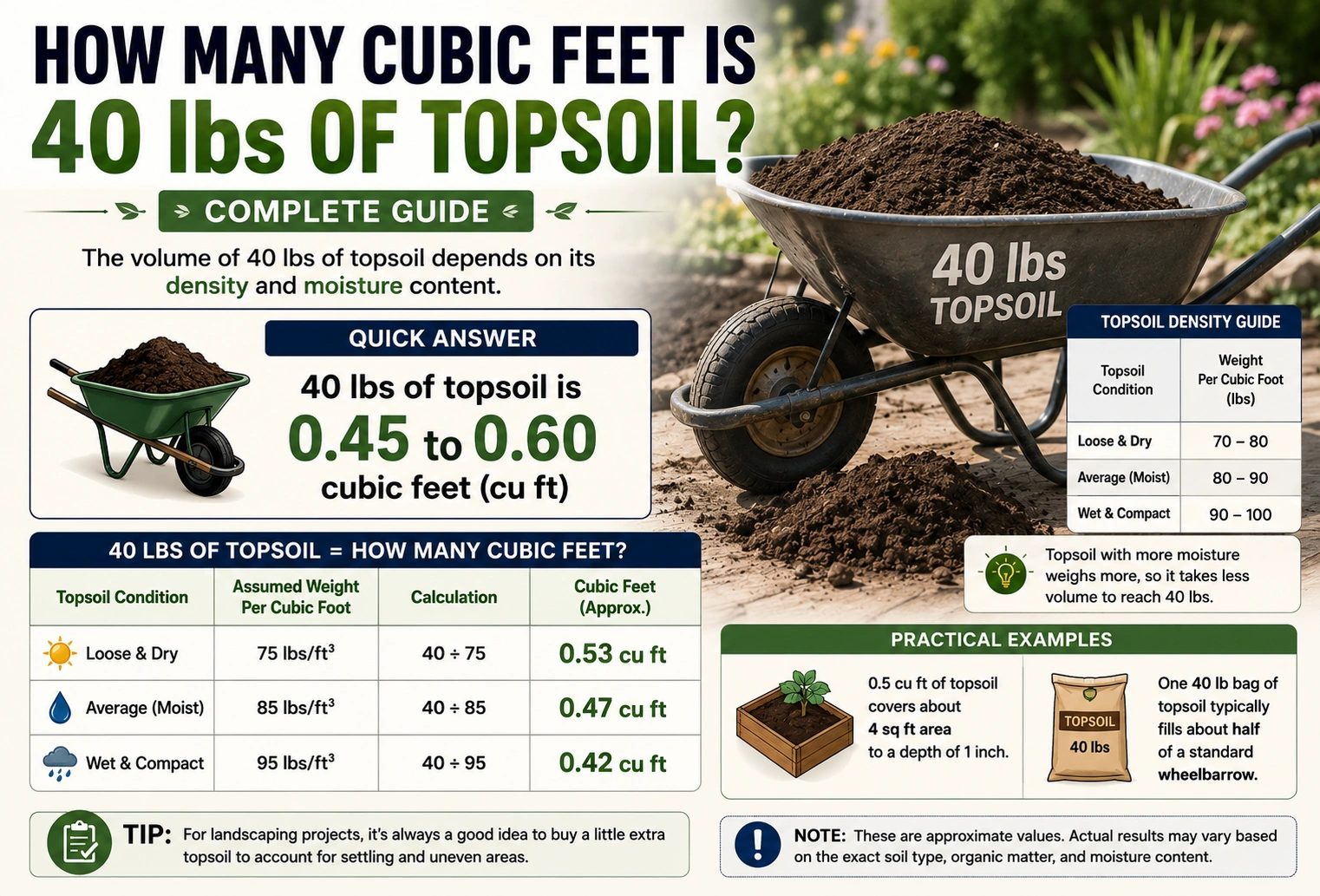
How many cubic feet is 40 lbs of topsoil? The answer depends on the density and moisture content of the topsoil. A 40-pound bag of topsoil typically contains about 0.5 cubic feet, although the actual volume can vary.
For a quick estimate, you can use:
40 lbs ÷ 80 lbs per cubic foot = 0.5 cubic feet
So, a typical 40-lb bag of topsoil provides approximately 0.5 cubic feet of soil.
| Topsoil Density | 40 lbs Equals |
|---|---|
| 60 lbs/cu ft | 0.67 cu ft |
| 70 lbs/cu ft | 0.57 cu ft |
| 80 lbs/cu ft | 0.50 cu ft |
| 90 lbs/cu ft | 0.44 cu ft |
| 100 lbs/cu ft | 0.40 cu ft |
For the most accurate answer, check the bag’s listed volume in cubic feet.
What Is a Cubic Foot of Topsoil?
A cubic foot measures volume rather than weight.
One cubic foot is a space measuring:
1 foot × 1 foot × 1 foot
So:
1 cubic foot = 1,728 cubic inches
Topsoil is commonly sold by both weight and volume, but these measurements are not interchangeable without knowing the soil’s density.
A 40-pound bag may contain a different number of cubic feet depending on whether the soil is:
- Dry or wet
- Loose or compacted
- Sandy or clay-heavy
- Mixed with compost
- Blended with other materials
That’s why there isn’t one exact cubic-foot conversion for every 40-pound bag.
How Many Cubic Feet Does 40 lbs of Topsoil Cover?
For a general estimate, 40 pounds of topsoil ≈ 0.5 cubic feet.
That means one 40-pound bag could fill approximately:
1/2 of a cubic-foot container
For example:
0.5 cubic feet × 2 = 1 cubic foot
So you would need approximately two 40-pound bags to obtain 1 cubic foot, assuming each bag contains 0.5 cubic feet.
| Number of 40-lb Bags | Approx. Volume |
|---|---|
| 1 bag | 0.5 cu ft |
| 2 bags | 1.0 cu ft |
| 4 bags | 2.0 cu ft |
| 6 bags | 3.0 cu ft |
| 8 bags | 4.0 cu ft |
| 10 bags | 5.0 cu ft |
| 20 bags | 10.0 cu ft |
These figures use the simple 0.5 cubic feet per bag estimate.
How to Convert 40 Pounds of Topsoil to Cubic Feet
Unlike inches-to-feet conversions, converting pounds to cubic feet requires density.
The basic formula is:
Volume = Weight ÷ Density
For example, if the topsoil has an estimated density of 80 pounds per cubic foot:
40 ÷ 80 = 0.5 cubic feet
Therefore:
40 lbs of topsoil ≈ 0.5 cubic feet
The important point is that weight alone isn’t enough to calculate an exact volume.
Why Does Topsoil Weight Vary?
Topsoil doesn’t have a fixed weight per cubic foot.
The density changes based on its composition and condition.
Moisture
Wet soil weighs more than dry soil for the same amount of soil.
Organic Matter
Soil containing lots of compost or other organic material may be lighter than dense mineral soil.
Compaction
Loose soil takes up more space than compacted soil.
Soil Composition
Sand, clay, silt, compost, and other materials have different densities.
Because of these factors, two different 40-pound bags can have different volumes.
40 lbs of Topsoil in Cubic Yards
You may also need to convert bagged topsoil into cubic yards for larger landscaping projects.
One cubic yard contains:
27 cubic feet
If one 40-pound bag contains approximately 0.5 cubic feet:
27 ÷ 0.5 = 54 bags
So, you would need approximately 54 bags of 40-pound topsoil to equal one cubic yard.
| Topsoil Volume | Approx. 40-lb Bags |
|---|---|
| 0.5 cu ft | 1 bag |
| 1 cu ft | 2 bags |
| 2 cu ft | 4 bags |
| 5 cu ft | 10 bags |
| 10 cu ft | 20 bags |
| 20 cu ft | 40 bags |
| 27 cu ft | 54 bags |
Actual bag requirements depend on the volume printed on the product packaging.
How Many 40-lb Bags of Topsoil Do You Need?
To calculate the number of bags needed, first determine the volume of your garden bed.
Use:
Length × Width × Depth = Cubic Feet
Make sure all measurements are in feet.
Example
Suppose your garden bed is:
- 10 feet long
- 4 feet wide
- 0.5 feet deep
Calculate:
10 × 4 × 0.5 = 20 cubic feet
If each 40-pound bag provides 0.5 cubic feet:
20 ÷ 0.5 = 40 bags
So you would need approximately 40 bags.
How Much Area Does 40 lbs of Topsoil Cover?
Coverage depends on how deeply you spread the soil.
If one 40-pound bag contains approximately 0.5 cubic feet, its coverage changes with depth.
The formula is:
Coverage Area = Cubic Feet ÷ Depth in Feet
For 0.5 cubic feet:
At 1 Inch Deep
1 inch = 1/12 foot
0.5 ÷ 1/12 = 6 square feet
At 2 Inches Deep
2 inches = 1/6 foot
0.5 ÷ 1/6 = 3 square feet
At 3 Inches Deep
3 inches = 0.25 foot
0.5 ÷ 0.25 = 2 square feet
At 4 Inches Deep
4 inches = 1/3 foot
0.5 ÷ 1/3 = 1.5 square feet
| Soil Depth | Approx. Coverage From 0.5 cu ft |
|---|---|
| 1 inch | 6 sq ft |
| 2 inches | 3 sq ft |
| 3 inches | 2 sq ft |
| 4 inches | 1.5 sq ft |
| 6 inches | 1 sq ft |
These are theoretical coverage figures. Settling and uneven application can reduce practical coverage.
How Many 40-lb Bags for a 100-Square-Foot Garden?
Suppose you want to spread topsoil over 100 square feet at a depth of 3 inches.
First convert 3 inches to feet:
3 ÷ 12 = 0.25 feet
Now calculate volume:
100 × 0.25 = 25 cubic feet
If each 40-pound bag provides approximately 0.5 cubic feet:
25 ÷ 0.5 = 50 bags
So you would need approximately 50 bags.
| Area | Depth | Soil Needed | Approx. 40-lb Bags |
|---|---|---|---|
| 100 sq ft | 1 in | 8.33 cu ft | 17 |
| 100 sq ft | 2 in | 16.67 cu ft | 34 |
| 100 sq ft | 3 in | 25 cu ft | 50 |
| 100 sq ft | 4 in | 33.33 cu ft | 67 |
| 100 sq ft | 6 in | 50 cu ft | 100 |
Round up to a whole bag when purchasing.
40 lbs of Topsoil vs. 40 lbs of Compost
Both products weigh 40 pounds, but they may occupy different volumes.
That’s because weight does not determine volume by itself.
For example:
| Material | Weight | Possible Volume |
|---|---|---|
| Topsoil | 40 lbs | ~0.5 cu ft |
| Compost | 40 lbs | Can vary |
| Potting mix | 40 lbs | Can vary |
| Sand | 40 lbs | Can vary |
| Mulch | 40 lbs | Can vary significantly |
The density of each material determines how much physical space it occupies.
Should You Buy Topsoil by Weight or Cubic Feet?
For landscaping, volume is often more useful than weight.
If your garden bed requires 20 cubic feet of soil, buying soil labeled by cubic feet makes the calculation easier.
For example:
20 cubic feet needed
If a bag contains:
0.5 cubic feet
Then:
20 ÷ 0.5 = 40 bags
If a bag contains 1 cubic foot, you would need only 20 bags.
Always compare the volume printed on the bag, rather than assuming all 40-pound bags contain the same amount.
How Much Does 1 Cubic Foot of Topsoil Weigh?
If we use the 80-pound-per-cubic-foot estimate:
1 cubic foot ≈ 80 pounds
Therefore:
40 pounds ≈ 0.5 cubic feet
But actual topsoil can weigh more or less depending on moisture and composition.
| Approx. Density | 1 Cubic Foot | 40-lb Equivalent |
|---|---|---|
| 60 lb/cu ft | 60 lbs | 0.67 cu ft |
| 70 lb/cu ft | 70 lbs | 0.57 cu ft |
| 80 lb/cu ft | 80 lbs | 0.50 cu ft |
| 90 lb/cu ft | 90 lbs | 0.44 cu ft |
| 100 lb/cu ft | 100 lbs | 0.40 cu ft |
This demonstrates why an exact conversion requires the soil’s density.
Common Mistakes When Calculating Topsoil
Mistake 1: Assuming Every 40-lb Bag Is 0.5 Cubic Feet
This is only an estimate.
Mistake 2: Ignoring Moisture
Wet soil can weigh substantially more than dry soil.
Mistake 3: Confusing Cubic Feet With Square Feet
Cubic feet measure volume. Square feet measure area.
Mistake 4: Forgetting Soil Depth
A garden bed’s length and width aren’t enough. You also need the desired depth.
Mistake 5: Buying Based Only on Bag Weight
Check the bag’s listed volume whenever possible.
Mistake 6: Forgetting Settling
Loose soil can settle after installation, so your final depth may be lower than the initial depth.
Tips for Buying the Right Amount of Topsoil
Before purchasing soil:
- Measure the length of the area.
- Measure its width.
- Decide how deep you want the soil.
- Calculate cubic feet.
- Check the bag’s listed volume.
- Divide total volume by bag volume.
- Round up to the next whole bag.
- Consider some extra soil for settling and uneven areas.
For large landscaping jobs, buying bulk topsoil by the cubic yard can be more practical than purchasing dozens of individual bags.
FAQs
1. How many cubic feet is 40 lbs of topsoil?
A typical estimate is approximately 0.5 cubic feet, but the actual volume depends on the soil’s density and moisture content.
2. How many 40-lb bags of topsoil are in a cubic yard?
If each 40-pound bag contains approximately 0.5 cubic feet, you need about 54 bags to equal one cubic yard.
3. How much area does a 40-lb bag of topsoil cover?
If a 40-pound bag contains about 0.5 cubic feet, it can cover approximately 2 square feet at 3 inches deep, or about 3 square feet at 2 inches deep.
4. How many 40-lb bags do I need for 100 square feet?
At a 3-inch depth, 100 square feet requires approximately 25 cubic feet of soil. At 0.5 cubic feet per bag, that’s about 50 bags.
5. Is 40 lbs always equal to 0.5 cubic feet of topsoil?
No. 40 pounds is a weight measurement, while cubic feet measure volume. The conversion changes according to density, moisture, and soil composition.
Conclusion
So, how many cubic feet is 40 lbs of topsoil? A useful general estimate is about 0.5 cubic feet, assuming a density of approximately 80 pounds per cubic foot.
However, this isn’t an exact universal conversion. Topsoil density changes with moisture, organic matter, composition, and compaction. For the most accurate calculation, check the cubic-foot volume printed on the bag.
For gardening and landscaping projects, calculate the total cubic feet you need first, then divide that number by the volume of one bag. This gives you a much more reliable estimate of how many bags to purchase.
Discover More Articles
How Many Feet Is a 55 Inch TV? Size & Distance Guide