
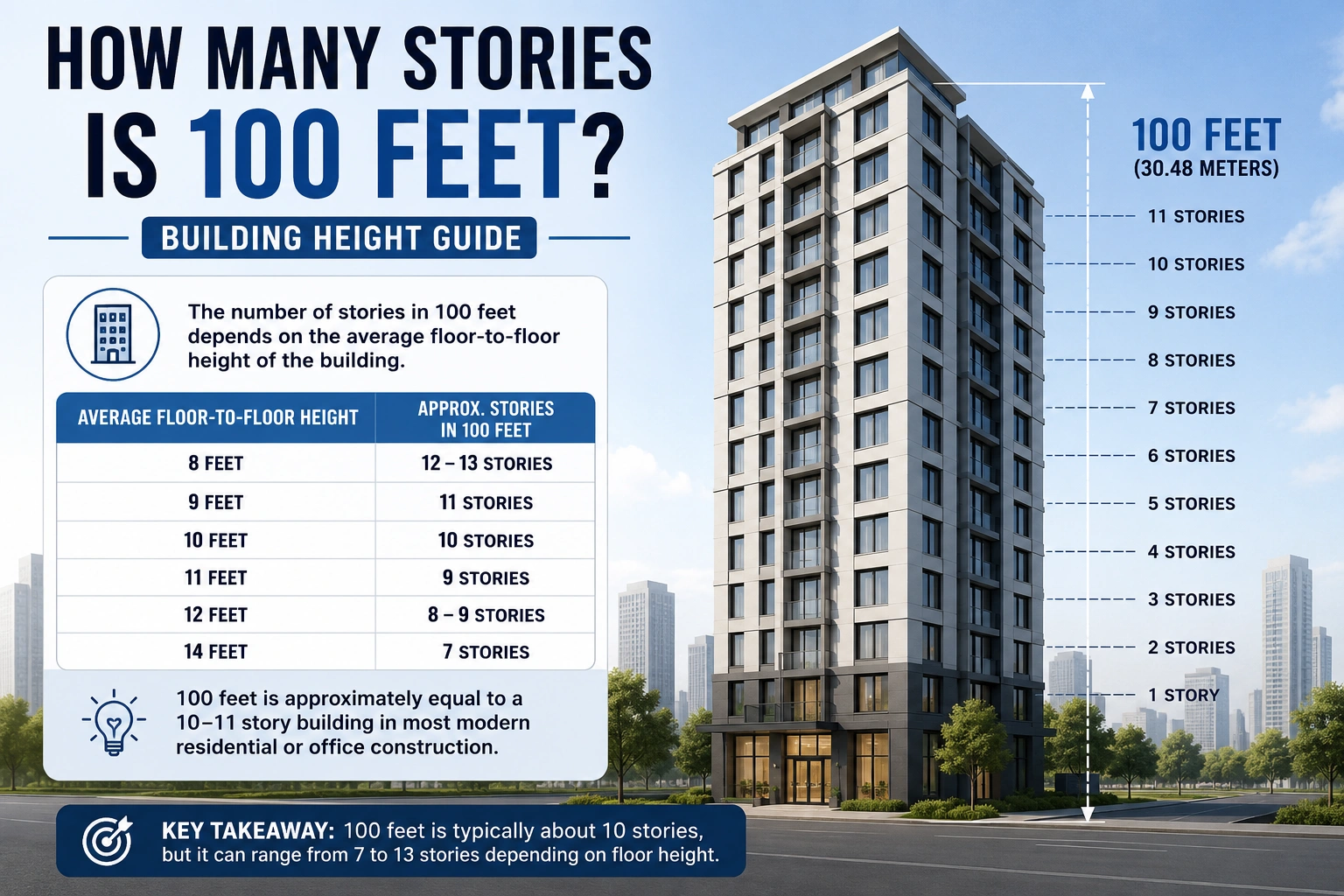
If you’re looking at a building plan, reading property listings, or simply curious about building heights, you may wonder: how many stories is 100 feet? The answer depends on the type of building because different structures have different floor-to-floor heights.
The quick answer is:
- 100 feet is approximately 8 to 10 stories tall
Most buildings fall within this range depending on whether they are residential, commercial, or mixed-use structures.
Understanding Building Stories
Before converting feet into stories, it’s helpful to understand what a story means.
What Is a Story?
A story (or floor) is a level within a building.
Examples include:
- Ground floor
- Second floor
- Third floor
- Penthouse level
The height of each story varies depending on building design.
Typical Floor Heights
Average story heights are:
| Building Type | Average Height Per Story |
|---|---|
| Residential | 10 feet |
| Apartment Building | 10–12 feet |
| Office Building | 12–14 feet |
| Hotel | 10–12 feet |
| Mixed-Use Building | 11–13 feet |
These averages are commonly used for estimation.
Why Story Heights Vary
Factors affecting story height include:
- Ceiling height
- Structural systems
- HVAC equipment
- Architectural design
- Building codes
How Many Stories Is 100 Feet?
The number of stories depends on the average height per floor.
For residential buildings:
100÷10=10 stories
Result:
- Approximately 10 stories
Commercial Building Estimate
Office buildings often average 12 feet per story.
Calculation:
100÷12≈8.3 stories
Result:
- Approximately 8 stories
General Rule
Most 100-foot buildings are:
- 8 stories (commercial)
- 9 stories (mixed-use)
- 10 stories (residential)
Stories to Feet Conversion Formula
Estimating stories from height is straightforward.
Residential Formula
Use:
Stories=10Height in Feet
For 100 feet:
100÷10=10
Commercial Formula
Use:
Stories=12Height in Feet
For 100 feet:
100÷12≈8.3
Building Height Comparison Chart
Here are common building height estimates.
| Height (Feet) | Approximate Stories |
|---|---|
| 20 ft | 2 stories |
| 30 ft | 3 stories |
| 50 ft | 5 stories |
| 75 ft | 7–8 stories |
| 100 ft | 8–10 stories |
| 150 ft | 12–15 stories |
| 200 ft | 16–20 stories |
This chart provides quick estimates.
Real-World Examples of 100-Foot Buildings
Understanding a 100-foot height becomes easier with examples.
Apartment Buildings
Many mid-rise apartment complexes are around 8–10 stories tall.
Office Buildings
A typical office building around 100 feet tall often contains 8 floors.
Hotels
Hotels commonly fall within the 8–10 story range for a 100-foot structure.
Mixed-Use Buildings
Retail and residential combinations often reach approximately 9 stories at 100 feet.
Factors That Affect Story Height
Not all floors have identical heights.
Ceiling Heights
Luxury buildings often feature taller ceilings.
Mechanical Floors
Commercial structures may include equipment floors that increase overall height.
Architectural Features
Decorative roof structures can add height without adding stories.
Building Codes
Local regulations sometimes influence floor-to-floor dimensions.
Common Height Conversion Mistakes
Avoid these common errors.
Assuming Every Story Is 10 Feet
Commercial buildings are often taller.
Ignoring Roof Structures
Parapets and mechanical penthouses can add several feet.
Using Exterior Height Alone
Some buildings have unusually tall lobbies or ground floors.
Expert Tips for Estimating Stories
Professionals often use quick estimation methods.
Residential Buildings
Assume roughly 10 feet per story.
Commercial Buildings
Assume roughly 12 feet per story.
Mixed-Use Buildings
Estimate between 11 and 13 feet per floor.
Verify Official Building Data
When precision matters, consult architectural plans or property records.
Real-World Example
Suppose an apartment building is:
100 feet tall
Using the residential estimate:
100÷10=10 stories
Result:
- The building would be approximately 10 stories tall.
FAQs
1. How many stories is a 100-foot building?
Typically between 8 and 10 stories.
2. Is 100 feet considered a tall building?
It is generally considered a mid-rise building.
3. How many residential stories fit into 100 feet?
Approximately 10 stories.
4. How many office floors fit into 100 feet?
Approximately 8 stories.
5. Why do story heights vary?
Different building types require different ceiling heights, structural systems, and mechanical spaces.
Conclusion
Understanding how many stories is 100 feet helps when comparing building heights, evaluating properties, or learning about architecture. Using common floor-to-floor measurements:
100÷10=10 stories
for residential buildings, and
100÷12≈8 stories
for commercial buildings.
As a general rule:
- 100 feet equals approximately 8 to 10 stories
This estimate provides a useful way to visualize building heights and compare structures in everyday life.
Discover More Articles
How Many Feet Is 85 Inches? Exact Conversion Guide
How Many Inches Are in 4 Feet? Exact Conversion Guide
How Many Square Feet Does a Quart of Paint Cover? Complete Coverage Guide