
If you’re wondering how many feet is 72 inches, you’re asking one of the most common measurement questions. This conversion is used in everyday situations like measuring height, furniture, room dimensions, and more.
The good news? It’s a very simple calculation once you understand the relationship between inches and feet.
In this guide, you’ll learn:
- The exact answer
- A simple formula
- Step-by-step conversion
- Real-life examples and tips
Let’s begin with the quick answer.
Quick Answer: 72 Inches in Feet
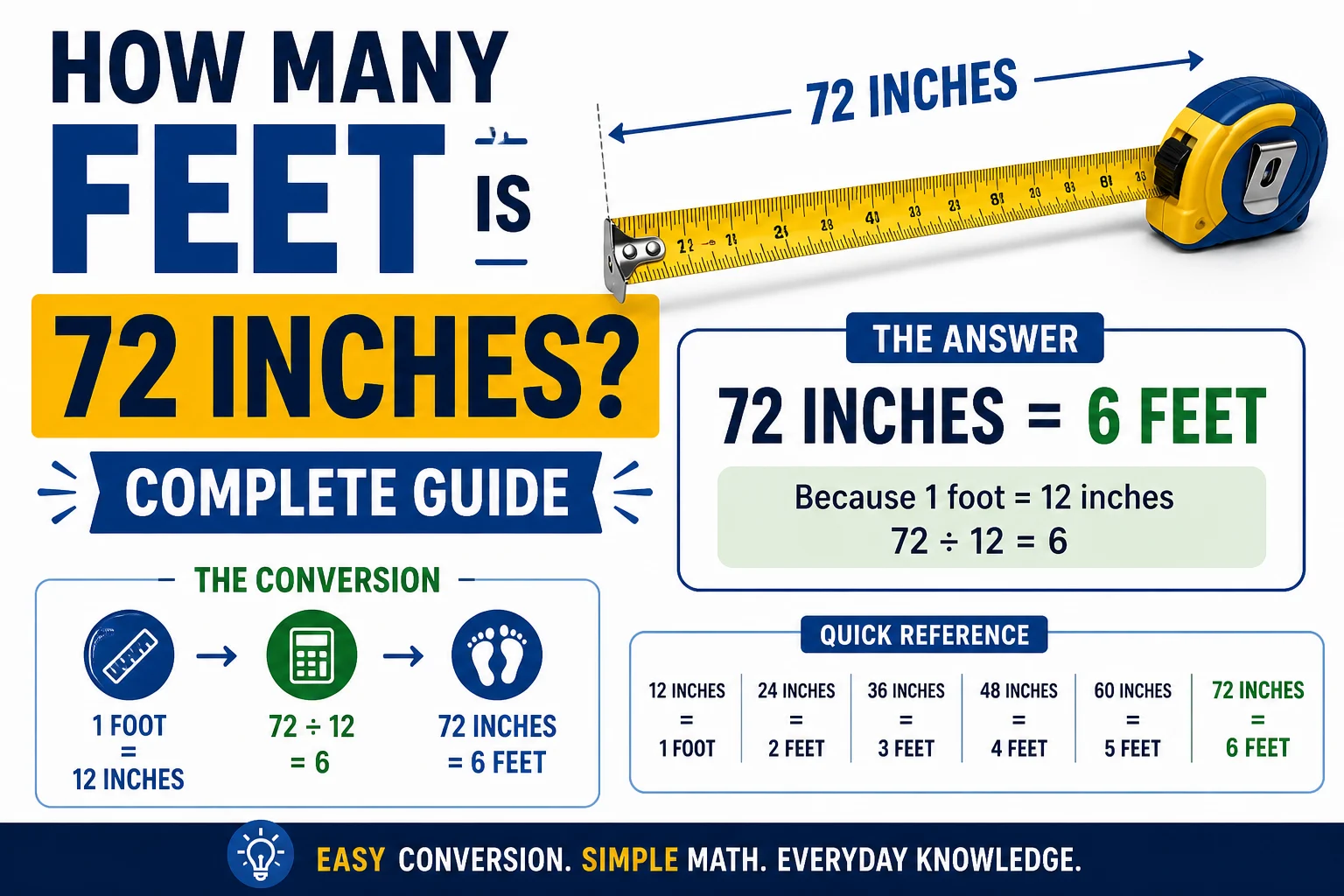
👉 72 inches = 6 feet
This is an exact value with no rounding required.
So, if you need a quick response:
👉 72 inches equals exactly 6 feet
Understanding Inches and Feet
Before diving into calculations, it helps to understand the units.
What Is an Inch?
An inch is a unit of length in the imperial system.
- 12 inches = 1 foot
- Commonly used for smaller measurements like screens and tools
What Is a Foot?
A foot is a larger unit of length.
- 1 foot = 12 inches
- Used for height, room size, and general measurements
This relationship makes conversions straightforward.
How Many Feet Is 72 Inches (Step-by-Step Conversion)
Let’s break it down.
Conversion Formula
To convert inches to feet:
Feet = Inches ÷ 12
Calculation Breakdown
Now apply the formula:
72 ÷ 12 = 6
So,
👉 72 inches = 6 feet
Conversion Table for Inches to Feet
Here’s a quick reference:
| Inches | Feet |
|---|---|
| 12 | 1 ft |
| 24 | 2 ft |
| 36 | 3 ft |
| 48 | 4 ft |
| 60 | 5 ft |
| 72 | 6 ft |
| 84 | 7 ft |
| 96 | 8 ft |
This table helps you estimate quickly.
72 Inches in Feet and Inches
Since 72 divides evenly by 12:
👉 72 inches = 6 feet 0 inches
There’s no remainder, making it a clean conversion.
Real-Life Examples of 72 Inches
To better visualize this measurement, here are some examples:
- The height of a tall adult person
- A standard door height (approx.)
- The length of a large sofa
- A full-size mattress length
These examples help you understand what 6 feet looks like in real life.
Why Convert Inches to Feet?
This conversion is useful in many situations:
1. Home Improvement
Measurements are often given in inches but easier to visualize in feet.
2. Furniture Shopping
Large items are easier to understand in feet.
3. Construction Work
Accurate conversions ensure proper planning.
4. Everyday Measurements
Height and room sizes are often expressed in feet.
Common Mistakes When Converting Units
Avoid these errors:
❌ Using the Wrong Divisor
Always divide by 12, not 10.
❌ Mixing Units
Don’t confuse inches with centimeters.
❌ Overcomplicating Simple Conversions
Some values like 72 inches convert exactly—keep it simple.
❌ Forgetting Units
Always label your final answer.
Expert Tips for Quick Conversion
Speed up your calculations with these tips:
✔ Memorize Key Values
- 12 inches = 1 foot
- 72 inches = 6 feet
✔ Use Multiples of 12
Break numbers into known values.
✔ Estimate Quickly
If close to a multiple of 12, approximate easily.
✔ Practice Mental Math
Division by 12 becomes easier with practice.
FAQs
1. How many feet is 72 inches exactly?
72 inches equals 6 feet.
2. What is 72 inches in feet and inches?
It is 6 feet 0 inches.
3. How do you convert inches to feet?
Divide inches by 12.
4. Is 72 inches equal to 6 feet?
Yes, exactly.
5. Why is 12 used in the conversion?
Because 1 foot equals 12 inches.
Conclusion
So, how many feet is 72 inches?
👉 The answer is simple: 72 inches = 6 feet
This is an exact and easy conversion thanks to the fixed relationship between inches and feet.
Just remember:
Divide inches by 12 to get feet.
With this simple rule, you can confidently convert any measurement quickly and accurately for everyday use.
Discover More Articles
How Many Square Feet Are in an Acre? Complete Guide